Category: Information

  • How to Build an IT Strategy Without a Full-Time CIO: A Practical Framework for Mid-Market Leaders

    How to Build an IT Strategy Without a Full-Time CIO: A Practical Framework for Mid-Market Leaders

    Most mid-market executives are expected to own a technology roadmap they were never equipped to build. You are running a $50M to $500M business, managing real operational complexity, and somewhere between the board meeting and the quarterly review, someone decided that IT strategy is your responsibility too. Without a dedicated CIO in the seat, that responsibility tends to sit unresolved.

    This is not a hiring oversight. It is a structural reality of the mid-market, and it has a practical solution.

    This post walks you through a proven approach to IT strategy consulting that does not require a full-time executive to execute. You will learn what a credible IT strategy actually contains, how to move through a four-phase development process covering capability inventory, business outcome mapping, vendor prioritization, and governance cadence, and where fractional IT advisory fits as the connective tissue that makes the whole framework executable. You will also find a 90-day quick-win roadmap and real-world examples to ground the process in practice.

    If your organization needs a functioning IT strategy and cannot justify a full-time CIO, this framework was built for you.

    The CIO Gap Is Structural, Not a Hiring Oversight

    A full-time CIO at a company in the $20M to $250M revenue range carries a total compensation package that routinely exceeds $300,000 annually once salary, benefits, and equity are included. For most mid-market organizations, that cost cannot be justified against the role’s direct revenue contribution, and the position goes unfilled.

    The resulting pattern is predictable and consistent. IT decisions migrate to whoever is available: the COO absorbs infrastructure questions, the controller approves software contracts, an office manager handles vendor calls, and a managed service provider fills the gaps with reactive support. Each of those parties is managing a different set of incentives and none of them holds a unified view of the company’s technology direction. Decisions get made, but they are not connected to each other or to business outcomes.

    This is not a talent problem. The COO is not underperforming, and the MSP is not necessarily at fault. It is a structural mismatch: mid-market companies are organized for operational execution, not for the volume and complexity of consequential technology decisions they now face. Cloud infrastructure commitments, cybersecurity requirements tied to client contracts or regulatory frameworks, and a software stack that has grown faster than anyone managed it have all expanded the decision surface significantly over the past five years.

    For companies operating across the Philadelphia corridor, from Wilmington through Exton and out to Reading, PA, that expansion has real operational cost. A compliance gap that a CIO would have caught in a vendor review instead surfaces during a client audit. A software contract auto-renews at above-market rates because no one owns the renewal calendar strategically. These are not isolated incidents; they are predictable outputs of a structural gap.

    Recognizing that the gap is structural changes the solution. If it were a talent problem, the answer would be a hire. Because it is structural, the answer is a framework, a defined process, and the right expertise applied at the right intervals. Understanding what a fractional technology executive actually does in operational terms clarifies why the model fits the problem: it provides strategic leadership without the permanent overhead a full-time role requires.

    What a Credible IT Strategy Actually Contains

    Once you accept that the gap is structural, the next question is practical: what exactly needs to be built?

    An IT strategy is not a software inventory or a vendor contract renewal calendar. It is a documented set of decisions about which technology capabilities the business will build, buy, or retire, and the business rationale behind each choice. That distinction matters because most mid-market organizations already have the former and mistake it for the latter.

    A credible IT strategy for a mid-market organization has four core components:

    • Current-state capability inventory: A business-readable map of what technology the company has, what is at risk, and what is unknown
    • Business outcome mapping: A direct connection between technology decisions and the company’s top revenue, operational, and risk objectives
    • Infrastructure and vendor prioritization plan: A sequenced action list that identifies which gaps get addressed first and why
    • Governance cadence: A defined review structure that keeps the strategy current as business conditions change

    Mid-market IT strategy examples often look deceptively simple in final form: a one-page capability matrix, a prioritized vendor list, a quarterly review calendar. The simplicity is the point. The strategic thinking embedded in each element is what produces alignment; the document is just how that thinking gets recorded and acted on.

    Most IT strategy templates available online were designed for enterprise organizations with dedicated IT departments, compliance teams, and multi-year planning cycles. They default to complexity that a 75-person company in Cherry Hill or a regional services firm in Lancaster cannot staff or sustain. Adapting an enterprise framework to a mid-market context is not simplification; it is a different design problem entirely.

    The framework in this piece is built specifically for organizations without a full-time IT executive. It assumes a business leader who is accountable for the outcome, limited internal IT capacity, and the willingness to bring in structured outside support where the internal expertise does not exist. Those are the actual conditions most mid-market companies operate under, and the framework should reflect them.

    Phase 1: Current-State Capability Inventory

    The capability inventory is the foundation the rest of the strategy rests on. You cannot prioritize what you have not documented, and most mid-market organizations discover gaps and redundancies at this stage that were invisible before anyone looked systematically.

    The Five Domains to Assess

    The inventory covers five areas:

    • Infrastructure and endpoints: Hardware, network architecture, and cloud environments, including what is owned versus leased and what is approaching end-of-life
    • Software and licensing: The full SaaS stack, on-premise applications, and shadow IT that business units have acquired outside formal procurement
    • Vendor and MSP relationships: Active contracts, SLA terms, and a comparison of services billed against services actually delivered
    • Security posture: Access controls, patch status, and whether backup and recovery processes have been validated recently, not just documented
    • Internal IT capacity: Who owns which systems, how escalation works, and where institutional knowledge lives in a single person rather than in documentation

    A Diagnostic Question That Cuts Through Complexity

    For each domain, ask one question: if the person who currently manages this left tomorrow, how long would it take the business to understand what exists and how it works? Any honest answer longer than two weeks signals a documentation and governance gap, regardless of how well-managed that domain appears on the surface.

    Where the Most Value Often Surfaces Regionally

    For companies in Lancaster, Cherry Hill, and the greater Philadelphia region operating with a single MSP handling the majority of IT support, the vendor relationship audit is consistently where the inventory produces the most immediate strategic value. Misaligned contracts, services billed but not delivered, and coverage gaps in security monitoring are common findings. If you are unsure whether your current MSP relationship is working in your favor, the signs your MSP is costing more than it’s saving are worth reviewing before the audit begins.

    What Phase 1 Produces

    The output is not a technical document. It is a business-readable capability map, typically five to fifteen pages depending on company size, that gives non-technical executives a clear answer to three questions: what does the company have, what is at risk, and what is currently unknown. That map becomes the input for every decision in the phases that follow.

    Phase 2: Mapping Technology Decisions to Business Outcomes

    With the capability inventory complete, the next step is where most mid-market IT strategies break down.

    Business outcome mapping is the phase organizations most consistently skip, and its absence explains why so many technology investments feel disconnected from company performance. When IT decisions are made without anchoring to business objectives, the resulting purchases optimize for technical metrics: uptime, ticket volume, hardware refresh cycles. None of those metrics tell a CEO whether technology is advancing revenue, reducing operational risk, or enabling growth.

    Start with your top business objectives, not your technology gaps.

    Identify the three to five business objectives your organization needs to achieve over the next 12 to 24 months. These should come directly from your strategic plan or leadership team. Examples that appear regularly in mid-market engagements include:

    • Expanding into a new regional market
    • Reducing operational overhead by 15 percent
    • Shortening customer onboarding time
    • Achieving a compliance certification required by a key client

    For each objective, identify the IT capabilities required to support it, then rate whether your current state supports that objective adequately, partially, or not at all. This single exercise creates a direct, auditable line between technology investment decisions and business outcomes that non-technical executives can evaluate and defend.

    Use a three-column matrix as your working template.

    The IT strategy template that works consistently for mid-market organizations at this phase is deliberately simple:

    Business ObjectiveRequired IT CapabilityCurrent Capability Rating
    Reduce onboarding timeCRM integration with onboarding workflowYellow
    Achieve SOC 2 certificationAccess controls, audit logging, MFARed

    Red, yellow, and green ratings are readable in a board meeting and actionable in a vendor conversation. As Gartner practitioners note, effective IT leadership treats business objectives as the primary objectives and technology as the toolbox, not the other way around.

    This mapping output also becomes the decision filter for vendor consolidation and technology stack rationalization: if a vendor or tool cannot be tied to a rated capability gap, it has no strategic justification.

    IT strategy consulting engagements that skip this phase and jump directly to infrastructure recommendations are a documented source of buyer regret. Technology solutions without business outcome anchors tend to produce scope creep, budget overruns, and adoption failures that are difficult to explain to leadership after the fact. The mapping matrix prevents that by making the strategic rationale visible before any investment is committed.

    Phase 3: Infrastructure and Vendor Prioritization

    The output of Phases 1 and 2 is a map of gaps and opportunities. Phase 3 converts that map into a decision document: which items get addressed first, in what sequence, and at what level of investment.

    The Two-Axis Prioritization Framework

    Score each identified gap against two criteria:

    • Business impact: How directly does resolving this gap advance one of the top business objectives from Phase 2?
    • Execution feasibility: How quickly and cleanly can this be resolved given current resources, vendor relationships, and internal capacity?

    Items that score high on both axes become the 90-day action list. Items high on impact but low on feasibility require staged planning. Items low on both get deferred without guilt.

    Technology Debt as Its Own Category

    Technology debt warrants a separate lane in this process. Legacy systems, unsupported software, and infrastructure past end-of-life do not sit still; their cost compounds the longer remediation is deferred. CMU’s Software Engineering Institute documents this accumulation dynamic across a decade of research, and Deloitte’s analysis quantifies it as a measurable drag on organizational value and growth.

    Most mid-market companies carry more technology debt than their leadership team realizes. The capability inventory from Phase 1 is typically where it surfaces.

    MSP Relationship Optimization

    For companies across the Philadelphia and Delaware Valley region, MSP contract realignment is consistently the highest-leverage action in this phase. The pattern is predictable: organizations are either paying for service tiers they are not fully utilizing, or they are under-covered in areas that carry real exposure, specifically security monitoring, backup validation, and strategic advisory. Realigning those contracts to reflect current business needs produces both cost and risk improvements, often before any new technology is deployed.

    Vendor Consolidation

    Consolidation decisions must be anchored to the outcome mapping from Phase 2, not to price. Fewer vendors reduce management overhead and sharpen accountability, but only when the remaining vendors can actually support the capabilities the business requires. Price-driven consolidation that leaves a critical capability gap trades one problem for a worse one. For a concrete illustration of what disciplined vendor consolidation produces, see 47 Vendors Down to 18, $340K Annual Savings.

    Phase 4 establishes the governance structure that keeps these prioritization decisions current as business conditions change.

    Phase 4: Establishing a Governance Cadence

    A prioritized action list tells you what to fix. A governance cadence determines whether that work actually gets done, stays relevant, and continues to reflect where the business is headed. Without a defined review process, even a well-constructed IT strategy degrades within six to twelve months as priorities shift, vendors change, and technology decisions accumulate outside any structured framework.

    Three Levels of Governance

    For mid-market organizations without a full-time CIO, the cadence operates at three levels:

    Monthly operational review. Attendees: IT lead or MSP, COO or operations owner. Agenda: active project status, incident review, open vendor issues. This meeting keeps tactical execution on track and surfaces problems before they compound.

    Quarterly strategic review. Attendees: CEO or COO, CFO, fractional IT advisor if engaged. Agenda: outcome mapping progress, prioritization list updates, budget alignment. This is where the strategy stays connected to business conditions rather than drifting on autopilot.

    Annual IT strategy refresh. A full reassessment against the capability inventory and updated business objectives. This is not a new strategy from scratch; it is a structured recalibration of what has changed and what the next year requires.

    Decision Rights Documentation

    Most mid-market companies lack a decision rights document and immediately benefit when they create one. It answers four questions precisely: Who can approve vendor contracts below a defined dollar threshold? Who escalates security incidents, and to whom? Who owns software procurement decisions? Who has authority to commit capital to infrastructure investments?

    Without documented answers, these decisions default to whoever is available, which produces inconsistency and untracked commitments. A one-page decision rights matrix eliminates that ambiguity.

    Governance as a Credibility Signal

    For companies in regulated industries or approaching a financing event, a structured governance cadence is a material signal to boards and investors. The SEC’s increased focus on cybersecurity risk disclosure reflects a broader expectation that IT decisions are made through documented processes with clear rationale, not ad hoc judgment calls. That expectation applies to mid-market organizations, not just public companies.

    Time Is Not the Barrier

    For a 50 to 200 person organization in Exton, Reading, or the Wilmington area, this cadence requires roughly four to six hours of executive time per month across all three levels. The obstacle is rarely the time; it is the absence of a defined structure that makes that time productive.

    Where Fractional IT Advisory Fits Into This Framework

    Fractional IT advisory is not a replacement for internal ownership of the strategy; it is the expertise layer that makes the process executable when that capacity does not exist at the executive level. The distinction matters: an outside advisor does not own the outcomes, but they do provide the structured experience that moves the work from intention to completion.

    Each phase of the framework maps to a specific advisory contribution.

    Phase 1 benefits most from an outside perspective. Internal stakeholders routinely normalize the gaps they live with daily, whether an MSP contract that no longer reflects current needs or a backup process that has never been tested in production. An advisor who has conducted dozens of similar capability inventories arrives without those blind spots and surfaces findings that internal reviews consistently miss or deprioritize.

    Phases 2 and 3 are where fractional IT leadership creates the highest strategic leverage. Translating infrastructure options into business language, pressure-testing vendor relationships against actual outcomes, and sequencing priorities without months of internal deliberation requires direct operational experience. A skilled advisor compresses that process into structured working sessions because they have made these decisions before, in comparable organizations, with comparable constraints.

    Phase 4 is where fractional advisory sustains ongoing value. After the strategy is built, the work shifts to keeping it current: attending quarterly reviews, validating that the prioritization list reflects current business conditions, and serving as an accountable voice in vendor negotiations. That role keeps the governance cadence functional without the cost or commitment of a permanent executive hire.

    For mid-market companies across Lancaster, Cherry Hill, Philadelphia, and the surrounding region, Orloff Phillips brings two decades of strategic advisory experience to this exact structure. The focus is not on deploying new technology for its own sake; it is on building the IT strategy framework the business requires, aligning vendors and MSP relationships to it, and establishing the governance cadence that keeps it operational over time.

    Quick-Win Roadmap: Your First 90 Days

    That advisory structure gives you a partner for the process. Here is how to run it.

    Days 1 to 30: Capability Inventory

    Conduct a focused assessment across five domains: infrastructure and endpoints, software and licensing, vendor and MSP relationships, security posture, and internal IT capacity. The goal is not exhaustive documentation. It is a business-readable summary, typically 5 to 15 pages, that answers three questions for each domain: what exists, what is at risk, and what is unknown.

    This output changes the quality of every technology conversation that follows. Executives stop debating from assumption and start deciding from documented fact.

    Three quick wins consistently surface during this phase in mid-market assessments:

    • Redundant SaaS subscriptions. Companies that have grown through acquisition or rapid hiring routinely pay for duplicate tools and licenses tied to departed employees.
    • Unvalidated backups. Many organizations document a backup process that has not been tested in months. Validation takes hours and eliminates a category of unquantified risk.
    • MSP contract gaps. Reviewing coverage against actual business needs routinely reveals that security monitoring, backup validation, or strategic advisory are not included in what the company assumed was comprehensive support.

    Days 31 to 60: Business Outcome Mapping

    Schedule a working session with your executive team. Take the company’s top three to five business objectives for the next 12 months. For each one, rate current IT capabilities as Red, Yellow, or Green. Identify the two or three gaps that most directly constrain a stated business objective. Those gaps become the anchor priorities for the IT strategy.

    This session does not require technical expertise. It requires business clarity. If you can name your objectives, the mapping follows.

    Days 61 to 90: Prioritization and Governance Structure

    Produce a prioritized action list using the impact-versus-feasibility framework. Items that score high on both axes become your immediate action set. Document decision rights for common IT decision categories: vendor approvals, software procurement, security escalations, and capital commitments.

    Before day 90 closes, schedule the first monthly operational review and the first quarterly strategic review on the calendar. The calendar commitment is the governance cadence taking shape.

    The 90-day roadmap is not the IT strategy. It is the process of building one. Executives who complete these three phases have the inputs required to produce a credible, board-ready strategy document and the governance structure to maintain it. If you are ready to start with the capability inventory, let’s identify what’s slowing your business down before the next quarter begins.

    IT Strategy Examples: What This Looks Like in Practice

    The framework described in the previous sections produces real findings. These representative patterns from mid-market advisory work illustrate what that looks like in practice.

    A professional services firm in the Philadelphia suburbs with 80 employees and a single MSP relationship completed a capability inventory and found that backup validation had not been tested in 14 months, three software licenses were still billing for departed employees, and the MSP contract contained no proactive security monitoring. No new technology was purchased. The budget was redirected toward fixing what already existed, which is precisely where the risk was concentrated.

    A distribution company in the Lancaster area had already budgeted an ERP upgrade when the business outcome mapping exercise surfaced a critical misalignment. The upgrade would not address the customer onboarding bottleneck their CEO had identified as the top operational priority. The mapping process redirected the investment toward a middleware integration that resolved the actual business problem at lower cost than the original project.

    A financial services firm near Wilmington established a quarterly IT governance review after six years without one. Within two quarters, the structured review surfaced a vendor contract that had been auto-renewing at above-market rates for three years. The immediate cost savings prompted a broader vendor alignment exercise that had been deferred indefinitely under the previous unstructured approach.

    The pattern across all three scenarios is consistent: the value came from creating a structured decision-making process, not from deploying new technology. Each finding was present before the framework was applied. None of it was visible without the process to surface it.

    The practical lesson for mid-market executives is that IT strategy is primarily a decision-making discipline. The leaders who benefit most are not the ones with the deepest technology knowledge; they are the ones most rigorous about connecting technology decisions to business outcomes. That is a management competency, not a technical one, and it is the foundation of everything covered in The Book on Success-Focused Technology Leadership.

    Building IT Strategy Without a Full-Time CIO Is an Executable Process

    The pattern across every example in this piece is consistent: the companies that closed their IT leadership gap did not do it by hiring a full-time CIO or deploying new technology. They did it by building a process.

    The four-phase framework, capability inventory, outcome mapping, infrastructure and vendor prioritization, and governance cadence, gives mid-market leaders exactly that: a repeatable structure for making better technology decisions without permanent executive overhead. Each phase produces a usable output. Together, they produce a strategy that is board-readable, operationally grounded, and maintainable with the internal resources most mid-market companies already have.

    The 90-day roadmap converts that framework into immediate action. A focused capability inventory in the first 30 days. An outcome mapping session in days 31 to 60. A prioritized action list and governance calendar locked in before the quarter closes. That sequence does not require a full-time IT executive to execute; it requires a committed business leader and a clear process.

    Fractional IT advisory compresses the timeline and raises the quality of each phase. An advisor who has conducted dozens of capability assessments identifies gaps faster than an internal team seeing the process for the first time. Outcome mapping sessions run more efficiently when a strategic technology consulting partner can translate technical findings into business language in real time. Governance cadences hold when there is an accountable outside voice in the quarterly review.

    For mid-market companies in Exton, Philadelphia, Cherry Hill, Wilmington, Lancaster, and Reading PA, the distance between current IT operations and a structured IT strategy is almost always shorter than it appears. The work is not technical. It is organizational: creating the process, documenting the decisions, and building the cadence that keeps the strategy active as the business evolves.

    The starting point is straightforward. Conduct the capability inventory. Run the outcome mapping exercise. Schedule the first governance review. If you need a strategic partner to accelerate that process and ensure it reflects current best practices in vendor management and IT governance strategy, Orloff Phillips is built specifically for this work.

    Conclusion

    Building an IT strategy without a full-time CIO is not a compromise; it is a deliberate, executable process available to any mid-market organization willing to commit to it. The framework is clear: assess your current capabilities honestly, map technology decisions to real business outcomes, prioritize your infrastructure and vendors with discipline, and establish a governance cadence that keeps the strategy alive. You do not need a corner-office executive to do this work. You need the right process and the right partner.

    For organizations across the Philadelphia region and beyond, the gap between where you are and where you need to be is shorter than it looks. Start with the 90-day roadmap. Run the capability inventory this week. Every structured IT decision you make from this point forward compounds in value.

    Ready to accelerate the process? Contact Orloff Phillips to schedule your initial capability assessment.
  • From Fragmented to Unified: What an IT Infrastructure Modernization Engagement Actually Produces

    From Fragmented to Unified: What an IT Infrastructure Modernization Engagement Actually Produces

    Most organizations don’t realize how fragmented their infrastructure has become until the operational friction becomes impossible to ignore. Redundant vendors, overlapping tools, and accountability gaps that live in the spaces between teams: these are the quiet costs that no vendor pitch ever quantifies, and no technology refresh ever resolves.

    When the decision to modernize IT infrastructure finally reaches the planning stage, the conversation typically stalls in the same place. Scope feels too broad, risk feels too high, and the outcome remains frustratingly conceptual. That stall is usually the result of one missing element: a clear understanding of what a structured modernization engagement actually produces.

    This analysis cuts through that ambiguity. Drawing on the realities of how fragmentation compounds over time, this post defines what a true infrastructure modernization engagement delivers, specifically a rationalized vendor map, a prioritized remediation roadmap, and a governance model designed to prevent re-fragmentation. It also covers how internal teams take ownership after the engagement closes and what a realistic timeline looks like from first conversation to concrete outcome. The goal is to make the path forward visible, bounded, and actionable.

    The Fragmentation Problem No Vendor Pitch Quantifies

    With global IT spending projected to hit $6.31 trillion in 2026, a 13.5% year-over-year increase, every line item in a technology budget faces sharper scrutiny. Organizations carrying sprawling vendor portfolios are discovering that growth in spending does not automatically produce clarity in operations.

    Fragmented infrastructure compounds that pressure through four specific costs. Management overhead accumulates when IT staff coordinate across siloed vendors with no shared accountability. Security postures become inconsistent when disconnected tools report to separate owners with no unified policy layer. Compliance mapping breaks down when no single party owns the obligation to align controls to regulatory requirements. Operational visibility degrades when monitoring spans systems that do not communicate. None of these costs appear on a vendor invoice, which is precisely why no vendor pitch quantifies them.

    Cybersecurity professionals across industries have reached a clear consensus: fragmentation is a competitive liability, not a neutral condition. The active push toward vendor consolidation and product integration reflects organizations learning this lesson after incidents, failed audits, or spiraling support costs.

    For mid-sized businesses, the fragmented environment typically arrived gradually. Each vendor addition made sense at the time. An MSP transition left legacy tools in place. A department procured a point solution outside the IT approval process. Without a unifying IT infrastructure strategy, those additions accumulate into an architecture no one has fully documented.

    That is the sharper definition of the problem: fragmentation is not simply too many vendors. It is the absence of documented architecture, undefined accountability between vendors, and no governance process preventing future sprawl. A structured infrastructure audit typically surfaces accountability gaps that internal teams have worked around for years without recognizing as structural risks.

    Why Modernization Is Not a Technology Refresh or Migration Project

    Once you understand the fragmentation problem, the instinct is to fix it by buying newer equipment or moving workloads to the cloud. Both responses are understandable. Neither addresses the actual problem.

    A technology refresh swaps aging hardware or software for newer equivalents. It does not eliminate redundancy between overlapping vendors, close accountability gaps between MSP relationships, or produce a documented architecture the internal team can operate. After a refresh, you have newer components inside the same fragmented structure.

    A migration project moves workloads from one environment to another. It does not rationalize the vendor relationships layered around those workloads, and it does not define who owns what after cutover. The ownership ambiguity that created operational risk before the migration typically reasserts itself within months.

    An IT infrastructure modernization engagement is a structured advisory process. It starts with the current-state architecture, identifies where fragmentation creates operational and security risk, and produces three specific deliverables that outlast the engagement. The distinction matters because the deliverables determine what the internal team can actually own and operate independently.

    In multi-provider environments, that visibility gap is not a minor inconvenience, it is a breach or compliance failure waiting for a triggering event. Modernization resolves it before that event occurs. This is closely related to the broader case for vendor consolidation as a strategic priority rather than a cost-cutting exercise.

    The consulting engagement model also differs fundamentally from managed services. It transfers architecture knowledge and ownership to the internal team rather than creating ongoing dependency on an external provider. When the engagement closes, the organization owns the artifacts, not the firm.

    Deliverable One: The Rationalized Vendor Map

    The first of those three deliverables is the rationalized vendor map, and it is where every credible modernization engagement begins.

    The artifact is not a spreadsheet. It is a structured inventory that maps every active technology vendor, contract, and service touchpoint to three data points: the business function it serves, the internal owner accountable for it, and the contract term governing it. A flat list of vendor names tells you nothing about overlap, accountability, or renewal exposure. A mapped artifact tells you everything.

    Rationalization surfaces three specific failure patterns. Redundancy is two vendors performing the same function, typically discovered after an MSP transition where the replacement was added before the predecessor was exited. Gaps are functions with no accountable vendor and no internal owner, the kind that surface as blame exchanges when something breaks. Misalignment is a vendor still under contract for a service the business no longer uses, often a legacy holdover from a department that made a procurement decision three years ago and moved on.

    For businesses carrying vendor portfolios across the Philadelphia corridor, including organizations in Exton, Lancaster, Cherry Hill, and Wilmington, finding active vendor relationships with overlapping scopes is common. Organic growth and departmental purchasing decisions accumulate vendor relationships faster than any IT infrastructure strategy can absorb them. 68 percent of IT organizations now plan vendor consolidation specifically because this pattern is widespread, not exceptional.

    The output of rationalization is a classification decision on every vendor relationship: retain, renegotiate, consolidate, or exit. That four-option framework replaces the abstract instruction to “reduce vendors” with a prioritized action list. As a hypothetical illustration, rationalizing from dozens of vendors to a focused set can generate six-figure annual savings, the exact figure depends on contract terms and overlap.

    Before this deliverable exists, the environment has no defined boundary, and that ambiguity delays every remediation conversation that follows.

    Deliverable Two: The Prioritized Remediation Roadmap

    The next question after classification is sequence. The remediation roadmap answers that question with specificity.

    The roadmap structures actions across three horizons: immediate (0 to 60 days), near-term (60 to 180 days), and strategic (180 days to 12 months). This phasing is not arbitrary. It reflects a deliberate prioritization logic that is risk-weighted, not effort-weighted. Actions that close security posture gaps or resolve unowned compliance obligations move first, regardless of complexity. Cost reduction and operational simplification follow once accountability is established.

    This distinction matters because the natural instinct of most teams is to start with what is easiest to fix. A risk-weighted sequence forces the harder, higher-stakes items to the front of the queue, which is where they belong.

    Each roadmap item is built around four components: the responsible internal owner, the vendor or tool in scope, the expected outcome, and the success criteria. That structure is what separates a remediation roadmap from the assessments many businesses have already received. Most assessments diagnose fragmentation accurately but stop there. They identify what is broken without prescribing when to fix it, in what order, or who is responsible.

    The roadmap is designed to be operated internally from day one. Documentation standards, owner assignments, and review cadences are embedded during the engagement, not handed off as instructions after it closes. The internal team does not need the consulting firm to execute; they need a clear sequence and defined ownership. That is what this deliverable provides.

    Deliverable Three: The Governance Model That Prevents Re-Fragmentation

    The governance model determines whether the work holds.

    Re-fragmentation is the default outcome when modernization stops at documentation. Without a defined process for how future technology decisions get made, vendor sprawl reasserts itself faster than most teams anticipate, through departmental software purchases, MSP scope expansions, and one-off vendor additions that each seem reasonable in isolation but collectively rebuild the problem you just solved.

    The governance model addresses this through three operational mechanisms:

    • Vendor evaluation framework: Defined criteria and an approval workflow required before any new IT infrastructure provider or tool enters the environment
    • Architecture review cadence: A quarterly or semi-annual comparison of the live environment against the rationalized vendor map, to catch drift before it compounds
    • Escalation path for exceptions: A structured route for edge cases that need stakeholder sign-off, rather than defaulting to “just add the vendor”

    This is not bureaucracy. It is the mechanism that gives internal teams standing to say no. Without it, every vendor addition is a reflex decision with no accountability structure to slow it down.

    For lean IT teams across Lancaster, Reading, and the broader Philadelphia region, the governance model is designed to be operationally light: one-page approval workflows, named review owners, and documentation templates maintainable without dedicated staff. Organizations that want executive-level oversight embedded in the process can align this cadence with a part-time technology leader’s decision-making role and governance responsibilities.

    This deliverable is what separates a modernization engagement from a consulting report. A report recommends. The governance model operates.

    How Internal Teams Take Ownership After the Engagement Closes

    A governance model only holds if the team behind it understands why it was built that way. That is why internal enablement is structured into the engagement itself, not offered as a follow-on service once the deliverables are signed off.

    Documentation standards are established during the engagement, not after it. Every new vendor, configuration change, or tool addition gets recorded against a defined format, producing a living architecture record the internal team maintains going forward. The architecture does not freeze at handoff; it stays current because the process for updating it is already in place.

    Handoff sessions cover reasoning, not just artifacts. The internal team learns why specific vendors were consolidated, which risks drove the sequencing in the remediation roadmap, and how the governance model handles edge cases that do not fit a standard approval workflow. That context is what allows the team to make confident decisions after the engagement closes, without calling back for guidance.

    This is the core distinction between a modernization engagement and a managed service arrangement built around ongoing external dependency. For mid-sized businesses in Cherry Hill, Wilmington, and Exton that do not carry a dedicated enterprise architect on staff, this matters practically. The engagement installs an architecture function without adding headcount. What the existing team receives is a set of documented processes and defined decision rights they can execute with the staff already in place.

    What to Expect: A Realistic Engagement Timeline

    Knowing what the internal team will own after an engagement closes is one question. Knowing when they will own it is the other.

    The engagement runs in three phases, based on Orloff Phillips’ engagement experience. Phase one, the current-state assessment, is the most time-intensive phase. This is where vendor inventory is completed, architecture is documented, accountability is mapped, and fragmentation risk is identified by category. The environment rarely documents itself cleanly.

    Phase two, deliverable production, follows. The rationalized vendor map is finalized, the remediation roadmap is sequenced with owner assignments, and the governance model is drafted and reviewed with internal stakeholders. No deliverable is handed over without internal review baked in.

    Phase three, the internal enablement handoff, is the shortest phase. Documentation transfers, governance workflows activate, the first architecture review gets scheduled, and internal owners are confirmed for every roadmap item. The engagement does not close until ownership is confirmed, not just assumed.

    For organizations carrying a typical mid-market vendor portfolio, those phases produce three durable, operational deliverables rather than an assessment report that loses relevance before the next budget cycle.

    That timeline matters practically. Business leaders across the Philadelphia and Delaware Valley region, including those in Lancaster, Reading, and Cherry Hill, can align the engagement start to budget approval windows, upcoming compliance reviews, or MSP contract renewal dates. This is what separates a planned modernization from one that stalls waiting for the right moment that never arrives.

    Turning a Modernization Conversation Into a Concrete Outcome

    Knowing the timeline is only useful if you know what you are building toward. Those three deliverables, vendor map, remediation roadmap, governance model, are the concrete standard against which any modernization proposal should be evaluated.

    For businesses in Philadelphia, Wilmington, Exton, Cherry Hill, Lancaster, and Reading carrying fragmented vendor portfolios, any modernization proposal that cannot identify them by name, assign internal owners to each, and describe how they survive the engagement closing is describing something other than modernization.

    The most clarifying question to put to any IT infrastructure provider before signing anything is direct: what specifically will we own at the end of this engagement, and what prevents us from repeating this conversation in 24 months? Vague answers reveal vague engagements. A governance model that operationalizes future vendor decisions is the only mechanism that breaks the re-fragmentation cycle.

    Orloff Phillips structures every infrastructure modernization engagement around exactly these three deliverables. The starting point is a current-state conversation, not a sales cycle. If your environment is fragmented and the cost of that fragmentation is becoming visible in your operations, security posture, or compliance obligations, that conversation is the right next step.

    Conclusion

    IT infrastructure fragmentation does not resolve itself. It compounds. For organizations in the Philadelphia region carrying the operational, security, and compliance costs of a fragmented environment, the path forward begins with a single honest question: what will we own when this engagement closes?

    If you are ready to answer that question with something concrete, the current-state conversation is the right place to start. That conversation is where clarity begins.

  • What Vendor Alignment Actually Means and Why Most IT Vendor Portfolios Lack It

    What Vendor Alignment Actually Means and Why Most IT Vendor Portfolios Lack It

    Most IT leaders believe they have a vendor management problem. What they actually have is an alignment problem, and the distinction matters more than most organizations recognize. Vendor alignment is not a headcount exercise or a consolidation initiative; it is the structural condition in which every technology vendor in your portfolio carries a defined scope, measurable accountability, and contract terms that reinforce each other rather than work against your operational goals. Without it, even a lean vendor portfolio can generate redundancy, coverage gaps, and accountability failures that no single internal owner can resolve.

    The uncomfortable truth is that most businesses have never designed their vendor portfolio. They have accumulated it, one reactive decision at a time, until the resulting structure became too complex to manage and too entangled to fix quickly. This post examines what genuine vendor alignment requires, how misalignment forms and compounds over time, and what the governance, contractual, and operational architecture of a properly designed portfolio actually looks like. If you manage vendor relationships at any level of organizational complexity, what follows will reframe how you diagnose the problems you are already living with.

    What Vendor Alignment Actually Means

    The concept is frequently confused with adjacent disciplines. Vendor consolidation reduces vendor count. Vendor coordination manages day-to-day communication between active vendors. Vendor management handles ongoing relationship oversight. Alignment is the architectural layer beneath all three; it is the condition those disciplines are supposed to maintain, not the activity itself.

    Three conditions must hold simultaneously:

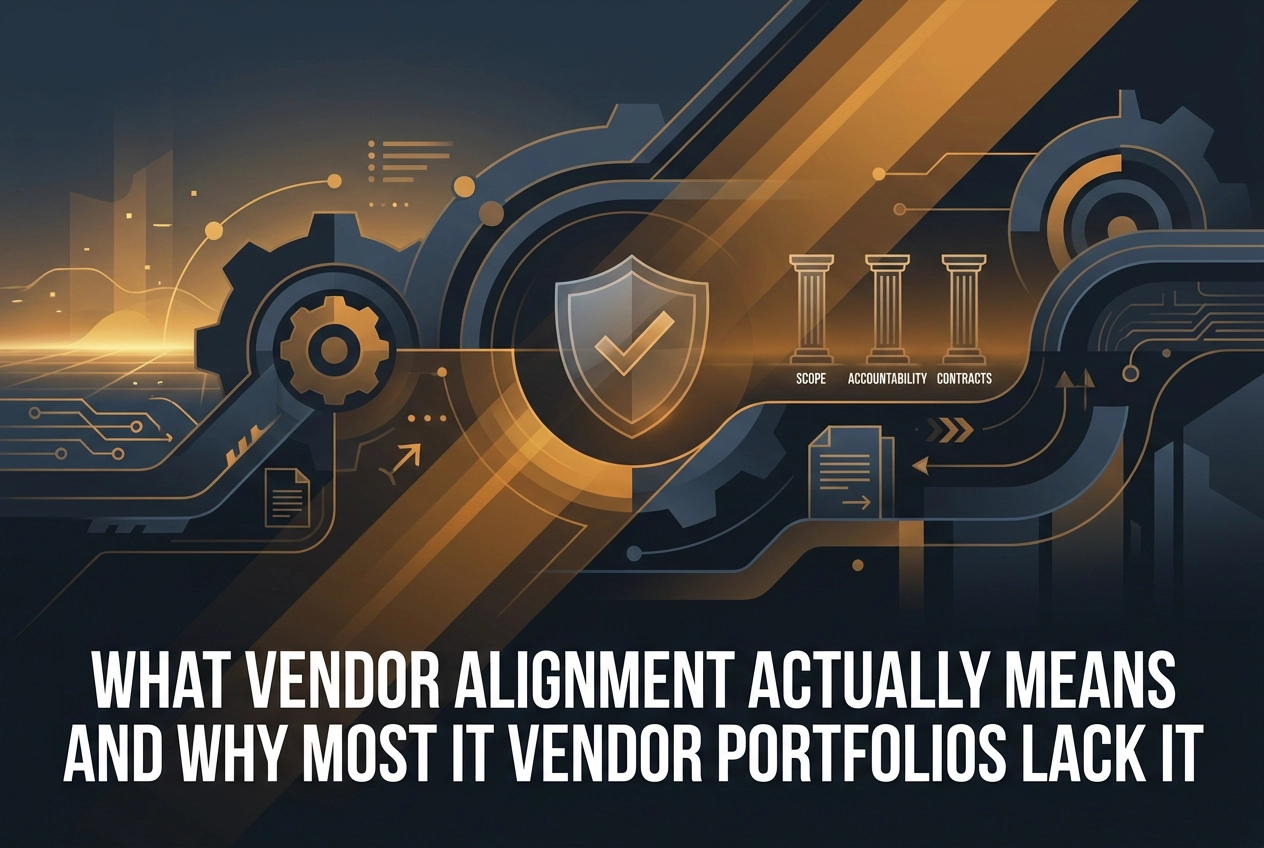
    • Every vendor holds a defined, non-overlapping scope
    • Every vendor has measurable accountability tied to specific deliverables and performance standards
    • Contract terms across the portfolio reinforce rather than conflict with each other

    Remove any one condition and the other two cannot compensate. A vendor with a well-defined scope but no measurable accountability still produces disputes. A vendor with clear performance standards operating under a contract that conflicts with an adjacent vendor’s terms still produces coverage failures.

    The critical implication: alignment is an intentional design output. It cannot emerge organically from a reactively accumulated portfolio, regardless of how well individual vendor relationships are managed. Goodwill between a business and its vendors does not substitute for structural coherence between contracts.

    For mid-market businesses across the Philadelphia metro region, this distinction carries real operational weight. Most IT environments have layered vendors over years in response to immediate pressures, without an integrating architecture governing how those vendors relate to each other. The result is a portfolio that functions adequately in isolation but fractures under cross-vendor stress.

    How Most Vendor Portfolios Are Actually Built

    Understanding why alignment is absent requires looking at how most portfolios were built in the first place. The answer is rarely negligence; it is accumulated reaction.

    Most businesses add vendors in response to immediate pressure. A compliance deadline surfaces and a new security tool gets procured. An MSP recommends a backup solution and it gets added. A department identifies a capability gap and contracts a point solution independently. Each decision is locally rational. Collectively, they produce a portfolio that was never designed as a system, because it wasn’t. As research on supplier portfolio dynamics confirms, “supplier count often grows faster than supplier strategy,” and the portfolio that results “looks flexible from the outside but feels chaotic from the inside.”

    Leadership transitions compound the problem. When the IT director who negotiated a contract leaves, the rationale for that vendor leaves with them. Renewals get handled by calendar date rather than by any evaluation of whether the vendor still fits. Within a few years, no one inside the organization can explain why specific vendors were selected or whether their current scope reflects any deliberate architectural decision.

    The failure signatures of this pattern are consistent and recognizable: overlapping scopes that neither vendor fully claims ownership of, coverage gaps where each vendor assumes the adjacent responsibility belongs to someone else, and contracts negotiated in isolation that now conflict operationally. These are not performance failures; they are structural ones.

    What sustains the problem is the absence of vendor lifecycle management as an active discipline. Exit decisions require more effort than vendor additions, so portfolios accumulate without corresponding pruning, interdependency evaluation, or stress-testing against the current operational model. The result, as seen in engagements where reactive accumulation is diagnosed and corrected, is not a collection of underperforming vendors but a portfolio architecture that was never designed to perform cohesively.

    The fragmentation is the architecture. That distinction matters, because it determines where the fix has to start.

    The Three Structural Failures That Define a Misaligned Portfolio

    Reactive accumulation produces predictable structural damage. That damage concentrates into three failure patterns, each with a distinct operational signature.

    Scope redundancy occurs when two or more vendors hold contracted responsibilities that overlap. The immediate cost is financial: the business pays twice for the same capability. The deeper cost is accountability diffusion. When two vendors share responsibility for an outcome, neither owns it fully, and both have an incentive to interpret their obligations narrowly when performance is questioned.

    Gap coverage failure is the inverse condition. Adjacent vendor scopes leave uncontracted territory that each vendor reasonably treats as outside their remit. No vendor is technically wrong; the gap simply exists because no one designed the boundary. The operational problem is timing: these gaps are invisible until an incident exposes them, at which point the cost of discovering unowned territory is measured in downtime, not in contract review hours. If you’ve experienced the frustration of a failure that no vendor would fully own, recognizing when your MSP relationship has structurally broken down is a useful diagnostic starting point.

    Fragmented accountability chain is the compounding failure. When no internal owner can trace a service failure back to a specific contractual obligation, the organization absorbs operational risk that should belong to a vendor. The risk does not disappear; it transfers inward, silently.

    Vague contract terms accelerate all three conditions. When deliverables, timelines, and performance standards are not explicitly defined, accountability becomes a negotiation after the fact rather than a measurement against a standard. Disputes are the predictable output.

    These failures do not operate independently. A portfolio with scope redundancy almost always develops gap coverage failures over time, because vendors under pressure retreat to their narrowest contractual interpretation, and the space between interpretations becomes unowned territory.

    Why Vendor Consolidation Alone Does Not Solve the Problem

    Recognizing those three structural failures often triggers an immediate response: reduce the vendor count. Consolidation feels decisive. It simplifies invoicing, shortens the vendor list, and signals operational discipline. The problem is that it treats a symptom rather than the condition.

    The structural failures described above do not disappear when the vendor count shrinks, unless alignment conditions are explicitly redesigned in the process.

    The most common consolidation mistake is optimizing for the wrong metric. Procurement teams measure success in contract count and invoice volume because those numbers are visible and easy to report. Alignment is neither. Reducing monthly vendor invoices from twelve to seven is a financial outcome; it says nothing about whether the remaining seven vendors have coherent, non-overlapping scopes or whether any of them now owns a coverage gap the eliminated vendors were quietly filling.

    That last point carries serious operational risk. Vendors that appear redundant from a procurement perspective are sometimes providing informal gap coverage that no contract explicitly documents. Eliminating them without mapping vendor interdependencies through a structured IT infrastructure audit leaves those gaps invisible until an incident forces them into view.

    Consolidation decisions made exclusively at the procurement layer, without direct input from the operational teams who depend on vendor outputs daily, consistently produce portfolios that look leaner on paper and perform more fragility under pressure. The people who know which vendor is actually being called at 9 p.m. during an outage are rarely in the room when the contract reduction decision is made.

    Alignment-driven consolidation is a legitimate and valuable goal. It becomes achievable only when the process begins with a full portfolio audit mapping current scope, accountability ownership, and contract terms across every active vendor relationship. Reduction decisions made after that audit can be structural. Reduction decisions made before it are guesswork.

    The Governance Architecture That Alignment Requires

    Redesigning consolidation decisions without rebuilding the governance layer that holds those decisions in place produces the same fragmentation under a smaller vendor count. The structural fix requires architecture, not just reduction.

    Vendor alignment governance operates at two distinct levels. At the enterprise level, someone owns portfolio-wide decisions: which vendors belong in the portfolio, how scopes are bounded relative to each other, and whether the portfolio as a whole is delivering coherent operational outcomes. This is precisely the function a part-time technology executive performing strategic oversight fills for mid-market businesses in the Philadelphia metro region that lack a full-time CIO. At the service level, individual vendor relationships require owners accountable for specific performance standards within defined tiers.

    Tiered classification is what makes differentiated governance sustainable. Separating core infrastructure vendors from mission-critical vendors from business-critical vendors allows the organization to apply rigorous oversight where operational exposure is highest without generating administrative burden across every vendor relationship simultaneously. Without that separation, governance either collapses under its own weight or gets applied uniformly at the lowest common denominator.

    The accountability gap most organizations experience is an architecture failure, not a personnel failure. Without a defined governance model, cross-vendor issues default to whoever escalates loudest internally rather than whoever contractually owns the outcome. That default pattern is not fixable by hiring better people; it is fixable only by documenting which internal owner is responsible when a service failure crosses vendor boundaries. The absence of that documentation is where fragmented accountability becomes operationally dangerous, converting every multi-vendor incident into an improvised internal negotiation.

    Governance frameworks are not administrative overhead. They are the mechanism that keeps alignment conditions intact as vendor contracts are renegotiated, personnel turns over, and the portfolio adds new relationships. Alignment designed without a governance structure to maintain it degrades at the first contract renewal cycle.

    Contract Engineering as an Alignment Tool

    Governance architecture defines who owns alignment decisions. Contract engineering determines whether the documents those owners are responsible for can actually support accountability in practice.

    Most vendor contracts are negotiated in isolation. Each vendor’s legal team optimizes for that vendor’s interests, which is rational from their position. The problem emerges at the portfolio level: a set of contracts that are individually defensible but collectively incoherent, with overlapping scope definitions in some places and uncontracted territory in others.

    Scope of work definitions are where most contracts fail operationally. A scope clause that describes services in general terms cannot function as an accountability tracking tool. Effective SOW language specifies discrete deliverables, explicit timelines, and measurable performance standards. When payment terms are tied to milestones rather than calendar dates, each payment cycle becomes an operational checkpoint, not just a financial one. The business retains structural leverage that monthly invoicing permanently surrenders.

    Termination clauses deserve equal scrutiny. Exit conditions written in vague terms create transitions that collapse into disputes. An alignment-ready termination clause names specific failure-to-deliver scenarios, defines breach thresholds, and obligates the exiting vendor to provide transition support. Without those provisions, replacing a vendor becomes an operational emergency rather than a managed handoff.

    Cross-portfolio contract review is a discipline most businesses in the Philadelphia metro region have never performed. Reading contracts sequentially, each appears reasonable. Reading them side by side exposes overlapping scope definitions, contradictory performance standards, and accountability gaps that no individual contract review would surface. Businesses with clear engagements and clear outcomes built into every vendor relationship do not discover these conflicts during incidents; they resolve them at the drafting stage.

    Calendar-based payment structures are a contract engineering choice with alignment consequences. They transfer leverage to the vendor the moment a contract is signed. Milestone-tied structures keep accountability measurable at defined intervals and preserve the organization’s ability to enforce performance standards rather than simply document their breach after the fact.

    MSP Relationships and the Specific Alignment Challenge They Create

    Contract terms, however precise, only produce alignment if the underlying scope architecture is sound. For businesses that rely on a Managed Service Provider, that architecture is where the hardest alignment work lives.

    MSP contracts differ from point-solution vendor contracts in three structural ways: they span broader operational domains, run on longer terms than typical point-solution contracts, and embed the MSP into infrastructure that the business cannot easily extract from mid-cycle. Those characteristics make scope drift more likely and misalignment more costly to correct.

    The overlap problem is predictable and nearly universal. A business establishes its MSP relationship first, then adds point-solution vendors over subsequent years to address specific gaps: a cloud backup vendor, a cybersecurity platform, a communication tool. Each addition is evaluated independently. Nobody audits whether the new vendor’s contracted scope duplicates something already inside the MSP agreement. Redundancy and gap coverage failures accumulate quietly, with neither party explicitly acknowledging the conflict, so it remains contractually invisible until an incident forces the question.

    Accountability diffusion compounds the problem. Most MSP agreements define performance at the relationship level, not the service level. Response time commitments and satisfaction ratings describe the MSP’s overall conduct. They do not assign measurable accountability to specific services or outcomes. When a failure occurs, the absence of service-level granularity converts what should be a contractual determination into an interpretive argument, and those arguments rarely resolve quickly or cleanly.

    Aligning an MSP relationship with the rest of the portfolio requires a specific diagnostic: what does the MSP own end-to-end, what does it share with adjacent vendors, and what has it informally assumed without contractual backing? That third category is often the largest.

    For businesses across the Philadelphia metro region that depend on an MSP as their primary IT partner, the MSP contract is the highest-leverage alignment intervention available. Scope clarity at that level propagates downstream across every vendor relationship it touches. A live conversation on real execution is often where that diagnostic process begins.

    How to Assess Whether Your Vendor Portfolio Is Aligned

    Once the MSP scope question is resolved, the same analytical discipline extends to every other vendor in the portfolio. Assessment follows five steps, applied in sequence.

    Complete vendor inventory. Document every active vendor: contracted scope, performance standards, internal accountability owner, and contract expiration date. Most organizations in the Philadelphia metro region discover they cannot finish this inventory without significant effort. That difficulty is itself diagnostic. If your team cannot quickly produce a complete, accurate list, the portfolio lacks the basic visibility that alignment requires.

    Interdependency mapping. For each vendor, identify which adjacent vendor relationships are required for that vendor to actually deliver its contracted outcome. Then check whether any of those dependencies appear in any contract. They rarely do. Undocumented dependencies are where gap coverage failures live before an incident makes them visible.

    Accountability stress testing. Select three to five recent operational incidents or service failures. For each one, trace the accountability chain backward: which vendor contractually owned the outcome, whether that vendor was held accountable, and what the resolution path actually looked like. This exercise surfaces fragmented accountability chains faster than any document review. If the answer to “who owned this” is “it depends,” the portfolio is misaligned.

    Contract coherence review. Read vendor contracts side by side, not in sequence. Flag scope definitions that overlap between vendors, performance standards that contradict each other, and termination conditions that would create a coverage gap if triggered. Contracts negotiated in isolation rarely contradict themselves individually; incoherence only appears when they are examined together.

    Vendor lifecycle management review. For each vendor relationship, assess whether the original rationale still holds, whether contracted scope matches current usage, and whether the contract terms reflect the current risk the relationship carries. Portfolios built reactively over several years routinely contain vendors whose scope has drifted significantly from what was originally contracted, creating both redundancy and uncovered risk.

    Building Toward Alignment: The Transition from Reactive to Designed

    Once the audit findings are in hand, the path forward is a phased discipline, not a single cleanup project. Each phase builds on the last, and skipping ahead produces the same fragmented conditions you started with.

    Phase one is documentation: produce the complete vendor inventory using the five-step audit sequence described above. This phase routinely surfaces vendors whose operational scope has drifted well beyond, or well short of, their contracted definition. That gap is where misalignment lives, and it cannot be corrected until it is visible.

    Phase two is structural redesign. Using the audit findings, redraw scope boundaries to close gaps and eliminate overlaps. Contracts that no longer reflect operational reality need to be updated or renegotiated, not managed around. Each vendor tier requires an explicitly assigned internal owner; without named accountability, the redesigned structure will erode under the pressure of day-to-day operations.

    Phase three is governance implementation. Structural redesign creates alignment conditions; governance maintains them. This phase establishes the oversight model that keeps the portfolio aligned as it evolves: renewal review cadences that evaluate scope fit before contracts auto-renew, performance measurement processes tied to specific deliverables, and documented escalation paths for failures that cross vendor boundaries. Without this layer, the portfolio will drift back toward reactive accumulation within one contract cycle.

    The sequencing is deliberate. No reduction or renegotiation decisions belong in phase one. Organizations that jump to vendor consolidation before completing the documentation and redesign phases consistently replicate the same structural problems with fewer vendors.

    Orloff Phillips works with businesses across the Philadelphia metro region to execute this transition. Every engagement begins with the portfolio audit and governance architecture, building the structural foundation before any vendor reduction or contract renegotiation decisions are made.

    The Operational Cost of Continuing Without Alignment

    The transition work described above addresses how to fix misalignment. What it cannot recover is the cost already absorbed by operating without it.

    Redundancy charges are the easiest cost to see on an invoice, but they rarely represent the largest exposure. Paying two vendors for overlapping capabilities wastes budget directly. The more consequential waste is the accountability gap that overlapping scopes almost always produce: when two vendors share a capability, neither fully owns the outcome, and that diffusion of ownership costs far more during incidents than it does on a line-item review.

    Incident resolution time is where misalignment becomes operationally painful. When a failure crosses vendor boundaries and no defined accountability chain exists, the incident cannot be escalated externally until someone internally has diagnosed which vendor owns it. That diagnostic work is unplanned, unbudgeted, and performed under pressure. A cross-vendor failure that should take hours to resolve routinely becomes a multi-day internal project because the portfolio was never designed to answer the question of who is responsible.

    Vendor coordination overhead is a staffing cost that rarely gets attributed correctly. When scopes overlap or conflict, internal staff spend real hours brokering between vendors, translating requirements, and mediating disputes that a well-structured contract would have made impossible. This overhead scales directly with the degree of misalignment; it does not plateau.

    Strategic decisions become structurally compromised. When leadership cannot reliably assess what the current portfolio is delivering because accountability is fragmented across vendors, there is no coherent baseline against which to evaluate new technology investments. Businesses in this condition often defer or misdirect capital decisions because the data needed to make them accurately does not exist.

    The compounding problem is the most important one to understand. Misalignment does not stabilize. Each vendor added to a misaligned portfolio introduces new overlap and gap risk. The cost of not addressing alignment is not fixed; it grows with every contract signed into an unexamined portfolio.

    Alignment Is an Architecture Decision, Not a Vendor Problem

    Those compounding costs are not a vendor performance problem. They are the predictable output of a portfolio that was never architecturally designed.

    Vendor alignment cannot emerge from good vendor relationships, attentive vendor management, or even a well-executed consolidation effort unless the structural conditions were intentionally engineered in the process. Relationships change. Personnel turns over. Contracts renew with revised language. Without a designed architecture underneath, none of those activities produces lasting alignment, they produce temporary stability in a fragile system.

    Those three conditions, defined scope, measurable accountability, and coherent contract terms, are entirely within your control to build. None of these conditions require a perfect vendor roster or a reduced vendor count. They require intentional design decisions, applied consistently.

    For businesses that have accumulated vendors reactively over several years, the starting point is not a restructuring initiative. It is an honest inventory of what the current portfolio actually contains, as opposed to what leadership believes it contains. Most organizations in the Philadelphia metro region have never completed that inventory at the scope and accountability level. That gap, by itself, explains most of the friction.

    Three actions worth taking this quarter:

    • Vendor inventory audit: Document every active vendor, their contracted scope, their performance standards, and their internal accountability owner
    • Accountability stress test: Trace three recent operational incidents back through the accountability chain and identify where ownership broke down or was unresolved
    • Internal ownership assignment: Name the person responsible for cross-vendor alignment decisions before any contract is signed or renewed

    Orloff Phillips works with businesses across the Philadelphia metro region to build the portfolio architecture that operational efficiency requires. The engagement starts with alignment clarity specific to your environment, not a generic vendor reduction target.

    Conclusion

    Vendor alignment is not a procurement outcome; it is an architecture decision that determines how well your entire IT environment performs under real operational conditions. Most portfolios fail not because of the wrong vendors, but because of absent governance, unclear accountability, and contracts that were never designed to support coordination. Consolidation without structure solves nothing. The businesses that operate efficiently are the ones that have designed their portfolios with intention rather than inherited them through habit.

    The gap between where most organizations are and where they need to be is rarely about vendor quality. It is about internal clarity and deliberate design.

    If your vendor portfolio has grown reactively, now is the time to change that trajectory. Start with the audit. Assign ownership. Build the architecture your operations actually require. Orloff Phillips is ready to help you get there.

  • What a Fractional CIO Actually Costs and Whether the ROI Justifies It

    What a Fractional CIO Actually Costs and Whether the ROI Justifies It

    Most businesses searching for fractional CIO pricing are asking the right question in the wrong way. They pull up salary comparison sites, benchmark a full-time CIO’s base compensation, and use that number as their reference point. The problem is that comparison was flawed before it even started.

    The real cost equation behind a fractional CIO engagement is more nuanced, and frankly more revealing, than a simple salary-to-retainer comparison. When you account for the fully loaded cost of a full-time hire, and then factor in the price of the leadership vacuum that currently exists in its absence, the ROI calculus shifts dramatically.

    This post breaks down exactly what a fractional CIO costs, how pricing models are structured, and what the engagement actually delivers against the alternatives. You will learn how to quantify the hidden costs of deferred IT decisions, vendor misalignment, and stalled infrastructure projects. You will also walk away with a practical framework for evaluating whether a fractional CIO engagement makes financial sense for your organization, and how it stacks up against a full-time hire or project-based consulting. The honest answer on cost and ROI is here. It just requires looking at the right numbers.

    You Are Comparing Fractional CIO Cost to the Wrong Number

    Most buyers researching this topic start by Googling “CIO salary,” find a number somewhere between $180,000 and $280,000, and then evaluate a fractional CIO engagement against that benchmark. It feels like a logical comparison. It is the wrong one.

    A fractional CIO is a senior technology executive who works on a part-time or retainer basis, providing strategic IT leadership without a full-time headcount commitment. If you want the full operational picture of what that looks like in practice, this breakdown of what a part-time technology executive actually owns and delivers is worth reading before you price anything.

    The correct cost comparison is not fractional CIO pricing versus a full-time chief information officer salary. It is fractional CIO pricing versus the fully-loaded cost of having no strategic IT leadership at all, which includes deferred infrastructure decisions, unchecked vendor spend, and IT projects that stall without an executive owner.

    This piece builds that comparison across three columns: the true fully-loaded cost of a full-time CIO hire, the market range for a fractional engagement, and the cost of the leadership vacuum most mid-market companies are already absorbing without recognizing it.

    That third column is where the real number lives.

    This analysis is written for businesses in the Philadelphia, Exton, Wilmington, Cherry Hill, Lancaster, and Reading, PA region; companies that have outgrown their current IT structure but are not yet positioned to justify a $250,000 executive hire.

    The True Cost of a Full-Time CIO Goes Well Beyond Base Salary

    The base salary figure is only the starting point, and it understates the real commitment significantly.

    Industry compensation surveys suggest full-time CIO base salaries for companies in the $10M to $100M revenue range commonly run into the low-to-mid six figures annually. That number alone gives most mid-market business owners pause. But it is not the number that should drive the decision.

    Fully-loaded employment costs, covering benefits, payroll taxes, equity, and bonus expectations, add meaningfully on top of base salary, often by a third or more, though exact figures vary by benefits design. Add the recruiting burden on top of that, and you are looking at a substantially higher total commitment than the base salary alone before the new executive has reviewed a single vendor contract.

    Then comes the ramp period. Time-to-productivity for a new CIO hire involves a significant onboarding window. During that window, the business pays full compensation while the executive is still mapping vendor relationships, learning infrastructure history, and navigating internal politics.

    For a company in the Philadelphia corridor with $50M in revenue, a full-time CIO represents a material share of revenue in direct compensation alone, for a role that may genuinely require only 15 to 20 hours of strategic attention per week.

    How Fractional CIO Pricing Actually Works

    Fractional CIO engagements are priced as monthly retainers, and the structure is more tiered than most buyers expect.

    Entry advisory retainers ($4,000 to $6,000/month) cover advisory and governance functions: vendor review, IT roadmap development, and executive-level technology guidance at a defined weekly hour commitment. This tier suits businesses that need strategic direction and accountability but do not yet require hands-on operational involvement.

    Operational fractional retainers ($7,000 to $10,000/month) shift toward active engagement. At this level, expect direct vendor management, project oversight, IT team leadership, and representation in executive or board-level conversations. This is the most common entry point for mid-market companies that have an MSP relationship or internal IT staff but lack the leadership layer to direct either effectively.

    Embedded CIO engagements ($10,000 to $14,000/month) are appropriate for businesses in active IT transformation, compliance infrastructure buildout (HIPAA, SOC 2, CMMC), or technology integration tied to M&A activity. Scope and hours increase accordingly.

    Interim or transformation engagements ($14,000 to $20,000/month) address the most complex situations, including multi-site environments, regulatory overhauls, or post-acquisition integration work requiring near-full-time executive presence.

    That represents a 60 to 80 percent cost reduction compared to a fully-loaded full-time hire. The structural advantages extend beyond the price difference. An experienced fractional CIO arrives with vendor benchmarks, governance frameworks, and working knowledge of regional IT markets already in hand, none of which requires a ramp period to access.

    For businesses that have never had a formal IT leadership review, pairing a fractional engagement with an independent IT infrastructure assessment that surfaces what internal teams typically miss accelerates the ROI timeline considerably.

    The Cost Nobody Puts on the Spreadsheet: The IT Leadership Vacuum

    Knowing what a fractional CIO costs is only half the equation. The other half never appears on a budget spreadsheet.

    When a company operates without strategic IT leadership, those costs do not disappear. They accumulate silently across four categories that compound with every passing quarter.

    Infrastructure debt. Without an accountable technology leader reviewing architecture decisions, systems collect band-aid fixes and compatibility gaps that grow more expensive the longer they sit. In our experience working with mid-market companies across this region, this pattern is consistent among companies in the Exton and Philadelphia area that relied on reactive MSP support rather than proactive planning. A $15,000 remediation in year one becomes a $60,000 infrastructure overhaul in year three.

    Vendor and MSP misalignment. Companies without IT leadership oversight routinely pay for managed service contracts that were never renegotiated, carry redundant software licenses across departments, and have no leverage to enforce SLA accountability. MSP contract reviews routinely surface material overspend at companies in this revenue range, redundant licenses, unrenegotiated rates, and unenforceable SLAs add up faster than most finance teams expect.

    Deferred decisions. Every quarter a cloud migration, security review, or CRM consolidation goes unmade represents compounding risk exposure. A fractional CIO typically addresses these in a structured roadmap within 30 to 60 days of engagement.

    Project abandonment. IT initiatives without an executive owner stall. A failed ERP rollout or a compliance gap surfaced during audit carries costs that far exceed a full year of fractional engagement fees.

    Conservatively, a $30M company carrying unaudited MSP contracts, deferred infrastructure decisions, and a stalled initiative can accumulate leadership-gap costs well above the annual price of a mid-tier fractional engagement, without those costs appearing on any single budget line.

    A Practical ROI Framework for Evaluating a Fractional CIO Engagement

    Step 1: Calculate your fully-loaded baseline. Add up your current MSP contract costs, software licensing spend, and any IT project budgets that are stalled or over budget. This total is your denominator. It represents what you are already spending on technology operations without strategic leadership directing any of it.

    Step 2: Estimate your leadership gap cost across three line items.

    • Vendor overspend: What would a contract review likely surface? Use a conservative figure.
    • Deferred decision cost: Assign a dollar value to each major IT decision delayed more than one quarter. Factor in compounding risk, not just missed efficiency.
    • Project delay cost: Calculate sunk labor and timeline slippage on any stalled initiative.

    Step 3: Compare the gap cost against a retainer. Match the engagement tier to your company’s size and complexity. A $10,000/month retainer runs $120,000 annually. If your leadership gap cost exceeds that, the math already favors engagement.

    Step 4: Add the non-financial factors. How many hours per week is your CEO or COO currently absorbing IT decisions? What is your security and compliance exposure without oversight? Vendor accountability improvements compound quarterly. These items do not appear on the spreadsheet, but they have real cost consequences.

    Worked example: A 120-employee company near Lancaster or Reading, PA, with $40M in revenue and an unbenchmarked MSP relationship, could, in an illustrative scenario, recover the full cost of a $10,000/month retainer within a few months through vendor savings and project reactivation, a payback timeline consistent with what providers cite for typical engagements.

    Focus on payback period. The monthly retainer is a line item; the payback timeline is the actual decision metric.

    Fractional CIO vs. Full-Time Hire vs. Project Consulting: Which Fits Your Business

    Once the ROI math points toward fractional engagement, the remaining question is whether fractional is actually the right model for your situation, or whether a full-time hire or project consultant would serve you better.

    Full-time CIO is the correct answer as the organization scales toward enterprise complexity and daily executive IT presence becomes operationally necessary, where the role demands daily executive presence, board-level technology representation, and oversight of complex, multi-site IT environments.

    Project-based IT consulting fills discrete tactical gaps: a network assessment, a vendor evaluation, a security audit. What it does not provide is continuity. A consultant who delivers a report and exits does not own the outcome, does not govern your MSP relationship next quarter, and is not accountable when the recommendations stall in implementation.

    Fractional CIO sits between those two options and is the right fit for companies with 50 to 500 employees or IT budgets in the $500K to $5M range that already have an IT team or MSP relationship but lack the strategic layer to direct them, govern vendor spend, and translate technology decisions into business results.

    One important distinction: a fractional CTO (chief technology officer) is a separate role. The CTO owns product development and engineering leadership; the CIO owns business technology operations, infrastructure, vendor relationships, and IT governance. Companies researching options sometimes conflate the two, which leads to mismatched engagements.

    For mid-market businesses across the Philadelphia corridor, including Wilmington, Cherry Hill, and the western suburbs around Exton, proximity compounds the value. A fractional CIO familiar with regional compliance environments and local vendor markets reaches productive engagement faster than a remote generalist learning your context from scratch.

    What to Look For in a Fractional CIO Engagement Before You Sign

    Once you have identified the right fit for your business, the next step is evaluating whether a specific engagement is structured to deliver results. Not all fractional CIO arrangements are built the same way.

    Demand written scope. Before signing anything, require a documented engagement scope that specifies committed hours per week, named deliverables within the first 90 days, and explicit ownership of vendor relationships and IT governance decisions. Vague retainer language produces vague outcomes. If the agreement does not define what the fractional CIO owns, no one owns it.

    Verify vendor neutrality. A fractional CIO affiliated with or incentivized by specific technology vendors cannot give you objective advice on your MSP contract, your software stack, or your infrastructure roadmap. Confirm the engagement is fee-only and free of referral arrangements. The guidance you are paying for only has value if it is conflict-free.

    Confirm hands-on MSP experience. For most mid-market companies, the fastest ROI comes from cleaning up existing vendor relationships, not from abstract strategy work. Ask specifically whether the provider has benchmarked and renegotiated MSP contracts. Vendor consolidation is where measurable savings appear earliest; make sure the fractional CIO you hire has done it before.

    Require business-side credibility. The best fractional CIOs translate technology decisions into financial outcomes. They should be as comfortable presenting to your CFO or board as they are reviewing infrastructure architecture. If a candidate cannot frame an IT recommendation in terms of cost, risk, or revenue impact, they are not a strategic leader.

    Insist on flexible terms. Quarterly or month-to-month renewal structures protect you until the engagement has demonstrated value. A provider confident in their results will not require a 12-month commitment upfront.

    Orloff Phillips structures its fractional IT leadership engagements around MSP cleanup, vendor alignment, and infrastructure governance, with clear engagements and clear outcomes built in from day one. ROI visibility tends to arrive earlier than most buyers expect, often driven by vendor savings in the first engagement phase.

    The Honest Answer on Fractional CIO Cost and ROI

    As established above, the right comparison is not fractional retainer versus full-time salary, it is retainer versus the fully-loaded cost of the gap it fills.

    The numbers make this concrete:

    OptionAnnual Cost
    Full-time CIO (fully loaded)$250,000+ (salary, benefits, taxes, recruiting)
    Fractional CIO (scope-dependent)$60,000 to $180,000
    No IT leadership (hidden costs)Variable, MSP overspend, deferred decisions, and stalled projects accumulate without appearing on a single line.

    For businesses in Philadelphia, Exton, Wilmington, Cherry Hill, Lancaster, and Reading PA, the practical starting point is a vendor and MSP spend review. That review establishes your actual leadership gap baseline, and it gives you a defensible denominator before you price any engagement.

    The number that determines whether a fractional CIO engagement makes financial sense is not the monthly retainer. It is the payback period. For most mid-market companies, that period is measured in months, not years, and it is consistently shorter than they expect before they do the math.

    Conclusion

    The decision is straightforward once the right numbers are on the table: quantify your leadership gap, compare it to a retainer, and focus on payback period. If your business is carrying an IT leadership gap, a vendor and MSP spend review is the right place to start.

  • How IT Infrastructure Fragmentation Accumulates and Why It Is So Hard to See from the Inside

    How IT Infrastructure Fragmentation Accumulates and Why It Is So Hard to See from the Inside

    Most technology leaders do not wake up one day and decide to build a fragmented IT environment. They approve an acquisition. They greenlight a departmental software request. They authorize a cloud migration under deadline pressure. Each decision is rational, documented, and defensible. Yet over years, those individually sound choices compound into something that quietly undermines governance, security, AI adoption, and operational coherence across the entire organization.

    This is the paradox at the heart of IT infrastructure management: the very people closest to the environment are often the least equipped to see it clearly. When every decision made sense at the time, there is no obvious moment to point to, no single failure to investigate. The fragmentation is invisible precisely because it accumulated gradually.

    This analysis maps the specific patterns through which fragmentation builds, from acquisition-driven architecture debt and departmental tool sprawl to piecemeal cloud migrations and siloed identity systems. It explains why internal teams consistently miss the aggregate picture, how fragmentation surfaces as business symptoms rather than IT alerts, and what it takes to finally name and cost the pattern you are living inside.

    What IT Infrastructure Fragmentation Actually Means

    Most definitions of IT infrastructure treat it as a stack of layers: hardware, networking, software, data, and security. Vendor literature reinforces this view, describing each layer in isolation with its own maturity model and upgrade path. That framing is useful for procurement. It is useless for diagnosing fragmentation.

    Fragmentation is not a broken system. It is a coherence failure across systems that each work independently. Every application runs. Every database returns results. Every access policy enforces something. The problem is that none of them were designed in relation to each other, and the gaps between them are where operational risk, reporting error, and modernization failure quietly accumulate.

    This is a critical distinction from complexity. Complex infrastructure is manageable because its interdependencies are understood and governed. Fragmented infrastructure is structurally misaligned: the interdependencies exist, but no single architecture owns them. Complexity responds to good IT infrastructure management. Fragmentation resists it, because the problem is not scale or sophistication; it is the absence of a reconciling architecture across components that were each built or acquired on their own terms.

    Fragmentation concentrates in three domains. Data architecture is where competing schemas, disconnected warehouses, and duplicate records make a single version of business truth unreachable. ERP and operational systems are where acquisitions, upgrades, and workarounds leave organizations running parallel process logic with no authoritative source. Access control and identity is where personnel changes, acquired entities, and disconnected directories accumulate permissions that no one has fully audited.

    Because vendor literature addresses each domain separately, the cross-domain coherence failure remains invisible to teams working within any single layer. A security team can have excellent identity hygiene inside its own system while having no visibility into an acquired subsidiary’s directory. Each layer passes its own review. The aggregate fails silently.

    Mid-market businesses across Philadelphia, Wilmington, Exton, and Lancaster frequently encounter this pattern. Regional growth through acquisition and multi-site expansion is common in these markets, but post-acquisition IT rationalization is consistently under-resourced, producing inherited architectures that no one fully designed. This pattern of accumulating a bloated and misaligned technology stack through individually defensible decisions is the defining mechanism this post maps.

    Rational Decisions, Irrational Outcomes: The Accumulation Mechanism

    Recognizing fragmentation as a coherence failure is clarifying. What remains harder to accept is that no one caused it through negligence. The architecture that now resists change was built, decision by decision, by people making reasonable calls.

    This is the accumulation mechanism: fragmentation is not the residue of bad judgment. It is the aggregate output of individually defensible choices that were never reconciled into a unified architecture.

    Each decision type follows the same logic. An acquisition closes, and retaining the acquired company’s ERP avoids a costly, risky migration during a sensitive revenue integration period. A department purchases a SaaS tool because procurement cycles are too slow and the per-seat cost sits below the capital threshold that triggers IT review. A workload migrates to the cloud because one vendor offers a compelling cost reduction for that specific application. A second MSP is added because the first does not cover the geography of a new office. Every one of these decisions has a coherent business rationale. None of them is a mistake in isolation.

    The compounding effect is where the damage accumulates. Three such decisions made across three years produce an architecture that no single person designed and no single team owns. The acquisition team owned the first choice. The department head owned the second. A project manager owned the third. No one held the aggregate, because the aggregate was never the subject of a single decision.

    This pattern is structurally different from technical debt. Technical debt is deferred work: a known obligation postponed for later. Fragmentation is misaligned work: systems that each function correctly but were never designed to cohere. There is no backlog entry for it, because no one recognized it as a liability at the time of creation. This distinction matters when scoping remediation, and it is a gap that a structured external IT infrastructure audit is specifically designed to surface.

    The damage curve follows a predictable pattern: fragmentation in enterprise data systems rarely produces immediate failure. Instead, competing data versions erode governance and reporting confidence incrementally, long before any system visibly breaks. By the time leadership notices, the problem is years old.

    Acquisition-Driven Fragmentation: When Growth Creates Architecture Debt

    Of all the accumulation patterns, acquisition-driven fragmentation is the most structurally entrenched because it arrives with a ready-made justification: the deal closed, revenue is integrating, and IT can follow later.

    It rarely does.

    When a company is acquired, its technology stack comes with it: a legacy ERP that encodes years of operational logic, an identity and access control system built around its own org chart, cloud tenancies provisioned under its own billing accounts, and frequently its own MSP relationship managing day-to-day support. IT due diligence guidelines explicitly flag this inherited technical debt as a pre-close risk, yet reconciliation is routinely deferred post-close because the cost and timeline are unattractive against the revenue integration timeline.

    The business case logic is straightforward: consolidating two ERPs is expensive, disruptive, and slow. Integrating the sales pipeline and customer accounts is faster and more visible to leadership. So IT reconciliation gets pushed to the next planning cycle, then the one after that. The acquired company’s MSP contract renews. The cloud tenancy stays active. The data schema remains separate. All three persist, not because anyone decided they should, but because no one made the decision to eliminate them.

    Access control is where this deferral carries the most direct risk. IT integration guidance identifies identity and access management as a key post-merger risk area. Organizations managing two disconnected identity systems cannot reliably audit who has access to what across the combined entity. Access rights granted under the acquired company’s policies persist under the acquirer’s infrastructure, often without visibility.

    Regional mid-market companies in Cherry Hill, Reading, and Lancaster are common examples of this dynamic. Growth through acquisition is common in these markets; dedicated post-acquisition IT rationalization programs are not. The result is an architecture that expands with each deal and consolidates with none of them.

    Departmental Tool Sprawl and the Shadow IT Infrastructure Problem

    Acquisitions introduce fragmentation through discrete, visible events. Departmental tool sprawl works differently: it accumulates invisibly, one low-cost SaaS subscription at a time, through a governance structure that makes each purchase entirely legitimate.

    The mechanism is straightforward. Most organizations set a capital expenditure threshold above which IT review is required. The modern SaaS market prices products well beneath that ceiling. A sales team subscribes to a prospecting tool, a marketing team adds a reporting platform, an operations team adopts a workflow application. Each purchase clears the approval process without triggering an architecture review. No single decision is wrong. The aggregate is a parallel data infrastructure that no one formally sanctioned.

    The data consequence is what makes this pattern costly. Sales exports pipeline data from its CRM integration. Finance pulls revenue figures from its own reporting layer. Operations tracks fulfillment through a separate workflow tool. All three outputs can be technically accurate within their respective systems and still produce numbers that cannot be reconciled. Leadership meetings devolve into arguments about which figure is correct, when the real problem is no single authoritative source exists. This is an IT infrastructure management failure, not a departmental behavior problem.

    That distinction matters. Shadow IT is broadly recognized as a growing organizational problem, but blaming employees for adopting tools that work misses the root cause. Departments buy outside the governance process because the official process is too slow to meet their operational pace. Shadow IT signals that the core IT infrastructure management function is not serving departmental needs at the speed the business requires.

    The compounding problem is structural. Many of these tools integrate natively with each other but not with the ERP. Over time, they form a second-tier data layer that other workflows begin to depend on. Removing any single tool breaks downstream processes. The informal stack has become load-bearing infrastructure, and cleaning it up carries the same risk and cost as touching a core system. Organizations that recognize this early are in a far better position than those who discover it mid-modernization; the latter often find, as covered in assessments of when an MSP relationship is costing more than it saves, that fragmented vendor and tool relationships share the same structural root.

    Piecemeal Cloud Migrations and the Multi-Tenancy Trap

    Each cloud migration was individually justified, and none were reconciled into a coherent whole.

    The typical sequence begins with a single workload, a file server, a backup system, a development environment, moved to the cloud to solve a specific problem. Cost reduction, a vendor incentive, a performance bottleneck, or a team initiative all produce the same outcome: one workload migrated, one new cloud tenancy opened, one governance boundary created that did not exist the week before.

    The incompatibility accumulates across tenancies, not within them. When a second workload migrates a year later, often through a different vendor with a different contract structure, it lands in a separate environment with its own identity controls, its own logging configuration, and its own access policies. Neither environment was designed to operate alongside the other. A third migration, a fourth, each legitimate, produces the same result: multiple cloud architectures with no unified governance layer connecting them.

    This is the multi-tenancy trap. The individual environments function correctly. The gap is between them, and that gap has no owner.

    The data movement problem compounds the governance gap. Workloads frequently migrate without their full data context. Reporting pipelines that assumed co-located data suddenly require custom integration bridges to pull information across environment boundaries. Those bridges are built to solve an immediate problem, then quietly become permanent. Each one represents ongoing maintenance that was never budgeted and rarely documented.

    The result is a reporting architecture built on improvised connectors rather than intentional design, and every connector is a dependency that will surface during the next migration or upgrade attempt.

    In IT infrastructure consulting engagements, Orloff Phillips routinely opens with a cloud environment audit before reviewing anything else. For businesses across the Philadelphia, Wilmington, and Exton markets, that audit consistently surfaces multiple distinct cloud environments that the organization’s own IT team cannot fully account for, each with separate contracts, separate governance assumptions, and no reconciling architecture across them.

    Why Internal Teams Cannot See the Fragmentation Pattern

    What makes fragmentation durable is not its complexity but the organizational blind spots that prevent it from being seen as a unified pattern.

    Institutional memory distributes the gap across people. The director who negotiated the original MSP contract may have left two years ago. The team that ran the ERP implementation is dispersed. The person who authorized the acquired company’s cloud tenancy never joined the parent organization’s IT leadership. No single person was present for all the decisions, so no single person holds the complete picture. This is not negligence; it is the structural consequence of decisions made across years and personnel changes.

    Standard IT infrastructure management processes compound the problem. Those processes were designed to operate existing systems reliably, not to audit whether the architecture across those systems is coherent. Ticketing systems, change management workflows, and vendor SLAs each address a discrete system in isolation. None of them surface the question: does the sum of these systems constitute a governable architecture?

    The result is what researchers describe as a gradually boiling water effect. Fragmentation accumulating over five years produces no single crisis moment, only a slow erosion of governance confidence, reporting reliability, and the organization’s capacity to modernize. Leadership begins to distrust data outputs. Projects surface unknown dependencies. Initiatives stall without a clear cause.

    Research reinforces this blind spot from another angle: organizations consistently prioritize technical challenges such as data quality and model performance before defining underlying business objectives. This sequencing error is a symptom of not seeing the architecture problem clearly. When the root cause is invisible, teams treat downstream symptoms as the primary problem, and investments stay misaligned.

    This is precisely where the value of an outside perspective becomes structural rather than optional. A fractional CIO or part-time technology executive enters without the rationalization narrative embedded in institutional memory, which is what makes the aggregate visible for the first time.

    How Fragmentation Surfaces as Business Symptoms, Not IT Problems

    The sharpest current signal of hidden fragmentation is the AI pilot stall.

    The AI stall is the sharpest current signal. Only roughly one-third of organizations have moved AI initiatives beyond the pilot stage into genuine production deployment, despite the overwhelming majority now using AI in at least one business function. The instinct is to blame model quality, tooling gaps, or organizational readiness. The structural cause is more fundamental: fragmented data architecture means there is no coherent data layer for AI systems to operate against. Models trained on misaligned, inconsistently governed data produce outputs that are technically plausible but contextually unreliable. The pilot works in a controlled environment; it fails to scale because the underlying data environment was never unified. If your organization has technology that feels harder to use than it should, stalled AI pilots are often the most visible expression of that friction.

    Competing data versions erode executive confidence in a specific, compounding way. When finance produces one revenue figure for a quarter and operations produces a different one from the same period, leadership does not simply resolve the discrepancy. Over time, leadership stops trusting the data layer entirely. Decisions migrate toward instinct or informal consensus, which compounds the cost of fragmentation well beyond the IT organization.

    Modernization projects surface the hidden architecture. Teams scoping ERP upgrades or platform migrations routinely discover dependencies that were not documented because no one mapped the full architecture. Projects that were scoped at six months run twelve. Budgets expand. The dependency was always there; it only became visible when someone tried to change something.

    Security exposure follows the same invisible accumulation pattern. Access rights granted during an acquisition or a personnel transition persist in disconnected identity systems long after the business context that justified them is gone. No single event creates the exposure; it accumulates quietly across every unreconciled identity boundary.

    The External Frame: What IT Infrastructure Consulting Reveals

    Recognizing fragmentation as a business problem is only half the work. The harder step is understanding why internal teams, despite their competence, cannot resolve it on their own.

    What external IT infrastructure consulting maps that internal audits cannot is the full accumulation sequence across vendor relationships, MSP boundaries, and integration dependencies.

    That sequence reveals which decisions were made, in what order, under what business pressures, and what each one cost relative to what a reconciled architecture would cost today. This class of problem is structural, requiring architectural perspective rather than component-level review. Internal audits are designed to assess whether existing systems are functioning. They are not designed to evaluate whether the architecture those systems compose is coherent.

    The distinction between technical remediation and strategic fragmentation diagnosis is direct. Technical remediation fixes a failing component; it replaces the legacy server, patches the integration, upgrades the ERP module. Strategic diagnosis names the architecture problem above those components, costs the current state against a rationalized alternative, and produces a decision framework for sequenced investment. Without that diagnosis, remediation efforts address symptoms while the structural misalignment persists.

    Orloff Phillips approaches fragmentation diagnosis for businesses across the Philadelphia, Exton, and Wilmington markets by starting with vendor and MSP relationships rather than the technical architecture itself. Vendor contracts, MSP scope boundaries, and integration dependencies reveal actual architecture state more accurately than internal documentation, which is typically incomplete or outdated. The architecture surfaces through the relationships, not the other way around.

    The business case is direct: organizations that quantify fragmentation costs before launching modernization initiatives avoid investing in the wrong layer. Most modernization failures trace to misaligned investment, not insufficient budget. External diagnosis closes that gap before it becomes expensive.

    A Diagnostic Checklist: Recognizing Fragmentation in Your Own Environment

    Review each symptom against your current environment. Answer honestly, not aspirationally.

    Your business IT infrastructure is managed by more than one MSP or contracted vendor, with no single party accountable for the whole. Each vendor manages its own scope and escalates nothing horizontally. Gaps between scopes go unmanaged by default.

    Reporting outputs from different departments regularly produce different numbers for the same metric and the same time period. Finance and operations each have a defensible methodology. Neither is wrong in isolation. The architecture is wrong because it produces two versions of the same fact.

    AI or analytics initiatives have been in pilot for more than six months with no defined path to production deployment. This is not a model problem or a tooling problem. Pilots stall when the underlying data architecture cannot support consistent, governed inputs at scale. The pilot works; the foundation does not.

    Your cloud environment contains workloads migrated at different times, governed under different contracts or tenancies, with no unified oversight layer. Each migration was individually justified. Together, they produced an environment no single team can fully account for or govern coherently.

    Identifying access rights for departed employees, acquired-company users, or legacy system accounts requires a manual audit because no unified identity system exists. This is not a housekeeping issue. It is a documented security exposure that compounds with every acquisition, personnel change, or system addition that goes unreconciled.

    ERP upgrade or platform migration projects consistently surface unknown dependencies that were not in the original project scope. Scope creep of this kind is not a planning failure. It is evidence that the architecture was never fully documented, because no single team held the complete picture at one time.


    How to Use This Checklist

    One symptom may reflect an isolated gap. Two may reflect a pattern under control. Three or more symptoms present simultaneously indicate that fragmentation has passed the threshold where internal management alone can resolve it.

    At three symptoms, the architecture has accumulated enough misalignment across enough domains that a coherent remediation path requires an external frame. Internal teams can fix individual components; they cannot redesign the accumulation sequence from inside it. That distinction is precisely what an external architecture review is structured to provide.

    Conclusion: Naming the Pattern Is the First Step Toward Resolving It

    If the checklist surfaces three or more symptoms, the productive response is recognition, not alarm.

    The first move is diagnosis, not remediation. Remediation without diagnosis produces the same compounding problem at a higher cost. The correct starting point is mapping the accumulation sequence: which decisions created which layers, what those layers currently cost to maintain, and what a reconciled alternative would cost instead. That comparison creates the business case. Without it, modernization initiatives tend to address symptoms rather than the structural misalignment underneath them.

    Orloff Phillips works with businesses in this region to do exactly that work. The engagement begins with vendor and MSP relationships, surfaces the architecture those relationships have produced, maps the accumulation sequence, and builds the cost comparison that internal teams cannot build objectively. Vendor alignment, MSP consolidation, and strategic infrastructure rationalization are not parallel tracks; they are sequential steps in a coherent diagnosis-to-resolution process.

    The organizations that modernize fastest are rarely those with the cleanest starting point. They are the ones who invested early in understanding precisely where they were. Clarity about the current state is not a preliminary. It is the strategic advantage that makes every subsequent decision faster, cheaper, and more likely to hold.

  • Fractional CIO Services Explained: What a Part-Time Technology Executive Actually Does for Your Business

    Fractional CIO Services Explained: What a Part-Time Technology Executive Actually Does for Your Business

    Most companies exploring fractional CIO services enter the conversation with the wrong mental model. They picture a seasoned IT professional who shows up two days a week, manages vendors, and keeps the lights on. That picture is not just incomplete; it leads directly to misaligned expectations, underutilized engagements, and, ultimately, wasted spend.

    A fractional CIO is an executive function, not a staffing solution. The distinction carries real operational consequences: who owns the technology roadmap, who governs vendor relationships, who speaks to the board on technology risk, and how authority is structured when decisions need to be made under pressure.

    This post cuts through the noise to give you a working definition built on decisions, deliverables, and cadence rather than a vague job description. You will learn exactly where the fractional CIO scope begins and ends, how it differs from an IT manager or project consultant, what the first 90 days actually look like, and which questions to ask before signing an engagement. Whether you are evaluating this model for the first time or trying to determine whether your current setup is delivering executive-level value, the analysis that follows gives you the framework to find out.

    The Misconception That Costs Companies Before the Engagement Starts

    That mental model — a senior IT professional who shows up part-time to manage vendors — is wrong in a specific way. The problem is categorical, not cosmetic. When an organization frames a fractional CIO as reduced-cost IT management, it purchases the role against operational criteria: responsiveness, ticket escalation, vendor coordination. Those are legitimate operational needs. They are also not what a fractional CIO is for. The result is a mismatch in deliverables, accountability, and ultimately ROI, because the company is measuring executive-level strategic output against a help desk standard.

    Fractional CIO meaning is not determined by hours on-site. It is determined by the altitude of decisions owned. A fractional CIO sets technology strategy, governs vendors against business outcomes, owns the IT investment recommendation, and reports on technology risk at the board level. Those functions exist above the operational layer entirely, regardless of whether the engagement is two days a week or two days a month.

    Companies that conflate fractional CIO services with outsourced IT management tend to end up with exactly that: a well-credentialed vendor contact who surfaces escalations and produces slide decks, rather than an executive who owns the decisions shaping the company’s technology trajectory.

    The distinction matters most before the engagement starts. Organizations that understand what they are actually buying can structure the engagement correctly, define the right success metrics, and extract strategic value from day one. Those that don’t add a line item and wonder why nothing changed.

    What Is a Fractional CIO: A Working Definition Built on Decisions, Not Hours

    A fractional CIO is a part-time executive who owns strategic IT decisions for an organization on a defined engagement model. The operative word is owns. This is not a contractor executing tasks at a reduced hourly rate; it is an executive function with genuine decision authority.

    That authority covers four domains: technology roadmap ownership, vendor selection and governance, IT budget recommendations, and board-level reporting on technology risk and investment. A fractional CIO authors the multi-year plan connecting IT to business objectives, governs the vendors executing against it, translates IT spend into investment logic the CFO can evaluate, and briefs the board on technology risk in terms that drive decisions rather than fill agenda slots. That strategic ownership is the foundation on which vendor governance, budget accountability, and board reporting all rest.

    Fractional describes the engagement structure, not the commitment to outcomes. The scope is calibrated to what the organization currently needs rather than a full-time salary and benefits package. The strategic altitude of the work does not change; the organizational footprint does.

    Peer-reviewed research published in Information Systems and e-Business Management identifies fractional CIO adoption as an emerging model in SMEs, documenting multiple distinct engagement types including strategic IT management, restructuring, rapid scaling, and hands-on support. The same research notes that most SMEs lack the resources to employ a full-time CIO, yet executive-level technology leadership is a material factor in competitive performance. Failing to assign strategic IT responsibility to a qualified executive produces reduced performance and lost business value.

    This is precisely the structural problem facing mid-market businesses across Philadelphia, Exton, Wilmington, Cherry Hill, Lancaster, and Reading, PA. These organizations face genuine CIO-level challenges: vendor sprawl, technology debt, security risk, and growth-stage infrastructure decisions. But a full-time CIO hire carries salary and benefits that are difficult to justify — and often difficult to attract — at that company’s scale.

    A fractional CIO resolves that mismatch by delivering the same strategic perspective an internal CIO would bring, with technology decisions grounded in business objectives rather than IT convention, within an engagement model sized to the company’s current stage and capacity.

    Fractional CIO vs. Part-Time IT Manager vs. Project Consultant: Where the Lines Actually Fall

    That definition clarifies what a fractional CIO is. The sharper test is what it is not, because the adjacent roles are close enough to create genuine confusion.

    Part-time IT manager is an operational role. The scope is execution: keeping systems running, managing tickets, and maintaining day-to-day vendor relationships. A fractional CIO sits above that layer entirely, setting the strategy that operational staff then execute. These roles do not compete; they occupy different altitudes. Conflating them is what produces misdirected engagements.

    Project consultant on retainer is scoped to a defined output: a system migration, a security audit, a cloud deployment. Their authority ends at the project boundary. A fractional CIO owns the decisions that precede any project, specifically what gets prioritized, what gets funded, and in what sequence. That is a categorically different type of authority.

    MSP account manager is a vendor-side role. Their objective is retention and contract expansion, not objective governance of your technology portfolio. A fractional CIO governs vendors, including the MSP itself, evaluating service delivery against business outcomes rather than contract compliance alone. One role represents the vendor’s interests; the other represents yours.

    Interim CIO is a full-time, temporary placement, typically activated during a crisis or leadership transition. A fractional CIO is a sustained, part-time engagement structured for stable strategic leadership over a defined period. The trigger conditions and organizational design are fundamentally different.

    The distinction that matters most operationally: IT governance frameworks separate strategic alignment and risk management from service delivery functions. Project-level IT advisory consulting sits in the service delivery layer; it produces recommendations but carries no ongoing accountability for outcomes. Fractional CIO services operate in the governance layer, where the person setting the strategy is accountable for the results, not just the quality of the analysis delivered.

    The organizational question is not which label fits. It is whether the company’s IT leadership gap is strategic or operational, and which model actually addresses that specific gap with the appropriate level of decision authority.

    The Decisions a Fractional CIO Actually Owns Inside Your Organization

    Once the label is settled, the operational question becomes concrete: which decisions does this person actually own?

    Technology roadmap ownership is the anchor responsibility. The fractional CIO authors a multi-year roadmap that connects IT investments directly to business growth objectives, then maintains it as a living document reviewed on a defined cycle. This is not a kickoff deliverable that gets filed after the engagement launch; it is the governing instrument the fractional CIO updates as business performance, market conditions, and technology options shift.

    Vendor governance and selection authority is where that roadmap meets real spending. The fractional CIO evaluates, selects, and governs technology vendors across the entire portfolio — MSPs, SaaS platforms, infrastructure providers, and security firms — including contract negotiation, SLA accountability, and vendor consolidation decisions. The fractional CIO’s position is objective; their job is to measure vendor performance against business outcomes, not against the vendor’s preferred metrics.

    IT budget recommendations and spend governance translate business priorities into investment decisions. The fractional CIO owns the recommendation layer, building the case for specific allocations and defending those positions directly to the CFO and CEO. This is not a summary of what IT wants; it is an executive-level argument for where technology spending produces the highest business return.

    Security and compliance posture decisions establish the organization’s risk tolerance framework. The fractional CIO owns the architecture of that framework, including decisions about security investments, compliance readiness, and incident response capability. For businesses in regulated industries across the Philadelphia region, including healthcare and financial services firms in Wilmington, Cherry Hill, and the broader metro area, this decision authority is not optional governance hygiene; it is direct risk management.

    Internal IT capability assessment examines whether the existing IT function, in-house staff or MSP-supported, can execute the strategy. Where gaps exist, the fractional CIO recommends staffing changes, capability investments, or vendor relationship restructuring.

    Board and executive reporting closes the loop. The fractional CIO translates technology performance and risk into strategic briefings that connect IT health to business exposure and growth opportunity, giving executives the context to make decisions rather than simply receive updates.

    What Falls Outside the Fractional CIO Scope (and Why That Line Matters)

    Defining what a fractional CIO owns is only half the framework. The other half is equally important: understanding what the role explicitly does not cover.

    Day-to-day IT operations fall outside fractional CIO scope. Incident tickets, help desk management, and routine maintenance belong to the operational layer, handled by an internal IT team or an MSP. That boundary is not a limitation; it is a design principle. When a fractional CIO gets pulled into operational work, their strategic capacity is consumed by execution tasks, and the executive-level perspective the company is paying for disappears into the ticket queue.

    Implementation execution is also outside scope. The fractional CIO decides what gets built or deployed and governs delivery against defined outcomes. They do not serve as project manager or hands-on technical resource for the implementation itself. Strategy ownership and execution delivery are distinct functions; conflating them collapses the governance layer.

    A fractional CIO does not replace your MSP. They govern the MSP relationship: setting performance expectations, reviewing service delivery against business outcomes, and deciding whether the current arrangement still serves the company’s strategic direction. That is a fundamentally different function than account management.

    On that same line, operational vendor management sits below fractional CIO scope. License renewals, support ticket escalations, and contract renewals belong to the IT operations layer. The fractional CIO engages at the governance level, not the account management level. There is a meaningful difference between evaluating whether a vendor relationship serves long-term business objectives and processing a renewal invoice.

    Overlapping approval authority over IT decisions can make accountability unclear and allow vendors to circumvent oversight. The same dynamic emerges when fractional CIO scope is poorly defined.

    Scope clarity is a governance design decision, not a conversation to defer. For businesses ready to move beyond reactive IT leadership, executing this across business and technology requires that the engagement structure specify these boundaries before work begins, not after role conflicts surface.

    Engagement Cadence and Deliverables: What a Fractional CIO Actually Produces

    Once scope boundaries are defined, the engagement structure needs to specify one more dimension: what the fractional CIO produces, and on what rhythm.

    Cadence is a governance design decision, not a scheduling preference. A common engagement rhythm — weekly strategy sessions, monthly executive reviews, quarterly board presentations — should be written into the engagement structure and aligned to the company’s existing planning cycles, though the right intervals depend on the organization’s planning cycles. A cadence that runs parallel to how the business makes decisions creates continuity; one that doesn’t gets treated as overhead.

    Deliverables by Engagement Stage

    The work the fractional CIO produces changes as the engagement matures.

    During the initial assessment phase, the core deliverables are a technology audit, a vendor landscape review, and a gap analysis. These establish the baseline: what exists, who provides it, and where strategic exposure lives.

    In steady-state operation, the deliverable set shifts to roadmap updates, board reports, vendor scorecards, and investment recommendations. These are not produced once and filed; they recur on the defined cadence.

    Board-Level Reporting

    Board-level technology reporting is a defining fractional CIO deliverable and one that most mid-market companies lack entirely. The fractional CIO translates infrastructure health, technology risk, and IT investment performance into a format that non-technical executives can evaluate and act on. This is not a status update; it is a strategic briefing that connects IT posture to business exposure.

    Vendor Governance as Recurring Output

    Vendor governance deliverables include formal SLA performance reviews, vendor consolidation analyses, and contract negotiation support. These are recurring outputs tied to the engagement cadence, not one-time documents produced at kickoff and forgotten.

    Defining Success Before Work Begins

    Measurable outcomes should be established at engagement outset. Useful examples include reduction in unplanned IT spend, improved vendor SLA performance, on-schedule board briefing delivery, completion of security compliance milestones, and alignment of IT budget to business priorities. Clear engagements and clear outcomes mean the accountability framework is built in from day one, not retrofitted after expectations have already diverged.

    Governance Structure: How Authority and Escalation Actually Work

    Deliverables define what a fractional CIO produces; governance defines who has the authority to act on them. Without an explicit authority structure, even the best roadmap stalls at the decision layer.

    Decision authority must be documented in three tiers. The engagement agreement should specify which decisions the fractional CIO makes unilaterally, which require CEO or CFO sign-off, and which are advisory recommendations only. Leaving this undefined forces every decision into an informal negotiation, which erodes both speed and accountability.

    Escalation paths require the same deliberate design. Consider three scenarios that arise in any technology environment: a vendor chronically misses SLA commitments, a security incident triggers a response, or a capital-intensive infrastructure investment surfaces mid-year. In each case, the fractional CIO’s role in the approval or response chain should be written down before the situation occurs, not improvised when it does. Ambiguity at the escalation layer is where strategic engagements quietly fail.

    Budget authority is a governance variable, not a default. Some engagements grant the fractional CIO direct allocation authority up to a defined dollar threshold; others are purely advisory, with spend approved through the CFO. Neither model is wrong, but organizations that leave this question open create bottlenecks where IT decisions queue behind executives who lack the context to evaluate them quickly.

    Reporting structure determines whether the function works at all. The fractional CIO must report directly to the CEO or COO. Positioning the role below the IT manager inverts the authority hierarchy and prevents the strategic function from operating above the operational layer it is supposed to lead.

    For businesses coordinating technology decisions across multiple vendors, locations, or business units, including those across Wilmington, Cherry Hill, Lancaster, and Reading, PA, governance clarity is not a formality. It is the infrastructure that makes multi-vendor, multi-site decision-making coherent rather than chaotic.

    Finally, the engagement structure itself needs a review cycle. Whether annually or at another defined interval, that review should evaluate whether the fractional CIO’s scope, cadence, and authority still match the organization’s current needs, because what fits a company at year one may be miscalibrated by year two.

    How to Determine Whether a Fractional CIO Is the Right Fit for Your Business

    Once governance structure is in place, the next practical question is whether your organization actually needs one. Five operational signals answer that more reliably than any job description.

    Strategic IT decisions are being made by default, not design. If technology investments get approved because a vendor has a strong relationship with someone in leadership, or get deferred indefinitely because no one owns the decision, the organization has a fractional CIO-shaped gap. Ownership is the operative word: decisions made by default produce technology debt, not strategy.

    IT spend is not connected to business outcomes. If your leadership team cannot answer what last year’s IT budget produced in terms of business performance, risk reduction, or competitive capability, the missing layer is strategic technology leadership. Budget accountability without outcome accountability is just expense management.

    Vendor relationships lack governance. When your MSP, SaaS vendors, and infrastructure providers are managed through invoice approval rather than performance accountability, no one is asking whether those vendors are delivering against business objectives. A fractional CIO installs that governance layer, converting passive vendor relationships into managed ones with defined expectations.

    The board or executive team cannot assess technology risk. If technology never surfaces on the board agenda in a substantive way, or if the CEO cannot speak to the company’s cyber risk posture or IT investment trajectory, that is not a reporting problem; it is a leadership gap. A fractional CIO translates technology risk into terms the executive team can evaluate and act on.

    The organization is approaching a growth event. Companies preparing for an acquisition, a capital raise, or significant operational scaling need a documented, defensible technology posture. Due diligence scrutinizes IT governance, security controls, vendor dependencies, and infrastructure scalability. A fractional CIO builds and documents that posture before it gets tested.

    When a full-time CIO hire is premature but the strategic gap is real, fractional CIO services through a firm like Orloff Phillips give mid-market businesses across Exton, Philadelphia, Wilmington, Cherry Hill, Lancaster, and Reading, PA the executive technology leadership they need, structured to match their current scale.

    Fractional CIO vs. Full-Time CIO: The Honest Trade-Off Analysis

    Once you’ve confirmed a fractional CIO-shaped gap exists, the next question is whether fractional is actually the right answer, or whether a full-time hire is what the situation demands. The honest analysis requires separating two distinct questions: scale and availability.

    A full-time CIO brings something no fractional model fully replicates. That is organizational depth: presence in every executive conversation, full operational context, and the capacity to build and manage a large IT organization over time. For businesses above a certain scale and complexity threshold, that depth matters. The fractional model does not claim otherwise.

    The case for fractional is not primarily about cost savings; it is about right-sizing. A business whose IT complexity does not yet justify a full-time CIO does not gain executive-level strategy by hiring one prematurely — it gains overhead. The strategic function is genuinely needed. The full organizational capacity is not.

    The real trade-off is availability and context depth. A fractional CIO operates on a defined cadence and will not be present for every meeting, every operational decision, or every real-time escalation. That is a genuine limitation, and it must be addressed in the engagement design through clear operating procedures that cover the gaps, not discovered after the contract is signed.

    For businesses where IT is a competitive differentiator rather than an operational support function, the full-time hire may become necessary sooner than expected. A well-structured fractional engagement accounts for this by including a transition framework so the shift, when it comes, is planned and not reactive.

    Fractional IT advisory consulting differs fundamentally from project-based advisory because it provides continuity. A project consultant starts fresh each engagement. A fractional CIO carries institutional context from quarter to quarter, accumulating the organizational knowledge that makes strategic decisions progressively sharper over time.

    The governing question is not cost. It is whether the organization’s strategic IT decisions currently have a credible owner, and which model installs that ownership most effectively at the company’s current stage.

    What the First 90 Days of a Fractional CIO Engagement Actually Look Like

    Once you’ve resolved the fractional vs. full-time question, the next practical concern is concrete: what actually happens when the engagement starts?

    The first 90 days follow a deliberate sequence, and the structure matters.

    Days 1 to 30: Discovery and Audit

    The fractional CIO’s first move is an evidence-based technology audit, not a series of introductory meetings. The scope covers current infrastructure, vendor relationships, IT spend, security posture, and internal team capability. Every finding is documented. The output is not a narrative summary of impressions; it is a gap assessment with supporting evidence that can be presented to leadership and acted upon.

    Days 30 to 60: Diagnosis and Prioritization

    Audit findings are synthesized into a prioritized gap analysis. The fractional CIO presents an initial technology roadmap identifying quick wins, near-term investments, and longer-horizon initiatives. This phase typically includes the first board or executive briefing, where technology risk and opportunity are translated into terms that non-technical leadership can evaluate and approve.

    Days 60 to 90: Governance Activation

    Vendor governance frameworks are established. MSP performance reviews are initiated against defined service expectations. The operating cadence for the engagement is formalized so that standing commitments replace ad hoc interactions — structured sessions and reporting rhythms that give the engagement continuity from this point forward.

    Orloff Phillips structures fractional CIO engagements for mid-market businesses across the Philadelphia region, including Exton, Wilmington, Cherry Hill, Lancaster, and Reading, PA, using this phased approach precisely because strategic clarity must precede execution. Changing vendors, restructuring IT spend, or deploying new infrastructure before the audit is complete produces the same problems the engagement was hired to fix.

    What separates a productive first 90 days from a passive one is willingness to surface difficult findings early: an MSP that is underperforming, IT spend with no defensible business justification, or security gaps that represent real business exposure.

    By day 90, three concrete outputs should exist: a documented technology roadmap, a functioning vendor governance structure, and an established executive reporting cadence — the evidence that a decision-owning executive is in place, not another advisor producing recommendations without accountability.

    Evaluating Fractional CIO Services: The Questions That Actually Matter

    Once the 90-day foundation is built, the real evaluation question shifts from “what did we get?” to “is this the right structure going forward?” That question deserves operational precision, not a conceptual checklist.

    What decisions does this person own outright? What requires executive sign-off? What deliverables are produced, on what cadence, and in what format? What does success look like at 12 months and 24 months, in measurable terms? Vague answers to these questions are a governance failure before the engagement even matures.

    The core distinction between a fractional CIO engagement and glorified outsourcing is accountability. Outsourcing transfers execution. A fractional CIO owns decisions and is answerable for outcomes. If no one can clearly state who made a technology investment decision or who is responsible when a vendor underperforms, the engagement is advisory in practice regardless of its title.

    Businesses across Exton, Philadelphia, Wilmington, Cherry Hill, Lancaster, and Reading, PA that are ready for that level of accountability should contact Orloff Phillips to assess whether a fractional CIO engagement fits their current gap.

    Conclusion

    A fractional CIO is not a budget compromise. It is a deliberate structural decision to place accountable executive technology leadership inside your organization without the full-time overhead that stage of growth cannot yet justify.

    The core takeaways from this guide are straightforward. First, the role is defined by decision ownership, not hours worked. Second, the engagement must have clear governance, defined deliverables, and measurable outcomes from day one. Third, the line between fractional CIO and advisory consulting is accountability; if no one owns the outcome, the title is meaningless.

    If your business is carrying technology decisions without a credible owner, that gap is costing you more than a fractional CIO engagement ever would. Businesses across Exton, Philadelphia, Wilmington, Cherry Hill, Lancaster, and Reading, PA can contact Orloff Phillips today to assess exactly where that gap exists and how to close it.

Orloff
Orloff AI AI
Online — Direct answers, no fluff
Powered by Orloff Phillips