Most organizations don’t realize how fragmented their infrastructure has become until the operational friction becomes impossible to ignore. Redundant vendors, overlapping tools, and accountability gaps that live in the spaces between teams: these are the quiet costs that no vendor pitch ever quantifies, and no technology refresh ever resolves.
When the decision to modernize IT infrastructure finally reaches the planning stage, the conversation typically stalls in the same place. Scope feels too broad, risk feels too high, and the outcome remains frustratingly conceptual. That stall is usually the result of one missing element: a clear understanding of what a structured modernization engagement actually produces.
This analysis cuts through that ambiguity. Drawing on the realities of how fragmentation compounds over time, this post defines what a true infrastructure modernization engagement delivers, specifically a rationalized vendor map, a prioritized remediation roadmap, and a governance model designed to prevent re-fragmentation. It also covers how internal teams take ownership after the engagement closes and what a realistic timeline looks like from first conversation to concrete outcome. The goal is to make the path forward visible, bounded, and actionable.
The Fragmentation Problem No Vendor Pitch Quantifies
With global IT spending projected to hit $6.31 trillion in 2026, a 13.5% year-over-year increase, every line item in a technology budget faces sharper scrutiny. Organizations carrying sprawling vendor portfolios are discovering that growth in spending does not automatically produce clarity in operations.
Fragmented infrastructure compounds that pressure through four specific costs. Management overhead accumulates when IT staff coordinate across siloed vendors with no shared accountability. Security postures become inconsistent when disconnected tools report to separate owners with no unified policy layer. Compliance mapping breaks down when no single party owns the obligation to align controls to regulatory requirements. Operational visibility degrades when monitoring spans systems that do not communicate. None of these costs appear on a vendor invoice, which is precisely why no vendor pitch quantifies them.
Cybersecurity professionals across industries have reached a clear consensus: fragmentation is a competitive liability, not a neutral condition. The active push toward vendor consolidation and product integration reflects organizations learning this lesson after incidents, failed audits, or spiraling support costs.
For mid-sized businesses, the fragmented environment typically arrived gradually. Each vendor addition made sense at the time. An MSP transition left legacy tools in place. A department procured a point solution outside the IT approval process. Without a unifying IT infrastructure strategy, those additions accumulate into an architecture no one has fully documented.
That is the sharper definition of the problem: fragmentation is not simply too many vendors. It is the absence of documented architecture, undefined accountability between vendors, and no governance process preventing future sprawl. A structured infrastructure audit typically surfaces accountability gaps that internal teams have worked around for years without recognizing as structural risks.
Why Modernization Is Not a Technology Refresh or Migration Project
Once you understand the fragmentation problem, the instinct is to fix it by buying newer equipment or moving workloads to the cloud. Both responses are understandable. Neither addresses the actual problem.
A technology refresh swaps aging hardware or software for newer equivalents. It does not eliminate redundancy between overlapping vendors, close accountability gaps between MSP relationships, or produce a documented architecture the internal team can operate. After a refresh, you have newer components inside the same fragmented structure.
A migration project moves workloads from one environment to another. It does not rationalize the vendor relationships layered around those workloads, and it does not define who owns what after cutover. The ownership ambiguity that created operational risk before the migration typically reasserts itself within months.
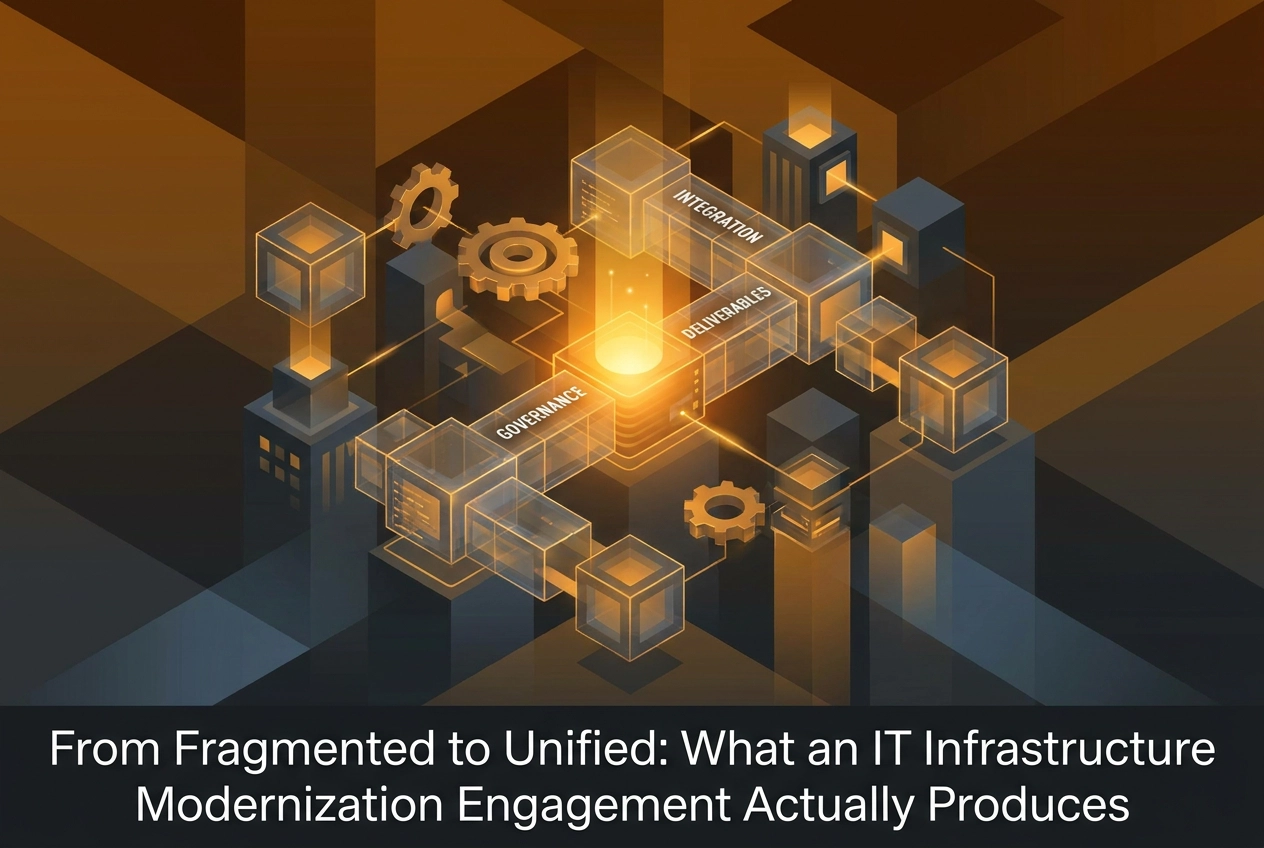
An IT infrastructure modernization engagement is a structured advisory process. It starts with the current-state architecture, identifies where fragmentation creates operational and security risk, and produces three specific deliverables that outlast the engagement. The distinction matters because the deliverables determine what the internal team can actually own and operate independently.
In multi-provider environments, that visibility gap is not a minor inconvenience, it is a breach or compliance failure waiting for a triggering event. Modernization resolves it before that event occurs. This is closely related to the broader case for vendor consolidation as a strategic priority rather than a cost-cutting exercise.
The consulting engagement model also differs fundamentally from managed services. It transfers architecture knowledge and ownership to the internal team rather than creating ongoing dependency on an external provider. When the engagement closes, the organization owns the artifacts, not the firm.
Deliverable One: The Rationalized Vendor Map
The first of those three deliverables is the rationalized vendor map, and it is where every credible modernization engagement begins.
The artifact is not a spreadsheet. It is a structured inventory that maps every active technology vendor, contract, and service touchpoint to three data points: the business function it serves, the internal owner accountable for it, and the contract term governing it. A flat list of vendor names tells you nothing about overlap, accountability, or renewal exposure. A mapped artifact tells you everything.
Rationalization surfaces three specific failure patterns. Redundancy is two vendors performing the same function, typically discovered after an MSP transition where the replacement was added before the predecessor was exited. Gaps are functions with no accountable vendor and no internal owner, the kind that surface as blame exchanges when something breaks. Misalignment is a vendor still under contract for a service the business no longer uses, often a legacy holdover from a department that made a procurement decision three years ago and moved on.
For businesses carrying vendor portfolios across the Philadelphia corridor, including organizations in Exton, Lancaster, Cherry Hill, and Wilmington, finding active vendor relationships with overlapping scopes is common. Organic growth and departmental purchasing decisions accumulate vendor relationships faster than any IT infrastructure strategy can absorb them. 68 percent of IT organizations now plan vendor consolidation specifically because this pattern is widespread, not exceptional.
The output of rationalization is a classification decision on every vendor relationship: retain, renegotiate, consolidate, or exit. That four-option framework replaces the abstract instruction to “reduce vendors” with a prioritized action list. As a hypothetical illustration, rationalizing from dozens of vendors to a focused set can generate six-figure annual savings, the exact figure depends on contract terms and overlap.
Before this deliverable exists, the environment has no defined boundary, and that ambiguity delays every remediation conversation that follows.
Deliverable Two: The Prioritized Remediation Roadmap
The next question after classification is sequence. The remediation roadmap answers that question with specificity.
The roadmap structures actions across three horizons: immediate (0 to 60 days), near-term (60 to 180 days), and strategic (180 days to 12 months). This phasing is not arbitrary. It reflects a deliberate prioritization logic that is risk-weighted, not effort-weighted. Actions that close security posture gaps or resolve unowned compliance obligations move first, regardless of complexity. Cost reduction and operational simplification follow once accountability is established.
This distinction matters because the natural instinct of most teams is to start with what is easiest to fix. A risk-weighted sequence forces the harder, higher-stakes items to the front of the queue, which is where they belong.
Each roadmap item is built around four components: the responsible internal owner, the vendor or tool in scope, the expected outcome, and the success criteria. That structure is what separates a remediation roadmap from the assessments many businesses have already received. Most assessments diagnose fragmentation accurately but stop there. They identify what is broken without prescribing when to fix it, in what order, or who is responsible.
The roadmap is designed to be operated internally from day one. Documentation standards, owner assignments, and review cadences are embedded during the engagement, not handed off as instructions after it closes. The internal team does not need the consulting firm to execute; they need a clear sequence and defined ownership. That is what this deliverable provides.
Deliverable Three: The Governance Model That Prevents Re-Fragmentation
The governance model determines whether the work holds.
Re-fragmentation is the default outcome when modernization stops at documentation. Without a defined process for how future technology decisions get made, vendor sprawl reasserts itself faster than most teams anticipate, through departmental software purchases, MSP scope expansions, and one-off vendor additions that each seem reasonable in isolation but collectively rebuild the problem you just solved.
The governance model addresses this through three operational mechanisms:
- Vendor evaluation framework: Defined criteria and an approval workflow required before any new IT infrastructure provider or tool enters the environment
- Architecture review cadence: A quarterly or semi-annual comparison of the live environment against the rationalized vendor map, to catch drift before it compounds
- Escalation path for exceptions: A structured route for edge cases that need stakeholder sign-off, rather than defaulting to “just add the vendor”
This is not bureaucracy. It is the mechanism that gives internal teams standing to say no. Without it, every vendor addition is a reflex decision with no accountability structure to slow it down.
For lean IT teams across Lancaster, Reading, and the broader Philadelphia region, the governance model is designed to be operationally light: one-page approval workflows, named review owners, and documentation templates maintainable without dedicated staff. Organizations that want executive-level oversight embedded in the process can align this cadence with a part-time technology leader’s decision-making role and governance responsibilities.
This deliverable is what separates a modernization engagement from a consulting report. A report recommends. The governance model operates.
How Internal Teams Take Ownership After the Engagement Closes
A governance model only holds if the team behind it understands why it was built that way. That is why internal enablement is structured into the engagement itself, not offered as a follow-on service once the deliverables are signed off.
Documentation standards are established during the engagement, not after it. Every new vendor, configuration change, or tool addition gets recorded against a defined format, producing a living architecture record the internal team maintains going forward. The architecture does not freeze at handoff; it stays current because the process for updating it is already in place.
Handoff sessions cover reasoning, not just artifacts. The internal team learns why specific vendors were consolidated, which risks drove the sequencing in the remediation roadmap, and how the governance model handles edge cases that do not fit a standard approval workflow. That context is what allows the team to make confident decisions after the engagement closes, without calling back for guidance.
This is the core distinction between a modernization engagement and a managed service arrangement built around ongoing external dependency. For mid-sized businesses in Cherry Hill, Wilmington, and Exton that do not carry a dedicated enterprise architect on staff, this matters practically. The engagement installs an architecture function without adding headcount. What the existing team receives is a set of documented processes and defined decision rights they can execute with the staff already in place.
What to Expect: A Realistic Engagement Timeline
Knowing what the internal team will own after an engagement closes is one question. Knowing when they will own it is the other.
The engagement runs in three phases, based on Orloff Phillips’ engagement experience. Phase one, the current-state assessment, is the most time-intensive phase. This is where vendor inventory is completed, architecture is documented, accountability is mapped, and fragmentation risk is identified by category. The environment rarely documents itself cleanly.
Phase two, deliverable production, follows. The rationalized vendor map is finalized, the remediation roadmap is sequenced with owner assignments, and the governance model is drafted and reviewed with internal stakeholders. No deliverable is handed over without internal review baked in.
Phase three, the internal enablement handoff, is the shortest phase. Documentation transfers, governance workflows activate, the first architecture review gets scheduled, and internal owners are confirmed for every roadmap item. The engagement does not close until ownership is confirmed, not just assumed.
For organizations carrying a typical mid-market vendor portfolio, those phases produce three durable, operational deliverables rather than an assessment report that loses relevance before the next budget cycle.
That timeline matters practically. Business leaders across the Philadelphia and Delaware Valley region, including those in Lancaster, Reading, and Cherry Hill, can align the engagement start to budget approval windows, upcoming compliance reviews, or MSP contract renewal dates. This is what separates a planned modernization from one that stalls waiting for the right moment that never arrives.
Turning a Modernization Conversation Into a Concrete Outcome
Knowing the timeline is only useful if you know what you are building toward. Those three deliverables, vendor map, remediation roadmap, governance model, are the concrete standard against which any modernization proposal should be evaluated.
For businesses in Philadelphia, Wilmington, Exton, Cherry Hill, Lancaster, and Reading carrying fragmented vendor portfolios, any modernization proposal that cannot identify them by name, assign internal owners to each, and describe how they survive the engagement closing is describing something other than modernization.
The most clarifying question to put to any IT infrastructure provider before signing anything is direct: what specifically will we own at the end of this engagement, and what prevents us from repeating this conversation in 24 months? Vague answers reveal vague engagements. A governance model that operationalizes future vendor decisions is the only mechanism that breaks the re-fragmentation cycle.
Orloff Phillips structures every infrastructure modernization engagement around exactly these three deliverables. The starting point is a current-state conversation, not a sales cycle. If your environment is fragmented and the cost of that fragmentation is becoming visible in your operations, security posture, or compliance obligations, that conversation is the right next step.
Conclusion
IT infrastructure fragmentation does not resolve itself. It compounds. For organizations in the Philadelphia region carrying the operational, security, and compliance costs of a fragmented environment, the path forward begins with a single honest question: what will we own when this engagement closes?
If you are ready to answer that question with something concrete, the current-state conversation is the right place to start. That conversation is where clarity begins.

Leave a Reply