
Most organizations assume that world-class technology leadership comes with a world-class price tag. That assumption leads to one of two costly mistakes: either overpaying for a full-time CTO your business doesn’t yet need, or leaving a critical strategic gap that quietly undermines your growth. A fractional CTO is a third path, one that delivers genuine C-suite expertise on a part-time or contract basis. This guide breaks down what a fractional CTO actually does, how they compare to full-time counterparts, when the model makes the most sense, and how to get maximum value from the engagement.
Table of Contents
- Defining a fractional CTO and their core responsibilities
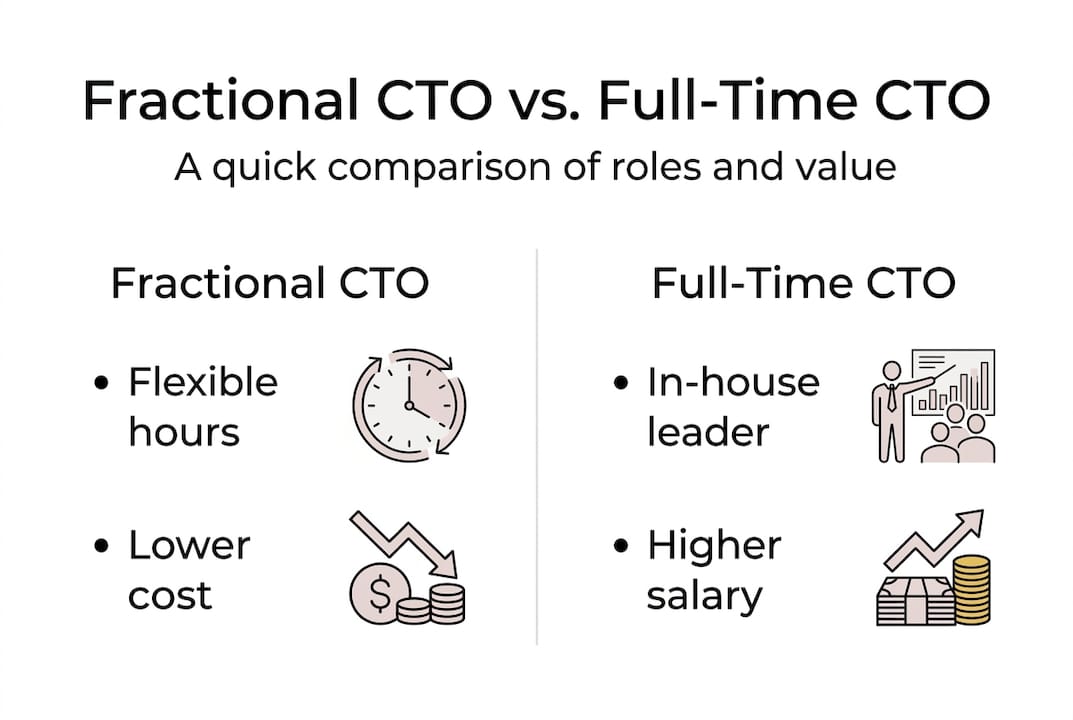
- Fractional CTO vs. full-time CTO: Key differences and use cases
- When and why organizations choose fractional CTOs
- How to engage and maximize value from a fractional CTO
- Our perspective: Why the traditional CTO role is evolving
- Explore fractional CTO solutions for your business
- Frequently asked questions
Key Takeaways
| Point | Details |
|---|---|
| Strategic flexibility | Fractional CTOs allow organizations to scale leadership flexibly without full-time cost. |
| Best-fit scenarios | They are ideal for scaling companies, digital transformation, and non-tech founders needing guidance. |
| Hybrid models rising | Many companies blend fractional and full-time CTO engagements as they expand. |
| Smart engagement process | Clear onboarding, deliverables, and KPIs maximize fractional CTO value. |
Defining a fractional CTO and their core responsibilities
Now that you see there are alternatives to full-time tech leadership, let’s clearly define what a fractional CTO is and what they actually do.
A fractional CTO is an experienced technology executive who works with your organization on a part-time or contract basis, typically a few days per week or a set number of hours per month. They are not a consultant who hands you a report and disappears. They are an active strategic leader who sits inside your leadership team, shapes your technology roadmap, and ensures your tech investments align directly with your business goals.
The core responsibilities of a fractional CTO typically include:
- Developing and owning the technology strategy aligned to business objectives
- Overseeing digital transformation initiatives and vendor relationships
- Evaluating and managing technology teams, including hiring and mentoring technical leads
- Aligning IT infrastructure and architecture decisions with long-term growth plans
- Advising the CEO and board on technology risk, cybersecurity posture, and innovation opportunities
- Managing budgets and technology spend to ensure ROI on every dollar invested
The key distinction is that a fractional CTO delivers strategic value, not daily hands-on engineering. They are most effective when your organization needs direction, not just execution. As one industry analysis notes, fractional CTOs are ideal for strategic guidance, especially for non-technical founders or scaling tech teams.
This model fits naturally within the broader landscape of fractional executive roles, where organizations access senior-level expertise across finance, operations, and technology without the overhead of full-time employment.
“The fractional model isn’t about getting less leadership. It’s about getting the right leadership at the right scale for where your business actually is.”
Pro Tip: Pair your fractional CTO with strong technical leads who can handle daily operations. The fractional CTO sets the direction; your internal team executes it. That combination is often more effective than a single full-time hire trying to do both.
Fractional CTO vs. full-time CTO: Key differences and use cases
With the definition in hand, organizations often wonder: is a fractional CTO enough, or do you need a full-time leader? Here’s a clear comparison.
The answer depends on your organization’s size, complexity, and growth stage. Both models have distinct strengths, and choosing the wrong one is an expensive mistake in either direction.
| Factor | Fractional CTO | Full-Time CTO |
|---|---|---|
| Engagement | Part-time, contract-based | Full-time employee |
| Cost | $5,000 to $20,000/month | $200,000 to $400,000+/year |
| Strategic focus | High | High |
| Daily team management | Limited | Extensive |
| Best org size | Under 15 engineers, $1M to $20M revenue | 15+ engineers, complex systems |
| Ideal use case | Transformation, advisory, scaling | Hypergrowth, core-tech platforms |
The data is clear: organizations under 15 engineers with $1M to $20M in revenue are typically best served by a fractional CTO, while larger, hypergrowth, or core-tech companies need a full-time leader.
Here are the top scenarios where each model excels:
- Fractional CTO fits best when you’re launching a new product, undergoing a technology overhaul, or bridging a leadership gap between hires.
- Full-time CTO fits best when you have a large engineering organization, continuous platform development, or significant technology-dependent revenue.
- Hybrid models are growing fast, where a fractional CTO handles strategy while internal leads manage execution. Our technology consulting experts see this hybrid approach increasingly adopted by mid-sized organizations navigating transitions.
- Transitional periods often benefit from hybrid CTO-consulting roles that blend strategic oversight with network-driven problem solving.
One important insight: many organizations default to hiring a full-time CTO because it feels like the “serious” choice. But for a company at $5M in revenue with eight engineers, that decision can burn $300,000 annually on a role that only needs 20% of a person’s time.
When and why organizations choose fractional CTOs
Beyond the basic differences, understanding the right timing and business reasons can help you decide if a fractional CTO makes sense for your organization.
Certain business moments almost always signal the need for fractional technology leadership. Recognizing them early saves money and prevents costly missteps.
Common triggers that lead organizations to engage a fractional CTO:
- Rapid growth that outpaces your current technical infrastructure
- A non-technical founding or leadership team that needs a trusted technology voice
- A major system migration, platform upgrade, or cloud transition on the horizon
- Budget constraints that make a full-time CTO hire unrealistic right now
- A gap between CTO departures and new hires that can’t be left unmanaged
| Business stage | Recommended tech leadership model |
|---|---|
| Early-stage startup (pre-revenue) | Technical co-founder or part-time advisor |
| Growth stage ($1M to $20M revenue) | Fractional CTO |
| Scaling ($20M to $100M revenue) | Fractional CTO with strong internal leads or hybrid |
| Enterprise ($100M+ revenue) | Full-time CTO with full leadership team |
| Digital transformation project | Fractional CTO or specialized consultant |
The budget flexibility and strategic guidance that fractional CTOs provide make them especially valuable for non-technical founders and companies in active scaling phases.

One often-overlooked trigger is geographic expansion. Organizations scaling across time zones face unique technology coordination challenges that a fractional CTO with distributed team experience can navigate quickly. Similarly, companies pursuing new revenue lines or market pivots benefit from the kind of objective strategic counsel that a fractional CTO brings, without the internal politics that sometimes cloud judgment in full-time roles.
For organizations exploring how technology leadership connects to broader business growth, unlocking business potential requires aligning every function, including technology, with long-term strategic intent.
Pro Tip: Before engaging a fractional CTO, define three to five specific KPIs you want them to move within the first 90 days. Clear metrics and a regular communication rhythm, weekly check-ins plus monthly leadership reviews, dramatically increase the return on this engagement.
How to engage and maximize value from a fractional CTO
Once you decide on a fractional CTO, it’s important to ensure a smooth onboarding and ongoing value. Here’s how to do it right.
The engagement structure matters as much as the person you hire. A brilliant fractional CTO working without clear scope will underdeliver. A good one with a well-structured engagement will exceed expectations.
- Align leadership expectations first. Before the first day, your CEO, COO, and board should agree on what success looks like. Misaligned expectations at the top create confusion for the fractional CTO and your team.
- Define scope and deliverables. Agree on specific outcomes: a technology roadmap, a vendor evaluation, a security audit, a hiring plan. Vague mandates produce vague results.
- Conduct structured interviews. Ask candidates about specific transformation projects they’ve led, how they’ve managed technical debt, and how they communicate complex issues to non-technical stakeholders. Always check references from similar-sized organizations.
- Onboard them into your business context. Share your financials, your product roadmap, your team structure, and your biggest pain points. The faster they understand your business, the faster they add value.
- Build in regular evaluation checkpoints. Review progress at 30, 60, and 90 days. Adjust scope as needed.
- Leverage hybrid structures. Pair your fractional CTO with internal technical leads who own daily execution. This is where remote collaboration best practices become critical, especially for distributed teams.
As the industry trend confirms, hybrid CTO roles combining strategic guidance and part-time operational oversight are increasingly common and increasingly effective.
“Role clarity isn’t just good management hygiene. For a fractional CTO, it’s the single biggest factor separating transformative engagements from disappointing ones.”
For organizations focused on technology resilience and security alongside strategy, pairing fractional leadership with smart IT deployment frameworks ensures that strategic decisions translate into secure, scalable infrastructure.
Our perspective: Why the traditional CTO role is evolving
Having explored the details, here’s our candid view on what this shift means for digital leadership.
The traditional full-time CTO model was built for a different era, one where technology was a single, monolithic department rather than the connective tissue running through every business function. That model assumes you need one person, fully embedded, managing everything from server infrastructure to product vision. For most mid-sized organizations, that’s simply not how technology works anymore.
What most guides miss is this: the fractional model doesn’t just save money. It gives you access to expertise that would otherwise be completely out of reach. A seasoned CTO with 20 years of experience leading enterprise transformations doesn’t come cheap as a full-time hire. But as a fractional leader, their knowledge becomes accessible.
The uncomfortable truth is that many organizations hire full-time CTOs out of habit or optics, not genuine need. They want the title on the org chart. But a fractional CTO who’s deeply aligned with your goals will outperform a full-time hire who’s coasting in a role that doesn’t fully challenge them.
Our fractional executive insights consistently show that the organizations getting the most from this model are the ones who evaluate their true business needs rather than defaulting to industry norms. That’s the mindset shift that separates smart growth from expensive imitation.
Explore fractional CTO solutions for your business
If the case for flexible technology leadership resonates with you, the next step is finding the right partner to make it real.
At Orloff Phillips, we offer tailored fractional executive services designed specifically for mid-sized to large organizations that need strategic technology leadership without the full-time overhead. Whether you’re navigating a digital transformation, building out your IT roadmap, or bridging a leadership gap, our experienced fractional CTOs bring the clarity and direction your organization needs. Ready to explore what’s possible? Connect with our team to schedule a consultation and discuss how we can align technology strategy with your business goals.
Frequently asked questions
What does a fractional CTO do that an interim or outsourced CTO does not?
A fractional CTO provides long-term strategic guidance and business alignment on an ongoing basis, while interim CTOs fill urgent short-term gaps and outsourced CTOs focus narrowly on project delivery.
How many hours per month does a fractional CTO typically provide?
Most fractional CTOs work between 20 and 80 hours monthly, with the exact commitment shaped by your organization’s scope, complexity, and specific engagement terms.
How much does a fractional CTO typically cost compared to a full-time CTO?
Fractional CTOs can reduce leadership costs by 50 to 70 percent compared to a full-time hire, making senior technology leadership financially viable for organizations that couldn’t otherwise afford it.
Can a fractional CTO manage software development teams directly?
In smaller organizations, yes; for larger teams, a fractional CTO focuses on strategy and light management while daily team oversight stays with internal technical leads.
Leave a Reply