Author: Faizur Khan

  • Business transformation checklist for lasting results

    Business transformation checklist for lasting results

    Transformation initiatives are under intense pressure from the moment they launch. Executives are expected to deliver measurable results quickly, yet transformation success rates follow a phased framework: Assess/Define, Build Foundation, Engage Organization, Design Future State, Pilot/Validate, Implement, and Sustain. The problem is that most organizations skip steps, underinvest in people, and rush toward technology solutions before redesigning the processes those tools are meant to support. This article gives you a complete, evidence-backed checklist built around that seven-phase structure, so your transformation initiative moves from a good idea on paper to measurable, lasting change in the organization.

    Table of Contents

    Key Takeaways

    PointDetails
    Phased framework is criticalFollowing a structured seven-phase approach increases the odds of transformation success.
    Executive leadership mattersC-level sponsorship and dedicated teams are proven to reduce failure rates.
    Technology follows processRedesign business processes before adopting new technology solutions.
    Communication drives adoptionRepeating key transformation messages throughout the organization ensures alignment.
    Ongoing measurement sustains changeContinuous tracking and governance help transformation efforts stick for the long term.

    Understand the seven phases of business transformation

    Every successful transformation follows a recognizable structure, even when the specific details differ by industry or company size. Understanding the business transformation steps before you launch prevents the most costly mistakes, including starting implementation before your foundation is solid.

    According to the 7-phase framework, the typical sequence and timeline looks like this:

    PhaseFocus areaTypical duration
    1. AssessDiagnose current state, define scope1 to 2 months
    2. Build foundationTeam structure, governance, budget2 to 3 months
    3. Engage organizationCommunication, resistance managementOngoing
    4. Design future stateProcess, technology, org design2 to 4 months
    5. Pilot and validateTest in controlled conditions1 to 3 months
    6. ImplementScaled rollout3 to 6 months
    7. SustainMeasurement, governance, adaptationOngoing

    The sequence matters more than most leaders assume. Skipping from assessment directly to implementation, for example, is one of the most common and expensive errors you can make. It leaves the team without governance, the organization without buy-in, and the technology without a redesigned process to support.

    Here is why each phase earns its place:

    • Assess surfaces gaps you did not know existed and frames the transformation scope accurately.
    • Build foundation ensures that the right people, budget, and accountability structures are locked in before work begins.
    • Engage organization reduces the resistance that will otherwise slow everything down mid-initiative.
    • Design future state aligns process, people, and technology in the right order.
    • Pilot and validate lets you catch flawed assumptions before scaling them.
    • Implement is where validated designs go live across the organization.
    • Sustain is where most transformations quietly fail because governance stops and momentum fades.

    Statistic to know: Research consistently shows that over 70% of transformation initiatives do not achieve their stated objectives, and the primary culprit is skipping or compressing phases rather than lack of budget or ambition. Treating transformation as a project with a defined end date rather than a phased journey is a fundamental strategic error.

    Checklist step one: Defining vision and assessing readiness

    Once you understand the phased structure, your first actionable work is establishing why you are transforming, what success looks like, and whether the organization has the leadership commitment to see it through.

    This is where most transformations get into trouble before they even start. Vision statements get written by committees and end up too vague to guide decisions. Leadership alignment is assumed rather than tested. Sponsorship gets assigned to a senior VP instead of the CEO, and the initiative loses altitude before it gains speed.

    Your readiness checklist for this phase should include:

    1. Define a specific, measurable transformation vision that the CEO can articulate in one sentence.
    2. Conduct an honest leadership alignment assessment. Do your top ten leaders agree on the priority and the pace?
    3. Identify and confirm a CEO champion for executive advisory in transformation who has visible, active authority over the initiative.
    4. Form a steering committee with real decision-making power and a defined meeting cadence.
    5. Build a RACI matrix (Responsible, Accountable, Consulted, Informed) that covers every critical workstream.
    6. Draft an initial communication plan that addresses why now and what this means for each audience.
    7. Set baseline metrics so you can measure movement from the very beginning.

    The leadership commitment requirements are non-negotiable: a CEO champion, a dedicated transformation team, a functioning steering committee, and a RACI matrix. These are not bureaucratic formalities. They are the structural prerequisites for every other phase.

    Pro Tip: If your CEO will not champion the transformation personally, do not start. A lower-level sponsor signals to the organization that the initiative is optional, and resistance will multiply at every level below the sponsor.

    Statistic to know: Transformation initiatives with active CEO sponsorship are significantly more likely to hit their targets than those with delegated sponsorship. The behavior of the top leader sets the cultural permission for everyone else to change.

    Checklist step two: Building high-impact transformation infrastructure

    With vision and readiness addressed, you’ll need the right people, structure, and resourcing to turn plans into action. This phase is where most mid-sized organizations underinvest because it feels like overhead rather than progress. It is not.

    Transformation team meeting with project roadmap

    Your transformation team is not a side project for people with other jobs. A dedicated full-time team with 10 to 15 percent budget allocation is the standard for initiatives that deliver results. The core roles look like this:

    RoleReports toPrimary accountability
    Transformation leaderCEO directlyOverall initiative ownership
    Program managerTransformation leaderWorkstream coordination, timelines
    Change management leadTransformation leaderCommunication, resistance, adoption
    Workstream leadsProgram managerDomain-specific execution
    Technology advisorTransformation leaderArchitecture and vendor alignment

    Compare two common approaches to transformation staffing:

    ApproachTeam structureTypical outcome
    Part-time, shared resourcesPeople split between BAU and transformationSlower pace, constant context-switching, missed milestones
    Dedicated, full-time teamCommitted solely to transformation goalsFaster execution, clearer accountability, higher success rates

    The evidence firmly favors dedicated resources. When people have competing priorities, transformation work loses to day-to-day pressure every single time. Technology consulting for growth situations frequently reveals that organizations which invested in proper team infrastructure recovered that investment many times over in reduced rework and timeline compression.

    Your infrastructure checklist for this phase should include:

    • Assign each core role and confirm availability in writing.
    • Lock budget before any workstream begins (not on a rolling promise basis).
    • Establish a feedback mechanism so frontline employees can surface issues before they become blockers.
    • Define governance meeting frequency: weekly for the program team, bi-weekly for the steering committee.
    • Document escalation paths so decisions do not bottleneck at mid-management.

    On communication: the seven-times repetition standard is not a figure of speech. Research on organizational change consistently shows that employees need to hear a message across multiple channels, in multiple formats, approximately seven times before they internalize it. This means your communication plan cannot be a single town hall followed by an email update. It requires a multi-channel strategy across email, team meetings, internal platforms, leadership roundtables, and direct manager conversations.

    The value of business consultants becomes most apparent in this phase, where external advisors bring governance models and communication frameworks that organizations have rarely built internally.

    Pro Tip: Build your communication calendar before your implementation calendar. If employees hear about changes after they happen rather than before, you will spend more time managing damage than driving progress.

    Checklist step three: Engaging the organization and redesigning for the future

    With foundational infrastructure in place, the real work begins: mobilizing your organization and designing sustainable improvements.

    Engagement is not a soft activity. It is the mechanism that determines whether your new processes will actually be followed after launch, or whether the organization will quietly revert to familiar patterns within 90 days. Most initiatives that look successful at go-live unravel within six months because engagement was treated as a communications exercise rather than a structural discipline.

    Your engagement and design checklist should include:

    • Map stakeholder groups by their level of impact and their level of resistance.
    • Involve frontline staff in process mapping sessions, not just managers. They know where the actual friction lives.
    • Create a formal resistance management plan with named owners for each high-risk stakeholder group.
    • Establish two-way communication channels where employees can ask questions and get real answers.
    • Redesign processes before selecting or configuring technology. This sequence is critical.

    “Design the future state for processes, technology, and organizational structure in that order. Automating a broken process with new technology only produces broken results faster.” — Business Transformation Strategy Guide

    The instruction to engage the organization through communication and resistance management, then design the future state, then pilot and validate, is a sequence that cannot be reversed without paying a heavy price. Technology is an enabler of redesigned processes. It is not a replacement for process thinking.

    After process redesign is complete, pilot and validate your new model in a controlled setting. Choose a business unit or geography that is representative but not mission-critical. Define success criteria before the pilot starts, not after. Collect structured feedback, measure against your baseline, and document what needs adjustment before you scale.

    Remote collaboration best practices are increasingly relevant here, since many transformation pilots now involve distributed teams who need structured tools and protocols to participate meaningfully in design and feedback sessions.

    Checklist step four: Implement, sustain, and measure transformation

    After piloting and validating the new approach, it’s crucial to execute broadly and embed the changes for ongoing results. Implementation at scale is where all of your prior investment pays off or falls apart.

    Your implementation checklist should follow this sequence:

    1. Apply pilot learnings to update your playbook before the broader rollout begins.
    2. Execute in defined waves rather than a single big-bang launch to reduce risk.
    3. Assign a dedicated support function for the first 90 days post-launch to address issues in real time.
    4. Activate your measurement framework from day one of implementation.
    5. Schedule a formal 30, 60, and 90-day review against your KPIs (Key Performance Indicators).

    For sustainability, dashboards, feedback loops, and ongoing governance are the tools that keep transformation alive after the initiative team disbands. Without them, organizations celebrate go-live as the finish line and stop the structured attention that sustains results.

    Here is a practical measurement framework for the sustain phase:

    Metric categoryExample KPIsReview frequency
    Operational efficiencyProcess cycle time, error ratesWeekly
    Financial performanceCost per transaction, revenue impactMonthly
    Employee adoptionTool usage rates, training completionBi-weekly
    Customer impactSatisfaction scores, resolution timeMonthly
    Governance healthIssue resolution time, escalation rateWeekly

    The steps for sustainable growth require that you treat sustain as a permanent operating mode, not a temporary phase. Governance meetings should continue on a defined cadence, KPIs should be reviewed with the same rigor applied during implementation, and course corrections should happen based on data rather than instinct.

    Pro Tip: Build a “benefits realization report” into your quarterly business review cycle for at least two years after implementation. This keeps leadership attention on whether the transformation is delivering what was promised, and it creates accountability for sustaining the gains.

    Why most transformation checklists fall short: our hard-won lessons

    Here is the uncomfortable reality we have observed across dozens of transformation engagements: most leadership teams treat checklists as a linear exercise to be completed and filed, rather than as a living framework that demands constant adaptation as conditions change.

    The seven-phase model described here is correct in its structure. But real transformations are not clean or sequential. External market shifts, leadership changes, budget pressures, and technology failures all create deviations from the plan. The organizations that succeed are not the ones that followed the checklist perfectly. They are the ones that used the checklist as a forcing function while staying relentlessly adaptive.

    Executive over-communication is the element that gets underestimated most consistently. Leaders tell us after failed initiatives that they communicated clearly and often. Employees at those same organizations report hearing almost nothing meaningful until problems were already visible. The gap is real and it is almost always larger than leadership believes.

    Measurement is where commitment gets tested. Early in an initiative, everyone agrees that KPIs matter. By month four, governance meetings get shorter, dashboards get fewer viewers, and the initiative quietly loses its grip on executive attention. The organizations that sustain transformation are those that institutionalize measurement as a non-negotiable leadership discipline, not a reporting formality.

    And on the technology question: we will say this plainly. Installing new software into an unredesigned process is one of the most expensive mistakes a business can make. We have seen it happen in ERP implementations, CRM rollouts, and workflow automation projects. The technology consulting insights consistently point to the same root cause: the organization was excited about the tool and impatient with the process work. The result is always a system that the team works around rather than with.

    The checklist is not a bureaucratic exercise. It is the discipline that separates transformations that stick from those that cost a great deal and change very little.

    Partner for transformation success with Orloff Phillips

    Business transformation at scale is not something most leadership teams navigate well without experienced outside perspective. The frameworks are learnable, but the judgment required to adapt them under real organizational pressure takes years to develop.
    https://orloffphillips.com

    Orloff Phillips specializes in exactly this kind of strategic partnership. Whether your organization needs technology strategy essentials to sharpen your digital direction, or a proven partner to guide you through each phase of your business transformation solutions journey, our fractional executive services are built to accelerate your results without the cost of a full-time C-suite hire. Our advisors bring hands-on experience across governance design, technology roadmapping, and change leadership, giving your team the expert guidance needed to execute confidently and sustain the gains your organization worked hard to achieve.

    Frequently asked questions

    What are the most common reasons business transformations fail?

    Most failures stem from weak executive commitment, lack of dedicated full-time teams, and introducing technology before redesigning processes. Prioritizing executive sponsorship early and integrating technology only after process redesign are two of the most impactful corrections organizations can make.

    How much should companies budget for effective business transformation?

    Successful transformations allocate 10 to 15 percent of their total project budget to a dedicated transformation team, treating that investment as essential infrastructure rather than overhead.

    How do you ensure organization-wide adoption of transformation initiatives?

    Best practice requires over-communication with seven-times repetition across multiple channels, combined with involving frontline employees in design sessions so they have ownership rather than just awareness.

    When should technology be introduced during transformation?

    Integrate technology after process redesign is complete, not before. Deploying technology into an unredesigned process automates existing problems rather than eliminating them.


  • Advisory services that drive executive transformation success

    Advisory services that drive executive transformation success

    Most digital transformation initiatives are built on a false premise: that deploying the right technology and allocating sufficient budget is enough to guarantee results. The data says otherwise. Research benchmarks show that 70 to 75 percent of transformation programs fail due to poor strategic alignment and inadequate change management, while Bain estimates that 88 percent miss their original ambitions entirely. The gap between execution and outcome is not a technology problem. It is a leadership and strategy problem, and it is precisely where advisory services deliver their most measurable value.

    Table of Contents

    Key Takeaways

    PointDetails
    High failure ratesMost digital transformations fail without expert advisory, mainly due to poor alignment and weak execution.
    Advisor impactAdvisory services double the chance of success by bridging strategy, leadership, and change management gaps.
    Modern modelsAI is shifting advisory services toward outcome-based and tech-enabled approaches, but insight and judgment remain critical.
    Overcoming obstaclesLegacy complexity and resistance require targeted advisory engagement for effective transformation.
    Collaborative valueThe best results come when advisors spark internal alignment and adaptive action, not just deliver playbooks.

    Why transformation fails without advisory services

    Well-resourced organizations fail at transformation every day. They hire talented people, invest in enterprise platforms, and announce ambitious roadmaps. Then, 18 months later, adoption is low, costs have ballooned, and the original business case has quietly been shelved. The problem is rarely a lack of effort. It is a lack of the structured, external perspective that keeps execution aligned with strategy over time.

    The numbers are sobering. Failure rates across transformations consistently sit between 70 and 88 percent across studies from BCG, McKinsey, and Bain. Only about 30 percent of organizations report genuine success. Firms that engage structured advisory support, however, see their odds of success improve by 1.5 to 2 times compared to those going it alone. That is not a marginal improvement. It is the difference between a transformation that reshapes a business and one that burns through capital with little to show for it.

    The failure points tend to cluster around three recurring issues:

    • Strategic misalignment: Business leaders and technology teams pursue different definitions of success, often without realizing it until resources are already committed.
    • Weak change management: People resist disruption, and without a structured approach to communication, training, and leadership engagement, adoption collapses.
    • Unrealistic goals: Executives set targets that ignore organizational capacity, technical debt, or market conditions, and there is no one in the room empowered to push back.
    Failure factorOrganizations affectedPrimary consequence
    Poor strategic alignment70%+ of failed initiativesMisallocated investment
    Inadequate change management55-60% of breakdownsLow adoption rates
    Unrealistic scope/goalsMajority of budget overrunsMissed ROI timelines
    Lack of external perspectivePervasive across industriesBlind spots in execution

    “The most dangerous assumption in transformation is that internal teams can objectively assess their own blind spots. They rarely can.”

    This is where consulting expertise in change management becomes essential. External advisors bring a critical detachment that internal teams cannot replicate. They have seen what works across dozens of industries and can recognize failure patterns early enough to correct them. The advisory value in digital growth is not about importing answers. It is about asking better questions faster than an internal team ever could.

    Consultant gives feedback to executive

    The hidden cost of skipping advisory is not just a failed project. It is the organizational cynicism that follows, where staff become resistant to future initiatives and leadership credibility takes a hit that can last for years.

    Core roles advisory services play in successful transformation

    Knowing that advisory services improve outcomes is one thing. Understanding precisely how they do it is what allows you to select the right partner and structure the engagement for maximum impact. Expert advisors are not consultants who hand over a report and disappear. The best engagements are hands-on, iterative, and deeply integrated with your leadership team.

    Here are the four core roles that expert advisors play across a successful transformation lifecycle:

    1. Diagnostic analysis of operations and culture. Before recommending anything, a strong advisor maps your current state in detail. That means assessing not only technology infrastructure but also decision-making processes, cultural norms, and the informal power structures that often determine whether change succeeds or stalls. The diagnostic phase is where advisors surface the issues that internal teams have normalized and stopped seeing.

    2. Creating and stress-testing transformation strategy. Advisors develop strategy in collaboration with your leadership team, but they add a discipline that internal teams often skip: stress testing. That means modeling failure scenarios, pressure-testing assumptions, and building contingency into the roadmap before a single dollar is deployed. Following transformation steps for sustainable growth requires this kind of structured rigor.

    3. Driving stakeholder alignment and engagement. One of the most underestimated transformation challenges is keeping executives, department heads, and front-line managers aligned across a multi-year effort. Advisors establish governance structures, facilitate alignment workshops, and maintain accountability between leadership layers. They act as a neutral party in conversations where internal politics would otherwise derail progress.

    4. Change management and execution support. Strategy without execution is theory. Advisors bring tested frameworks for managing the human side of change: communication plans, adoption metrics, training programs, and feedback loops. This is the discipline that most internal teams lack and most transformation initiatives underinvest in.

    Pro Tip: Secure small, visible wins in the first 90 days of any transformation engagement. Early momentum shifts organizational culture faster than any mandate from the top. Your advisory team should help you identify and prioritize these wins as part of their initial planning.

    The math reinforces all of this. With structured advisory support, transformation success odds improve by 1.5 to 2 times. That improvement is not accidental. It reflects the compounding value of experienced judgment applied at each critical decision point, from day one through final adoption. Strong IT strategy essentials are a core part of what experienced advisors bring, especially in environments where technology is both the vehicle and the primary obstacle.

    Common obstacles: Complexity, legacy systems, and cultural resistance

    Even organizations with strong advisory support hit walls. The obstacles that derail mid-sized and large organizations are not the same ones that trip up startups. They are deeper, stickier, and often invisible to leadership until the damage is already done.

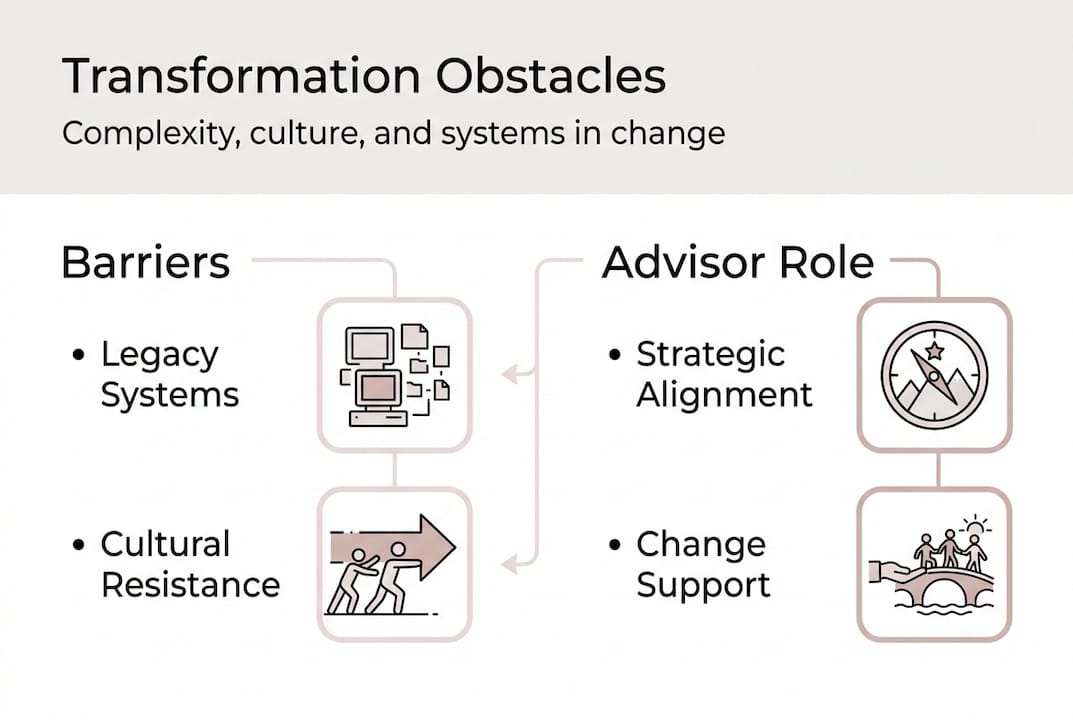
    Legacy system complexity is one of the most persistent barriers. Many mid-sized firms inherited patchwork IT environments across years of mergers, acquisitions, and vendor transitions. These systems are not simply outdated. They are deeply embedded in daily operations, often undocumented, and frequently running processes that no one fully understands anymore. Attempting to modernize without advisory oversight in this environment is like renovating a building without reading the structural plans.

    Infographic showing transformation barriers and advisory roles

    Cultural resistance and stakeholder misalignment are equally destructive. Research on transformation breakdowns shows that cultural resistance and executive misalignment account for 55 to 60 percent of program failures. This is not about employees refusing to use new software. It is about deeper organizational behaviors: siloed thinking, risk aversion embedded in middle management, and executives who publicly endorse transformation while privately protecting the status quo.

    Here is where remote collaboration challenges can compound the problem. In distributed or hybrid organizations, misalignment spreads faster and is harder to correct because informal conversations that once bridged gaps simply do not happen at the same frequency.

    ObstacleOrganizations impactedAdvisory intervention
    Legacy system complexityMost mid-sized firmsArchitecture assessment and phased migration
    Cultural resistance55-60% of failuresChange management frameworks and executive coaching
    Stakeholder misalignmentMajority of budget overrunsGovernance structures and facilitated alignment
    AI integration misstepsGrowing rapidly in 2026Process review before automation

    AI integration without advisory oversight is an emerging risk that deserves special attention. Organizations are rushing to automate workflows with AI tools, but integrating AI without process review carries a serious hazard: you end up automating broken processes at scale. The inefficiency does not disappear. It accelerates. Advisors with AI expertise review processes before automation, ensuring that what you scale is genuinely worth scaling.

    When to bring in specialized advisors:

    • When a legacy system migration touches more than two core business functions
    • When executive team alignment on transformation goals is visibly inconsistent
    • When a previous transformation initiative failed or stalled and organizational trust is low
    • When AI adoption is on the roadmap but internal teams lack the technical and process expertise to govern it

    Pro Tip: If you are encountering the same objections from different departments about a transformation initiative, that is not a communication problem. It is a governance problem. An experienced advisor will see this pattern immediately and address root causes rather than symptoms.

    How advisory models are evolving in the era of AI

    The advisory industry itself is undergoing a significant shift, and executives who understand that shift will negotiate better engagements and extract more value from their advisory partners. The traditional model, where firms bill by the hour or by the day for labor-intensive deliverables, is giving way to something more sophisticated.

    “AI shifts advisory from labor-hour billing to outcome-based ‘Service as Software,’ but incumbents struggle to encode judgment and remain vulnerable to domain-focused AI natives.” Consulting’s Fourth Transformation

    This shift has real implications for how you structure advisory contracts. Outcome-based models tie advisory fees to measurable business results rather than hours worked. That alignment of incentives changes the entire dynamic of the engagement. Your advisor is not motivated to extend the project. They are motivated to produce results fast.

    What executive sponsors should look for in a modern advisory partner:

    • Clear outcome metrics defined upfront. If an advisor cannot articulate how their engagement will be measured, that is a red flag.
    • AI fluency without AI obsession. The best advisors understand AI tools and can apply them selectively, but they do not push automation for its own sake.
    • Embedded execution support. The era of the 200-page strategy deck is over. Advisors should be willing to roll up their sleeves and work alongside your teams.
    • Adaptability across engagement length. Some transformations need a two-year advisory relationship. Others need 90-day sprints. Rigidity in engagement structure is a warning sign.
    • Domain-specific expertise. General management consulting is losing ground to advisors who bring deep expertise in specific industries or functional areas like cybersecurity, IT roadmapping, or operational efficiency.

    Questions to ask any advisory provider before signing a contract:

    • Can you show documented outcomes from comparable engagements, not just testimonials?
    • How do you measure and report progress against our transformation goals?
    • What does your change management methodology look like in practice?
    • How are you integrating AI tools into your advisory process, and what governance do you apply?

    Exploring the right technology reset and execution advisory for your organization requires understanding not just what advisors do, but how they prove it. The most capable firms are transparent about their methods, rigorous about measurement, and accountable for outcomes in a way that traditional consulting firms historically avoided.

    The firms that will thrive in the next decade are not the ones that simply deploy advisors faster. They are the ones that combine human judgment with AI-powered analysis to deliver insights at a speed and depth that was not possible five years ago. For executives, that means advisory services that were once reserved for the largest enterprises are now accessible, practical, and measurable for mid-sized organizations too.

    A fresh perspective: What most executives get wrong about advisory value

    Here is an uncomfortable truth: the executives who get the least from advisory engagements are usually the ones who treat advisors as knowledge vendors. They expect the advisor to arrive with a proven playbook, apply it systematically, and hand over a transformed organization on the way out. That is not how lasting change works.

    The real value of advisory is not knowledge transfer. It is catalysis. A great advisor does not import solutions. They create the internal conditions where your own leadership team can solve problems they previously could not see clearly. That distinction matters enormously in practice.

    Off-the-shelf frameworks fail not because the frameworks are wrong, but because they do not account for the specific history, culture, and politics of your organization. A methodology that transformed a financial services firm will not transfer cleanly to a regional healthcare system, even if the surface-level challenges look identical.

    The best transformation outcomes we observe consistently come from collaborative, adaptive engagements where advisors and internal teams co-create solutions. The advisor challenges assumptions, brings external pattern recognition, and holds the organization accountable to its own stated goals. But the leadership team owns the outcome. That sense of ownership is what makes change stick. Exploring the full value that business consultants deliver only makes sense when both sides of the engagement are genuinely committed to that collaborative model.

    Partnering with the right advisory team for lasting impact

    Understanding why transformation fails and what good advisory looks like is necessary, but it does not substitute for experienced partners who can deliver results in the context of your specific organization, industry, and goals.

    https://orloffphillips.com

    At Orloff Phillips, we bring fractional executive leadership and strategic advisory services designed specifically for mid-sized and large U.S. organizations navigating complex transformation. Whether your challenge is a legacy IT environment that is blocking growth, a culture resistant to change, or an AI adoption strategy that lacks governance, our team has the experience to move you from roadmap to results. Our advisory and leadership services are built around measurable outcomes, not billable hours. If you are ready to dramatically improve your odds of transformation success, we would like to be part of that conversation.

    Frequently asked questions

    Why do most transformation projects fail?

    Most projects fail because of poor alignment between business goals and technology execution, combined with weak change management practices. Benchmark research shows that 70 to 88 percent of initiatives miss their targets for these structural reasons rather than technical ones.

    What kind of advisory service has the most impact?

    Services that focus on leadership alignment, cultural change, and strategy execution consistently deliver the highest transformation outcomes. Studies confirm that advisory support with these priorities improves success odds by 1.5 to 2 times versus unguided initiatives.

    How does AI change the value of advisory services?

    AI is shifting advisory toward outcome-based models where results replace hours as the billing metric, but human judgment remains essential for the complex leadership and cultural challenges that no algorithm can yet navigate reliably.

    When should executives engage advisory services in a transformation?

    Executives should bring advisors in at the beginning of a transformation, particularly when dealing with legacy system complexity or visible cultural resistance, because early advisory involvement prevents the compounding errors that become expensive to fix later.

  • Top cybersecurity tips every executive should know

    Top cybersecurity tips every executive should know

    The global average data breach cost reached $4.44 million in 2025, with the US average climbing to $10.22 million per incident. For executives, these numbers represent more than financial loss. They signal reputational damage, regulatory exposure, and the erosion of stakeholder trust built over years. Yet most organizations still treat cybersecurity as a back-office IT problem rather than a board-level priority. This article lays out a structured, actionable framework covering governance, essential controls, testing discipline, and complex emerging threats so you can make better decisions and protect what your organization has built.

    Table of Contents

    Key Takeaways

    PointDetails
    Lead cyber from the topExecutive governance and enterprise risk framing are non-negotiable for true resilience.
    Prioritize core controlsDeploy essential technical controls and robust employee training to block most attacks.
    Validate with testingFrequent tabletop exercises and real-world simulations ensure readiness and expose blind spots.
    Plan for complex threatsAddress OT/IT integration, supply chain risks, and build continuity into all scenarios.
    Leverage AI for savingsAdopting advanced tools like AI can dramatically reduce breach costs and response time.

    Framework for executive cyber governance

    Cybersecurity governance is not a technology issue. It is an enterprise risk issue, and it belongs in the same strategic conversation as financial risk, legal exposure, and operational continuity. When executives treat it as someone else’s problem, they create dangerous blind spots that attackers are very good at finding.

    Executives discuss cyber risk in boardroom meeting

    The first step is establishing clear ownership at the top. That means defining who in your leadership team is accountable for cybersecurity outcomes, not just who manages the security team. Many organizations confuse the two. A CISO managing day-to-day operations is not the same as a board that actively monitors risk posture, approves security investment, and receives regular, meaningful briefings on threat trends.

    Effective executive governance for cybersecurity requires building structure around three pillars:

    • Leadership accountability: The CEO, board, and executive committee must formally own cybersecurity risk, not delegate it entirely downward.
    • Cross-department integration: Legal, HR, finance, and operations all carry cybersecurity responsibilities. Your governance model must include them.
    • Documented risk appetite: You need a written statement of how much risk your organization is willing to accept, and that statement must inform investment decisions.
    • Vendor and supply chain oversight: Third-party risk is now one of the largest attack vectors. Governance must extend beyond your walls.
    • Regular board-level reporting: Security metrics must reach the boardroom in plain language, not buried in technical jargon.

    The NIST Cybersecurity Framework version 2.0 introduced a dedicated Govern function that formalizes exactly this kind of leadership accountability. It covers risk strategy, roles and responsibilities, policy, and supply chain risk management as core elements of an enterprise security posture. Meanwhile, CISA’s CPG Report 2.0 provides a prioritized set of Cross-Sector Cybersecurity Performance Goals aligned with NIST CSF 2.0, giving executives a concrete baseline to measure their governance posture against.

    “Cybersecurity governance done right changes how your entire organization communicates about risk. Leaders stop asking ‘did we get hacked?’ and start asking ‘what’s our current risk exposure and what are we doing about it?’”

    Governance frameworks also improve how you prioritize resources. When leadership has a clear risk register, you can make informed tradeoffs between investing in prevention, detection, or response capabilities. Without that structure, security budgets get allocated reactively based on the last incident rather than the most likely and most costly threats.

    Pro Tip: Schedule a quarterly cybersecurity briefing directly with your board or senior leadership committee. Require the agenda to include current risk ratings, control gaps, and any third-party exposure changes. This one habit signals organizational seriousness and drives accountability faster than any policy document.

    Pairing NIST CSF 2.0 with effective risk mitigation strategies gives your governance model both the structure to operate and the language to communicate risk clearly across stakeholder groups.

    Critical security controls every leader must implement

    Once governance is in place, the next priority is making sure your organization has the foundational security controls that block the majority of attacks. The good news is that most breaches still exploit basic weaknesses, not sophisticated zero-day vulnerabilities. Closing those gaps has an outsized return on investment.

    CISA has distilled four essential cybersecurity practices that every business, regardless of size or sector, should have in place:

    1. Train employees to recognize phishing. Phishing remains the leading entry point for ransomware, business email compromise, and credential theft. Regular, scenario-based training cuts susceptibility rates dramatically. Generic annual awareness videos don’t move the needle. Simulated phishing campaigns with real-time coaching do.
    2. Require strong, unique passwords. Credential stuffing attacks exploit password reuse across platforms. A password manager policy combined with minimum length and complexity requirements eliminates most of this exposure. Require it for every employee, not just those in sensitive roles.
    3. Enforce multifactor authentication (MFA). MFA blocks over 99% of automated account takeover attempts. Prioritize it for email, VPN, cloud platforms, and any system with access to sensitive data. If you have contractors or vendors with system access, require MFA from them too.
    4. Keep software updated consistently. Unpatched vulnerabilities are one of the most common attack paths. Establish a patch management policy with defined timelines, and hold every department accountable for their systems.

    The reality is that many organizations have policies on paper for all four of these, but enforcement is inconsistent. As an executive, your job is to verify compliance, not assume it.

    Here is a practical approach to building effective security training programs that actually change behavior organization-wide:

    • Tie security behavior to performance conversations. When managers discuss it, employees prioritize it.
    • Make training role-specific. Finance teams need training on wire fraud scenarios. HR teams need training on data handling. Generic content loses people’s attention.
    • Use metrics. Track click rates on simulated phishing, patch compliance percentages, and MFA adoption. Report these to leadership quarterly.
    • Celebrate improvement publicly. Positive reinforcement works. Recognize teams with strong security behavior records.

    Pro Tip: Ask your IT or security team to show you the current MFA adoption rate across the organization. In most companies, this number is lower than leadership expects, and even a 10% gap represents thousands of exposed accounts.

    Non-technical staff are not the weak link. They are a critical defense layer when they are equipped and motivated properly. Executives who frame security as a shared organizational responsibility rather than an IT burden get significantly better adoption across the board.

    Regular testing, exercises and breach cost realities

    Having controls in place is not the same as having controls that work. Organizations that skip regular validation of their security posture are operating on assumption, and assumptions get exploited.

    Tabletop exercises (TTX) are structured simulations where leadership and key stakeholders walk through a hypothetical cyber incident to test decision-making, communication, and response capabilities. They do not require technical tools. They require honest conversation, pre-planned scenarios, and willingness to identify gaps. Conducting regular TTX sessions along with TTP (tactics, techniques, and procedures) replays validates your incident response plans before a real attacker does.

    The financial case for testing is clear. Review these breach cost benchmarks:

    MetricValue
    Global average breach cost (2025)$4.44 million
    US average breach cost (2025)$10.22 million
    Savings from AI/automation adoption$1.9 million per breach
    Reduction in breach lifecycle with AI80 days faster detection/containment
    Cost increase for breaches over 200 daysSignificantly higher total cost

    The breach cost data shows that organizations using AI and automation for threat detection and response shortened their breach lifecycle by 80 days and saved an average of $1.9 million per incident. That is not a marginal improvement. That is a structural advantage that compounds over time.

    “Speed is the most underrated factor in breach economics. The faster you detect and contain, the lower your total cost. Testing is how you get faster.”

    For executives, the reporting checklist for incident response preparedness should cover:

    • When was the last full tabletop exercise conducted, and who attended?
    • Does the incident response plan address ransomware, data exfiltration, and third-party breach scenarios separately?
    • How long did detection and containment take in the last real or simulated incident?
    • Are legal, communications, and finance included in breach response planning, or only IT?

    Investing in AI and automation for breach response is one of the highest-return security investments available to executive teams right now. It reduces human latency in detection, accelerates triage, and dramatically compresses the time between initial compromise and containment.

    Pro Tip: Run at least one tabletop exercise per year that deliberately involves your executive team, not just your security staff. The decisions that determine breach cost are made at the executive level, and you cannot practice those decisions if you are never in the room.

    Advanced challenges: OT/IT convergence, supply chain and resilience planning

    Once your foundational controls and testing processes are solid, the next layer of complexity involves three interconnected challenges that are becoming defining issues for executives in 2026.

    OT/IT convergence refers to the integration of Operational Technology (OT), the systems that control physical processes like manufacturing equipment, utilities, and building systems, with Information Technology (IT) networks. When these systems were isolated, a cyberattack on IT had limited physical impact. As they converge, the attack surface expands dramatically, and the consequences shift from data loss to operational disruption and even physical safety risk.

    Risk AreaIT SystemsOT Systems
    Primary assetData and applicationsPhysical processes and equipment
    Breach consequenceData theft, fraudOperational shutdown, safety incidents
    Patching flexibilityHighLow (often legacy and hard to update)
    Recovery speedFasterOften weeks to months
    Governance maturityGenerally higherOften less developed

    The CPG Report 2.0 explicitly addresses OT/IT convergence, noting that unpatched vulnerabilities in converged environments enable compromise at scale, and that IT/OT convergence strategies must be integrated into executive-level security governance.

    Supply chain risk is equally significant. Attackers increasingly target smaller, less-defended vendors as a pathway into larger organizations. A single compromised software vendor or managed service provider can expose dozens of enterprise clients simultaneously. Key executive actions on supply chain include:

    • Require vendors to meet defined security standards before granting system access.
    • Include cybersecurity requirements and audit rights in all vendor contracts.
    • Conduct periodic reviews of third-party access privileges.
    • Establish a process for responding when a vendor reports a breach.

    Strong supply chain risk management practices are no longer optional for organizations with complex vendor ecosystems. They are a baseline expectation from regulators, cyber insurers, and sophisticated enterprise clients.

    On mobile communications, executives handling sensitive strategic information should require end-to-end encrypted (E2EE) communication tools. Standard SMS and many commercial email platforms do not provide adequate protection for board-level conversations.

    For resilience planning, the UK’s National Cyber Security Centre recommends that organizations map critical systems and plan explicitly for continuity under degraded IT/OT conditions. This means identifying which systems, if compromised, would halt operations entirely, and building continuity plans that allow partial or manual operation while recovery proceeds.

    Building organizational resilience at the executive level means accepting that a breach is not a hypothetical. It is a probability. Organizations that plan for degraded operations recover faster, spend less, and protect their reputation more effectively than those that plan only to prevent breaches.

    A leadership perspective: What most executive security advice misses

    Here is the uncomfortable truth that most cybersecurity articles for executives skip over. The organizations that get breached badly are rarely the ones without the right framework. They are the ones where executives checked the governance box and then stopped asking hard questions.

    Cybersecurity compliance is not cybersecurity resilience. You can have every NIST function documented and still be fundamentally unprepared because no one at the leadership level is genuinely curious about the gaps. Real security culture comes from executives who ask questions that make their security teams uncomfortable, not to be difficult, but because that discomfort is where real problems surface.

    The most valuable thing an executive can bring to a security review is not technical knowledge. It is persistent, informed skepticism. Ask your team to show you evidence of controls working, not just documentation that controls exist. Ask what the last real incident or near-miss revealed. Ask what the attacker would find easiest to exploit right now.

    An outside perspective on governance gaps is often what moves organizations from theoretical compliance to actual readiness. Leaders who only hear from internal teams often get filtered information. The willingness to invite external scrutiny is a mark of mature executive leadership.

    How Orloff Phillips empowers executives in cybersecurity strategy

    The frameworks, controls, and testing disciplines covered in this article are only as effective as the leadership driving them. Most mid-sized and large organizations have capable IT teams but lack experienced executive leadership to translate security risk into board-level strategy and accountable decision-making.

    https://orloffphillips.com

    Orloff Phillips provides fractional executive solutions that place experienced technology leaders inside your organization without the cost or timeline of a full-time hire. Whether you need a fractional CTO leadership role to guide your security architecture, or broader technology strategy for executives to align your cybersecurity investment with organizational goals, Orloff Phillips brings the senior-level experience to move your security posture from reactive to strategic. Explore how our advisory model closes the gap between policy and practice.

    Frequently asked questions

    What are the top cybersecurity priorities for executives in 2026?

    Priorities include leadership-driven governance, strong foundational technical controls, regular incident response testing, and addressing OT/IT and supply chain risk using standards like CISA CPGs aligned with NIST CSF 2.0.

    How often should executive teams conduct cybersecurity tabletop exercises?

    Executive teams should conduct TTX sessions at least once per year and after any major organizational change, merger, or significant shift in the threat environment.

    How can AI and automation help executives reduce breach costs?

    Organizations using AI and automation saved $1.9 million per breach and shortened detection and containment timelines by 80 days, making it one of the highest-return security investments available.

    What makes OT/IT convergence a unique cybersecurity challenge?

    OT/IT convergence connects physical operational systems to digital networks, expanding attack surfaces and shifting potential consequences from data loss to operational shutdown, requiring specialized CPG governance beyond standard IT security.

    Why should executives map critical systems and plan for degraded operations?

    Mapping critical systems and building continuity plans ensures your organization can maintain partial operations during a breach, directly reducing recovery time and total breach cost as the NCSC resilience framework recommends.

  • 7 real-world examples of digital transformation wins

    7 real-world examples of digital transformation wins

    Digital transformation is no longer optional for organizations that want to stay competitive. Yet most executives find themselves stuck between vendor promises and vague success stories that offer little they can actually act on. The uncomfortable truth is that 70% of digital transformations fail due to culture and leadership gaps, not technology shortfalls. This article cuts through the noise by presenting seven concrete, data-driven transformation examples across manufacturing, HR, retail, healthcare, and logistics, along with the specific lessons that made each one work so you can apply them directly to your own strategy.

    Table of Contents

    Key Takeaways

    PointDetails
    Clear success criteriaFocus on measurable productivity, scalability, and culture for transformation wins.
    Proven industry casesSuccessful transformations like Siemens and HR/AI pilots prove substantial efficiency gains.
    Phased execution worksFollowing a four-phase roadmap reduces risk and improves long-term outcomes.
    Culture over technologyAddressing leadership and culture gaps is essential for digital strategy success.

    What makes a digital transformation truly successful?

    Before examining real-world examples, it is worth establishing what success actually looks like. Too many organizations launch transformation projects focused on deploying technology and then measure success by whether the tools went live. That is the wrong metric entirely.

    True transformation delivers measurable outcomes across five core dimensions:

    • Productivity gains that are visible in output per employee or throughput per unit of time
    • Operational efficiency reflected in reduced cycle times, error rates, or overhead costs
    • Environmental or sustainability impact, which increasingly matters for regulatory and ESG (Environmental, Social, Governance) reasons
    • Scalability, meaning the transformation can expand across business units or geographies without rebuilding from scratch
    • Innovation capacity, or whether the new infrastructure enables the organization to test and launch new capabilities faster

    Most failed transformations skip at least two of these dimensions, usually scalability and innovation capacity, because leadership focuses on fixing today’s problems rather than building tomorrow’s platform.

    “70% of digital transformations fail due to culture and leadership gaps, not technology shortfalls.” This statistic should be on the wall of every executive steering committee.

    Understanding this failure rate before reviewing the examples matters because it reframes the question. The right question is not “What technology should we buy?” It is “Do we have the leadership alignment, cultural readiness, and iterative feedback mechanisms to sustain change?” When you look at scaling digital solutions across a large organization, these factors often determine the ceiling on how much value you can actually capture.

    Pro Tip: Before committing budget to any transformation initiative, run a 30-day pilot with a defined hypothesis, a measurable success metric, and a clear go/no-go decision point. Pilots that fail fast save organizations millions compared to full-scale deployments that fail slowly.

    Siemens Erlangen: Manufacturing’s digital lighthouse

    Few transformation stories in manufacturing match the scale and rigor of what Siemens accomplished at their Erlangen electronics facility in Germany. The factory deployed a tightly integrated stack of AI-driven analytics, digital twin technology (a real-time virtual replica of physical systems), and advanced robotics across the production floor.

    Supervisor observing digital tools in factory production

    The results speak for themselves. The Siemens Erlangen factory achieved a 69% productivity increase and a 42% reduction in energy consumption, earning recognition as a World Economic Forum (WEF) Digital Lighthouse. That designation is reserved for fewer than 200 factories globally and signals best-in-class Industry 4.0 (the fourth industrial revolution combining physical and digital systems) execution.

    MetricBefore transformationAfter transformation
    Productivity indexBaseline+69%
    Energy consumptionBaseline-42%
    WEF recognitionNoneDigital Lighthouse
    Production flexibilityLowHigh (AI-adaptive)
    New technology rolesMinimalIntegrated at scale

    What made this work beyond the technology itself?

    • Executive vision with clear KPIs set from the top before any system was deployed
    • Integration of new human roles including data scientists and digital twin operators alongside traditional factory workers
    • Phased scalability, with the Erlangen facility serving as a replicable template for other Siemens plants
    • Cross-functional governance ensuring that IT, operations, and finance stayed aligned throughout

    The lesson for mid to large manufacturers is not to copy Siemens’ exact technology stack but to replicate their governance model. Think about how Siemens digital transformation strategies connected operational compliance to competitive differentiation, and consider how your own organization can build that connection. Productivity at this scale does not come from better hardware alone. It comes from leadership that treats transformation as an ongoing operating model rather than a one-time project.

    HR and AI pilots: Transforming workforce efficiency

    Manufacturing examples illustrate macro-level impact, but digital transformation delivers value inside every department of an organization, including HR. One of the most consistently high-ROI (return on investment) use cases involves deploying AI-powered virtual agents to handle employee service requests, from payroll inquiries to benefits enrollment and policy questions.

    In documented HR/AI pilots, organizations measured 73% ticket deflection and $1.5 million in direct annual savings by routing standard HR requests through an intelligent self-service layer rather than live HR staff. That deflection rate means nearly three out of four employee requests never reach a human agent, freeing HR professionals to focus on strategic workforce planning, complex cases, and employee development.

    The measurable outcomes from these pilots include:

    • 73% reduction in Level 1 support tickets through AI-powered self-service
    • $1.5 million in annual cost savings from reduced support staffing overhead
    • Faster employee resolution times, often under 90 seconds for routine requests versus hours for human-handled queues
    • Higher employee satisfaction scores when self-service tools are intuitive and accurate

    It is worth noting that workforce transformation benefits are not evenly distributed. Organizations in heavily regulated industries, such as finance or healthcare, face additional compliance constraints that can limit which HR processes are safe to automate. Environmental and regulatory risk factors can moderately reduce the ROI of AI automation if not accounted for in the planning phase. That is precisely why any organization exploring HR transformation consulting should conduct a regulatory pre-assessment before selecting an automation platform.

    Pro Tip: Change management for human-centric technology is the single biggest differentiator between AI pilots that scale and those that stall. Employees resist tools they do not trust. Invest in transparent communication, clear escalation paths, and visible success metrics during rollout to accelerate adoption and sustain it.

    Other standout examples: Digital transformation by industry

    Manufacturing and HR represent two transformation archetypes. Here are five additional examples across different industries, each illustrating a distinct value lever.

    1. Walmart (retail): Deployed AI-driven supply chain analytics and automated replenishment across thousands of store locations, reducing out-of-stock incidents by over 16% and cutting inventory carrying costs at scale.
    2. Mayo Clinic (healthcare): Integrated predictive analytics into clinical workflows, enabling earlier identification of high-risk patients and reducing hospital readmission rates by leveraging real-time data from electronic health records.
    3. DHL (logistics): Rolled out augmented reality (AR) wearables for warehouse picking operations, reducing picking errors by 25% and cutting new employee training time from weeks to days.
    4. Microsoft (enterprise SaaS): Transitioned from a packaged software model to a cloud-first subscription platform, which not only changed their revenue structure but repositioned the company as an innovation platform for enterprise customers globally.
    5. Schneider Electric (energy management): Used IoT (Internet of Things) sensors and digital twin technology across customer facilities to optimize energy consumption, delivering documented savings of up to 30% on energy costs for enterprise clients.
    OrganizationIndustryPrimary value leverExecution modelInnovation impact
    WalmartRetailSupply chain AIPhased rolloutHigh
    Mayo ClinicHealthcarePredictive analyticsPilot to scaleHigh
    DHLLogisticsAR wearablesBig-bang by regionMedium
    MicrosoftEnterprise techCloud platform shiftMulti-year phasedVery high
    Schneider ElectricEnergyIoT and digital twinPhased by clientHigh

    What separates the phased execution model from a “big-bang” (all-at-once) approach? Simply put, phased execution reduces risk at every stage. A proven 4-phase roadmap, covering Assessment, Planning, Implementation, and Optimization, creates structured checkpoints where leadership can validate outcomes before committing the next tranche of investment. The big-bang approach looks faster on paper but eliminates those validation checkpoints, which is exactly when most transformations go off the rails.

    Organizations serious about transformation for sustainable growth consistently favor the phased model, and the industry examples above confirm it. Even DHL’s regional rollout was effectively a phased approach within a larger organizational context. When you look at your own transformation execution services options, ask whether your partner has experience managing the handoffs between phases, not just individual phase delivery.

    Roadmap to success: How to replicate proven transformation wins

    The patterns across these industry examples converge on a consistent four-phase execution model that reduces risk and increases the probability of sustainable value creation.

    1. Assessment: Map your current technology landscape, operational workflows, and organizational readiness. Identify the highest-value pain points and the cultural or structural barriers that will resist change. This phase produces a clear starting point and a transformation hypothesis.

    2. Planning: Translate the assessment findings into a prioritized roadmap with defined milestones, resource requirements, and success metrics. Assign executive sponsors for each workstream. This is where governance structure gets built, not improvised later.

    3. Implementation: Execute in time-boxed sprints (short, defined work periods) rather than long waterfall (sequential, rigid) project schedules. Build feedback loops into every sprint so that teams can course-correct before problems compound. Phased execution at this stage is what separates organizations that capture value quickly from those that spend years deploying solutions before measuring results.

    4. Optimization: Treat go-live as the beginning of value capture, not the end of the project. Monitor KPIs (Key Performance Indicators) continuously, run periodic reviews to identify new automation or integration opportunities, and build assetization practices, meaning you document and package what works so it can be reused or scaled.

    The human and leadership factors deserve special emphasis here. Organizations that treat implementation as a technology deployment project rather than a change management program consistently underperform. Culture, communication, and leadership visibility are not soft factors. They are the most predictable variables in transformation success or failure. Building remote collaboration in digital projects into your planning phase, for example, becomes critical when transformation teams are distributed across time zones and business units.

    Pro Tip: Assetization is one of the most underused levers in enterprise transformation. When a team solves a complex integration problem or builds an effective change communication framework, document it as a reusable asset. Organizations that build internal “transformation libraries” reduce the cost and time of each subsequent initiative by 20 to 40%.

    Why most digital transformations miss the mark—and what works

    Here is something that rarely gets said plainly in this space: most digital transformations disappoint not because organizations chose the wrong technology but because they chose technology before they addressed leadership alignment and cultural readiness.

    We have seen organizations invest seven figures in enterprise platforms, only to watch adoption stall at 30% because no one secured genuine buy-in from middle management. Middle managers are the make-or-break layer in any transformation. They control day-to-day workflows, they influence team behavior, and they are the first to quietly undermine tools they do not understand or trust.

    The most effective approach is to treat the first six months of any transformation as primarily a culture and leadership investment, not a technology deployment. That means transparent metrics visible to everyone, not just the C-suite. It means leaders publicly engaging with new tools, not just endorsing them in all-hands meetings. And it means rewarding teams that surface problems early rather than punishing failure.

    The assetization concept matters here too. Organizations that build a consultant-led transformation model, where external experts work alongside internal teams to build repeatable capabilities rather than just deliver a system, consistently outperform organizations that treat transformation as a vendor installation project. The difference is whether your organization ends the engagement smarter and more capable, or simply better equipped.

    Human potential is the lever that all the AI, digital twin, and IoT technology in the world cannot replace. The executives who understand that lead transformations that actually last.

    Explore expert guidance for your transformation journey

    The examples and frameworks in this article represent a starting point, not a complete playbook. Every organization faces a unique combination of technology debt, cultural readiness, and strategic priorities that requires tailored guidance to navigate effectively.

    https://orloffphillips.com

    At Orloff Phillips, we specialize in helping mid to large organizations translate transformation ambition into measurable results through fractional executive expertise in technology leadership, operations, and strategy. Whether you need a virtual CIO, a CTO for a critical initiative, or structured advisory support across your business transformation steps, our team brings the proven experience to accelerate your path from planning to results. Connect with us to explore how a tailored fractional leadership engagement can help your organization capture the kind of value you read about in these examples.

    Frequently asked questions

    What is a successful example of digital transformation in manufacturing?

    The Siemens Erlangen factory achieved a 69% productivity increase and a 42% reduction in energy use through digital twin, AI, and robotics integration, earning WEF Digital Lighthouse status.

    How do AI pilots impact HR operations?

    HR/AI pilots have delivered 73% support ticket reduction and saved $1.5 million annually through intelligent self-service automation, freeing HR teams for higher-value strategic work.

    What are the four phases of a digital transformation roadmap?

    The four phases are Assessment, Planning, Implementation, and Optimization, each designed to reduce risk and validate outcomes before the next investment commitment.

    Why do most digital transformations fail?

    Most failures trace back to culture and leadership gaps rather than technology problems, specifically weak middle management buy-in and insufficient change management investment.

    How can executives ensure a digital transformation delivers ROI?

    Start with clearly scoped pilot programs tied to measurable business outcomes, prioritize culture and leadership alignment before technology deployment, and build continuous optimization into the operating model from day one.

  • Technology consulting: why it drives strategic growth

    Technology consulting: why it drives strategic growth

    Most organizations today sit on impressive technology stacks yet consistently fail to extract real value from them. The gap is rarely about tools. It is almost always about how those tools connect to business strategy, governance, and people. Technology consulting exists to close that gap. It goes far beyond fixing server issues or rolling out new software. When done right, it rewires how an organization operates, competes, and grows. This article breaks down why technology consulting is essential for mid-sized to large businesses, what common pitfalls to avoid, and how consulting-led transformation creates measurable, lasting results.

    Table of Contents

    Key Takeaways

    PointDetails
    Consulting drives transformationStrategic technology consulting enables deep operational change, not just IT enhancements.
    Avoid common barriersConsultants help overcome governance failures and staff resistance to drive efficiency.
    Measure impact with KPIsEffective consulting delivers results that can be tracked through business performance indicators.
    Embed consulting for successTreat consulting as a continuous organizational strategy, not a one-off project.

    Why technology consulting is mission-critical—not just a productivity boost

    There is a persistent and costly myth in many boardrooms: technology consulting is just a fancier version of IT support. You call someone in, they optimize your systems, and you move on. That framing misses the point entirely and leaves serious value on the table.

    True technology consulting addresses systemic barriers. It does not just install software or patch networks. It examines how your entire organization uses, governs, and integrates technology across every function. As research into AI age consulting challenges shows, organizations frequently have technology readiness but lag dangerously in operating models and governance, making deep consulting intervention essential for true impact rather than surface-level productivity gains.

    “Technology is ready. Organizations are not. The bottleneck is no longer the software, it is the governance model, the culture, and the operating structure that surrounds it.”

    This is why leading businesses now treat technology consulting as a core strategic function, not an emergency service. Consultants who operate at this level reframe every technology decision as a business decision. They ask: Does this investment serve your competitive position? Does it reduce friction for your customers? Does it scale with your growth plans?

    The business consultant value generated by this approach is measurable and substantial. Consultants surface misalignments between IT spending and business priorities, redesign workflows, and hold leadership accountable to outcomes rather than just deliverables.

    Here is what strategic technology consulting actually addresses:

    • Disconnected systems that prevent data from flowing across departments
    • Governance gaps where no one owns technology decisions at a strategic level
    • IT investments that have no clear link to revenue, efficiency, or customer experience
    • Leadership teams that lack the technical fluency to evaluate vendor proposals critically
    • Culture barriers where staff resist new tools because they were never part of the solution

    Understanding business consulting fundamentals reveals that the most effective engagements are not transactional. They are transformational, touching people, processes, and platforms in sequence.

    Pro Tip: Avoid launching siloed IT projects without a consulting framework in place first. Technology changes that skip organizational alignment almost always create new problems while solving old ones.

    How technology consulting drives operational efficiency and digital transformation

    Now that we see why consulting is central, let us explore its impact on efficiency and transformation.

    Consultants trained in strategic technology leadership do not just evaluate your tools. They dissect your process bottlenecks and design solutions that scale. That distinction matters enormously. A bottleneck in order processing, for example, is rarely fixed by buying better software. It is fixed by reengineering the process and then selecting the right technology to support the new design.

    Consultant studying process diagrams on whiteboard

    Here is a quick comparison of what that difference looks like in practice:

    FactorDIY tech upgradeConsulting-led transformation
    Starting pointAvailable toolsBusiness outcomes
    ApproachTechnology firstStrategy first
    Change managementMinimalStructured and ongoing
    ROI measurementUnclearKPI-driven from day one
    ScalabilityOften limitedDesigned for growth
    Risk managementReactiveProactive and built in

    The contrast is stark. When businesses attempt operations audit services without consulting guidance, they frequently invest in platforms that solve the wrong problems at scale.

    A consulting-led transformation typically follows a structured path:

    1. Assessment: Map current technology assets, workflows, and pain points against business goals.
    2. Gap analysis: Identify where current systems fail to support strategic priorities.
    3. Strategy design: Build a roadmap that connects technology investments to specific business outcomes.
    4. Execution planning: Sequence implementation to minimize disruption and maximize adoption.
    5. Governance setup: Define who owns each technology decision and how outcomes will be measured.
    6. Review and iteration: Establish regular checkpoints to refine the strategy as the business evolves.

    This is not a one-time project. Effective consulting creates an operating rhythm where technology decisions are always tied back to business strategy. Research confirms that true impact requires treating consulting as a strategic discipline, not a productivity tool deployed when things break.

    For teams navigating distributed workforces, remote collaboration best practices also play a critical role in ensuring that efficiency gains from consulting do not dissolve when people are not in the same room.

    Pro Tip: When evaluating any technology investment, lead with the business outcome you need to achieve. If you cannot describe how a tool improves a measurable result, it is not the right investment yet.

    Overcoming common barriers: How consulting unlocks full technology potential

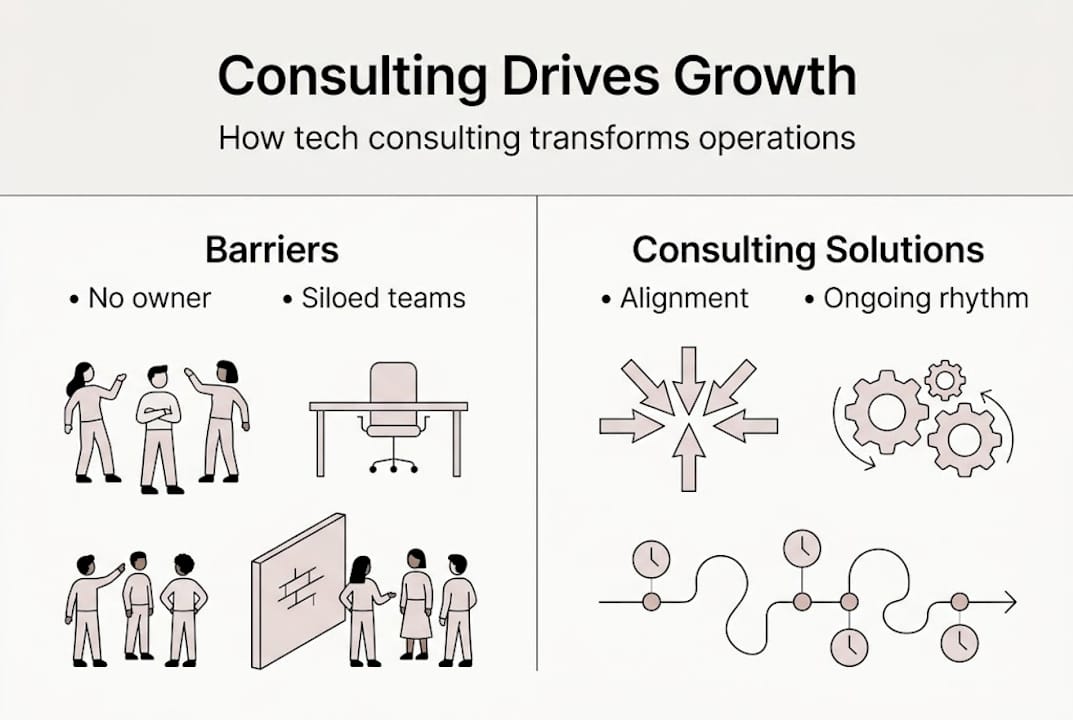
    But what holds many companies back? Let us break down the most common obstacles and the consulting solutions.

    Even organizations that recognize the value of strategic consulting often stall out before seeing results. The barriers are predictable, and they show up in almost every industry:

    • Legacy systems that are deeply embedded in daily operations and expensive to replace
    • Staff resistance driven by fear of job displacement or frustration with poorly implemented tools
    • Missing KPIs that leave teams without a clear standard for measuring success
    • Unclear ownership where no executive is accountable for technology outcomes
    • Vendor dependency that locks organizations into outdated platforms without a viable exit strategy

    Governance failures are particularly damaging. When organizations lack structure around technology decisions, the outdated IT pitfalls compound quietly over time. Costs balloon, security gaps widen, and teams build workarounds that create even more fragility.

    Here is how common governance gaps map to consulting solutions:

    Governance gapBusiness impactConsulting solution
    No technology ownerReactive, inconsistent decisionsFractional CIO or CTO placement
    No KPI frameworkCan’t measure transformation ROIKPI design and dashboard setup
    Siloed IT functionDisconnected from business goalsCross-functional alignment workshops
    Vendor lock-inLimited flexibility and high costsVendor audit and contract strategy
    Weak change managementLow adoption of new toolsStructured change management programs

    Research into consulting for transformation consistently shows that organizations lag most in governance and operating models, not in technology availability. The tools exist. The structures to govern them often do not.

    Strategic consulting solves this by creating alignment across leadership, building a culture that sees technology as a competitive lever, and establishing KPI-driven execution that connects daily technology decisions to long-term business goals. The shift from reactive to proactive technology governance is often the single biggest driver of transformation ROI.

    Real-world impact: Case studies and practical examples of tech consulting success

    With the barriers resolved, let us peek at how real companies leverage consulting for measurable gains.

    The results from well-executed technology consulting engagements are not incremental. They are often transformative. Consider these representative business scenarios:

    • A regional healthcare network eliminated manual reporting across 12 facilities by consolidating data systems under a unified governance model, reducing administrative time by over 30% within the first year.
    • A mid-sized logistics company worked with fractional CTO leadership to redesign its routing and inventory tracking systems, cutting operational costs significantly while improving delivery accuracy.
    • A financial services firm facing regulatory pressure engaged consulting to overhaul its cybersecurity governance, avoiding potential fines and rebuilding client trust through demonstrable compliance.
    • A manufacturing business used consulting-led process mapping to identify three major workflow bottlenecks, then implemented targeted automation that increased throughput without adding headcount.

    The common thread across every example is that technology was not the hero. The strategic framework that surrounded the technology was what produced the results. Consulting created the conditions for technology to perform.

    Data consistently supports this pattern. Organizations that treat consulting as an ongoing strategic function, rather than a one-time fix, report substantially higher transformation ROI compared to those that manage technology projects internally without external strategic guidance.

    You can explore detailed technology consulting case studies that show the specific levers that drove results for organizations facing similar challenges.

    The lesson that carries across all of these examples: start with outcomes, build governance around them, and let technology serve the strategy. Not the other way around.

    Infographic on consulting barriers and solutions

    Why most companies approach technology consulting wrong—and how to get it right

    Here is the uncomfortable truth most organizations do not want to hear: they hire consultants the same way they hire plumbers. They wait for something to break, call someone in, pay the invoice, and move on. That model guarantees you will be in the same situation again within 18 months.

    The research is clear that true impact requires a strategic approach, not a transactional one. Yet most companies still treat consulting as a one-off fix. The organizations winning at digital transformation are the ones that have made consulting part of their operating rhythm, not just their crisis response.

    When vetting consultants, stop asking only about technical credentials. Ask how they have changed governance models. Ask how they have built internal capability so the organization does not become dependent on external support. Ask for evidence of culture change, not just system change.

    To unlock business value at scale, consulting must become part of how you think about growth, not just how you fix problems. Embed it. Fund it. Measure it.

    Explore strategic consulting services for lasting business transformation

    If this article has clarified anything, it is that strategic technology consulting is not a luxury for large enterprises. It is a competitive necessity for any organization serious about growth and operational resilience.

    https://orloffphillips.com

    At Orloff Phillips, we offer tailored consulting services designed for mid-sized to large organizations ready to move beyond reactive IT and into strategic transformation. From fractional CIO and CTO placements to operations audits, digital resets, and governance coaching, our engagements are built around your outcomes. Explore our success stories to see how we have helped organizations like yours achieve measurable results. When you are ready to make consulting a core part of your strategy, we are ready to help you build the framework that makes it stick.

    Frequently asked questions

    What distinguishes technology consulting from traditional IT support?

    Technology consulting focuses on strategic transformation and aligning business goals with technology, while IT support handles day-to-day technical issues. Where IT support keeps the lights on, consulting determines which lights you should even be running and why, based on what drives strategic impact for the business.

    How can a business measure the ROI of technology consulting?

    Track KPIs such as process efficiency gains, cost reductions, revenue growth, and competitive positioning after each consulting engagement. Firms that link measurable transformation targets to consulting work from the start consistently report clearer and stronger ROI.

    When should organizations consider fractional executives for consulting?

    Businesses facing rapid digital change, leadership gaps, or major transformation initiatives benefit most from fractional C-level consultants. These roles provide experienced, outcome-focused leadership that helps organizations manage transformation without the cost or commitment of a full-time executive hire.

    What are the most common mistakes companies make with technology consulting?

    The biggest mistake is treating consulting as a one-time project rather than an ongoing strategic function. Companies that ignore governance, skip change management, or focus only on the technology consistently fail to meet transformation goals, because true impact requires strategy, not just tools.

  • Executive advisory: the key to digital transformation

    Executive advisory: the key to digital transformation

    Most mid-sized and large organizations believe technology success comes down to picking the right tools. Select the best cloud platform, invest in the newest security stack, and results will follow. This is one of the most expensive misconceptions in business today. The real driver of digital transformation success is not the technology itself but the strategic leadership guiding every decision. Executive advisory provides that critical layer, aligning technology investments with business goals, managing risk, and creating the organizational agility that turns good intentions into measurable outcomes. This guide breaks down exactly what executive advisory delivers and how to structure it for lasting impact.

    Table of Contents

    Key Takeaways

    PointDetails
    Strategic leadershipExecutive advisors provide direction, insight, and alignment beyond day-to-day management.
    Measurable impactWith the right frameworks, advisory engagement drives quantifiable digital transformation and efficiency gains.
    Outcome-driven structureEffective advisory relationships focus on iterative goals and metrics, not static participation.
    Value unlockUnlocking business value requires advisory input at the strategy, oversight, and execution layers.

    What executive advisory means for technology leadership

    Executive advisory is not a job title. It is a strategic function that sits above day-to-day operations and focuses on outcomes rather than execution. Understanding what falls under this umbrella is the first step toward using it effectively.

    At its core, executive advisory encompasses two main structures: advisory boards and fractional executives. Advisory boards are groups of senior leaders who provide strategic guidance, market insights, technology evaluation, and network access without holding operational authority. Fractional executive roles, on the other hand, involve experienced leaders who work part-time or on a project basis inside the organization, taking direct ownership of functions like IT roadmaps, cyber risk management, and alignment with business objectives.

    Advisors meeting about board structures

    The difference matters. An internal VP of Technology manages a team, approves budgets, and attends status meetings. An executive advisor challenges assumptions, benchmarks the organization against industry leaders, and asks whether the technology strategy actually serves the business model. As Harvard’s corporate governance research notes, advisory structures provide strategic guidance including market insights, tech evaluation, and networks, while fractional executives manage IT roadmaps, cyber risks, and goal alignment. These are complementary, not competing, roles.

    Here is a clear comparison to ground the distinction:

    FactorIn-house managementAdvisory boardFractional executive
    Time commitmentFull-timePeriodic sessionsPart-time or project-based
    FocusOperationsStrategy and oversightStrategy plus execution
    Cost structureSalary and benefitsRetainer or equityFlexible engagement fees
    Speed to valueSlower ramp-upImmediate insightsFast deployment
    AccountabilityInternal KPIsAdvisory outcomesContracted deliverables

    Key functions that executive advisors bring to the table include:

    • Strategic guidance: Connecting technology investment to revenue and growth goals
    • Technology evaluation: Objective assessment of platforms, vendors, and architectures
    • Risk management: Identifying cyber, compliance, and operational vulnerabilities before they escalate
    • Network access: Opening doors to vetted partners, vendors, and talent
    • Fractional CTO leadership: See fractional CTO leadership for how this role specifically accelerates transformation

    Pro Tip: When engaging an executive advisor, define success metrics upfront. Participation in meetings is not a deliverable. Reduction in vendor costs, faster project delivery, or improved security posture are.

    Tactical impact: How executive advisors accelerate digital transformation

    Strategy without tactics is wishful thinking. Executive advisors earn their keep not just by attending quarterly reviews but by deploying specific practices that change how organizations execute technology projects.

    Here are the primary tactics that drive measurable digital transformation:

    1. Phased IT roadmaps: Advisors break transformation into structured phases with clear milestones, owners, and exit criteria. This prevents the common failure mode of large technology projects that lose momentum after the first six months.
    2. Cyber risk as a strategic priority: Rather than treating cybersecurity as an IT department checkbox, executive advisors reframe it as a board-level business risk, connecting security posture directly to customer trust and regulatory standing.
    3. DORA metric integration: DevOps Research and Assessment metrics (deployment frequency, change failure rate, mean time to recovery) give organizations an objective view of operational velocity, letting advisors spot bottlenecks before they become crises.
    4. Vendor management discipline: Advisors bring structured vendor management strategies that improve contract terms, reduce dependency on single suppliers, and tie vendor performance to business outcomes.
    5. Cloud migration governance: Fractional executives handle cloud migration decisions with a lens on total cost of ownership, not just initial migration savings.

    The Harvard Law overview confirms that fractional executives specifically handle IT roadmaps and DORA metrics, cyber risk, vendor management, and cloud migration as core advisory responsibilities. Organizations that embed these practices into their transformation programs see faster delivery cycles and fewer costly course corrections.

    The following table shows how advisory contributions map to common project phases:

    Project phaseExecutive advisory contribution
    Discovery and planningStakeholder alignment, scope definition, risk identification
    Technology selectionVendor evaluation, architecture review, build-vs-buy analysis
    ImplementationMilestone governance, risk escalation, DORA baseline
    OptimizationKPI review, vendor renegotiation, capability building
    ScalingRoadmap extension, compliance readiness, board reporting

    For organizations looking to ground these tactics in a repeatable framework, exploring proven steps for tech transformation provides a structured starting point that complements advisory engagement.

    Infographic showing advisory impact steps

    Unlocking business value through strategic tech oversight

    Tactics produce outputs. Strategic tech oversight produces business value. The distinction is significant, and it is where executive advisory separates good technology organizations from great ones.

    The most effective advisory structures connect directly to Objectives and Key Results. OKRs give executives and boards a shared language for evaluating whether technology investments are actually moving the needle on revenue, efficiency, or market position. When an advisory relationship is grounded in OKRs, it becomes much harder for technology initiatives to drift into vanity projects with no clear business justification.

    Measurable benefits that organizations consistently report from structured executive advisory include:

    • Reduced project risk: Early identification of scope creep, vendor underperformance, and integration failures
    • Faster delivery: Phased roadmaps and milestone accountability cut average project timelines
    • Improved vendor leverage: Advisors with market knowledge renegotiate contracts and enforce performance standards
    • Regulatory resilience: Proactive compliance guidance reduces the cost and disruption of audits
    • Talent optimization: Advisory networks surface specialized talent faster than traditional recruiting

    “Technology oversight via advisory structures unlocks measurable potential in leading organizations, as documented by Harvard and EY research on S&P firms. Boards that actively engage with technology strategy outperform peers on digital transformation velocity and risk-adjusted returns.”

    Consider a practical scenario. A mid-sized financial services firm facing a core banking modernization project engages a fractional CTO as their executive advisor. Within the first quarter, the advisor restructures the vendor selection process, eliminates two redundant platform candidates, and establishes DORA baselines across the development team. By month six, deployment frequency has doubled and change failure rates have dropped by 40 percent. The project delivers on time instead of running over by the typical industry average of eight months.

    This kind of outcome is not accidental. It reflects what happens when tech oversight is treated as a strategic business lever rather than a governance formality. Organizations ready to explore what this looks like in practice can review the full range of technology reset services aligned to these outcomes.

    Frameworks and best practices for structuring executive advisory

    Knowing that executive advisory works is useful. Knowing exactly how to structure it is what separates organizations that extract real value from those that pay for impressive credentials and get very little in return.

    Here is a practical approach to establishing effective advisory relationships:

    1. Define the mandate clearly: Before engaging any advisor, document the specific business challenge, the time horizon, and the measurable outcomes expected. Vague mandates produce vague results.
    2. Select for fit, not just prestige: Advisors with directly relevant industry experience in your sector and your transformation stage outperform generalists with impressive titles.
    3. Establish a governance rhythm: Monthly check-ins on DORA and operational KPIs, combined with quarterly strategic reviews, keep advisory relationships productive and accountable.
    4. Integrate with internal teams: Advisors who operate in silos create friction. Structure engagement so advisors interact directly with technology, finance, and operations leaders.
    5. Revisit the structure regularly: Business conditions change. Advisory mandates should be reviewed and updated every quarter, not locked in at the start of a contract.

    For transformation best practices that translate these steps into operational reality, structured frameworks provide the scaffolding that turns advisory intent into measurable progress.

    For organizations managing regulatory or ESG obligations, advisory structures also serve a compliance function. Embedding collaboration best practices and ESG consulting frameworks into the advisory mandate ensures that technology decisions are evaluated against sustainability and governance criteria, not just performance metrics. As Harvard’s research confirms, phased roadmaps and DORA tracking are essential for effective digital transformation and operational efficiency.

    Pro Tip: Treat advisory engagement as iterative, not static. Build quarterly checkpoints into the contract structure so that objectives, metrics, and the advisor’s role can evolve as the organization’s needs shift.

    A fresh perspective on executive advisory: What most organizations miss

    Here is the uncomfortable truth most consulting firms will not tell you: the majority of organizations that engage executive advisors are paying for access when they should be paying for impact.

    They recruit advisors with impressive networks and deep resumes, then schedule monthly calls that cover status updates and strategic musings. The advisor feels engaged. The organization feels like they are doing the right thing. And yet, nothing fundamentally changes in how the business makes technology decisions or executes transformation.

    The best-in-class organizations treat advisory relationships the way a serious athlete treats a coach. They expect to be challenged, held to measurable standards, and pushed toward results they could not achieve alone. They revisit their advisory structure quarterly, retire mandates that have served their purpose, and constantly ask whether the engagement is generating competitive edge through advisory or simply providing comfort.

    The real secret is this: advisory is less about expertise and more about enabling organizational agility. The most valuable thing an executive advisor does is not share knowledge. It is force your organization to confront the strategic decisions it has been avoiding and build the internal capability to execute with confidence.

    Turn strategic guidance into measurable results

    Understanding the value of executive advisory is the starting point. Operationalizing it is where the real work begins.

    https://orloffphillips.com

    Orloff Phillips specializes in helping mid-sized to large organizations move from advisory theory to measurable results. Whether you need a structured fractional CTO advisory engagement, a full review of your execution advisory services, or a roadmap for sustainable transformation, the approach is built around your specific business outcomes. Explore the proven transformation steps that our clients use to accelerate delivery, reduce risk, and align technology with their most critical business priorities. The next step toward real transformation starts here.

    Frequently asked questions

    How does executive advisory differ from traditional C-suite leadership?

    Executive advisory brings external strategic expertise and focuses on big-picture outcomes, while C-suite leaders manage daily operations. Advisory boards provide strategic guidance, market insights, and network access that internal leaders rarely have time to develop.

    What tangible benefits can executive advisory deliver in a digital transformation?

    Executive advisory accelerates IT transformation, improves vendor management, and de-risks initiatives by aligning technology with business goals. Fractional execs handle IT roadmaps, cyber risk, DORA metrics, and strategic alignment as core deliverables.

    Which KPIs are most useful for measuring the success of executive advisory engagements?

    DORA metrics, OKR achievement, and operational velocity are the most effective measures for tracking advisory-driven technology transformation. DORA and operational KPIs are specifically recognized as key indicators of transformation success.

    How should organizations structure executive advisory relationships for ongoing value?

    Organizations should adopt phased roadmaps, regular metric reviews, and flexible advisory structures that evolve with business needs. Phased roadmaps and iterative engagement are the foundation of effective digital transformation advisory.

Orloff
Orloff AI AI
Online — Direct answers, no fluff
Powered by Orloff Phillips