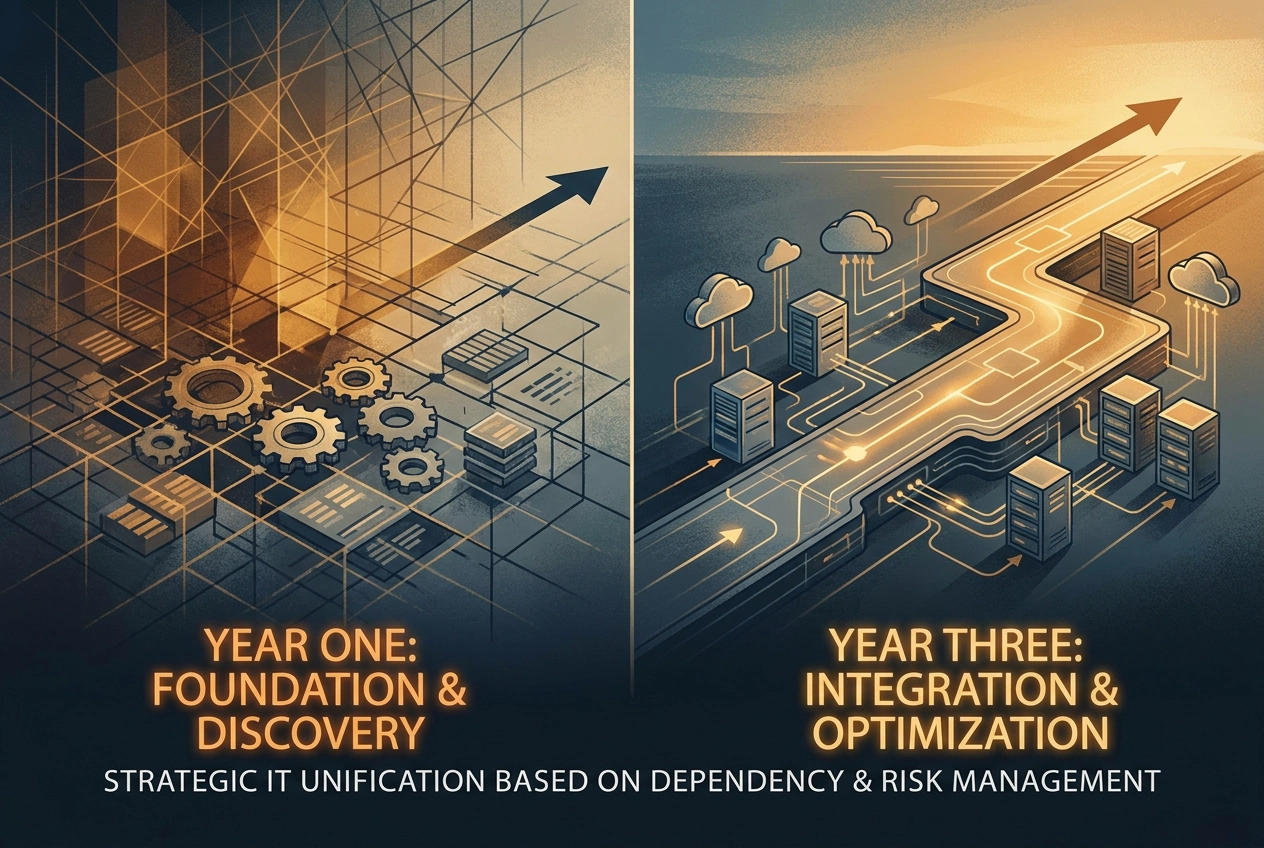
In our experience, infrastructure unification rarely fails because leaders lack ambition. It fails because they sequence work by vendor pressure, internal urgency, or the loudest request. A durable strategic IT plan orders initiatives by dependency and risk instead. This roadmap shows how mid-market leadership teams can split unification into a fundable, staffable year one and a compounding year three.
You will learn why programs stall on sequencing, how dependency and risk tests order priorities, and what belongs in year one: identity, network segmentation, and monitoring. Identity becomes the control plane everything else depends on, while network and monitoring deliver visible wins. Data and integration wait for years two and three; application and vendor rationalisation come last. We also cover funding and staffing, common sequencing mistakes, and the questions leadership teams ask before committing. Federal guidance reinforces the pattern: mature identity, device, and network foundations before longer-term strategic efforts. Foundation first, then let the rest compound.
Why Infrastructure Unification Programs Stall on Sequencing, Not Ambition
Across mid-market engagements in Exton, Philadelphia, Wilmington, Cherry Hill, Lancaster, and Reading, the same pattern repeats. Programs that stall rarely run out of ambition. They run out of dependency order.
Vendor-led sequences follow the seller’s roadmap, not the stack’s dependencies. When application or vendor consolidation launches first, it lands on top of identity, network, and monitoring work that does not exist yet. That is how a consolidation project turns into a year of integration patches instead of a finished outcome.
Federal practice points the same way, by analogy only. CISA’s FY2024 Report to Congress, dated January 29, 2025, reports that agencies’ early actions concentrated on the Identity, Device, and Network pillars as a foundation of their enterprise transition, and that those early improvements enabled longer-term strategic efforts. The scope is federal. The mid-market translation is ours.
The failure mode is predictable. Rework arrives because downstream work was built on unfinished foundations. Change fatigue sets in across a lean team. Budget gets spent without a visible outcome, and the leadership team loses confidence in the roadmap itself. Once that confidence is gone, the next phase is nearly impossible to fund.
Sequencing also changes the funding conversation. Year one produces measurable risk reduction that justifies year two spend. Ambition-first plans ask for multi-year trust before delivering anything leadership can point to.
That distinction decides whether your strategic IT plan survives its second budget cycle. A Philadelphia or Lancaster leadership team can defend a year-one envelope tied to identity, network, and monitoring outcomes. It cannot easily defend three years of spend against a plan whose first visible result sits eighteen months out. Vendor sprawl usually reveals this problem before the roadmap does, which is why vendor consolidation belongs behind the foundation rather than in front of it.
The discipline is simple to state and hard to hold: order work by dependency and risk, not by which vendor spoke last.
The Dependency and Risk Tests That Order Your Strategic IT Plan
Four tests order the work.
Dependency test. Does this layer require another layer to exist first? Identity, network, and monitoring are prerequisites for meaningful data, integration, and application consolidation. They come first by definition, not by preference.
Risk test. What is the cost of leaving this undone for another twelve months? Rank candidates by risk reduced per dollar, never by renewal date and never by where a vendor places the item on its own roadmap.
Blast radius and readiness test. How many systems, vendors, and teams does the change touch at once? Start with the smallest change that still reduces material risk, and pursue only what a named owner can actually carry this year. Mid-market teams rarely have slack for parallel workstreams, which is exactly where a framework for building an IT strategy without a full-time CIO earns its keep.
Reversibility test. Prefer year-one work that can be staged and rolled back without stranding systems you still depend on. Foundation work should not create new single points of failure.
Run every candidate initiative through all four tests, then rank the survivors on one sheet before you write a budget line.
The reference scaffold, used as analogy
CISA’s Zero Trust Maturity Model v2.0, dated April 2023, lists six pillars: Identity, Devices, Networks, Applications and Workloads, Data, and Cross-Cutting Capabilities. That ordering supplies useful structure for a foundation-first sequence. The model was produced by a US federal agency, however, so its application to a mid-market estate is by analogy, not proof. Treat it as a sanity check on your reasoning, not a substitute for it.
Applied together, the four tests produce a sequence that survives contact with a real budget: foundation layers first, everything downstream queued behind them. That sequencing is what turns the next decision into a narrow one.
What Belongs in Year One: Identity, Network, and Monitoring
Apply the four tests and the year-one answer narrows itself: identity, network, and monitoring. Three layers, each a prerequisite for what follows, and each capable of showing a visible outcome inside the same budget cycle. Three layers is also a scale, not a slogan. Anything beyond them is year two or later.
Publish the Phase Table Before the Work Starts
Keep it to one page with five columns: initiative, owner, dependency satisfied, measurable outcome, and not-in-year-one. That last column does the heaviest lifting. Deferred work stays visible rather than quietly returning through a renewal date or a hallway request. Review the table monthly; a table nobody reviews becomes a wish list.
Tie Every Initiative to a Metric Your CFO Already Tracks
Choose numbers leadership already sees, so progress needs no translation:
- Incident containment time
- Count of standing privileged accounts
- Unmanaged device count
- Vendor spend concentration
If an initiative cannot move one of those, it does not belong in year one.
One Internal Owner, One Advisory Seat
No year-one initiative proceeds without a named internal owner and a named advisory seat. The owner carries accountability; the advisory seat keeps the dependency order honest when a vendor or an urgent request pushes against it. Orloff Phillips can hold that advisory seat; see the Funding and Staffing section for staffing models.
Identity comes first, and it is the layer everything else rests on.
Identity First: The Control Plane Everything Else Depends On
With year one scoped to three layers, identity is the one that governs the other two. Start there because every network rule, log source, and application boundary ultimately resolves to an identity.
CISA’s Zero Trust Maturity Model v2.0 lists Identity as the first of six pillars. The NSA user pillar sheet reaches the same conclusion from an operational angle: it advises starting with the user pillar and cites credentials as the leading breach vector.
Year-one identity scope is deliberately finite:
- Authoritative directory cleanup, eliminating duplicate, stale, and unowned accounts.
- Joiner-mover-leaver automation tied to HR or another system of record.
- Privileged access management, with standing admin rights removed wherever possible.
- Phishing-resistant MFA coverage across every account, including service and vendor access.
- A full service account inventory, with named owners and rotation rules.
Define done for the year as one authoritative source of truth for identities, a measurable reduction in standing privilege, and access review evidence that satisfies auditors without last-minute heroics.
Measure four numbers monthly: percentage of accounts with MFA enforced, count of standing privileged accounts, time to revoke access after termination, and number of orphaned service accounts. Those four move faster than any project milestone and give leadership a real read on identity risk.
Identity also has a token layer, not only a password layer. CISA and NIST have published guidance on protecting cloud identity systems from token theft, forgery, and misuse; review it when scoping your MFA and session-management controls. The governance side of that work is covered in security, shared responsibility, and where IT leaders get burned.
The FICAM framework defines four practice areas: Identity Management, Credential Management, Access Management, and Federation and Governance. That structure is a useful cross-check when scoping the year-one identity workstream.
With identity stable, network and monitoring work can build on something that will not be rebuilt next year.
Network Segmentation and Monitoring: The Visible Year One Wins
With identity settled as the control plane, the next dependency is the network that carries access and the monitoring that proves control. Both belong in year one because both produce evidence leadership can see.
Network sequencing starts with documentation, not purchases. Map the real topology, including site links, remote access paths, and shadow IT connectivity, before selecting a segmentation model. This is where fragmentation hides; how IT infrastructure fragmentation accumulates explains why the gaps rarely appear on a whiteboard. Segment by trust boundary rather than VLAN convenience: group systems by what they genuinely need to talk to, then restrict everything else. Federal guidance supports the directional shift. CISA’s SASE roadmap under TIC 3.0 describes a move “from perimeter-focused architectures” toward modern practice, though it does not prescribe network modernisation before consolidation as a sequence, treat it as directional and verify details against the CISA original.
Monitoring is the early win leadership can see. Inventory existing log sources, forwarding paths, and alert routing before adding another console. Close gaps first. Define done in operational terms: coverage of crown jewel systems, alerts routed to a named owner, and a documented triage path. That gives the board a metric it understands.
For multi-site organisations, consolidated and segmented network paths are a fast visible win for a board or lender. It reduces exposure while simplifying the estate that later data and application work depends on.
That sets up what has to wait: data and integration.
What Has to Wait: Data and Integration in Years Two and Three
With identity, network, and monitoring standing, the pull is to start the data and integration work leadership has been requesting for years. Resist it. Data and integration depend on stable identity and network controls; starting them first is the most common way mid-market programs drown in scope.
Year Two: Data Foundations
Year-two data work is deliberately unglamorous: name the authoritative source for each domain, document lineage and dependencies, assign a data owner per domain, and set classification and retention rules your team can actually enforce. Enforceable beats elegant. A rule nobody can apply is worse than no rule, because it creates false assurance.
Integration: Fewer, Contract-First Interfaces
Favor a small number of contract-first interfaces over point-to-point sprawl. Build each interface against a defined contract, then retire the interfaces it replaces in the same project. If you only add, the integration estate keeps growing and the problem compounds rather than consolidates.
This deferral is Orloff Phillips’ advisory framework, drawn from mid-market engagements. It is not a standards requirement. The reasoning is simple: classification and access rules written against a stable identity model need far fewer rewrites than rules written against a directory you are about to rebuild. Challenge that logic directly. If your identity foundation is settled and your network boundaries are documented, data work can reasonably start sooner.
For a concrete view of what a sequenced engagement produces and when, read From Fragmented to Unified: What an IT Infrastructure Modernization Engagement Actually Produces.
Either way, application and vendor rationalisation still sits behind this layer.
Application and Vendor Rationalisation: The Last Layer
Once data and integration are stable, application and vendor rationalization finally becomes safe to attempt. This is where the sequencing logic established in the prior phase pays off: settled identity and network boundaries mean you consolidate once, not twice. This is where vendor alignment stops being a slogan and becomes portfolio engineering.
Build the Inventory Before You Build the Case
Start with a vendor and contract inventory. For each provider, record what it does, contract end date, annual spend, internal owner, overlap with internal capability, and exit cost. For an Exton or Lancaster manufacturer running six providers, that single page usually exposes the overlap leadership suspected and could not prove.
Score, Then Sequence Retirements
Score each vendor on four criteria: overlap with other tools, integration fit with your target architecture, risk exposure, and switching cost. Sequence retirements around contract cycles rather than forcing early breakage. Early termination fees and rushed migrations cost more than twelve months of patience.
MSP Alignment Belongs in This Layer
Treat MSP alignment as part of rationalization, not a separate project. Consolidate to fewer providers with clearer boundaries where it helps. Where specialization genuinely pays, keep multiple providers and write interface rules that name who owns what.
The Analogy, Not the Proof
CISA’s Zero Trust Maturity Model v2.0 lists Applications and Workloads after Identity, Devices, and Networks. That ordering is directional support for putting consolidation behind the foundation, but the model was written for federal agencies. Treat it as analogy, not proof, for a mid-market estate.
With the portfolio mapped and scored, the next constraint is not technical but financial: how a lean team funds and staffs each phase in sequence.
Funding and Staffing Your IT Strategic Roadmap in a Mid-Market Team
Rationalisation is also the most capital-hungry layer, which makes how you fund and staff everything before it the deciding factor.
Fund in Phases, Not in One Big Ask
A single multi-year appropriation rarely survives a mid-market board. A year-one envelope tied to named outcomes usually does, because it asks leadership to approve a result rather than a promise. Structure the roadmap as three funding gates: foundation (identity, network, monitoring), data and integration, then rationalisation. Each gate opens only when the prior phase reports evidence.
Staff to One Owner and One Partner
CISA’s FY2024 report to Congress describes cloud reliance and expanding threats as compounding existing challenges for federal agencies. Translated by analogy to a lean mid-market team, the operational lesson is that there is no slack for parallel workstreams. Your roadmap must be sized for one accountable internal owner and one external partner. Not one owner per pillar, not three vendors running concurrently.
Three models work at this scale:
- Internal owner plus advisory partner in a defined seat. The internal owner holds accountability; the advisor holds sequencing, vendor alignment, and challenge.
- Fractional CIO or CTO capacity. Best when no internal leader can carry the roadmap without dropping operational duties.
- Managed service with written scope boundaries. Workable only when the contract states what the provider does not own.
Budget the Governance Layer Explicitly
Sequencing, vendor alignment, and a monthly review cadence are line items with real value, not overhead to shave. Teams that cut this layer lose the discipline that keeps the sequence intact, a theme covered in our cybersecurity risk assessment guide for IT teams.
Guardrail: No Evidence, No Next Tranche
Do not release year-two funding while year-one outcomes are unmeasured. Each phase must close with evidence leadership can see: incidents contained faster, standing privilege reduced, coverage of crown jewel systems confirmed. The sequence holds only when the money follows the proof.
Common Sequencing Mistakes in Strategic IT Management
With year-two funding gated on year-one evidence, attention shifts to a subtler failure: work order. Five mistakes account for most of the sequencing drift we see across mid-market programmes.
Starting with the loudest vendor’s roadmap. If your sequence traces back to a sales conversation instead of a dependency map, expect rework well inside a two-year window. A plan that begins with whichever provider spoke last is a purchasing schedule, not a strategic IT roadmap.
Treating application consolidation as the visible win. Reversing the order to lead with applications makes foundation work look like mere enablement. It is not. Identity and network work then stalls mid-program, half-built, while the consolidation it was meant to support proceeds on unstable ground.
Running every workstream in parallel. Parallel execution looks ambitious on paper and performs poorly with a lean team. Nothing finishes, nothing gets measured, and no phase closes with evidence leadership can use.
Skipping the not-in-year-one list. Without an explicit deferral column, scope returns through ad hoc requests and renewal dates. The sequence rarely fails loudly. It dissolves quietly.
Letting a renewal date set the order substitutes a calendar constraint for a dependency map.
Each mistake shares one root cause: substituting someone else’s timing for your dependency map. The next question is what leadership should ask before committing.
Questions Leadership Teams Ask Before Committing
Avoiding those mistakes raises five questions leadership teams ask before committing to a strategic IT roadmap.
How long should year one take?
Six to twelve months is a reasonable planning assumption for the three foundation layers in a mid-market environment, sized to your team’s actual capacity. A compressed schedule that assumes staff you do not have produces the parallel-execution failure you just read about.
What if the budget covers only one layer?
Do identity first and do it properly. Then plan network and monitoring for the following budget cycle. A complete identity layer reduces more risk than three partial ones, and it makes the next year’s ask easier to justify.
Can we start data work in year one if we have a pressing data problem?
Only where exposure is immediate. Classify and restrict access to sensitive ungoverned data now, but defer consolidation until the identity foundation is settled.
How do we show the board progress?
Report one outcome metric per layer each quarter, drawn from numbers leadership already tracks: incident containment time, standing privileged accounts, unmanaged devices. Choose those metrics before the quarter starts, and keep technical milestones out of the boardroom.
Do we need to replace our MSP?
Not necessarily. The more common need is clearer scope boundaries and written accountability between internal IT and the provider. Consolidating to fewer providers helps only where those boundaries are documented; otherwise you have traded one unclear relationship for another.
Commit to the sequence, and the rest compounds.
Foundation First, Then Let the Rest Compound
The answers are only as durable as the sequence behind them. Everything in this guide reduces to one operating rule: order work by dependency and risk, never by vendor noise or a renewal date that happens to land in Q3. Year one belongs to identity, network, and monitoring, because each is a prerequisite for what follows. Years two and three belong to data, integration, and application and vendor rationalization, which only compound once the foundation holds.
Write the one-page phase table this week if you have not already.
Enforce the sequence with the eighteen-month review gate described in the Funding section.
That is how a strategic IT roadmap stops being a document and starts compounding: three foundation layers that hold, then two years of consolidation built on top of them.
If you want the sequencing session facilitated rather than run internally, Orloff Phillips runs dependency-ordered roadmap workshops for mid-market teams across Exton, Philadelphia, Wilmington, Cherry Hill, Lancaster, and Reading.
Conclusion
Infrastructure unification succeeds when sequence beats ambition. Order work by dependency and risk, not vendor noise or renewal dates. Year one is identity, network, and monitoring; years two and three are data, integration, and application and vendor rationalization. Foundation first, then let the rest compound. If your team needs help, Orloff Phillips facilitates dependency-ordered roadmap workshops for mid-market teams. Start with the table. Set the gate. Protect the sequence, and the roadmap becomes a compounding operating system, not a shelf document.

Leave a Reply