
Even organizations with mature procurement functions often watch risks slip through the cracks because vendor management gets confused with purchasing or supplier relationship management. These are not the same thing, and the gap between them costs real money. Misclassified responsibilities mean performance gaps go untracked, contracts auto-renew without review, and technology partners drift from your strategic goals. This guide cuts through the confusion, defines vendor management on its own terms, and gives executive decision-makers and operations managers a clear, actionable framework for building technology partnerships that actually deliver.
Table of Contents
- Defining vendor management: More than procurement
- Frameworks and methodologies: Tiered segmentation and governance models
- Key processes: Selection, performance, and risk control
- Technology’s role: Platforms, automation, and advanced metrics
- A fresh perspective: The pitfalls of treating vendors as interchangeable suppliers
- Next steps: Improving your vendor management program
- Frequently asked questions
Key Takeaways
| Point | Details |
|---|---|
| Vendor management defined | Vendor management means overseeing vendor performance, risk, and value—not just procurement. |
| Tiered strategies work | Tiered segmentation and hybrid governance cut costs and improve control for large organizations. |
| Scorecards matter | Using KPIs and scorecards reduces overruns and promotes better outcomes. |
| Tech tools increase ROI | VMS platforms automate oversight, driving savings and supporting faster decisions. |
Defining vendor management: More than procurement
Vendor management is the discipline of governing, monitoring, and optimizing your organization’s relationships with external suppliers after a contract is signed. It is not procurement, which ends at the point of purchase. It is not Supplier Relationship Management (SRM), which focuses on long-term strategic growth with a small number of critical partners. Vendor management sits in the operational middle ground, covering day-to-day performance, compliance, risk, and value delivery across your entire vendor portfolio.
Think of it this way. Procurement is the front door: sourcing, negotiating, and contracting. SRM is the penthouse: deep, strategic co-development with your most critical partners. Vendor management is everything in between, which is most of your building.
The core elements of vendor management include:
| Element | What it covers |
|---|---|
| Governance | Policies, roles, and escalation paths |
| Performance monitoring | KPIs, scorecards, and review cadences |
| Risk mitigation | Compliance, continuity, and financial exposure |
| Value optimization | Cost efficiency, innovation, and contract alignment |
As JP Morgan notes, vendor management is distinct from procurement and SRM, focusing on day-to-day operations rather than strategic growth. That distinction matters enormously in practice. When leaders blur these lines, they end up with procurement teams managing ongoing performance reviews they were never designed to handle, and SRM resources wasted on transactional vendors who need simple oversight, not strategic investment.
“The organizations that see the most value from their vendor relationships are those that treat vendor management as a discipline in its own right, not a byproduct of procurement.”
For organizations navigating business strategy transformation, getting this definition right is the first step. Without clarity on what vendor management actually covers, you cannot build the governance structures or accountability mechanisms that protect your organization.
The operational role of vendor management is also distinct from its strategic counterpart. Where SRM asks “How do we grow together?”, vendor management asks “Are you delivering what you promised, and are we managing the risk you represent?” Both questions matter, but they require different people, tools, and processes to answer well.
Frameworks and methodologies: Tiered segmentation and governance models
With a baseline understanding in place, examine the methodologies that leading organizations use to structure their vendor management efforts.
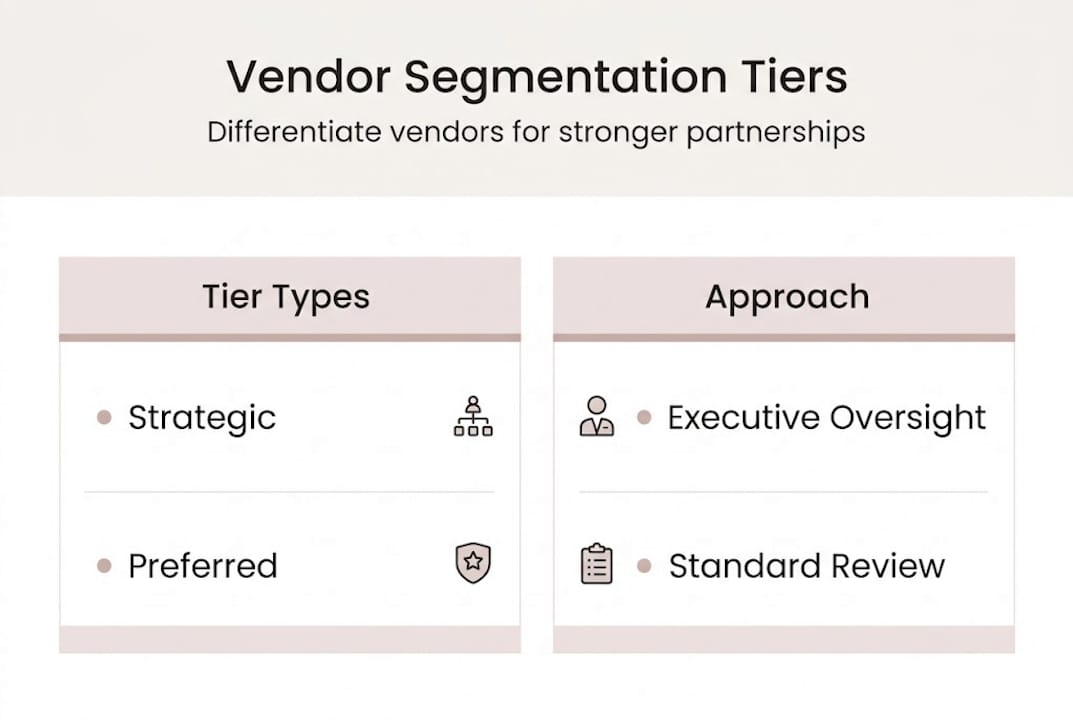
The most widely adopted approach is tiered vendor segmentation, which groups vendors by their strategic importance and operational risk. A typical three-tier model looks like this:
| Tier | Vendor type | Management approach |
|---|---|---|
| Tier 1 | Strategic | Executive oversight, quarterly business reviews, joint roadmaps |
| Tier 2 | Preferred | Dedicated manager, monthly KPI reviews, periodic audits |
| Tier 3 | Transactional | Automated monitoring, annual review, standardized contracts |
This segmentation prevents one of the most common and costly mistakes: applying the same level of attention to every vendor regardless of their impact. Your cloud infrastructure provider and your office supply company do not need the same governance model.
Governance structure is the other major decision. Organizations typically choose from three models:
- Centralized governance: A single team manages all vendor relationships. Consistent standards, but can become a bottleneck at scale.
- Decentralized governance: Business units manage their own vendors. Faster response, but inconsistent practices and blind spots.
- Hybrid governance: A central function sets policy and handles strategic vendors; business units manage transactional relationships within defined guardrails.
Tiered segmentation and hybrid governance are now widely used, with 69% of organizations adopting centralized resources for oversight while retaining local flexibility. That number reflects a real shift in how mature organizations think about control versus agility.
To build your own tiered approach, start with these steps:
- Audit your current vendor list and categorize by spend, strategic importance, and risk exposure.
- Define KPIs appropriate to each tier, simpler for Tier 3, more detailed for Tier 1.
- Assign ownership clearly, whether that is a vendor manager, a category lead, or a fractional executive.
- Build scorecards for each tier and set review cadences before rollout.
Pro Tip: If your organization spans multiple business units with different technology stacks, hybrid governance is almost always the right call. It gives you enterprise-wide visibility without slowing down the teams closest to the work. For context on how fractional executive benefits can accelerate this kind of governance build-out, the model translates directly to vendor oversight roles.
Key processes: Selection, performance, and risk control
Once methodologies are set, effective execution depends on mastering the core processes that run the lifecycle of every vendor relationship.

Vendor selection is where most risk enters the picture. A structured Request for Proposal (RFP) process forces vendors to respond to your specific requirements rather than their standard pitch. Evaluation criteria should be weighted: technical capability, financial stability, security posture, cultural fit, and references all carry different weight depending on the vendor tier.
Poor vendor selection carries real consequences. Improper vendor selection leads to significant project overruns and delays, with some organizations reporting 18% cost and timeline blowouts tied directly to this stage. That is not a rounding error. That is a budget crisis.
Pro Tip: Use weighted scorecards during selection, not just gut feel. Assign numeric weights to each evaluation criterion before you see any proposals, so the scoring process stays objective and defensible.
The performance management process covers:
- Standardized KPIs aligned to contract terms and business outcomes
- Monthly or quarterly scorecard reviews with formal documentation
- Escalation paths for underperformance, with defined thresholds
- Regular business reviews for strategic vendors, not just issue-driven conversations
The vendor lifecycle has four stages every operations manager should track:
- Onboarding: Credentialing, system access, compliance verification, and relationship kickoff
- Monitoring: Ongoing KPI tracking, risk scanning, and communication cadence
- Review: Formal performance evaluation, contract alignment check, and relationship health assessment
- Renewal or exit: Data-driven decision on whether to renew, renegotiate, or offboard
Vendor Management Systems (VMS) automate much of this. For organizations managing dozens or hundreds of vendors, manual tracking in spreadsheets is not just inefficient, it is a liability. A VMS centralizes contract storage, automates renewal alerts, and generates performance dashboards in real time. For organizations focused on expansion and risk mitigation, a VMS is often the operational backbone that makes scale possible.
Technology’s role: Platforms, automation, and advanced metrics
The pace of digital transformation means technology is now a cornerstone of effective vendor management, not an optional add-on.
A Vendor Management System is software designed specifically to centralize and automate the full vendor lifecycle. Core features typically include:
- Contract management: Centralized storage, version control, and automated renewal alerts
- Performance dashboards: Real-time KPI tracking across all vendor tiers
- Compliance monitoring: Automated checks against regulatory and contractual requirements
- Communication logs: Auditable records of all vendor interactions
- Risk scoring: Predictive signals based on financial health, incident history, and market data
The business case for VMS adoption is strong. VMS platforms deliver over 11% in savings for strategic adopters, driven by better contract utilization, reduced maverick spending, and faster issue resolution. That figure reflects organizations that invest in both the technology and the process discipline to use it well.
Automation handles the routine work: sending performance questionnaires, flagging expiring certificates of insurance, generating monthly scorecards, and alerting managers to SLA breaches before they escalate. This frees your team to focus on relationship quality and strategic decisions rather than data entry.
Advanced platforms now incorporate predictive analytics. Instead of reacting to a vendor’s declining performance, you get early warning signals, a drop in their financial stability score, an uptick in support ticket resolution time, a pattern of missed minor deadlines. These signals let you intervene before a problem becomes a crisis.
Common hurdles in VMS adoption include integration complexity with existing ERP or procurement systems, user adoption resistance from business units used to managing their own vendor relationships, and data quality issues when migrating from spreadsheets. The organizations that overcome these hurdles fastest treat the VMS implementation as a change management project, not just an IT deployment. Remote collaboration best practices apply directly here, especially when vendor management teams are distributed across locations.
A fresh perspective: The pitfalls of treating vendors as interchangeable suppliers
These insights converge on one critical mindset shift: the most expensive mistake in vendor management is not a bad contract. It is a bad mental model.
When executives treat all vendors as interchangeable suppliers, they flatten the relationship into a purely transactional exchange. Price becomes the only lever. Performance conversations become adversarial. And the vendors with the most to offer, your Tier 1 technology partners, disengage because they see no path to a real partnership.
Real gains surface when vendor management moves beyond tactical cost-cutting to a value partnership approach. We have seen this play out repeatedly: organizations that invest up front in segmentation and differentiated governance models report not just lower costs, but faster innovation cycles and fewer critical incidents.
The internal resistance to differentiated vendor strategies is real. Finance teams want uniform processes. Legal wants standard contracts. Operations wants simplicity. But the organizations that push through that resistance and build tiered, nuanced programs consistently outperform those that do not. The discomfort of differentiation is a one-time investment. The cost of treating a mission-critical technology vendor like a commodity supplier is ongoing. For leaders committed to proactive business growth, this mindset shift is non-negotiable.
Next steps: Improving your vendor management program
Executives ready to rethink their approach can tap additional support from Orloff Phillips. Our fractional technology leadership team works directly with mid-sized and large organizations to assess, redesign, and operationalize vendor management programs that reduce risk and drive measurable value.
Whether you need help building a tiered governance model, selecting and implementing a VMS, or developing KPI frameworks for your technology partners, we bring hands-on experience from real transformations. Explore how we support secure and resilient IT environments and vendor management consulting engagements tailored to your organization’s complexity. Our team also supports remote team solutions for distributed vendor management operations. Reach out to start the conversation.
Frequently asked questions
What is the primary goal of vendor management?
Vendor management aims to optimize vendor performance, reduce risk, and maximize value delivery to the organization. According to JP Morgan’s vendor guide, the core elements are governance, performance monitoring, risk mitigation, and value optimization.
How is vendor management different from procurement?
Procurement focuses on sourcing and contracting, while vendor management handles ongoing performance, compliance, and value after the contract is signed. The distinction between the two is critical for assigning the right teams to the right responsibilities.
What are the main types of vendor management models?
The three main models are centralized, decentralized, and hybrid, with most large organizations preferring hybrid for its balance of control and flexibility. Tiered segmentation paired with hybrid governance is considered a best practice for complex organizations.
What are the benefits of using a Vendor Management System (VMS)?
A VMS automates contract management, compliance monitoring, and performance tracking, delivering measurable cost savings and reduced administrative burden. Strategic VMS adopters report savings exceeding 11% through better contract utilization and faster issue resolution.
How do KPIs impact vendor management success?
Well-defined KPIs create accountability and give both parties a shared standard for measuring success, which prevents costly overruns and relationship drift. Real-time KPI monitoring is directly linked to better vendor outcomes and reduced project delays.
Recommended
- Remote Collaboration: Best Practices, Ch… | Orloff Phillips
- Strategic Legal Counsel: A Catalyst for … | Orloff Phillips
- Working Across Time Zones: Pros, Cons, a… | Orloff Phillips
- The Vital Role of Counsel in Protecting … | Orloff Phillips
- Effective strategies for managing logistics partners in ecommerce – ORNER
- Master the Inventory Control Process for Vendors Easily

Leave a Reply