
Business consulting is widely misunderstood. Most executives picture an expensive team arriving with slide decks and leaving behind a report that collects dust. But the reality is far more measured and, when done right, far more impactful. Engagements are episodic, typically costing around 3% of client payroll, with a median duration under one year. That’s not a bloated retainer. It’s a focused, time-bound intervention designed to move the needle on specific business challenges. This guide breaks down what business consulting actually is, what the evidence says about its returns, where it fails, and how your organization can get the most out of every engagement.
Table of Contents
- Defining business consulting: Scope, approach, and who it serves
- How consulting drives value: What the evidence shows
- Beyond the hype: Nuances, risks, and common misconceptions
- Making business consulting work for your organization
- A nuanced take: Why effective consulting is not just plug-and-play
- Next steps: Amplify your results with experienced consulting partners
- Frequently asked questions
Key Takeaways
| Point | Details |
|---|---|
| Business consulting defined | Consultants provide specialized advice and leadership to solve complex business challenges and enable transformation. |
| Proven ROI with nuances | Evidence shows consulting boosts productivity and wages, but effectiveness varies by client readiness and sector. |
| Risks require strategy | Risks like dependency and inefficiency can occur; maximizing value requires organizational preparation and clear objectives. |
| Practical application matters | Success depends on co-creation, internal ownership, and well-managed transitions, not just external expertise. |
Defining business consulting: Scope, approach, and who it serves
Business consulting means bringing external expertise into your organization to solve specific, high-stakes problems or drive meaningful transformation. The consultant doesn’t run your company. They diagnose, advise, and often help implement change within a defined scope and timeline.
The main categories of consulting most relevant to executive teams include:
- Strategy consulting: Market positioning, growth planning, competitive analysis, and M&A preparation.
- Technology consulting: IT roadmapping, digital transformation, cybersecurity, and vendor management.
- Operations consulting: Process optimization, supply chain efficiency, and cost reduction.
- HR and organizational consulting: Talent strategy, leadership development, and change management.
- Financial and risk consulting: Capital allocation, compliance frameworks, and risk mitigation.
Consultants serve C-suites, boards, and senior operational leaders. Understanding the role of strategic counsel in organizational decisions helps clarify why external advisors are often more effective than internal teams at driving difficult change.
Who actually uses consulting? Studies show it’s most prevalent in larger, higher-productivity firms, though organizations at the lower end of performance stand to gain the most. Consulting is episodic, typically under a year, meaning it’s not a permanent staffing solution. It’s a targeted intervention.
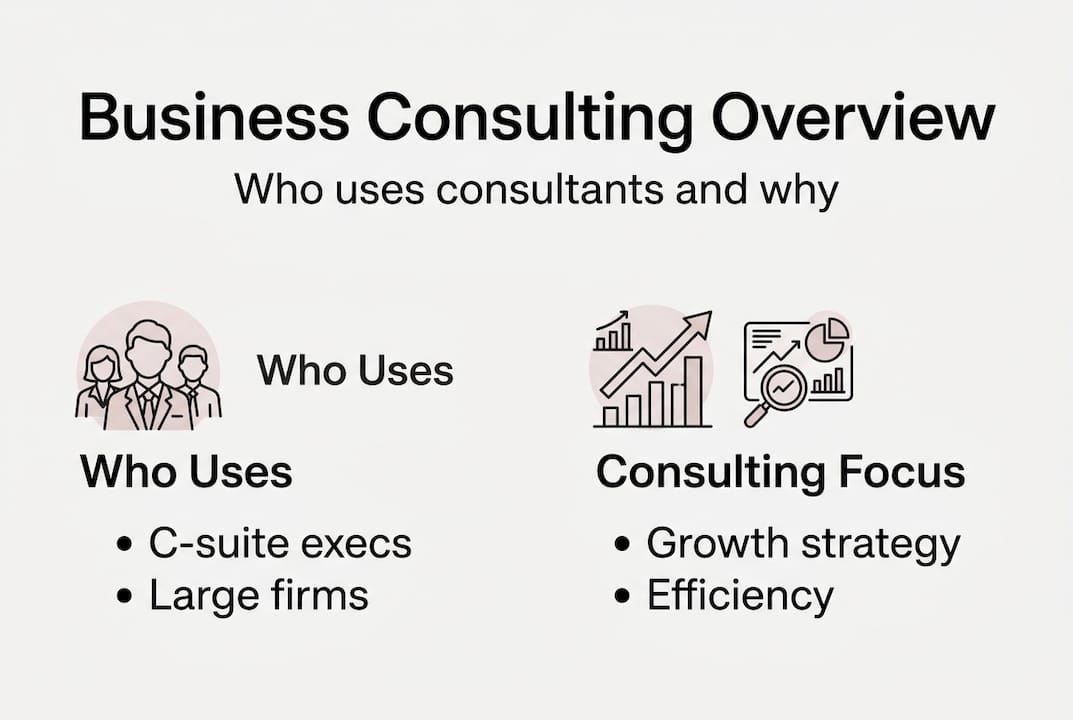
| Consulting type | Primary focus | Typical engagement length |
|---|---|---|
| Strategy | Growth, positioning, M&A | 3 to 9 months |
| Technology | IT, digital, cybersecurity | 6 to 18 months |
| Operations | Efficiency, cost, process | 3 to 12 months |
| HR/Organizational | Talent, culture, change | 4 to 10 months |
Pro Tip: Before you engage a consultant, define a single primary outcome. Not five outcomes. One. Organizations that anchor every engagement to a specific, measurable result get substantially more value than those with open-ended mandates.
The structure of most engagements follows a pattern: discovery and diagnosis, solution design, implementation support, and knowledge transfer. The most effective ones treat that last phase, knowledge transfer, as the whole point.
How consulting drives value: What the evidence shows
Skiptics often ask whether consulting actually moves the dial. The answer, supported by large-scale empirical research, is yes, but with important conditions.

The headline finding: firms that engaged business consultants saw +3.6% labor productivity and +2.7% wage growth over a five-year period compared to matched non-client firms. That’s not a marginal gain. For a 500-person organization, a 3.6% productivity lift translates to meaningful output without a corresponding headcount increase.
Here’s what the evidence supports:
- Productivity improvements are durable, persisting years after the engagement ends.
- Wage growth indicates that consulting raises the quality of work, not just output volume.
- Low-productivity firms benefit the most, a concept called allocative efficiency, where resources (and advice) flow to where they create the greatest lift.
- Both high-performing and struggling organizations hire consultants at higher rates than mid-tier firms, a U-shaped utilization curve that reflects two different strategic logics: high performers want to stay ahead, and low performers need a lifeline.
| Outcome metric | Average impact (5-year period) |
|---|---|
| Labor productivity | +3.6% |
| Wage growth | +2.7% |
| Engagement cost (% of payroll) | ~3% |
| Typical ROI horizon | 2 to 4 years |
These gains are particularly relevant for organizations investing in distributed or hybrid workforces. Aligning remote collaboration practices with a broader consulting-led transformation often accelerates the productivity curve.
It’s also worth noting that the benefits of remote work intersect directly with consulting-driven operational change. When consultants help redesign workflows, the organizations that have already built flexible infrastructure capture the gains faster.
The cost-to-benefit math is compelling when you frame it correctly. Paying approximately 3% of payroll for a gain of 3.6% productivity, sustained over five years, is not an expense. It’s leverage.
Beyond the hype: Nuances, risks, and common misconceptions
The data is encouraging, but business consulting is not a guaranteed win. Several real risks can undermine even well-intentioned engagements.
The most critical variable is absorptive capacity, the organization’s ability to take in new knowledge, adapt to new practices, and sustain change after the consultant leaves. Success depends heavily on this capacity. An organization that lacks internal champions, change management structures, or basic data literacy will struggle to implement even the best recommendations.
Other risks worth naming:
- Dependency: Repeated engagements without internal skill-building create reliance, not capability.
- Template-driven advice: Asset-based consulting models (where firms apply the same framework across clients) may deliver speed but sacrifice specificity. Your business is not a template.
- Public sector pitfalls: Research links consulting to inefficiency in some public sector contexts, particularly where procurement processes or political pressures distort engagement outcomes.
- Expert power imbalance: Consultants carry authority that can shut down internal dissent. When teams defer too readily, blind spots go unaddressed.
“The most dangerous consulting engagement is one where the client organization stops thinking critically and simply executes. Real transformation requires internal ownership.”
Understanding proactive legal counsel as a parallel advisory function helps frame why these same risks apply across professional services. The pattern is consistent: external experts only add value when the client organization actively participates in shaping outcomes.
Pro Tip: Ask every prospective consulting partner how they measure success at the end of an engagement. If the answer focuses entirely on deliverables (reports, decks, frameworks) rather than capability transfer, proceed with caution.
Not all consulting outcomes are dramatic. For some organizations, the win is simply avoiding a costly strategic mistake. That’s still a return, even if it doesn’t show up in a productivity index.
Making business consulting work for your organization
Knowing the risks, here’s how to structure an engagement that actually delivers.
- Clarify your objective before the first meeting. Define the business problem in one sentence. What decision do you need to make? What process needs to change? What capability do you not currently have? Vague mandates produce vague results.
- Build internal absorptive capacity first. If your team lacks the baseline skills to engage with consultant recommendations, invest in that infrastructure before the engagement begins. Training, documentation, and designated internal leads all matter.
- Assign an internal champion. Every consulting engagement needs an internal executive owner who attends key sessions, challenges assumptions, and owns the implementation. Without this, recommendations become shelf ware.
- Structure knowledge transfer into the contract. Don’t leave this to good intentions. Specify what documentation, training, and capability transfer the consultant must provide before the engagement closes.
- Design an exit plan from day one. What does success look like at 30, 60, and 90 days post-engagement? Sustainable transformation means the organization can operate independently after the consultant leaves.
Research confirms that expert power boosts self-efficacy, but this benefit diminishes under high organizational stress. If your team is already overwhelmed, a consulting engagement adds cognitive load before it adds capability. Timing matters.
Building systems that protect your organization during periods of change is part of protecting your business through smart advisory relationships. Similarly, legal counsel for growth mirrors consulting in one key way: both only work when leadership treats them as strategic partners, not just vendors.
Pro Tip: Run a short internal readiness assessment before signing any consulting contract. Cover four areas: team bandwidth, data availability, executive sponsorship, and clarity of objective. If any of these is missing, resolve it first.
A nuanced take: Why effective consulting is not just plug-and-play
Here’s a perspective that rarely appears in consulting brochures: the quality of the consultant matters far less than you think. The quality of your organizational readiness matters far more.
Most consulting failures aren’t consultant failures. They’re client failures. The organization wasn’t ready to absorb the recommendations. Leadership was aligned in theory but not in practice. The internal champion left halfway through. The team reverted to old habits three months after the engagement closed.
Contrasting evidence from the public sector makes this point sharply. Research links consulting to inefficiency in certain public sector environments, and the common thread isn’t bad consultants. It’s organizations that lacked the self-awareness to define what they actually needed, and the structures to implement what they received.
The best consulting ROI comes from executive investment in the learning process, not just the outcome. Leaders who sit in sessions, challenge findings, and take ownership of the strategy transformation process get dramatically different results than those who outsource the thinking entirely. Consulting is not a substitute for leadership. It’s an amplifier of it.
Next steps: Amplify your results with experienced consulting partners
If you’re ready to move from theory to real-world transformation, the principles covered in this article connect directly to what Orloff Phillips brings to executive teams across the United States.
Orloff Phillips specializes in fractional executive consulting that combines strategic technology leadership with hands-on operational transformation, giving organizations the expertise they need without the overhead of a full-time hire. Our transformative IT consulting approach aligns IT strategy with business outcomes in measurable, time-bound engagements built around your specific objectives. Whether you need a virtual CIO, a digital transformation roadmap, or a focused advisory engagement, the Orloff Phillips consulting overview outlines how we partner with organizations at every stage. Reach out to schedule a tailored discovery session and find out where consulting can move the needle for your team.
Frequently asked questions
What exactly do business consultants do?
Business consultants help organizations solve complex challenges, improve productivity, and drive transformation by providing external expertise and actionable strategies. Their work spans diagnosis, solution design, implementation support, and capability transfer, all aimed at organizational transformation and performance improvement.
How long does a typical consulting engagement last?
Most business consulting projects are episodic and focused. Engagements are median under one year, with a mean of 1.6 years, reflecting the targeted nature of most mandates rather than an ongoing advisory relationship.
What are the biggest risks of hiring business consultants?
The primary risks include organizational dependency, less personalized advice from template-driven models, and potential inefficiency when the client isn’t structured to implement change. Risks include dependency and inefficiency, particularly in environments with low absorptive capacity.
How can I make sure a consulting engagement delivers value?
Success requires clear objectives, strong internal sponsorship, and a structured plan for knowledge transfer. Absorptive capacity and defined roles are the two most critical factors in capturing the full value of an engagement.
How much does business consulting typically cost?
Business consulting averages around 3% of client payroll, with large firm engagements typically ranging between approximately EUR 245k and EUR 328k depending on scope, duration, and the consulting firm’s model.
Recommended
- Why Legal Counsel is Crucial for Sustain… | Orloff Phillips
- The Vital Role of Counsel in Protecting … | Orloff Phillips
- Strategic Legal Counsel: A Catalyst for … | Orloff Phillips
- From Compliance to Competitive Edge: How… | Orloff Phillips
- Pilotage d’entreprise : allier vision stratégique et opérationnelle
- What Is Business Management and Why It Matters

Leave a Reply