
Executive networking is the intentional practice of building meaningful professional relationships among senior leaders to gain trusted advice, new opportunities, and sustained career momentum. The industry term for this discipline is strategic relationship management, and understanding why executive networking works separates leaders who grow from those who stagnate. Platforms like LinkedIn and tools like Power Intro have made relationship building more accessible, yet the fundamentals remain unchanged. Warm introductions to C-level decision-makers generate a 46% response rate compared to only 3% for cold outreach. That gap is not a minor advantage. It is the difference between getting in the room and being ignored entirely.
Why executive networking is the growth strategy most leaders underestimate
The core benefit of executive networking is access. Access to vetted opportunities, candid advice, and reputational capital that no job board or LinkedIn search can replicate. Leaders who invest in their networks before they need them consistently outperform those who reach out only in moments of urgency.
“Leadership is not solitary. Peer perspectives accelerate growth in ways that internal teams and formal advisors rarely can.”
Executive networking accelerates leadership growth by providing access to diverse viewpoints that anticipate industry shifts and speed recovery from setbacks. This is not a soft benefit. When a market shifts or a competitor moves fast, the executive with a trusted peer network gets early signals. The one without it reads about it in the news.
The benefits of executive networking extend well beyond career advancement:
- Access to vetted opportunities. Board seats, advisory roles, and senior positions rarely appear on public job boards. They circulate through trusted networks first.
- Risk management. Peers who have navigated similar challenges share hard-won lessons that no consultant can replicate.
- Reputational capital. Effective director networking relies on reputational capital and discretion rather than convenience or cocktail party appearances.
- Decision quality. Modern peer networks function as decision environments where leaders share honest reflections that positional authority limits inside their own organizations.
The role of executive networking in business resilience is equally concrete. Leaders with strong peer networks recover faster from disruptions because they have real-time access to how others are responding. That intelligence is worth more than any market research report.
How and when should executives approach networking for maximum impact?

The best time to build your network is years before you need it. Elite executives treat networking as proactive, weekly discipline maintained regardless of job status, industry conditions, or calendar pressure. Boards and executive search firms rely on trusted networks long before any public search begins. If you are not already in those conversations, you are already behind.
The executive networking process that produces lasting results follows a clear sequence:
- Map your existing relationships. Audit who you know inside and outside your organization. Internal relationships often reveal stronger warm introduction paths than you expect.
- Identify the gaps. Determine which industries, functions, or seniority levels are missing from your network. Gaps in your network are gaps in your intelligence.
- Engage with low-stakes consistency. Share an article, comment on a peer’s post on LinkedIn, or send a brief note about a shared interest. These small touches build familiarity without pressure.
- Follow up within 48 hours. Short, relevant follow-ups after interactions strengthen trust without pushing transactional demands. A two-sentence message referencing a specific point from your conversation is enough.
- Lead with value, not asks. Make introductions, share intelligence, and offer your perspective before you ever request anything in return.
Pro Tip: Map your relationships using a simple spreadsheet with columns for name, organization, last contact date, and next action. Review it weekly. Relationships decay faster than most executives realize.
The most common mistake in the executive networking process is waiting for a triggering event. A job loss, a board search, or a business development need should not be the reason you pick up the phone. By then, the relationship is too cold to carry weight. Transactional “ask-first” approaches trigger guardrails among high-level peers. Leading with relevance and value is the only approach that works at the C-suite level.
Authentic relationship building vs. transactional contact collection
The distinction between authentic networking and contact collection is the most important concept in this field. Most executives collect contacts. The best executives build relationships. The difference shows up in outcomes.
| Approach | Characteristics | Benefits | Drawbacks |
|---|---|---|---|
| Authentic relationship building | Consistent, low-stakes engagement over time | Trust, candor, preferred access to opportunities | Requires sustained time investment |
| Transactional contact collection | Event-driven, ask-first, volume-focused | Short-term visibility | Triggers guardrails; relationships do not hold under pressure |
| Digital-only networking | LinkedIn connections, mass messaging | Scale and reach | Lacks shared context; low conversion to real access |
| Peer group membership | Structured forums, executive roundtables | Confidential peer exchange | Requires vetting and active participation |
The highest-value connections are built on shared context that enables candid conversation without posturing. This is what separates a genuine peer relationship from a LinkedIn connection. Shared context means you have worked through a real problem together, navigated a similar challenge, or built enough history that honesty is possible.
Authentic networks also protect confidentiality. At the board and C-suite level, the ability to speak candidly without fear of exposure is the prerequisite for any real exchange of value. Executives who understand the role of discretion in director networks build access to better rooms. Those who treat every interaction as a transaction get excluded from them.
Pro Tip: Join one structured executive peer group, such as a CEO roundtable or an industry advisory council, where participation requires contribution. The vetting process itself signals credibility to other members.
Digital platforms like LinkedIn remain useful for maintaining visibility and making initial connections. The mistake is treating a LinkedIn connection as a relationship. It is a starting point, not an outcome. The concept of a connector in professional networks describes the rare individuals who bridge otherwise disconnected groups. Becoming that person, rather than simply collecting contacts, is the goal.
What practical outcomes does strong executive networking produce?
Strong executive networks produce measurable business outcomes, not just career benefits. The impact shows up in deal flow, board access, market intelligence, and leadership resilience.
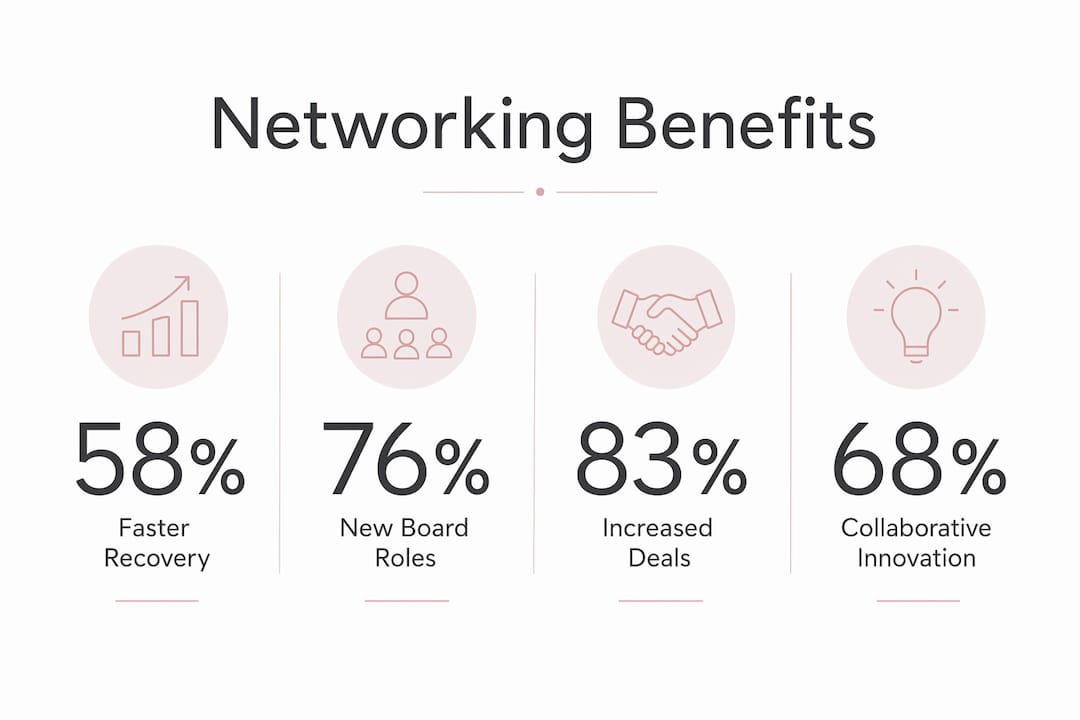
Leadership resilience and foresight. Executives with active peer networks identify industry shifts earlier. They hear about regulatory changes, competitive moves, and talent market shifts from peers who are living through them in real time. That foresight translates directly into better decisions.
Access to advisory and board roles. Board seats are almost never filled through public searches. They are filled through trusted referrals from people who have seen a candidate perform under pressure. Building consulting partnerships that drive growth requires the same relationship infrastructure that board access demands.
Deal-making and business development. The multiplier effect of a trusted introduction is significant. A warm introduction to a C-level buyer from a mutual peer carries credibility that no cold pitch can manufacture. The 46% response rate on warm introductions versus 3% on cold outreach is the clearest proof of this dynamic.
Innovation through collaboration. Executives who share challenges across organizational boundaries surface solutions faster. A CTO who knows three peers at non-competing companies in adjacent industries will encounter more diverse problem-solving approaches than one who stays inside a single professional circle.
| Business Outcome | Networking Mechanism | Real-World Example |
|---|---|---|
| Board seat access | Trusted referral from peer | Search firm contacts known network before posting role |
| Market intelligence | Peer roundtable exchange | Early signal on regulatory shift from industry peer |
| Business development | Warm introduction to buyer | 46% response rate vs. 3% cold outreach |
| Leadership resilience | Candid peer feedback | Peer challenge accelerates course correction |
| Talent acquisition | Network referral | Top candidate referred before public job posting |
The executive advisory function in digital transformation depends on exactly this kind of network. Technology leaders who lack peer relationships outside their own organization consistently make slower, more expensive decisions because they are working with incomplete information.
Key Takeaways
Executive networking is a sustained discipline that produces compounding returns when built on trust, consistency, and shared context rather than transactional contact collection.
| Point | Details |
|---|---|
| Start before you need it | Build your network years before a transition, search, or business need arises. |
| Warm introductions dominate | Warm introductions generate a 46% response rate versus 3% for cold outreach. |
| Lead with value | Transactional “ask-first” approaches damage trust at the C-suite level. |
| Authentic beats transactional | Shared context and discretion create access to better rooms and better decisions. |
| Treat it as infrastructure | Weekly, low-stakes engagement compounds into reputational capital over time. |
What I have learned about executive networking after years in the field
The executives I have seen build the most durable careers share one habit: they network hardest when they need it least. When business is good, when the role is secure, when the pipeline is full. That is exactly when most leaders stop. They treat networking as a response to scarcity rather than an investment in abundance.
The invisible nature of effective networking is what surprises most people. The best-connected executives I know do not attend every conference or dominate LinkedIn. They send a short note to a peer after reading something relevant. They make an introduction without being asked. They show up to a peer roundtable and listen more than they speak. None of that is visible from the outside. All of it compounds.
The pitfall I see most often is the executive who treats a new connection as a resource to extract rather than a relationship to build. That approach works once, if at all. The C-suite is a small world. Reputation travels faster than any press release.
My recommendation is simple. Pick five relationships that matter and invest in them consistently for the next 90 days. Not five hundred. Five. Send a relevant article. Make an introduction. Ask a genuine question about their work. That is the executive networking process that actually produces results. Everything else is performance.
— Orloff
How Orloffphillips supports executive leaders in building strategic advantage

Orloffphillips works with executive decision-makers across the United States who are navigating technology leadership, business transformation, and the kind of strategic decisions that require trusted advisors, not just vendors. The same principles that drive effective executive networking, trust, shared context, and long-term commitment, shape every engagement at Orloffphillips.
For executives evaluating their technology leadership structure, the Virtual CIO Selection Guide for Executives in 2026 offers a practical framework for making that decision with confidence. Orloffphillips also connects leaders through its Connector network, designed to build the kind of peer relationships that produce real access and real results.
FAQ
What is executive networking?
Executive networking is the intentional, ongoing practice of building professional relationships among senior leaders to gain trusted advice, access to opportunities, and reputational capital. It is a discipline, not an event.
Why does executive networking matter more than general networking?
At the executive level, most high-value opportunities circulate through trusted networks before any public announcement. Warm introductions generate a 46% response rate compared to 3% for cold outreach, making relationship quality the primary competitive advantage.
When is the best time to start building an executive network?
The best time is years before you need it. Elite executives maintain proactive, weekly networking habits regardless of job status, because boards and search firms rely on trusted networks long before any public search begins.
How do you avoid a transactional reputation in executive networking?
Lead with value before making any request. Share relevant intelligence, make introductions, and engage consistently over time. Transactional “ask-first” approaches trigger guardrails among high-level peers and damage trust quickly.
What is the difference between authentic networking and contact collection?
Authentic networking builds shared context and confidentiality over time, enabling candid conversation and preferred access to opportunities. Contact collection is volume-focused and event-driven, and it rarely produces access to the rooms where real decisions are made.

Leave a Reply