Category: Development

  • Cybersecurity Trends in 2026: What Enterprises Must Know

    Cybersecurity Trends in 2026: What Enterprises Must Know

    The defining cybersecurity story of 2026 is not a single threat. It is the convergence of autonomous AI, identity fragmentation, quantum urgency, and regulatory deadlines arriving at the same time. Enterprises that treat these as separate problems will spend the year reacting. Those that see the pattern will get ahead of it.

    Here is what the threat picture actually looks like right now:

    • Autonomous AI agents are embedding across enterprise applications at a pace most security teams did not anticipate, creating credential and isolation gaps that attackers are already exploiting.
    • Identity-first security has moved from a framework preference to a national security priority, driven by the reality that AI agents rarely operate with scoped permissions.
    • Zero Trust architectures, combined with continuous exposure management, are producing measurably better breach outcomes for early adopters compared to peers still running perimeter-based models.
    • Quantum-safe cryptography is no longer a future-state conversation. Government mandates and NIST post-quantum standards are forcing enterprises to act now, not in three years.
    • Regulatory deadlines are compressing. The CIRCIA final rule requiring 72-hour breach reporting for critical infrastructure entities is expected in September 2026, and California’s cybersecurity risk assessment rules for automated decision-making are already in effect.
    • IBM Security Services and X-Force Threat Intelligence data confirm that AI-driven attacks are accelerating intellectual property risk and expanding attack surfaces faster than most enterprise defenses can track.

    The sections below break down each of these trends with the specificity you need to brief your board, update your security roadmap, or pressure-test your current posture.

    1. How are autonomous AI agents changing enterprise security?
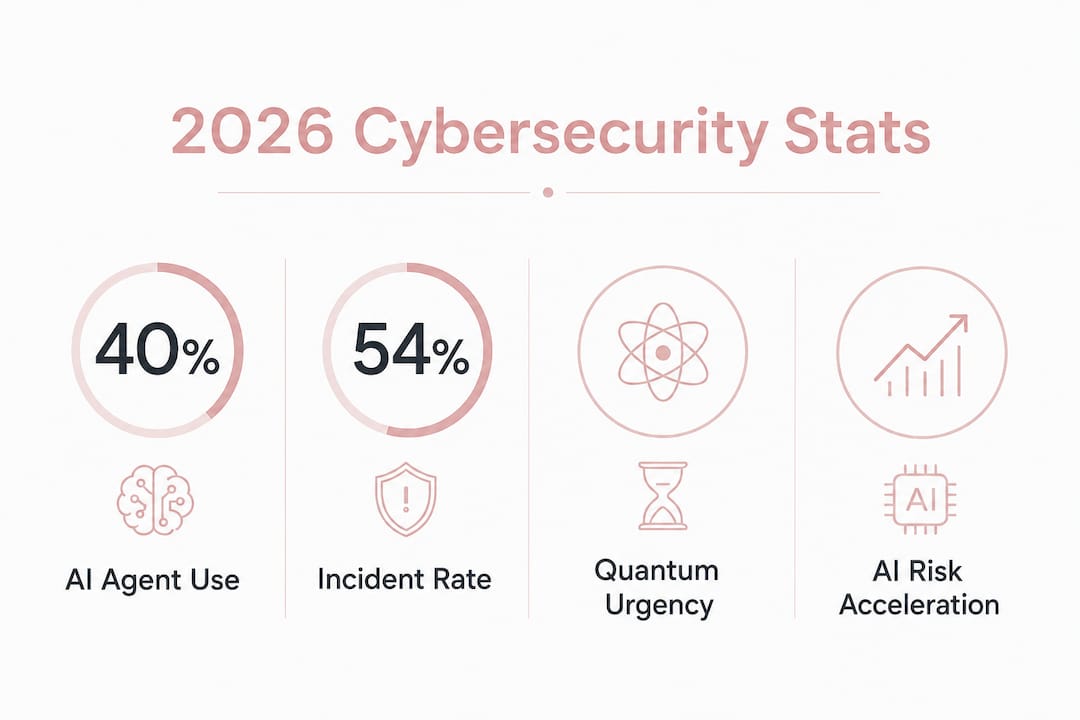
    Infographic highlighting key cybersecurity statistics for 2026

    AI agent adoption is expected to grow from less than 5% of enterprise applications in 2025 to 40% by the end of 2026. That growth curve is the core problem. Security programs built for human users and static software simply do not map onto agents that act autonomously, call external APIs, and persist across sessions.

    Hands typing on keyboard in tech home office

    The data on what is already going wrong is stark. 54% of enterprises have experienced an AI agent security incident or near miss. Yet 69% still allow agents to share credentials, and only 30% isolate high-risk agents in sandboxed environments. That gap between deployment speed and security controls is where most of the current exposure lives.

    Cybersecurity team reviewing incident reports in meeting room

    MetricCurrent State
    Enterprise apps using AI agents (2025)Less than 5%
    Enterprise apps using AI agents (end of 2026, projected)40%
    Enterprises with AI agent incidents or near misses54%
    Enterprises allowing credential sharing among agents69%
    Enterprises isolating high-risk agents30%
    Enterprises planning agent security tooling upgrades in 202659%

    Best practices emerging from security leaders include assigning unique machine identities to each agent, enforcing least-privilege access at the agent level, logging all agent actions for forensic traceability, and treating agent-to-agent communication as an untrusted channel by default. The NIST Cybersecurity Framework provides a governance baseline, but most organizations need agent-specific extensions on top of it.

    Pro Tip: Before deploying any new AI agent in a production environment, map every credential it touches and every external system it calls. If you cannot draw that map in under 30 minutes, the agent is not ready for production.

    2. Why identity security has become a national security priority

    Identity is the new perimeter, and the AI agent explosion has made that phrase literal rather than metaphorical. When an agent shares a human service account credential, a single compromise does not just expose one user. It exposes every system that credential touches, often across multiple business units, with no clean audit trail showing which actions were human and which were automated.

    The consequences of inadequate identity governance in an AI-heavy environment include:

    • Expanded blast radius: Shared credentials mean a compromised agent can move laterally across the entire scope of that credential’s permissions.
    • Forensic opacity: Distinguishing malicious agent activity from legitimate automation becomes extremely difficult after the fact.
    • Compliance exposure: Regulations like HIPAA, enforced by the HHS Office for Civil Rights, and financial sector rules from the FFIEC require demonstrable access controls that shared agent credentials cannot satisfy.

    Emerging identity standards for 2026 center on scoped machine identities, short-lived tokens, and continuous authentication rather than static API keys. The federal government’s push on identity, reflected in CISA guidance and the Department of Defense’s CMMC framework, signals that identity governance is no longer a vendor conversation. It is a policy one. For enterprise security leaders, the practical implication is straightforward: every AI agent needs its own identity, and that identity needs to be auditable.

    3. How do Zero Trust and continuous exposure management work together?

    Zero Trust operates on one principle: never assume a connection is safe because of where it originates. Every user, device, and workload must authenticate and be authorized continuously, not just at login. Enterprises that adopted Zero Trust frameworks before 2024 are seeing substantially better security outcomes and faster breach containment times compared to peers still running implicit-trust network models.

    Continuous Exposure Management (CEM) is the operational layer that makes Zero Trust sustainable at scale. Rather than running point-in-time vulnerability scans, CEM provides ongoing visibility into the attack surface, prioritizing exposures by actual exploitability rather than theoretical severity scores. Together, Zero Trust and CEM shift security from a reactive posture to a persistent one.

    Managed Detection and Response (MDR) solutions fit naturally into this architecture. MDR providers combine 24/7 threat monitoring, AI-assisted triage, and human analyst escalation to close the gap between detection and response. For mid-sized enterprises without a full security operations center, MDR is often the most practical path to Zero Trust-aligned detection coverage. The cybersecurity strategy considerations for organizations at this stage typically center on which MDR capabilities to build internally versus source externally.

    Advanced threat detection techniques layered into this ecosystem include:

    • Behavioral analytics to flag anomalous agent or user activity against established baselines.
    • Deception technology such as honeytokens and honeypots that trigger alerts when accessed.
    • AI-assisted log correlation across cloud, endpoint, and network telemetry to surface attack chains that rule-based systems miss.

    4. Quantum-safe cryptography: why 2026 is the year to act

    Traditional public-key encryption, including RSA and elliptic-curve cryptography, relies on mathematical problems that quantum computers will eventually solve in hours rather than years. “Harvest now, decrypt later” attacks are already happening: adversaries collect encrypted data today with the intent to decrypt it once quantum capability matures. Any data with a long confidentiality shelf life, including health records, financial contracts, and intellectual property, is already at risk.

    NIST finalized its first post-quantum cryptographic standards in 2024, including CRYSTALS-Kyber for key encapsulation and CRYSTALS-Dilithium for digital signatures. These are the building blocks enterprises need to start testing now. Government agencies operating under NSA’s Commercial National Security Algorithm Suite 2.0 (CNSA 2.0) have mandatory migration timelines that are already running.

    Cryptographic agility is the strategic response: designing systems so that cryptographic algorithms can be swapped without rebuilding the underlying architecture. Enterprises that hardcode a single algorithm into their infrastructure will face expensive rework when migration deadlines arrive. The practical steps for 2026 include:

    • Inventory all cryptographic dependencies across applications, APIs, and data stores.
    • Prioritize high-value data for early migration to post-quantum algorithms.
    • Test NIST-approved algorithms in non-production environments before committing to production rollouts.
    • Update vendor contracts to require post-quantum readiness roadmaps from all technology suppliers.

    5. Deepfakes, synthetic identities, and the new ransomware playbook

    The threat landscape in 2026 has a distinctly generative quality. Deepfake audio and video are now cheap enough to use in targeted business email compromise attacks, with attackers impersonating CFOs or legal counsel to authorize wire transfers or data disclosures. Synthetic identity fraud, where AI assembles plausible fake identities from real data fragments, is accelerating in financial services and healthcare onboarding.

    Ransomware has evolved past simple encryption. The dominant model now combines data exfiltration with encryption, giving attackers two leverage points: pay to restore access, or pay to prevent publication of stolen data. Some groups have added a third: threatening to notify regulators about the breach, using the victim’s own compliance obligations as coercion. Resilience strategies enterprises are prioritizing include:

    • Tabletop exercises that simulate ransomware scenarios including the regulatory notification clock.
    • Immutable backup architectures that attackers cannot reach through compromised admin credentials.
    • Cyber insurance reviews to confirm that policies cover extortion payments and regulatory fines, not just recovery costs.
    • AI-assisted phishing detection trained on deepfake indicators, not just text-based signals.

    The workforce dimension matters here too. Security teams that have never responded to a deepfake-enabled social engineering attack need practice before the real event. Simulation platforms that generate synthetic deepfake scenarios for training are moving from experimental to standard practice.

    6. What does the 2026 regulatory environment actually require?

    Two regulatory developments are reshaping enterprise compliance programs right now. First, the Cyber Incident Reporting for Critical Infrastructure Act (CIRCIA) final rule is expected in September 2026, requiring covered entities to report confirmed breaches to CISA within 72 hours of reasonably believing a covered incident occurred. That window is tight. Organizations that lack automated detection and a pre-approved incident response playbook will struggle to meet it.

    Second, California’s privacy protection agency finalized cybersecurity risk assessment rules applying to companies that process significant personal data or exceed defined revenue thresholds. These rules require documented risk assessments, not just policies.

    The broader governance picture includes:

    • NIST CSF 2.0, which added a “Govern” function to the original five, making board-level accountability explicit.
    • Secure-by-design principles from CISA, which shift responsibility for security defaults from end users to technology manufacturers.
    • DevSecOps practices that embed security testing into CI/CD pipelines rather than treating it as a pre-launch gate.

    For enterprises, regulatory convergence means that a single incident can now trigger obligations under CIRCIA, state privacy laws, HIPAA, and sector-specific rules simultaneously. Compliance teams that manage these in separate silos will miss cross-cutting obligations.

    7. How AI regulations are reshaping cybersecurity audits

    California’s final rules on automated decision-making require companies to conduct cybersecurity risk assessments specifically for AI systems that make or inform consequential decisions about individuals. This is a meaningful shift: it treats AI models as security assets requiring the same audit rigor as databases or network infrastructure.

    Regulatory note: California’s cybersecurity risk assessment requirements for automated decision-making technologies took effect in 2026, applying to companies processing significant personal data or meeting defined revenue thresholds. Covered organizations must document AI-specific risks, not just general data security controls.

    The practical audit implications include mapping which AI models touch personal data, documenting the data flows into and out of those models, and assessing the security controls around model training pipelines. AI governance frameworks from sources like the Stanford HAI AI Index show that most enterprises are still treating AI risk as a separate track from cybersecurity risk. Regulators are closing that gap whether organizations are ready or not.

    For security leaders, the integration point is the enterprise risk register. AI systems need entries alongside traditional IT assets, with owners, control assessments, and remediation timelines. Compliance teams working through the intersection of data privacy and AI governance will find that the documentation requirements overlap significantly with existing privacy program obligations.

    8. How AI is accelerating intellectual property risk

    IBM Security Services and X-Force Threat Intelligence flag AI-driven IP risk as one of the most underappreciated attack vectors of 2026. The mechanism is not complicated: AI tools trained on or given access to proprietary data can leak that data through model outputs, API responses, or prompt injection attacks. An employee who pastes a confidential contract into a public large language model has effectively exfiltrated that data, even if no malicious actor was involved.

    The attack surface expands further when enterprises deploy AI agents with access to internal knowledge bases, code repositories, or customer records. An agent compromised through a prompt injection attack can be directed to exfiltrate data in ways that look like normal agent behavior. Traditional data loss prevention tools, built for human-initiated file transfers, often miss this pattern entirely.

    Practical controls for IP protection in an AI-heavy environment include data classification policies that explicitly cover AI inputs and outputs, contractual restrictions on vendor AI training using customer data, and monitoring for unusual query patterns against internal knowledge bases. The AI governance guidance available for enterprise teams increasingly addresses these specific vectors rather than treating AI risk as purely a model accuracy problem.

    9. The cybersecurity talent shortage is getting worse, not better

    The gap between open cybersecurity positions and qualified candidates has not closed. It has widened, partly because the skill requirements have shifted. Organizations now need people who understand AI security, cloud-native architectures, and OT/IT convergence simultaneously. That combination is rare, and the pipeline from universities and bootcamps has not caught up.

    Workforce development strategies that are gaining traction in 2026 include:

    • Upskilling existing IT staff in security fundamentals rather than waiting for specialist hires.
    • Security automation to reduce the manual workload on analysts, letting smaller teams cover more ground.
    • Managed security service providers to fill coverage gaps, particularly for overnight and weekend monitoring.
    • Apprenticeship programs partnered with community colleges, which are producing job-ready candidates faster than four-year degree programs for many technical roles.

    The talent shortage also has a retention dimension. Security professionals experiencing alert fatigue from understaffed SOCs are leaving for less demanding roles. Organizations that invest in automation to reduce noise and give analysts more meaningful work tend to retain staff longer. That is not a soft benefit. Turnover in a security team during an active incident is a material risk.

    10. How geopolitical tensions are reshaping cybersecurity policy

    State-sponsored cyber activity from Russia, China, North Korea, and Iran has moved from occasional headline events to persistent background noise for enterprise security teams. The targets have broadened beyond defense contractors and government agencies to include supply chains, financial infrastructure, and critical utilities. NERC’s CIP-003-11 standard, effective may 26, 2026, directly addresses coordinated cyberattacks on distributed low-impact bulk electric system assets, reflecting how seriously regulators now take the infrastructure threat.

    The policy response in the United States has accelerated on several fronts. Export controls on advanced semiconductors limit adversary access to the compute needed for AI-enabled offensive operations. Software supply chain security requirements, including SBOM mandates for federal contractors, are spreading into commercial sectors. Enterprises with international operations face the additional complexity of conflicting data localization requirements across jurisdictions.

    For security teams, the geopolitical dimension means threat intelligence needs to include nation-state actor profiles, not just criminal groups. IBM’s X-Force Threat Intelligence and CISA’s cybersecurity advisories both provide actionable attribution and indicator data that enterprise teams can operationalize.

    11. Cloud-native security and multi-cloud complexity

    Most enterprises now run workloads across two or more cloud providers, and the security model for each differs enough to create gaps at the seams. Identity federation, network segmentation, and logging configurations that work correctly in one cloud environment do not automatically transfer to another. Attackers know this and target the integration points.

    Cloud-native security in 2026 centers on a few non-negotiable practices: cloud security posture management (CSPM) tools that continuously audit configurations against security benchmarks, workload protection platforms that extend Zero Trust principles to containers and serverless functions, and unified logging that aggregates events across providers into a single detection surface. The role of cybersecurity in business operations is increasingly inseparable from cloud architecture decisions, which means security leaders need a seat at the table when cloud strategy is set, not after the contracts are signed.

    12. IoT and OT security: the convergence problem

    Operational technology (OT) environments, including manufacturing systems, utilities, and building management infrastructure, were designed for reliability and longevity, not security. Many OT devices run firmware that cannot be patched, communicate over protocols with no authentication, and sit on networks that were never designed to be connected to the internet. The convergence of IT and OT networks, driven by efficiency and remote monitoring demands, has imported IT-style threats into environments that lack IT-style defenses.

    The 2026 priorities for IoT and OT security include network segmentation that isolates OT systems from IT and internet traffic, passive monitoring tools that detect anomalies without disrupting industrial protocols, and asset inventory programs that actually know what is on the OT network. The NERC CIP-003-11 standard for bulk electric system cyber systems is one model for how sector-specific OT security requirements are evolving, and similar frameworks are developing in water, oil and gas, and manufacturing.

    13. Where cybersecurity budgets are going in 2026

    Security budgets are growing, but the allocation is shifting. Spending on traditional perimeter security tools is flat or declining, while investment in identity and access management, AI-assisted detection, and cloud security is accelerating. MDR services are capturing budget that previously went to building internal SOC capacity, particularly in mid-market organizations where the economics of a fully staffed SOC do not work.

    Board-level attention to cyber risk has translated into more direct budget conversations. CISOs who can quantify risk in financial terms, using frameworks like FAIR (Factor Analysis of Information Risk), are getting better budget outcomes than those presenting technical metrics alone. Cyber insurance premiums continue to rise, and insurers are increasingly requiring documented security controls as a condition of coverage, which creates a secondary driver for investment in areas like MFA, endpoint detection, and incident response planning. For executives navigating these decisions, the technology leadership trends for 2026 provide useful context on how security investment fits within the broader technology strategy picture.


    Cybersecurity in 2026 rewards organizations that treat it as a business function, not a technical department. The enterprises getting ahead are the ones where security leaders have direct access to the board, where AI deployment decisions include security review from day one, and where regulatory compliance is treated as a floor rather than a ceiling.

    If your organization is navigating these shifts without a dedicated technology executive, a virtual CIO with cybersecurity depth can provide the strategic oversight you need without the cost and timeline of a full-time hire. Orloffphillips works with mid-sized and large organizations to build security programs that are proportionate to the actual threat picture, not just the compliance checklist.
    https://orloffphillips.com

    Key Takeaways

    The most important security reality of 2026 is that AI agent adoption, regulatory deadlines, and quantum urgency are converging simultaneously, and organizations that address them in silos will face compounding exposure.

    PointDetails
    AI agent security gap54% of enterprises have had an AI agent incident; 69% still allow credential sharing among agents. Only 30% of enterprises isolate high-risk agents in sandboxed environments.
    CIRCIA 72-hour reportingThe CIRCIA final rule expected in September 2026 requires breach reports within 72 hours of a confirmed covered incident.
    Quantum-safe cryptographyNIST post-quantum standards are finalized; enterprises must inventory cryptographic dependencies and begin migration planning now.
    Zero Trust outcomesEnterprises that adopted Zero Trust before 2024 show substantially better breach containment compared to peers on perimeter-based models.
    Budget shiftSecurity investment is moving from perimeter tools toward identity management, AI-assisted detection, and MDR services.
  • Cybersecurity Risk Assessment Guide for IT Teams

    Cybersecurity Risk Assessment Guide for IT Teams

    A cybersecurity risk assessment is defined as a structured process for identifying, analyzing, and prioritizing threats to an organization’s information assets so that security decisions are defensible, not reactive. The industry standard term for this process is “information security risk evaluation,” formalized under NIST SP 800-30, ISO 27005, and the CIS Controls framework. Every security team conducting this work needs a clear cybersecurity risk assessment guide, because the gap between a compliance checkbox exercise and a genuinely useful assessment comes down to methodology and execution. Organizations that treat risk assessments as living processes, not one-time reports, consistently make better security investments and respond faster when threats materialize.

    What does a cybersecurity risk assessment guide actually cover?

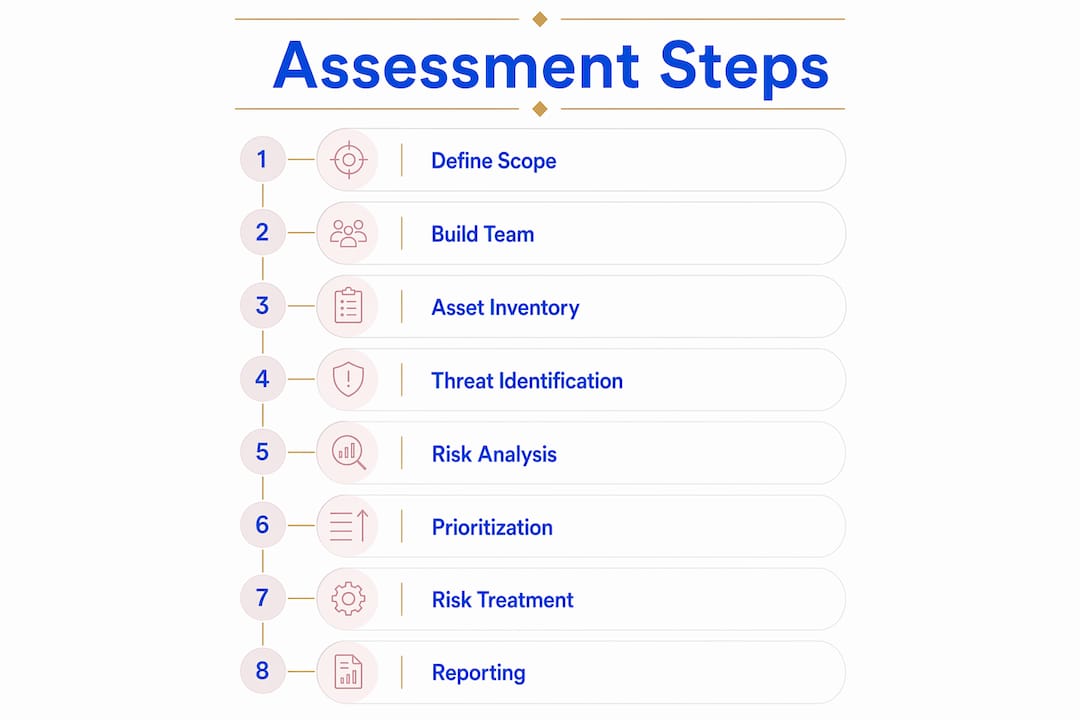
    A complete cybersecurity risk assessment follows 7–9 core steps: scope definition, asset inventory, threat identification, vulnerability identification, risk analysis, risk prioritization, treatment planning, implementation, and ongoing monitoring. Each step builds on the last. Skipping asset inventory, for example, means your threat analysis has no anchor, and your risk scores will reflect guesswork rather than reality.

    The foundational standards give you the structure. NIST SP 800-30 defines the risk assessment process at the federal level and is widely adopted across private industry. ISO 27005 provides a complementary framework for information security risk management. The CIS Controls offer a prioritized set of security actions that map directly to common risk categories. Using all three together gives your assessment both rigor and practical grounding.

    Hands holding NIST cybersecurity documents

    Risk assessments serve primarily as decision-support tools that must be evidence-driven and outcome-focused. That distinction matters. A report that lists 200 vulnerabilities without telling leadership which three to fix first has failed its purpose. The goal is not completeness for its own sake. The goal is clarity about where your organization is most exposed and what to do about it.

    Beyond compliance, a well-executed assessment gives your organization a defensible basis for security spending. Regulators, auditors, and boards all ask the same question: “How do you know your controls are appropriate?” A documented risk assessment is your answer.

    How to execute a step-by-step cybersecurity risk assessment

    Define scope and build your team

    Scope definition is the single decision that most determines assessment quality. A scope that is too narrow produces a false sense of security. A scope that is too broad produces a report no one can act on. Define scope by business function first, then map it to systems, data flows, and physical locations.

    Infographic displaying cybersecurity risk assessment steps

    Assessment depth depends heavily on resource allocation and team composition. Multi-disciplinary teams with longer timelines produce more granular and actionable insights. That is not an argument for unlimited budgets. It is an argument for being deliberate about who sits in the room.

    Your assessment team should include:

    • Security engineers who understand technical controls and vulnerability data
    • Legal counsel who can identify regulatory obligations and data classification requirements
    • Operations managers who know which systems are truly mission-critical
    • HR representatives who can address insider threat and personnel risk factors
    • Finance or risk officers who translate security findings into business impact language

    Failing to include legal, operational, and business stakeholders leads to superficial results and poor organizational buy-in. Security teams that run assessments in isolation consistently produce findings that never get funded or remediated.

    Conduct asset inventory and threat identification

    Asset inventory is not glamorous work, but it is the foundation of every credible risk analysis. Catalog hardware, software, data repositories, cloud services, third-party integrations, and physical access points. Classify each asset by sensitivity and criticality to business operations. An unclassified asset is an unmanaged risk.

    Threat identification follows asset inventory. Map known threat actors, attack vectors, and threat events to each asset category. Use sources like the MITRE ATT&CK framework, CISA advisories, and your own incident history. Pair threat identification with vulnerability scanning and manual review to surface exploitable weaknesses.

    Pro Tip: Run your asset inventory against your network diagram and your vendor contract list simultaneously. Assets that appear in only one of the three sources are your highest-risk blind spots.

    NIST CSF 2.0 combined with SP 800-30 provides a repeatable, control-based, outcome-focused framework that aligns cybersecurity outcomes with business priorities. Using this combination means your assessment produces findings that map directly to existing controls, making gap analysis faster and remediation planning more precise.

    For fintech and B2B SaaS environments, specialized risk identification methods for asset and process-based assessments add significant value, particularly where regulatory exposure is high and data flows cross multiple jurisdictions.

    How to analyze, prioritize, and treat cybersecurity risks

    Score risks using inherent and residual risk

    Every risk carries two values: inherent risk and residual risk. Inherent risk is the exposure level before any controls are applied. Residual risk is what remains after your existing controls are factored in. The gap between the two tells you whether your current controls are working or whether you are accepting more risk than you realize.

    Effective risk prioritization converts qualitative ratings into numerical scores based on business impact, allowing objective ranking within limited budget constraints. A five-point likelihood scale combined with a five-point impact scale produces a 25-point risk matrix. Risks scoring above 15 typically require immediate treatment. Risks scoring below 6 are candidates for acceptance with documentation.

    The four treatment options are:

    1. Mitigate. Implement or strengthen controls to reduce likelihood or impact.
    2. Transfer. Shift financial exposure through cyber insurance or contractual liability clauses.
    3. Avoid. Eliminate the activity or system that creates the risk.
    4. Accept. Consciously document the decision to carry the residual risk.

    Risk response options including acceptance require documented decisions and conscious management of residual risk. Acceptance without documentation is not a risk decision. It is negligence with plausible deniability.

    Align risk priorities with enterprise objectives

    NIST guidance requires mapping cyber risks to mission-essential functions within an Enterprise Risk Management framework. That means your risk register cannot live only in the security team’s spreadsheet. It must connect to the business functions that generate revenue, serve customers, or fulfill regulatory obligations.

    A formal Cybersecurity Risk Register should integrate with the enterprise risk register, mapping risks to business mission and enabling optimized capital allocation. When a CISO presents risk findings to a board, the most persuasive frame is always business impact, not technical severity.

    Pro Tip: Before presenting risk findings to leadership, translate each top-10 risk into a dollar-range business impact estimate. Boards respond to financial exposure far more reliably than to CVSS scores.

    Communicating risk priorities to leadership requires plain language, a clear ranking, and a recommended action for each top risk. A one-page risk summary with a heat map is more effective than a 40-page technical report for driving executive decisions.

    What are the most common pitfalls in cybersecurity risk assessments?

    The most damaging mistake security teams make is limiting assessments to technical elements like IP addresses and software vulnerabilities. That approach misses procedural failures, physical access risks, and personnel threats, which account for a significant share of actual security incidents.

    Other pitfalls that consistently undermine assessment value:

    • Treating the assessment as a compliance event. Compliance deadlines create artificial urgency and narrow scope. A risk assessment built around an audit calendar produces findings that satisfy auditors, not security teams.
    • Weak scope definition. Scopes that exclude cloud environments, third-party vendors, or remote work infrastructure leave the most dynamic parts of your attack surface unexamined.
    • No governance structure before you start. Risk register governance, including defining roles for risk acceptance and sign-off before assessment begins, avoids decision bottlenecks after findings are delivered. Without pre-defined ownership, findings sit in a queue while stakeholders debate accountability.
    • Ignoring the human layer. Phishing susceptibility, privileged access abuse, and contractor onboarding gaps are personnel risks that no vulnerability scanner will surface.

    Continuous monitoring and periodic reassessment are critical to maintaining an accurate risk profile and adapting to system or threat changes. A risk assessment completed in january is materially outdated by july if your environment has changed, new threat intelligence has emerged, or a major vendor has been breached.

    “A cybersecurity risk assessment that sits on a shelf is not a security asset. It is a liability. The moment it stops reflecting your current environment, it gives leadership false confidence and security teams a false mandate.”

    Alignment between cybersecurity risk registers and enterprise risk management frameworks ensures that cyber risks receive appropriate executive attention and funding. Without that alignment, security teams fight for budget against business units that speak the language of financial risk natively. For a broader view of how cybersecurity fits business strategy, integrating risk management into resilience planning is the logical next step.

    Key Takeaways

    A cybersecurity risk assessment produces defensible security decisions only when it integrates structured methodology, cross-functional governance, and continuous reassessment into a single repeatable process.

    PointDetails
    Define scope by business functionScope to business operations first, then map to systems and data flows to avoid blind spots.
    Build cross-functional teamsInclude legal, operations, HR, and finance alongside security engineers for complete risk coverage.
    Score inherent and residual riskCalculate both values to reveal whether existing controls are actually reducing exposure.
    Integrate with enterprise risk managementMap cyber risks to mission-critical functions so findings compete for budget on business terms.
    Reassess continuouslyTreat the risk assessment as a living process, not a static report, to maintain an accurate risk profile.

    Why most risk assessments fail before they start

    The hardest lesson I have learned working with mid-sized and large organizations on cybersecurity strategy is that most assessments fail in the planning phase, not the execution phase. Teams spend weeks on threat modeling and vulnerability scanning, then deliver findings to a leadership team that was never involved in defining what “acceptable risk” means for the organization. The result is a technically sound document that produces no decisions and no funding.

    The fix is not a better methodology. The fix is governance. Establishing governance early in the assessment lifecycle clarifies risk ownership and accelerates remediation. That means getting executives to agree on risk appetite, risk tolerance, and decision authority before the first asset is inventoried. Without those agreements, every finding becomes a negotiation.

    My second observation is that organizations consistently underestimate the value of mapping risks to mission-critical functions rather than to systems. A vulnerability in a payroll system is not just a technical finding. It is a business continuity risk, a regulatory exposure, and a reputational liability. When security teams frame findings in those terms, remediation timelines shrink dramatically.

    The organizations that get the most value from risk assessments treat them as a continuous improvement program. They schedule quarterly reviews, assign risk owners who report to the C-suite, and update their risk registers whenever a significant system change or threat event occurs. That cadence is not a burden. It is what separates organizations that manage risk from organizations that react to incidents.

    — Orloff

    Orloffphillips technology leadership for cybersecurity risk programs

    Cybersecurity risk management requires both technical depth and executive alignment. Orloffphillips works with mid-sized and large organizations across the United States to build risk assessment programs that connect security findings to business outcomes.

    https://orloffphillips.com

    Whether your organization needs a fractional CISO to lead your first formal assessment or an experienced technology strategist to align your risk register with enterprise priorities, Orloffphillips provides the leadership capacity to move from findings to decisions. Explore the technology strategy guide to see how risk management integrates with broader technology leadership. For organizations building or maturing their cybersecurity strategy, Orloffphillips offers tailored advisory that fits your organization’s scale and risk appetite.

    FAQ

    What is a cybersecurity risk assessment?

    A cybersecurity risk assessment is a structured process for identifying threats, vulnerabilities, and impacts to an organization’s information assets, following frameworks like NIST SP 800-30 and ISO 27005. The output is a prioritized risk register that guides security investment decisions.

    How often should organizations conduct a risk assessment?

    Organizations should conduct a formal risk assessment at least annually, with continuous monitoring and triggered reassessments whenever significant system changes, new threat intelligence, or major incidents occur.

    What is the difference between inherent risk and residual risk?

    Inherent risk is the exposure level before any controls are applied. Residual risk is what remains after existing controls are factored in. The gap between the two reveals whether current controls are effective.

    Which framework is best for a cybersecurity risk assessment?

    NIST CSF 2.0 combined with SP 800-30 provides a repeatable, control-based framework that aligns cybersecurity outcomes with business priorities and is widely recognized across both public and private sectors.

    Who should be involved in a cybersecurity risk assessment?

    Effective assessments require cross-functional teams that include security engineers, legal counsel, operations managers, HR representatives, and finance or risk officers. Excluding business stakeholders consistently produces findings that fail to gain organizational support or funding.

  • Why Choose Virtual Executives: The 2026 Leader’s Guide

    Why Choose Virtual Executives: The 2026 Leader’s Guide

    Virtual executives are senior leaders who deliver part-time, high-impact expertise remotely, giving businesses C-suite capability without the cost or commitment of a full-time hire. The industry term for this model is “fractional executive,” and understanding why choose virtual executives starts with one fact: fractional retainers range $3,000–$20,000 per month versus $200,000–$400,000 for a fully loaded full-time executive. That gap changes the math for every mid-sized company navigating growth, digital transformation, or a leadership gap. This guide covers the benefits of virtual executives, the scenarios where they excel, the role AI now plays, and a practical framework to decide if this model fits your organization.

    Why choose virtual executives over full-time hires?

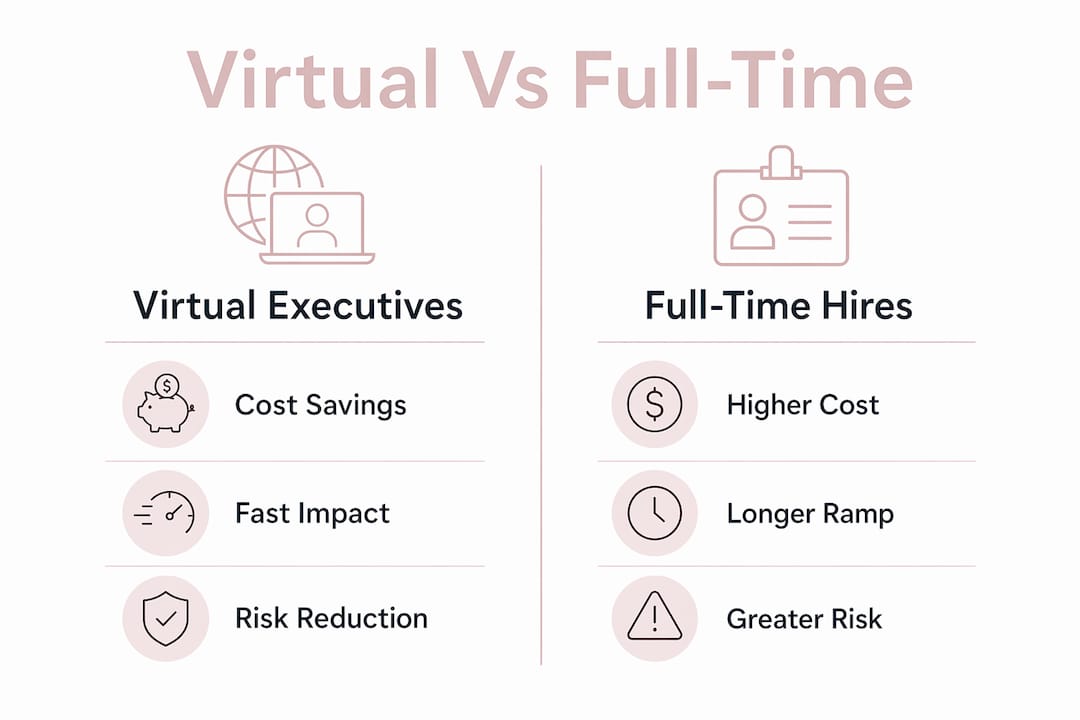
    The financial case is the starting point, but it is not the whole story. Hiring fractional executives saves 40–70% compared to fully loaded full-time hires when you account for salary, benefits, equity dilution, and recruiting fees. That saving frees capital for product development, sales, or technology infrastructure where it creates direct value.

    Speed is the second major advantage. Fractional executives deliver impact in 30–45 days compared to 3–6 months for a traditional full-time hire. A company facing a technology audit or a fundraising round cannot wait six months for a CTO to reach full productivity.

    Virtual executives collaborating in video meeting

    Risk reduction is the third pillar. Executive hiring failure rates run 40–50% within 18 months, making full-time C-suite hiring one of the highest-risk decisions a company makes. Fractional engagements remove that exposure. You can pause, end, or convert the role to full-time with short notice, which is particularly valuable during fundraising cycles, pivots, or market uncertainty.

    The advantages of remote executives also include network access. Virtual executives bring extensive professional networks that accelerate investor introductions, legal counsel, and partner relationships beyond what most in-house teams can build. That network effect often delivers more value than the role itself.

    Pro Tip: Before engaging a fractional executive, ask for three specific examples of measurable outcomes they delivered within the first 60 days at a previous client. Speed to impact is their core value proposition, and they should be able to prove it.

    • Cost savings: 40–70% reduction versus full-time, covering salary, benefits, equity, and recruiting.
    • Speed: Impact in 30–45 days versus 3–6 months for a traditional hire.
    • Risk reduction: Engagements can be paused or ended without the legal and financial weight of terminating a full-time executive.
    • Expertise on demand: Access to senior leaders with multi-stage company experience who would be unaffordable full-time.
    • Network leverage: Relationships with investors, attorneys, and partners that compress go-to-market timelines.

    How do virtual executives adapt to specific business needs?

    The fractional model fits well-defined situations. Startups that need a CFO for a Series A process, scaling companies that need a COO to build operational systems, and organizations in leadership transition all benefit from fractional C-suite leadership without committing to a permanent hire. The model works because the scope is clear and the timeline is finite.

    Infographic comparing virtual and full-time executives

    Fractional executives excel at 10–25 hours per week when the role addresses a specific functional gap or project. A fractional CHRO building a compensation framework, a fractional CTO leading a platform migration, or a virtual COO designing scalable processes are all well-matched use cases. The role scope matches the fractional involvement.

    Common scenarios where virtual executive services deliver the most value:

    • Startups (Series A–C): Need CFO or CTO expertise for fundraising, compliance, or technology architecture but cannot justify a full-time salary.
    • Volatile or transitional markets: Companies facing rapid change need flexible leadership that can be scaled up or down without restructuring.
    • Leadership gaps: An unexpected departure creates an immediate need for experienced interim leadership while a permanent search runs.
    • Specific projects: A cybersecurity overhaul, ERP implementation, or digital transformation initiative requires focused expertise for 6–12 months.

    The model does have limits. Founders often delay hiring executive support due to cost perceptions, but the bigger mistake is using a fractional model for roles that genuinely require full-time daily presence. A Chief People Officer building culture in a 500-person company through a merger needs to be in the room every day. A fractional arrangement in that context creates gaps that hurt the business.

    What role does AI play in virtual executive services?

    AI is changing what a virtual executive can deliver. The shift is not about automating reports. 55% of CFOs expect AI to take over more strategic work than routine tasks, which means the virtual CFO of 2026 is not just reviewing numbers. They are using AI to run scenario models, stress-test assumptions, and surface risks that a human analyst would miss in a standard review cycle.

    The next wave beyond automation is virtual executives acting as strategic thought partners who challenge assumptions and provide multi-angle analysis. An AI-augmented virtual CTO can monitor your entire technology stack, flag vendor contract anomalies, and prepare a board-ready risk briefing in hours rather than weeks. That is a qualitative leap in what part-time executive involvement can accomplish.

    “The virtual deputy CFO model represents a shift from task automation to strategic agency. The executive is no longer just reviewing outputs. They are using AI to continuously challenge the business’s financial assumptions and provide insight that a full-time hire without those tools simply cannot match.”

    Governance is the non-negotiable counterpart to AI augmentation. Governance frameworks are required for AI-driven virtual executive teams to manage delegation, error detection, and human oversight. Without a clear authority matrix, an AI-augmented executive role can produce confident but incorrect outputs with no one accountable for catching the error. Business leaders considering AI-augmented virtual executive services should review AI governance credentials to understand what oversight structures are now considered standard practice.

    Pro Tip: When evaluating an AI-augmented virtual executive, ask specifically how errors in AI-generated analysis are detected and escalated. The answer reveals whether the governance architecture is real or theoretical.

    How do you decide if a virtual executive is right for your company?

    The decision starts with mandate clarity. A clear scope with measurable 90-day success criteria is the single biggest predictor of a successful fractional engagement. Without it, the executive spends the first month diagnosing what the problem actually is, and you pay for that discovery time.

    Use this four-step framework before you engage:

    1. Define the problem. Write one sentence describing the specific gap: “We need a CTO to lead our cloud migration from on-premise infrastructure to AWS by Q3.” Vague mandates produce vague results.
    2. Set 90-day metrics. Identify three measurable outcomes the executive must deliver in the first 90 days. These become the engagement brief and the performance baseline.
    3. Assess presence requirements. If the role requires daily physical presence, team culture immersion, or real-time crisis response, a fractional model will underperform. Be honest about this before signing.
    4. Run the cost-benefit comparison. Compare the fractional retainer against the fully loaded cost of a full-time hire, including recruiting fees, benefits, and the 3–6 month ramp time where you are paying full salary for partial output.
    Decision factorFractional modelFull-time hire
    Time to impact30–45 days3–6 months
    Monthly cost$3,000–$20,000$17,000–$33,000+
    Engagement flexibilityPause or end with short noticeTermination costs and legal risk
    Best fitDefined scope, project-based, or transitionalOngoing daily presence, culture-critical roles

    Fractional executives demand rapid diagnosis, ruthless prioritization, and self-driven accountability to succeed. That profile is different from a full-time executive who builds into a role over a year. When you write your engagement brief, test candidates on exactly those qualities. Ask how they would prioritize in week one and what they would need from your team to move fast.

    Key Takeaways

    Virtual executives deliver the fastest, most cost-effective path to senior expertise when the engagement scope is clear, the 90-day metrics are defined, and the role does not require full-time daily presence.

    PointDetails
    Cost savings are significantFractional retainers save 40–70% versus fully loaded full-time executive costs.
    Speed to impact is a core advantageFractional executives deliver measurable results in 30–45 days versus 3–6 months for traditional hires.
    Mandate clarity drives successDefine scope and 90-day metrics before hiring to avoid costly discovery periods.
    AI augmentation raises the ceilingAI-augmented virtual executives provide strategic analysis that exceeds what a traditional part-time role could deliver.
    Governance is non-negotiableAny AI-augmented virtual executive engagement requires a clear authority matrix and human oversight structure.

    What I’ve learned from placing fractional executives in complex organizations

    The most common mistake I see is leaders treating a fractional engagement like a part-time employee. It is not. A fractional executive operates more like a specialist surgeon: they come in with a specific diagnosis, execute with precision, and leave the organization better than they found it. The engagement works when the leader on your side is equally prepared.

    The second lesson is about timing. Most founders wait too long to bring in senior help because they equate leadership with full-time cost. By the time they engage a fractional CFO or CTO, they have already made three decisions that the executive now has to undo. The preventive value of experienced fractional leadership is real, and it is consistently underpriced by the market.

    On AI augmentation: I am genuinely excited about what AI-augmented virtual executives can do, but I am cautious about the governance gap. Most organizations do not yet have the authority matrices and error-detection protocols that structured human oversight requires. The technology is ahead of the governance, and that is a risk leaders need to price in before they deploy it.

    My practical advice: start with a fractional executive in one function where the scope is clear and the metrics are measurable. Use that engagement to learn how your organization absorbs external executive leadership. Then expand. The companies that get the most from this model treat the first engagement as a capability-building exercise, not just a problem-solving exercise.

    — Orloff

    How Orloffphillips supports your virtual executive strategy

    Orloffphillips works with mid-sized and large organizations across the United States to identify, structure, and integrate virtual executive roles that deliver measurable results. The firm specializes in fractional CIO, CTO, and COO engagements, with deep expertise in digital transformation, cybersecurity, and IT roadmapping.

    https://orloffphillips.com

    Every engagement starts with a mandate-clarity session that produces a defined scope, 90-day success metrics, and a governance framework before the executive starts. If you are evaluating technology leadership specifically, the virtual CIO selection guide walks through the exact criteria, cost benchmarks, and interview questions you need to make a confident decision. For a broader view of how fractional executive models drive agility and results, Orloffphillips has the resources and the track record to guide your next step.

    FAQ

    What is a virtual executive?

    A virtual executive, also called a fractional executive, is a senior leader who works part-time and remotely for a company, providing C-suite expertise without a full-time employment commitment.

    How much does a virtual executive cost?

    Fractional executive retainers typically range from $3,000 to $20,000 per month, compared to $200,000–$400,000 annually for a fully loaded full-time hire.

    How fast can a virtual executive make an impact?

    Fractional executives typically deliver measurable impact within 30–45 days, significantly faster than the 3–6 month ramp time for a full-time hire.

    When is a virtual executive not the right choice?

    A virtual executive is not the right fit when the role requires full-time daily physical presence, deep cultural immersion, or real-time crisis response that a part-time arrangement cannot support.

    What roles work best as virtual executive positions?

    Fractional CFO, CTO, COO, and CHRO roles are the most common and effective, particularly for startups, companies in transition, or organizations running defined technology or operational projects.

  • What Is an IT Roadmap? A Guide for Business Leaders

    What Is an IT Roadmap? A Guide for Business Leaders

    An IT roadmap is defined as a sequenced, high-level strategic plan that aligns technology investments with business outcomes over a 12 to 36 month horizon. The formal industry term is “IT strategy roadmap,” and understanding the distinction matters. Most organizations confuse it with a project plan or a vendor release schedule. Neither is correct. A technology roadmap answers one question: “What technology decisions, in what order, will move this organization from where it is today to where it needs to be?” Orloffphillips works with executive teams across the United States to build exactly this kind of decision instrument, not documentation for its own sake.

    What is an IT roadmap, and how does it differ from strategy and project plans?

    An IT roadmap is not the same as an IT strategy, and treating them as interchangeable is one of the most common mistakes business professionals make. Strategy is the destination. The roadmap is the sequenced route, with timing, priorities, and ownership assigned to each leg of the journey. Project plans sit below both, detailing the tactical execution of individual initiatives.

    Think of it this way. Your IT strategy says, “We will become a cloud-first organization to support 40% headcount growth over three years.” Your IT roadmap says, “We will migrate core infrastructure in Q1, consolidate vendor contracts in Q2, and deploy the new collaboration platform in Q3.” Your project plans say, “The infrastructure migration will require these 14 tasks, these three team members, and this budget.”

    Professional interacting with IT roadmap tablet

    The three layers serve different audiences. The IT strategy speaks to the board and CEO. The roadmap speaks to the executive team and department heads. Project plans speak to the teams doing the work.

    Key distinctions that business professionals must keep clear:

    • IT strategy defines the business and technology destination, typically tied to a three to five year vision.
    • IT roadmap sequences the path with timing, priorities, and named owners across a 12 to 36 month window.
    • Project plans break initiatives into tasks, timelines, and resource assignments at the execution level.
    • Themes vs. tasks: A roadmap focuses on strategic themes and sequencing rather than listing every tactical task. Leadership needs direction, not a task list.

    The roadmap’s power comes from what it forces you to decide. When you sequence initiatives, you expose dependencies, resource conflicts, and trade-offs that a strategy document never surfaces.

    How is an effective IT roadmap structured and maintained?

    An effective IT roadmap follows a defined lifecycle, not a one-time planning event. The lifecycle includes defining business outcomes, assessing the current technology state, identifying risks, prioritizing by business impact, sequencing work, assigning owners and budgets, and reviewing quarterly. Each stage builds on the previous one, and skipping any step produces a plan that cannot be executed.

    The three time horizons

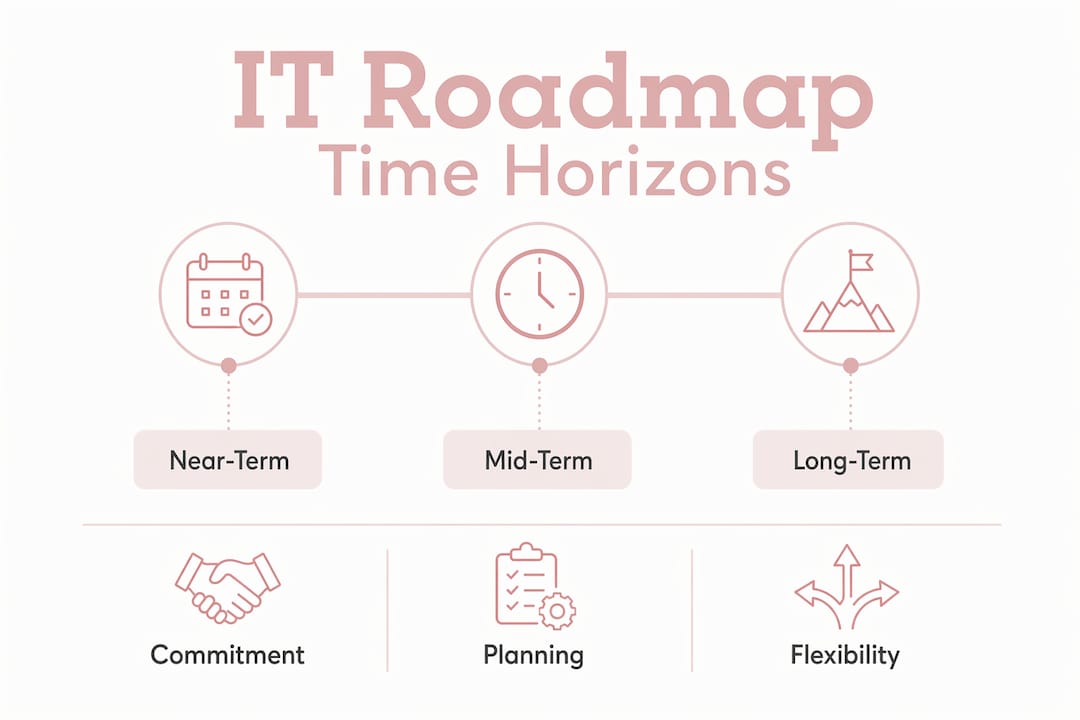
    Time horizons differentiate commitment levels across the roadmap. Near-term initiatives (0–6 months) are binding decisions with assigned budgets and owners. Mid-term initiatives (6–18 months) represent directional intent, subject to refinement as conditions change. Long-term initiatives (18–36 months) capture ambitions that inform current decisions without locking resources prematurely. This structure lets leaders apply appropriate governance at each horizon without over-engineering plans that are still evolving.

    Infographic showing IT roadmap time horizons

    Sequencing versus prioritization

    Most teams prioritize. Fewer teams sequence properly. Sequencing defines order and pacing based on dependencies and capacity, while prioritization simply ranks importance. A cybersecurity upgrade may rank lower in priority than a new CRM platform, but if the cybersecurity work is a prerequisite for the CRM integration, sequencing puts it first. Ignoring this distinction breaks roadmap schedules in practice.

    The review cadence

    1. Define outcomes first. Start with the business goals the roadmap must support, not the technology you want to buy.
    2. Assess the current state honestly. Inventory endpoints, licenses, contracts, and controls before sequencing anything.
    3. Identify risks and dependencies. Map what blocks what before assigning timelines.
    4. Prioritize by business impact. Use a scoring model to reduce bias and make trade-offs visible.
    5. Sequence with dependencies in mind. Order work by what must come first, not just what leadership prefers.
    6. Assign owners and budgets. Every initiative needs a named accountable person and a funding commitment.
    7. Review quarterly with live data. Successful roadmaps are updated quarterly with operational data, not revised once a year during budget season.

    Pro Tip: Set a fixed quarterly review date on the executive calendar before you publish the roadmap. A roadmap that has no scheduled review date becomes a static document within 90 days.

    What are the key benefits of an IT roadmap for business professionals?

    An IT roadmap secures executive buy-in by reframing technology investments as business enablers rather than cost centers. Connecting IT initiatives to specific business metrics like reducing system downtime or supporting headcount growth increases executive engagement and funding support. This shift from technical justification to business justification changes how the C-suite responds to IT requests.

    The governance benefit is equally significant. A roadmap makes trade-offs visible. When a new initiative appears mid-year, the roadmap shows exactly what gets displaced or delayed. That transparency prevents the common pattern where IT teams absorb new requests without adjusting scope, leading to overloaded teams and missed commitments.

    Key benefits business professionals gain from a well-maintained IT roadmap:

    • Executive alignment: Technology investments are framed in business language, making approval conversations faster and more productive.
    • Resource clarity: Sequencing exposes capacity conflicts before they become crises, not after.
    • Decision support: Roadmaps support consistent governance decisions by clarifying strategic intent, sequencing, trade-offs, and accountability in one view.
    • Adaptability: Quarterly updates let the organization respond to market shifts without abandoning the overall direction.
    • Stakeholder communication: A roadmap gives department heads a clear view of what technology changes are coming and when, reducing surprise and resistance.

    The IT planning roadmap also supports budget cycles. When technology initiatives are sequenced and tied to business outcomes, finance teams can plan capital and operating expenditures with greater confidence. That connection between IT and financial planning is where many organizations find the most immediate value.

    For organizations integrating new technologies into their business strategy, the roadmap provides the structure that prevents technology adoption from outpacing organizational readiness.

    How do you create and implement an IT roadmap effectively?

    Building a technology roadmap starts with an honest assessment of the current environment. Skipping the current-state assessment is the leading cause of IT roadmap failure, because without it, sequencing is guesswork. Inventory every significant system, contract, license, and control before writing a single initiative.

    Once the current state is documented, translate the business strategy into technology outcomes. Do not start with technology and work backward. Start with questions like: “What does the business need to achieve in the next 18 months?” and “What technology gaps prevent that?” The answers define the roadmap’s scope.

    The table below shows how to evaluate initiatives before sequencing them:

    Evaluation CriteriaWhat to assess
    Business impactDoes this initiative directly support a named business goal?
    DependenciesWhat must be completed before this initiative can start?
    Effort and costWhat resources, budget, and time does this require?
    RiskWhat happens if this is delayed or skipped?
    OwnershipWho is accountable for delivery and outcomes?

    Use a scoring model to rank initiatives against these criteria. Scoring reduces the influence of internal politics and makes the prioritization logic defensible to the executive team.

    After prioritization, sequence based on dependencies and pacing, not just scores. An initiative ranked second may need to start first because a higher-ranked initiative depends on its output. This is the step most IT planning roadmap processes skip, and it is the step most responsible for schedule failures.

    Assign a named owner and a confirmed budget to every initiative before publishing the roadmap. Initiatives without owners are wishes, not plans. Initiatives without budgets are aspirations, not commitments.

    Pro Tip: Build your roadmap in a format that can be updated without rebuilding from scratch. A live document reviewed quarterly with operational data outperforms a polished annual presentation every time. The IT risk management checklist from Orloffphillips provides a practical framework for identifying risks during the current-state assessment phase.

    Key Takeaways

    An IT roadmap is only as valuable as the governance discipline behind it. Organizations that treat it as a living decision tool consistently outperform those that treat it as annual documentation.

    PointDetails
    Definition and scopeAn IT roadmap sequences technology initiatives across a 12–36 month horizon tied to business outcomes.
    Strategy vs. roadmapStrategy sets the destination; the roadmap defines the sequenced route with timing and ownership.
    Sequencing over prioritizationDependencies and pacing determine order. Ranking alone produces broken schedules.
    Quarterly review disciplineUpdate the roadmap with live operational data every quarter to prevent it from becoming stale.
    Executive alignmentFraming IT investments in business outcome language secures funding and reduces approval friction.

    The roadmap mistake I see most often

    Every organization I have worked with has produced an IT roadmap at some point. Far fewer have produced one that actually guided decisions six months after it was published.

    The most common failure is not poor planning. It is building the roadmap before the IT strategy is clearly articulated. Without a clear strategic intent, the roadmap becomes a list of projects someone wanted to do anyway. It has no governance value because there is no agreed destination to sequence toward.

    The second failure is treating the roadmap as a deliverable rather than a decision instrument. Teams spend weeks producing a polished presentation, publish it, and then never open it again until the next annual planning cycle. By then, three major business conditions have changed and the roadmap is fiction.

    What actually works is treating the roadmap as a live readout. It sits in a shared space. It gets reviewed in every executive meeting where a technology decision is on the table. When a new initiative appears, the first question is: “Where does this fit in the sequence, and what does it displace?” That discipline is what separates organizations that execute well from those that are always surprised by IT costs and delays.

    The technology roadmapping guide Orloffphillips publishes for IT leaders covers the quarterly review process in detail. The process is not complicated. The discipline to follow it consistently is where most organizations need support.

    — Orloff

    How Orloffphillips supports IT roadmap execution

    Building a technology roadmap is straightforward in theory. Executing one that holds up through budget cycles, leadership changes, and shifting business priorities requires experienced guidance.

    https://orloffphillips.com

    Orloffphillips works with executive teams at mid-sized and large organizations across the United States to build IT roadmaps that function as real governance tools. The approach connects technology initiatives directly to business outcomes, sequences work based on dependencies and capacity, and establishes the review cadence that keeps the roadmap current. For organizations that need experienced strategic IT leadership without a full-time executive commitment, Orloffphillips offers fractional CIO and CTO engagements designed to deliver exactly that.

    FAQ

    What is an IT roadmap in simple terms?

    An IT roadmap is a sequenced plan that shows which technology initiatives an organization will pursue, in what order, and over what timeframe to achieve specific business goals. It typically covers a 12 to 36 month horizon.

    How is an IT roadmap different from an IT strategy?

    The IT strategy defines where the organization wants to go with technology. The IT roadmap defines the sequenced steps, timing, and ownership required to get there.

    How often should an IT roadmap be updated?

    An IT roadmap should be reviewed and updated quarterly using live operational data. Annual updates allow the roadmap to drift out of alignment with current business conditions.

    What is the most common reason IT roadmaps fail?

    The two leading causes are skipping the current-state assessment and building the roadmap before the IT strategy is clearly defined. Both produce a plan that cannot be executed accurately.

    Who owns the IT roadmap in an organization?

    The IT roadmap is owned by the senior technology leader, typically the CIO or CTO, but it requires active input and approval from the executive team to function as a governance tool.

  • Organizing Leadership Workshops 2026: A Practical Guide

    Organizing Leadership Workshops 2026: A Practical Guide

    Organizing leadership workshops is the process of designing and executing structured learning experiences that develop specific leadership behaviors tied to real business challenges. The best programs in 2026 go far beyond a single training day. They integrate behavioral assessments, experiential practice, and post-workshop accountability to produce measurable change. Only 24% of leadership professionals measure business impact from training, while 92% measure only learner reactions. That gap is exactly what separates forgettable workshops from ones that actually shift how leaders lead.

    How to plan leadership workshops with clear, measurable outcomes

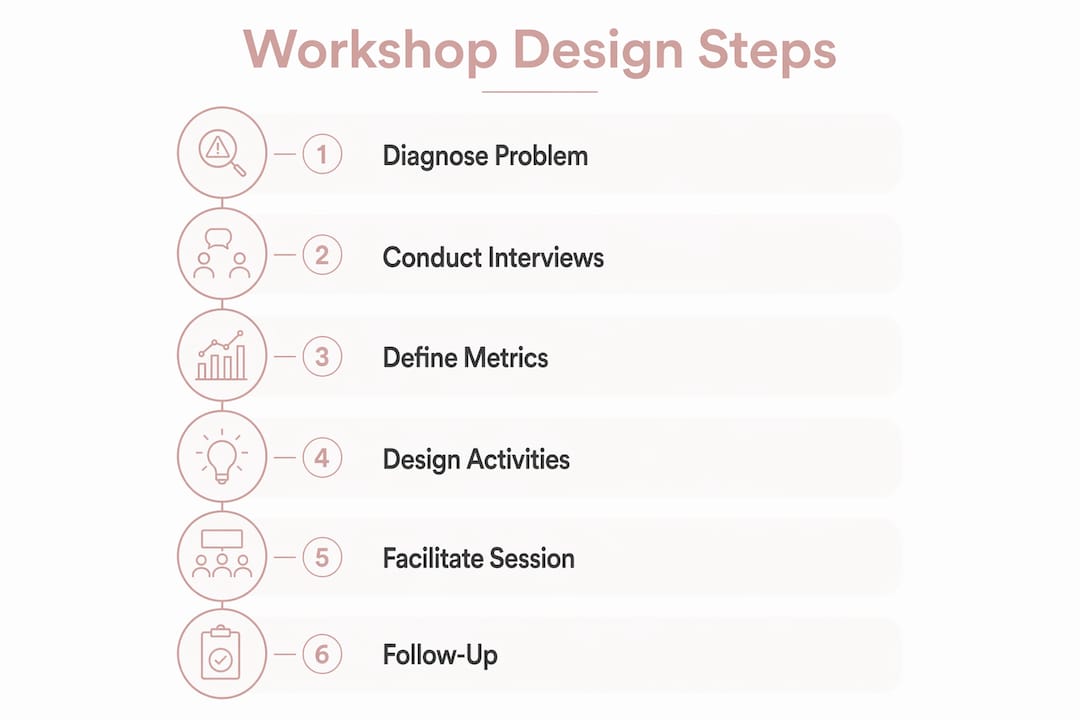
    The first step in planning any leadership development event is diagnosing the real business problem you are trying to solve. A workshop built around vague goals like “improve communication” produces vague results. Write specific behavioral outcomes instead: what should a participant do differently 90 days after the session ends?

    Stakeholder interviews are non-negotiable at this stage. Talk to direct managers, HR partners, and senior leaders before you design a single slide. Their input shapes the charter, which defines scope, success criteria, and budget. For multi-day retreats, plan 6–9 months ahead to allow time for pre-work, logistics, and participant preparation. Shorter half-day workshops can move faster, but still need 6–8 weeks of runway.

    Stakeholder interview in private office

    Participant readiness is a prerequisite, not an afterthought. Sending behavioral assessments like DiSC or CliftonStrengths before the event gives participants time to reflect. That reflection makes the workshop conversation richer and more personal from the first hour.

    Key planning steps to complete before design begins:

    • Define 2–3 specific behavioral outcomes tied to a named business challenge
    • Complete stakeholder interviews and document a workshop charter
    • Select and distribute pre-work assessments at least 3 weeks before the event
    • Confirm timeline: 6–9 months for retreats, 6–8 weeks minimum for workshops
    • Identify a sponsor who will reinforce learning after the event ends

    Pro Tip: Write your success metrics before you write your agenda. If you cannot describe what “success” looks like in behavioral terms, your design will drift toward content delivery instead of behavior change.

    What assessment tools and design frameworks maximize engagement?

    Behavioral assessment data is the foundation of a personalized workshop. Tools like DiSC, CliftonStrengths, and 360-degree feedback give facilitators concrete data to work with. They also give participants a shared language for discussing differences in communication style, decision-making, and conflict response. That shared language accelerates trust and makes difficult conversations feel safer.

    Infographic showing leadership workshop design steps

    Session design must prioritize doing over listening. Limit passive instruction to no more than 30–40% of total session time. The remaining time goes to role-playing, peer discussion, real-scenario problem-solving, and commitment planning. This ratio reflects the 70-20-10 development model, which places most learning in experience and social interaction rather than formal instruction.

    The 4A Model, developed by Jennifer Britton, offers a practical framework for session flow:

    1. Anchor: Connect new content to participants’ existing experience and assessment data
    2. Advance: Introduce the core concept or skill with minimal lecture time
    3. Apply: Practice the skill through a real workplace scenario or role-play
    4. Activate: Commit to a specific behavior change with a named accountability partner

    The 4A Model recommends interaction every 7–10 minutes and limits each session to three core takeaways. More than three and retention drops sharply.

    Design elementBest practice
    Passive instructionNo more than 30–40% of session time
    Experiential activitiesRole-play, peer coaching, live problem-solving
    Interaction frequencyEvery 7–10 minutes
    Core takeaways per sessionMaximum 3
    Psychological safetyNamed explicitly at session open

    Psychological safety is not a soft concept. It is a design requirement. Name it at the start of every session. Tell participants what is expected of them and what is off-limits in terms of judgment or ridicule. Without it, leaders will not take the risks that produce real learning.

    Pro Tip: Pair DiSC or CliftonStrengths data with a real team challenge participants are currently facing. Abstract exercises teach abstract lessons. Real problems teach real skills.

    For additional leadership workshop ideas that connect assessment data to team outcomes, Orloffphillips has published a practical resource worth reviewing before you finalize your design.

    How to execute and facilitate workshops that hold attention

    Open every workshop with an assessment debrief, not a welcome slide. When participants see their own behavioral data on screen in the first 20 minutes, attention sharpens immediately. They stop thinking about their inbox and start thinking about themselves. That shift is the facilitator’s most powerful tool.

    Use custom materials built around your organization’s actual challenges. Generic case studies produce generic insights. When a scenario mirrors a real decision a participant made last quarter, the learning sticks. Work with your stakeholders during planning to gather two or three real situations that can be anonymized and used as workshop cases.

    A sample half-day agenda (4 hours) looks like this:

    Time blockActivity
    8:00–8:30 AMWelcome, norms, and assessment debrief
    8:30–9:30 AMCore skill introduction with peer discussion
    9:30–10:30 AMApplied scenario role-play and debrief
    10:30–10:45 AMBreak
    10:45–11:30 AMCommitment planning and accountability pairs
    11:30 AM–12:00 PMWrap-up, Q&A, and next-step assignments

    Dynamic facilitation means naming what you observe. When a participant demonstrates a behavior that illustrates the session’s concept, call it out in real time. That specificity turns abstract theory into lived experience. It also signals to the group that the facilitator is paying close attention, which raises everyone’s engagement.

    Pro Tip: Assign accountability partners during the workshop, not after. Pairs formed in the room carry more social weight than ones assigned by email a week later.

    What follow-up strategies sustain learning after the workshop ends?

    87% of leadership skills learned are lost within 90 days without structured reinforcement. That number is not a warning. It is a design constraint. Build your follow-up plan before the workshop runs, not after.

    The most critical window is the first two weeks. Scheduling a follow-up within 14 days prevents the forgetting curve from erasing the workshop’s gains. This follow-up can be a group check-in call, a one-on-one coaching session, or a structured peer conversation. The format matters less than the timing.

    Accountability architecture includes visible, public commitments and scheduled behavior-change check-ins at 30, 90, and 180 days. Structured accountability multiplies the likelihood that new skills actually transfer to daily work.

    Build your reinforcement calendar into the workshop design from day one:

    • Day 1–14: Individual coaching session or group check-in call
    • Day 30: Peer accountability partner conversation with a structured prompt
    • Day 90: Manager check-in tied to the behavioral outcomes defined in planning
    • Day 180: Team-level outcome review against organizational KPIs

    Measurement must go beyond completion rates. Leadership evaluation should be multidimensional, tracking behavioral change, team engagement scores, and organizational KPIs. Completion rates and satisfaction surveys are vanity metrics. They tell you people attended and enjoyed themselves. They do not tell you whether anyone leads differently. For a deeper look at measuring business outcomes, Orloffphillips has published a guide specifically for leaders navigating this measurement challenge.

    Which leadership workshop themes matter most in 2026?

    Leadership development in 2026 requires skills that did not appear on most training agendas three years ago. Managing AI-augmented teams, leading through rapid change, and making decisions under uncertainty are now front-line leadership challenges, not executive-level abstractions.

    The most impactful leadership workshop themes for 2026 include:

    • Strategic decision-making under uncertainty: How to move fast with incomplete information
    • Managing hybrid and AI-augmented teams: Setting expectations, maintaining culture, and evaluating performance across distributed and automated workflows
    • Emotional intelligence under pressure: Recognizing and regulating emotional responses during conflict or crisis
    • Change management: Leading teams through organizational shifts without losing trust or momentum
    • Communication under pressure: Delivering difficult messages clearly and with credibility
    • Inclusive leadership: Building teams where different perspectives are heard and used
    • Adaptive leadership: Adjusting style and approach based on team needs and context

    Align your theme selection to the specific challenges your stakeholders named during planning. A theme that resonates with your organization’s current reality will always outperform a generic curriculum. Blend technical, interpersonal, and self-awareness modules across the program. Leaders who only develop one dimension plateau quickly.

    For context on how business strategy consulting intersects with leadership development planning, Kontrol Media Consultancy offers a useful 2026 perspective worth reading alongside your theme selection process.

    Key Takeaways

    Effective leadership workshops require behavioral outcomes, experiential design, and structured follow-up accountability to produce lasting change and measurable business results.

    PointDetails
    Define behavioral outcomes firstWrite specific, 90-day behavioral goals before designing any content or agenda.
    Limit passive instructionKeep lecture time below 40% and fill the rest with role-play and peer practice.
    Follow up within 14 daysA check-in in the first two weeks prevents the forgetting curve from erasing gains.
    Measure beyond satisfactionTrack behavioral change, team engagement, and KPIs, not just completion rates.
    Align themes to 2026 challengesPrioritize AI team management, emotional intelligence, and adaptive leadership content.

    What I have learned from running leadership workshops that actually work

    Most leadership workshops fail for the same reason: organizers treat them as events instead of ecosystems. You run a great day, people leave energized, and then nothing changes. The manager never reinforces the skills. There is no follow-up. The accountability partner conversation never happens. Six months later, the organization runs another workshop and wonders why the culture has not shifted.

    The uncomfortable truth is that a workshop without a reinforcement plan is just an expensive morale boost. I have seen organizations spend significant budget on facilitation and materials, then allocate nothing to coaching or check-ins. That is backwards. The workshop is the spark. The follow-up is the fuel.

    Psychological safety is the other variable that most planners underestimate. You can have the best assessment data, the sharpest facilitator, and the most relevant case studies. If participants do not feel safe enough to be honest about their gaps, none of it lands. Building safety is not a soft skill. It is a technical design decision. Name it, structure it, and protect it throughout the session.

    My strongest recommendation: go deep on fewer topics. Three skills practiced well will change behavior. Ten skills surveyed quickly will change nothing. Depth beats breadth every time in leadership development. Pair that depth with inclusive leadership strategies that make every participant feel the content applies to them, and you have a program worth running.

    — Orloff

    How Orloffphillips supports leadership workshop planning and execution

    Orloffphillips works with mid-sized and large organizations across the United States to design and deliver leadership development programs that produce real behavioral change. The team brings fractional executive experience to workshop planning, which means you get senior-level design thinking without a full-time commitment.

    https://orloffphillips.com

    Services include custom workshop design, behavioral assessment integration, facilitation, and post-workshop coaching. Orloffphillips also offers fractional CXO advisory support for organizations that need ongoing leadership strategy beyond a single event. If you are planning 2026 leadership development events and want a program built around measurable outcomes rather than attendance numbers, Orloffphillips is a practical next step. Visit the leadership workshop ideas page to see how the approach translates into program design.

    FAQ

    What is the ideal timeline for planning a leadership workshop?

    Plan multi-day retreats 6–9 months in advance and shorter workshops at least 6–8 weeks out. That lead time allows for stakeholder alignment, assessment distribution, and material customization.

    How much of a workshop should be experiential vs. lecture-based?

    Limit passive instruction to 30–40% of session time. The remaining time should go to role-playing, peer discussion, and applied problem-solving to anchor skills in real workplace behavior.

    Why do leadership skills fade so quickly after training?

    87% of skills are lost within 90 days without reinforcement. Structured follow-up at 14 days, 30 days, and 90 days is the primary defense against this skill attrition.

    What are the most important leadership workshop themes for 2026?

    Managing AI-augmented teams, emotional intelligence, adaptive leadership, and strategic decision-making under uncertainty are the highest-priority themes for 2026 leadership training sessions.

    How do you measure whether a leadership workshop actually worked?

    Track behavioral change, team engagement scores, and organizational KPIs rather than satisfaction surveys. Multidimensional evaluation built into the design from the start produces the most credible results.

  • The Role of Keynote Speaking in Leadership

    The Role of Keynote Speaking in Leadership

    Keynote speaking in leadership is defined as the deliberate use of high-stakes public address to shape organizational direction, build executive credibility, and accelerate culture change. The role of keynote speaking in leadership extends well beyond motivation. It functions as a strategic communication tool that drives alignment and trust across entire organizations. Research confirms that effective leadership speaking directly correlates with improved employee engagement, performance, and culture. Orloffphillips works with executives who understand this connection and want to use it deliberately.

    How does keynote speaking influence leadership effectiveness?

    Executive presence is not a personality trait. It is a set of observable behaviors, and keynote speaking is one of the most direct ways to demonstrate it. Audiences evaluate confidence, authenticity, and authority within seconds of a speaker taking the stage. That rapid subconscious judgment shapes how teams perceive a leader’s credibility for weeks afterward.

    Public speaking activates a feedback loop between the speaker and the audience. When a leader delivers a clear, well-structured message under pressure, the audience reads that as competence. When the message is vague or the delivery hesitant, trust erodes fast. This is why effective communication in leadership is now treated as a strategic skill, not a soft one.

    Executive delivering keynote speech at podium side view

    Keynote speaking also sharpens a leader’s ability to communicate under pressure. Preparing a keynote forces clarity. You cannot hide behind a committee report or a slide deck when you are the only person at the front of the room. That discipline carries directly into board meetings, investor calls, and crisis communications.

    Pro Tip: Record every keynote you deliver, then review it without sound. Watch your body language, pacing, and stage presence. What you see is exactly what your audience experienced.

    • Leaders who speak publicly with regularity report stronger team engagement and faster decision cycles.
    • Keynote preparation builds message discipline that transfers to all leadership communication.
    • Audiences distinguish between performed confidence and lived experience within the first few minutes.
    • Speakers with practitioner backgrounds, such as former executives or consultants, carry measurably higher credibility in change management contexts.

    What role do keynote speakers play in organizational change?

    Keynote speakers act as external validators of internal strategy. When a CEO announces a cultural shift, teams often wait to see if it sticks. When a credible outside voice delivers the same message with evidence and narrative, the shift accelerates. Leadership keynotes serve as catalysts for alignment, giving teams shared language they carry into daily work long after the event ends.

    The amplifying effect is measurable. 65% of organizations report that keynote messages are reinforced internally by leadership for 1–6 weeks after the event when the engagement is well integrated. That reinforcement window is where real culture change happens. A single keynote does not change behavior. Repeated references to its frameworks in meetings, communications, and decisions do.

    External keynotes also outperform internal communications in one specific way: they carry no political baggage. An internal memo from the C-suite arrives with context, history, and skepticism. A well-chosen external speaker arrives with none of that. The message lands cleaner.

    Infographic detailing stages of keynote speaking impact in leadership

    Pro Tip: Brief your keynote speaker on your organization’s specific language, current challenges, and strategic priorities at least two weeks before the event. Generic talks produce generic results.

    Impact AreaWhat the Research Shows
    Message reinforcement65% of organizations reinforce keynote messages internally for 1–6 weeks post-event
    ROI potentialOrganizations report returns up to five times the speaker’s fee when keynotes align with audience needs
    Culture alignmentLeaders aligned with speaker priorities report stronger shifts in culture metrics
    Change managementPractitioners with lived experience produce higher reception and effectiveness
    Post-event impactHighest ROI occurs when speaker frameworks are referenced repeatedly in meetings

    What do modern CEOs expect from keynote speaking?

    The expectations of executives have shifted sharply. CEOs now demand “substance-first” keynotes that deliver measurable outcomes, including improved decision-making and stronger cultural alignment. Entertainment value alone no longer justifies the investment. The KPIs executives track after a keynote include leadership consistency, communication under pressure, and retention of session content.

    The role of executive leadership in 2026 has grown more complex. Hybrid teams, AI adoption, and market volatility have created communication gaps that keynotes are uniquely positioned to close. Executives want speakers who address these realities directly, not speakers who recycle frameworks from a decade ago.

    Here is what the most effective keynote engagements deliver for executive audiences:

    • Customization: The speaker references the organization’s actual challenges, not generic industry trends.
    • Credibility: The speaker has operated at the executive level or navigated the specific challenge being discussed.
    • Actionability: Attendees leave with frameworks they can apply in their next leadership conversation.
    • Alignment: The keynote message connects directly to the organization’s stated strategy or transformation goals.
    • Measurement: Success metrics are defined before the event, not after.

    The selection process matters as much as the event itself. Executives who brief speakers thoroughly, align the keynote with a broader leadership initiative, and plan post-event reinforcement consistently report higher returns. Those who treat keynotes as standalone events rarely see lasting change.

    How can leaders maximize the impact of keynote speaking?

    The highest-performing keynote engagements follow a deliberate process before, during, and after the event. Transformational keynotes prioritize cognitive, emotional, and behavioral engagement to produce durable change. Experiential and interactive formats running 60–90 minutes consistently outperform shorter, purely motivational talks.

    1. Define the outcome first. Decide what behavior or belief should change before you select a speaker. Work backward from that outcome to identify the right message and format.
    2. Vet for practitioner experience. Speakers with practitioner backgrounds carry greater credibility, especially when communicating difficult change. Ask for examples of how they have navigated the challenge they will speak about.
    3. Integrate, do not isolate. Place the keynote within a broader leadership initiative. A keynote that sits alone in the calendar produces a spike in motivation and nothing else.
    4. Create shared vocabulary. After the event, require leadership to reference the speaker’s frameworks in meetings and written communications. The highest ROI occurs when this shared vocabulary persists for weeks.
    5. Measure the 4–6 week window. Track leadership behavior change in the month following the event. Survey teams on message retention and observe whether the keynote’s language appears in day-to-day decisions.
    6. Use interactive formats. Peer discussion, live problem-solving, and Q&A segments increase retention and behavioral follow-through far more than passive listening.

    Pro Tip: Avoid the “inspiration trap.” If your post-event survey only measures how energized people felt, you are measuring the wrong thing. Measure whether the frameworks appeared in the next leadership cycle.

    Overcoming the fear of public speaking is also part of this equation for leaders who want to deliver keynotes themselves. Building confidence on stage is a learnable skill, and leaders who invest in it gain a communication advantage that compounds over time. Public speaking training is now central to leadership development because communication is how leaders unite teams and drive change, not just inform them.

    Key Takeaways

    Keynote speaking in leadership produces its highest impact when it is integrated into a broader strategy, reinforced by leadership language, and measured against behavioral outcomes, not just audience satisfaction.

    PointDetails
    Keynotes build executive presenceAudiences evaluate a leader’s credibility within seconds, making delivery and substance equally critical.
    Reinforcement drives ROI65% of organizations reinforce keynote messages for 1–6 weeks post-event, which is where culture change takes hold.
    Substance over spectacleCEOs now measure keynote success by leadership consistency, decision quality, and message retention.
    Practitioner speakers outperformSpeakers with lived executive experience produce stronger reception and behavioral change in change management contexts.
    Integration multiplies impactOrganizations report returns up to five times the speaker’s fee when keynotes align with strategy and are reinforced afterward.

    Why I think most organizations underuse keynote speaking

    Most organizations treat keynote speaking as an event. They book a speaker, fill a room, collect feedback forms, and move on. That approach wastes most of the investment.

    What I have seen work, consistently, is treating the keynote as a launch point for a communication campaign. The speaker’s frameworks become the language of the next leadership cycle. The message gets referenced in one-on-ones, embedded in team meetings, and woven into how the executive team talks about strategy. That is when a keynote stops being a moment and starts being a mechanism.

    The other mistake I see is prioritizing name recognition over fit. A famous speaker who delivers a generic talk to your specific team produces less change than a less-known practitioner who has actually solved the problem your organization is facing. Credibility is contextual. Audiences know the difference, and they decide within the first few minutes whether to trust what they are hearing.

    Executives who treat inclusive leadership strategies and keynote speaking as separate disciplines miss the compounding effect. When a keynote reinforces the same values your leadership development program is building, the message lands harder and sticks longer.

    The leaders I respect most are the ones who invest in their own speaking ability as seriously as they invest in hiring external speakers. Both matter. One builds organizational culture. The other builds personal authority. You need both to lead effectively in 2026.

    — Orloff

    How Orloffphillips supports leadership communication and transformation

    Keynote speaking creates the spark. Sustaining that momentum requires the right leadership infrastructure behind it.

    https://orloffphillips.com

    Orloffphillips works with mid-sized to large organizations across the United States to build that infrastructure. From strategic IT leadership to business transformation planning, the firm’s fractional executive services help leadership teams embed the messages, frameworks, and behaviors that keynotes introduce. If your organization is navigating a technology shift, a cultural realignment, or a growth inflection point, Orloffphillips provides the experienced executive guidance to make that change stick well beyond the event itself.

    FAQ

    What is the role of keynote speaking in leadership?

    Keynote speaking in leadership is a strategic communication tool that builds executive presence, aligns organizations around shared language, and accelerates culture change. It functions as both a personal credibility signal and an organizational alignment mechanism.

    How does keynote speaking benefit organizational growth?

    When keynote messages are reinforced by leadership in the weeks following an event, organizations see measurable shifts in culture metrics, decision quality, and team alignment. Returns of up to five times the speaker’s fee are reported when keynotes align with strategy and are followed up consistently.

    What do CEOs look for in a leadership keynote?

    CEOs increasingly prioritize substance over inspiration, seeking keynotes that deliver measurable outcomes such as improved decision-making, stronger cultural alignment, and practical frameworks their teams can apply immediately.

    How long does keynote impact last in an organization?

    The critical reinforcement window is 4–6 weeks post-event. Organizations that actively reference the speaker’s frameworks in meetings and communications during this period see the most durable behavioral change.

    Should leaders develop their own keynote speaking skills?

    Yes. Effective leadership speaking is now recognized as a core executive skill that directly correlates with employee engagement, trust, and organizational performance. Leaders who invest in their own public speaking ability build a communication advantage that strengthens every aspect of their leadership.

Orloff
Orloff AI AI
Online — Direct answers, no fluff
Powered by Orloff Phillips