Digital transformation carries enormous promise and equally enormous risk. When initiatives stall, organizations don’t just lose their technology investment; they lose momentum, talent, and competitive positioning. Scope creep, skipped process redesign, and underestimated training are among the most common reasons large-scale efforts collapse before delivering value. This guide gives executive leaders a practical, honest roadmap covering strategy, execution, measurement, and the often-overlooked cultural and organizational factors that ultimately determine whether transformation sticks or fades.
Table of Contents
- Understanding digital transformation: What’s at stake?
- Preparation: Laying the strategic foundation
- Execution: Leading through complexity
- Verification: Measuring, learning, and adapting
- Why true digital transformation is a leadership challenge, not a tech project
- Accelerate your transformation with expert guidance
- Frequently asked questions
Key Takeaways
| Point | Details |
|---|---|
| Leadership sets the vision | Executives must clarify objectives and get buy-in before choosing technology. |
| Process before technology | Redefine business processes first to avoid costly pitfalls later. |
| Stepwise execution | Pilot programs, parallel runs, and ongoing feedback prevent failures. |
| Measure and adapt | Continuous verification and adaptation sustain long-term transformation success. |
| Expert support matters | Experienced partners help avoid leadership gaps and accelerate results. |
Understanding digital transformation: What’s at stake?
Now that we’ve set the stage, let’s clarify what leading digital transformation means in practice.
Many executives still treat digital transformation as a technology upgrade. Buy new software, migrate to the cloud, automate a few workflows, and call it done. That framing is dangerously incomplete. Real transformation touches three interconnected layers: technology, process, and culture. You can deploy the best enterprise resource planning system on the market and still fail spectacularly if your processes weren’t redesigned first and your people weren’t brought along for the journey.
“Digital transformation is not about technology. It’s about change. Technology is just the vehicle.”
The stakes are high. Organizations that get this right accelerate revenue growth, improve operational efficiency, and build the kind of adaptive culture that handles future disruption better. Those that get it wrong often end up with expensive systems that nobody uses, frustrated employees, and leadership credibility problems that linger for years.
Here’s a clear breakdown of what true digital transformation covers:
| Dimension | What it involves | Common failure point |
|---|---|---|
| Technology | Cloud, automation, data analytics, platforms | Selecting tech before redesigning processes |
| Process | Workflow redesign, end-to-end efficiency | Keeping legacy processes and layering tech on top |
| Culture | Mindset shift, change adoption, learning agility | Underinvesting in training and communication |
| Governance | Steering committees, accountability, KPIs | Leadership gaps exposing organizational limits |
The most critical insight here is that leadership must own outcomes, not delegate them to IT departments or vendors. As real-world transformation cases consistently show, leadership gaps directly expose organizational limits. When C-suite leaders treat transformation as a project to hand off, the initiative loses priority, resources dry up, and resistance wins.
Common organizational failure points include:
- Starting with technology selection instead of business problem definition
- Failing to adjust budgets when scope expands
- No executive champion to resolve cross-departmental conflicts
- Treating training as an afterthought rather than a core workstream
If you want to build an IT strategy that holds up under real pressure, understanding this full scope is your starting line.
Preparation: Laying the strategic foundation
With the stakes clear, we move to building a strategic foundation for sustainable transformation.
Before a single vendor is evaluated or a technology demo scheduled, executive leaders need to invest serious time in preparation. This phase is where most transformations are won or lost, yet it’s consistently rushed. The urgency to “show progress” often pushes organizations into technology selection before they’ve answered fundamental questions about what problem they’re solving and who owns the outcome.
Start with stakeholder alignment. Every transformation affects multiple departments, customer touchpoints, and operational workflows. If your CFO, COO, Chief Marketing Officer, and divisional heads aren’t aligned on the vision and objectives before work begins, conflicting priorities will derail execution. Holding structured vision workshops where leadership co-develops the transformation goals is not a soft leadership exercise; it’s a risk mitigation strategy.
Establish governance early. A steering committee with clear decision-making authority, escalation paths, and budget oversight is non-negotiable. This group shouldn’t just meet quarterly to review dashboards. They need to actively remove roadblocks, resolve turf conflicts, and keep transformation aligned with the business strategy as conditions change. Strong executive advisory insights consistently reinforce that governance structure is the difference between a transformation that adapts and one that stalls.
Here’s how reactive and proactive preparation models compare:
| Preparation approach | Characteristics | Likely outcome |
|---|---|---|
| Reactive (common) | Technology chosen first, governance added later | Scope creep, budget overruns, low adoption |
| Proactive (recommended) | Vision first, process redesign, then technology | Aligned rollout, measurable ROI, cultural buy-in |
Redesign processes before selecting technology. This is the single most underestimated preparation step. Deploying a new platform on top of a broken process doesn’t fix the process; it automates the inefficiency. Putting tech before process redesign is one of the most expensive mistakes organizations make. Map your current workflows, identify friction points, redesign the ideal state, and then select technology that supports it.
Budget for scope evolution. No transformation plan survives first contact with reality unchanged. Build formal change control processes that allow scope adjustments to trigger budget reviews. Leaders who operate on fixed-budget, fixed-scope assumptions quickly find themselves cutting corners on the training or integration work that makes the difference between adoption and abandonment.
Pro Tip: Build a cross-functional transformation leadership team that includes representatives from IT, finance, operations, HR, and customer-facing teams. When competing priorities emerge, and they will, this team can resolve conflicts without escalating every decision to the CEO.
For organizations exploring technology consulting for growth, the preparation phase is where an experienced external advisor adds the most leverage, helping executives avoid structural mistakes before they become expensive commitments.
Execution: Leading through complexity
Once a strong foundation is set, it’s time to execute transformation with strategic leadership.

Even well-prepared organizations face turbulence during execution. Technology behaves differently in production than it did in demos. Users resist new workflows even when they intellectually understand the benefits. Timelines slip. Vendors underdeliver. The leader’s job at this stage isn’t to shield the organization from these realities; it’s to navigate them without losing momentum or credibility.
Here is a proven, stepwise execution approach:
Launch a controlled pilot. Select one business unit, geography, or process as your initial rollout target. A pilot gives you real-world feedback without enterprise-wide exposure. It also lets you build a success story, a critical tool for managing resistance in later phases.
Run parallel processes during transition. Shutting down existing workflows the moment a new system goes live is a common and costly mistake. Skipping parallel runs exposes the organization to operational gaps when the new system encounters problems. Run both systems simultaneously for a defined period, typically four to eight weeks depending on complexity.
Invest heavily in training before go-live. Training should not be a one-hour session the day before launch. It needs to be role-specific, hands-on, and reinforced over weeks. User resistance is almost always rooted in feeling unprepared, not in opposition to change itself. Leaders who underestimate this consistently find that adoption metrics disappoint even when the technology works perfectly.
Communicate relentlessly. Employees at every level want to know how transformation affects them personally. Build a communication plan that goes beyond email blasts. Use town halls, team-level Q&A sessions, and direct manager briefings. Silence breeds rumors and resistance.
Track KPIs from day one. Define your key performance indicators before rollout, not after. Common transformation KPIs include system adoption rates, process cycle time reductions, error rates, and cost-per-transaction changes. Reviewing real-world transformation wins from comparable organizations can help you set realistic and meaningful benchmarks.
“The organizations that sustain transformation momentum are the ones that celebrate small wins loudly and treat setbacks as data, not failures.”
Pro Tip: Under-promise and over-deliver on early milestone commitments. A pilot that finishes on time with measurable results builds far more organizational trust than an ambitious Phase 1 promise that slips by three months. Trust is your currency during execution, spend it carefully.
Managing resistance requires both empathy and directness. When employees push back, listen for legitimate concerns about workflow disruption or job security, then address them explicitly. Unacknowledged concerns don’t disappear; they go underground and create passive resistance that’s harder to manage than open objection.
Verification: Measuring, learning, and adapting
Execution is only half the journey; verifying and learning from outcomes is how transformation sticks.
Many organizations declare victory too soon. The new platform is live, adoption numbers look reasonable, and leadership attention moves to the next priority. Then, six months later, teams have quietly reverted to old workarounds, data quality in the new system is degrading, and the ROI projections from the business case are nowhere in sight. Verification is how you prevent that outcome.
Measure what actually matters. Reporting on system uptime and user login counts is necessary but insufficient. The metrics that demonstrate real transformation value connect technology adoption to business outcomes. Here’s a framework:
| Metric category | Example indicators | Review frequency |
|---|---|---|
| Adoption | Active users, feature utilization rates | Weekly (first 90 days) |
| Process efficiency | Cycle time, error rate, throughput | Monthly |
| Financial impact | Cost savings, revenue contribution, ROI | Quarterly |
| Cultural indicators | Employee satisfaction with new tools, training completion | Quarterly |
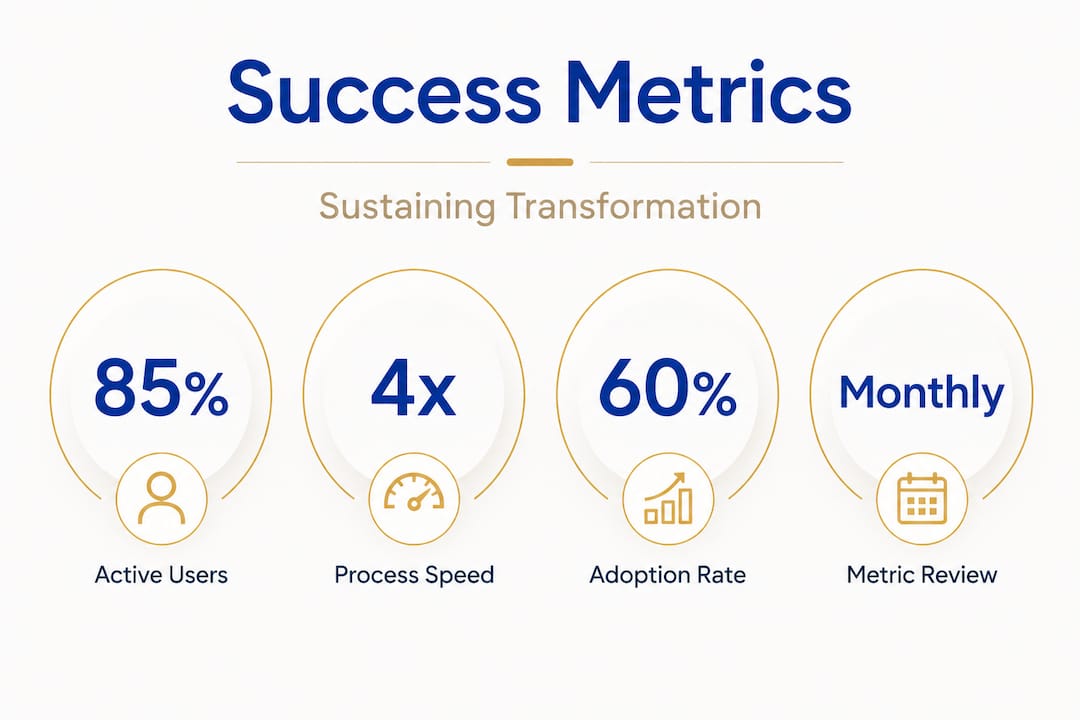
Build accountability into leadership structures. Leadership gaps directly limit organizational progress long after the technology goes live. Assign specific executives ownership of specific outcomes. When nobody is individually accountable for adoption or ROI, the metrics drift without consequence.
Learn from what didn’t work. Post-implementation reviews are one of the most consistently skipped activities in transformation programs. Schedule them at 30, 90, and 180 days post-launch. Ask hard questions. Where did the rollout deviate from the plan? Which user groups are struggling most? What assumptions turned out to be wrong? Use these findings to update the strategy, not just the documentation.
Sustain the culture shift. Technology can be implemented in months. Culture changes over years. Sustainable transformation requires ongoing reinforcement: visible leadership behavior aligned with the new ways of working, recognition programs for teams who model the change, and a willingness to revisit strategy when the environment shifts. Leaders who treat transformation as a project with an end date will see their investments erode. Exploring the steps for sustainable growth helps frame this as a continuous leadership responsibility rather than a one-time initiative.
Why true digital transformation is a leadership challenge, not a tech project
Having walked through the roadmap, let’s step back and look at why leadership, not technology choices, defines transformation outcomes.
Here’s the uncomfortable reality: most digital transformation failures aren’t technology failures. The software worked. The integration was technically sound. The vendor delivered what was promised. The transformation failed because leadership underestimated the human and organizational dimensions of change.
We’ve worked alongside organizations that spent millions on best-in-class platforms and watched those platforms gather virtual dust because the executive team handed the initiative to IT and checked in quarterly. Contrast that with companies that deployed less sophisticated tools but built strong governance, invested in their people, and kept leadership visibly engaged throughout. The latter group consistently delivered better outcomes.
The executive transformation advisory work we do repeatedly surfaces the same pattern: organizations that succeed treat transformation as a leadership discipline, not a technology deployment. They build structures for accountability, redesign processes with genuine rigor, and treat setbacks as feedback rather than excuses to scale back ambition.
The conventional wisdom says “choose the right technology and the rest follows.” That’s wrong. Choose the right leadership model, the right governance, and the right process foundation, and technology becomes a multiplier. Without those elements, even the most advanced platform becomes shelfware.
Leadership gaps expose organizational limits in ways that no technology investment can compensate for. Real leaders enable lasting change not by selecting the best tools, but by creating the conditions where people can adapt, grow, and take ownership of new ways of working.
Accelerate your transformation with expert guidance
If you’re ready to lead real digital transformation, expert partnership can be your force multiplier.
The roadmap in this guide gives you a rigorous framework, but navigating the complexity of real organizational transformation often requires an experienced partner who has seen these challenges across industries and leadership contexts. Knowing what to do and having the organizational bandwidth to do it well at the same time is where many capable executive teams hit their limits.
Orloff Phillips specializes in exactly this kind of strategic support. From technology strategy essentials at the C-level to hands-on technology consulting solutions that accelerate execution, our fractional executive and advisory services are designed to give you senior-level expertise without the full-time overhead. You can also explore real-world transformation wins that demonstrate how organizations like yours have achieved measurable, sustainable results with the right strategic partnership. The next step is a conversation.
Frequently asked questions
What is the first step leaders should take in digital transformation?
Begin by aligning business objectives with stakeholder buy-in before making any technology decisions. Prioritizing tech before process and leadership alignment is a primary driver of transformation failure.
Why do most digital transformation projects fail?
Projects fail mainly because of unclear vision, poor leadership accountability, underestimated training investment, and skipped process redesign. Scope creep without budget adjustments compounds these problems rapidly once rollout begins.
How important is executive sponsorship during transformation?
Strong executive sponsorship is critical to drive accountability, secure resources, and overcome organizational resistance at every phase. Without it, leadership gaps limit outcomes in ways no amount of technology investment can repair.
When should a company consider external advisors for digital transformation?
Engage external advisors when your organization lacks in-house expertise for strategic planning, technology integration, or process redesign at scale. Early advisory engagement prevents structural mistakes that become far more expensive to correct during execution.
How can leaders sustain transformation after initial rollout?
Leaders must build ongoing measurement cadences, learn from post-implementation reviews, and visibly model the cultural shifts the transformation requires. Sustained leadership accountability keeps transformation from degrading into old habits once initial attention fades.