
Every C-level executive in 2026 faces the same uncomfortable pressure: IT must justify its seat at the revenue table, not just keep the lights on. Boards want proof that technology investments move the needle on growth, resilience, and competitive positioning. The stakes are higher because the pace of AI adoption, cybersecurity threats, and regulatory change has compressed the window for slow, incremental decisions. This article breaks down five evidence-based IT strategy priorities built specifically for decision-makers at mid-sized to large U.S. organizations. Each tip is actionable, sequenced, and grounded in what leading CIOs are actually prioritizing right now.
Table of Contents
- Define clear IT-business alignment criteria
- Accelerate AI adoption with production-grade deployments
- Make cybersecurity the backbone, not an afterthought
- Upgrade data governance and digital provenance
- Modernize your IT operating model for speed and partnership
- Why IT strategy success in 2026 means bridging compliance, growth, and resilience
- Take your IT strategy to the next level with expert guidance
- Frequently asked questions
Key Takeaways
| Point | Details |
|---|---|
| Business-IT alignment | Use structured frameworks to tightly align IT initiatives with core business goals for stronger ROI. |
| AI adoption | Move AI from pilots to production to generate real value and stay competitive. |
| Cybersecurity foundation | Embed cybersecurity measures at the strategy stage to minimize risks and protect data. |
| Data governance | Establish unified governance and provenance to ensure trustworthy, high-quality data for AI and analytics. |
| Modern operating models | Revamp IT teams, skills, and partnerships for speed, agility, and sustainable transformation. |
Define clear IT-business alignment criteria
Most IT strategy failures trace back to one root cause: technology decisions made in isolation from business goals. Before your team debates vendor contracts or cloud migrations, you need explicit alignment criteria that connect every major IT initiative to a measurable business outcome.
The most effective leaders use structured frameworks to create this connection. The Run-Grow-Transform model categorizes IT spending into three buckets: keeping operations stable, enabling incremental growth, and funding bold transformation bets. Pairing that with a 7-step digital transformation blueprint gives your team a shared language for prioritizing resources and measuring progress.
Here is why this matters at the C-level. When IT operates without clear alignment criteria, transformation projects stall because nobody agrees on success metrics. 2026 IT strategy trends show that organizations closing the transformation gap are those where the CEO and CIO co-own the strategic agenda, not just share a slide deck once a quarter.
Apply these four criteria to every major IT initiative:
- Business outcome linkage. Can you name the specific revenue, cost, or risk metric this initiative moves?
- Executive sponsorship. Does a C-level leader own accountability beyond the IT department?
- OKR integration. Are IT objectives embedded in the company-wide OKR cycle?
- Governance cadence. Is there a steering committee meeting at least quarterly to course-correct?
Using structured IT frameworks turns alignment from a buzzword into a repeatable operating discipline. The goal is a resilient IT strategy that survives leadership changes and market shifts.
Pro Tip: Stand up an executive IT steering committee with rotating business unit representation. This single structural move reduces misalignment conflicts by giving functional leaders direct input before budgets are locked.
Accelerate AI adoption with production-grade deployments
AI investment is accelerating, but most organizations are still collecting pilots rather than production results. That gap is where competitive advantage is lost.

According to contrasting AI forecasts from Gartner, Forrester, and IDC, the divergence between leaders and laggards in 2026 comes down to deployment discipline. Leaders are treating AI as infrastructure, not experimentation.
| Stage | % of organizations | Average ROI timeline |
|---|---|---|
| Pilot only | 38% | 18+ months |
| Limited production | 51% | 9-12 months |
| Full production | 11% | Under 6 months |
The production-level shift to agentic and multiagent AI systems is the critical move for 2026. Agentic models operate autonomously across workflows, handling decisions that previously required human intervention at every step. This is not about replacing people. It is about removing bottlenecks in high-volume, rule-based processes.
To prioritize where AI delivers the fastest wins:
- Target processes with high transaction volume and low variability first
- Identify workflows where latency directly costs revenue
- Assess which teams have clean, structured data already available
- Avoid use cases that require significant regulatory approval before launch
“Organizations that rush AI to scale without governance frameworks will spend more fixing failures than they saved by moving fast.” This Forrester caution applies directly to mid-sized organizations without dedicated AI risk functions.
Review AI adoption best practices before committing deployment budgets. Governance infrastructure must precede scale, not follow it.
Pro Tip: Assign a dedicated AI deployment owner, separate from your data science team, whose sole mandate is moving validated pilots into production operations within defined timelines.
Make cybersecurity the backbone, not an afterthought
Rapid AI adoption creates a specific security problem: organizations expand their attack surface faster than they expand their security posture. This pattern is predictable, and it is expensive.
Average breach costs for mid-sized organizations hit $3.31 million, and that figure does not account for operational downtime, reputational damage, or regulatory penalties. The math for preemptive security investment is straightforward when you compare it against a single breach event.
| Approach | Average annual cost | Average breach exposure |
|---|---|---|
| Reactive security | $420K | $3.31M+ |
| Preemptive model | $680K | Under $400K |
Integrating preemptive cybersecurity into your IT strategy means making it a design principle, not a project phase. Here is how to sequence that integration:
- Conduct a threat surface audit before any new AI or cloud deployment goes live
- Embed security architects into every transformation project team from day one
- Implement confidential computing to protect data during active processing
- Deploy AI-native security platforms that detect anomalies faster than human analysts
- Establish a continuous compliance monitoring function tied to your governance calendar
Explore seamless security approaches that protect operations without creating friction for customers or internal teams. The best security programs are invisible to end users and inescapable for bad actors.
The organizations that treat cybersecurity as a strategic differentiator, not a cost center, are the ones that retain enterprise clients and pass vendor audits without emergency remediation sprints.
Upgrade data governance and digital provenance
AI is only as reliable as the data feeding it. This is not a technical observation. It is an executive accountability issue. When automated systems make decisions based on poor-quality or untracked data, the liability lands on leadership, not the algorithm.
Digital provenance refers to the documented trail of where data originated, how it was transformed, and who accessed it at each step. In an era where AI makes consequential decisions at speed, CIO digital transformation insights confirm that unified data layers with strong provenance tracking are prerequisites for defensible AI outcomes.
Your governance foundation should include:
- Data inventory: Know what data you have, where it lives, and who owns it
- Quality standards: Define acceptable thresholds for completeness, accuracy, and freshness
- Access controls: Enforce role-based permissions with audit trails for every sensitive dataset
- Lineage tracking: Map how data moves from source systems to AI models to business outputs
- Retention policies: Align data lifecycle management with both regulatory requirements and operational needs
Scheduling regular operational audits of your data environment surfaces gaps before they become compliance violations or AI failures. Organizations that skip this step discover the hard way that scaling AI on weak data foundations amplifies errors at machine speed.
Pro Tip: Appoint or contract a Chief Data Officer with cross-functional authority. Without a single accountable executive, data governance devolves into interdepartmental finger-pointing when something breaks.
Modernize your IT operating model for speed and partnership
The traditional IT operating model, built around centralized control, project-based delivery, and transactional vendor relationships, is structurally incompatible with the speed of transformation required in 2026. That is why 99% of IT leaders are actively changing their operating models right now.
The shift is not just organizational. It is philosophical. IT leaders who are winning are treating their function as a product and service provider to internal business units, not a shared utility.
Here are the key operating model shifts driving transformation velocity:
- Product-based teams. Replace project teams that disband after launch with persistent product squads that own outcomes long-term.
- Partner-first vendor strategy. Prioritize vendors who co-invest in your roadmap over those who simply fulfill purchase orders.
- AI-ready talent pipeline. Upskill existing staff systematically rather than relying entirely on external hiring in a tight market.
- Decentralized decision rights. Push technology decisions closer to business units while maintaining central guardrails for security and compliance.
- Outcome-based contracts. Restructure vendor agreements around measurable deliverables, not time-and-materials billing.
“Velocity without structure is chaos. The IT leaders succeeding in 2026 are the ones who built organizational resilience before they needed it.”
Reviewing modern IT models that match your current scale helps avoid over-engineering the operating structure before the organization is ready to absorb the change. The goal is sustainable speed, not structural complexity.
Why IT strategy success in 2026 means bridging compliance, growth, and resilience
Here is the perspective that most strategy frameworks miss: the organizations winning in 2026 are not the ones with the best technology stack. They are the ones that made compliance, revenue growth, and operational resilience into a single integrated agenda, not three separate workstreams.
Technology-first approaches routinely fail because they optimize for capability without accounting for regulatory exposure. The EU AI Act, data geopatriation requirements, and evolving U.S. state privacy laws are not abstract concerns. They are material risks that boards are asking about directly. Regulatory compliance tied to IT strategy is now a prerequisite for C-level buy-in, not a legal department side conversation.
The executives who earn sustained board confidence treat compliance as a strategic lever, not a constraint. They use legal counsel for IT strategy as a proactive planning input, not a reactive cost. When IT initiatives are framed around growth protection and risk reduction simultaneously, budget conversations change entirely.
Take your IT strategy to the next level with expert guidance
The tips in this article represent what separates organizations that scale with confidence from those that rebuild after costly missteps. Executing on all five priorities simultaneously requires more than internal bandwidth. It requires experienced leadership that has navigated these exact challenges across industries.
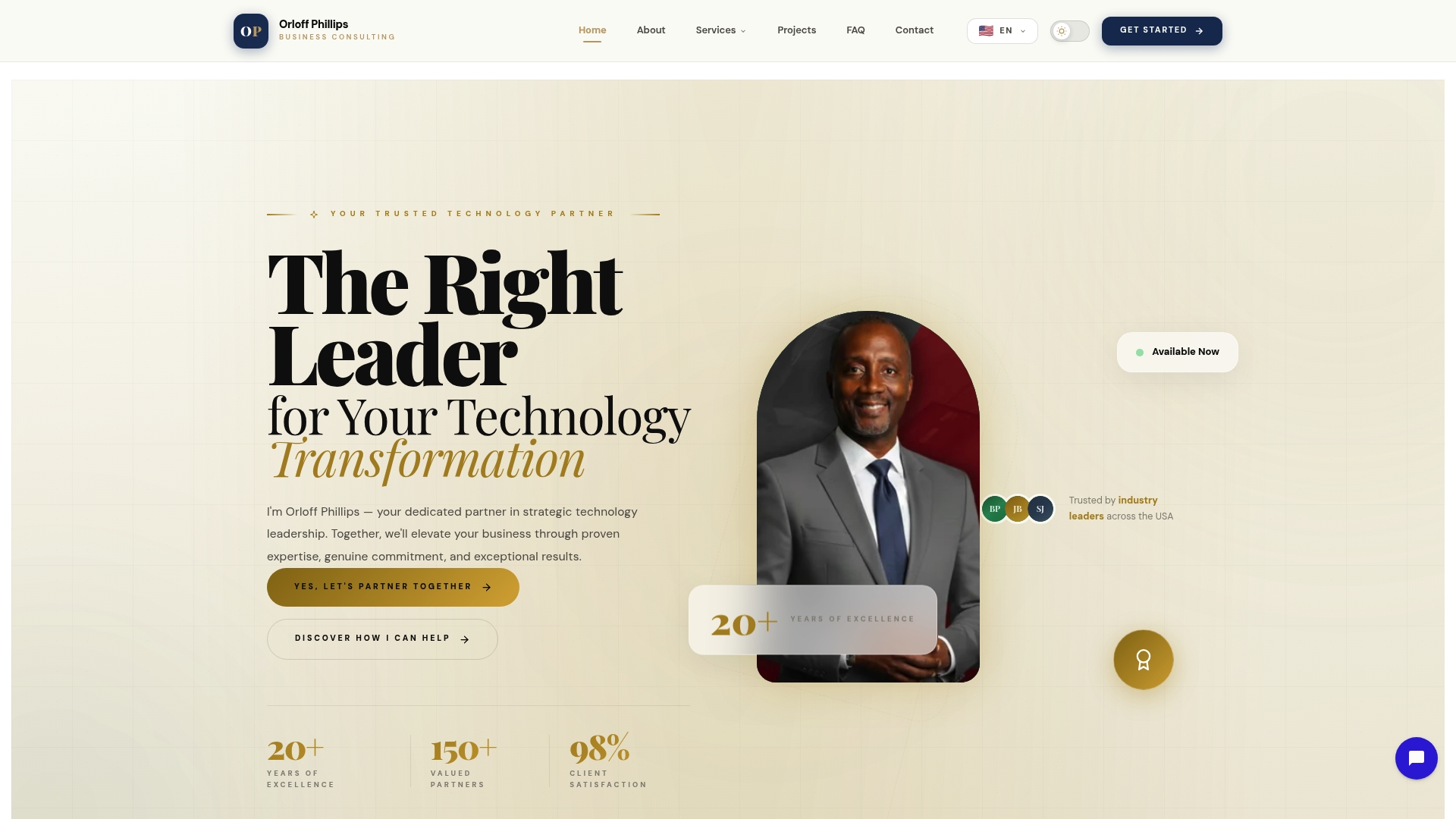
Orloff Phillips provides the strategic expertise to turn these priorities into measurable outcomes. Whether you need a business transformation roadmap to sequence your initiatives, fractional CTO leadership to guide AI and security decisions, or IT execution advisory to close the gap between strategy and delivery, our team brings C-level experience without full-time overhead. The next step starts with a conversation.
Frequently asked questions
What are the most urgent IT strategy priorities for 2026?
Focus on aligning IT with outcomes, deploying AI at production scale, embedding cybersecurity before expanding your technology footprint, and building unified data governance as a foundation for every advanced initiative.
Why is production-level AI adoption so critical now?
Pilots validate ideas but rarely generate returns. Only 11% have AI agents in full production versus 38% still piloting, meaning organizations that move to production now capture competitive advantages while others are still running tests.
How does confidential computing reduce security risk?
Confidential computing encrypts data while it is actively being processed, not just at rest or in transit, which closes the attack window that conventional encryption leaves open even when underlying infrastructure is compromised.
How can we improve IT agility for faster transformation?
Shift from project-based IT delivery to persistent product teams with long-term ownership, and replace transactional vendor relationships with strategic partnerships where vendors are accountable to your roadmap outcomes, not just their own delivery timelines.

Leave a Reply