
77% of companies report that their technology strategy is only “somewhat” aligned with business goals. That number should stop every C-level leader cold. Most executives assume they have a technology strategy because they have an IT budget, a CIO, and a five-year roadmap. But having those things is not the same as having a strategy that actually moves the business forward. This guide defines what technology strategy really means, separates it from IT operations, identifies what makes it work, and gives you a practical framework to stop treating it like an IT project and start using it as a business weapon.
Table of Contents
- Defining technology strategy: Beyond IT
- Core elements of a high-value technology strategy
- How to build and operationalize an effective technology strategy
- Common pitfalls and failure patterns: Lessons from the field
- A fresh take: Technology strategy is a leadership challenge, not an IT task
- Take your technology strategy from shelfware to business value
- Frequently asked questions
Key Takeaways
| Point | Details |
|---|---|
| Technology strategy is more than IT | It drives the business mission and is broader than traditional IT planning. |
| Continuous alignment is critical | Strategy must constantly adapt to market changes and business priorities. |
| Fractional leadership boosts agility | Fractional executives enable fast pivots and sustained value without full-time costs. |
| Common pitfalls can be avoided | Awareness of sunk cost, inertia, and poor leadership prevents wasted investments. |
Defining technology strategy: Beyond IT
There is a persistent confusion in boardrooms between technology strategy and IT strategy. They are not the same thing, and treating them as identical is one of the most expensive mistakes an organization can make.
Technology strategy is a structured, organization-wide plan for how technology investments and decisions will drive core business objectives. It lives at the intersection of market position, competitive advantage, innovation, and operational resilience. It is not a department plan. It is a business plan with technology as its engine.
IT strategy, by contrast, is functionally responsive and operationally driven. It answers questions like: How do we keep systems running? How do we reduce downtime? How do we manage vendors and control infrastructure costs? Critically important questions, but tactical ones. IT strategy is a subset of technology strategy, not a synonym for it.
| Dimension | Technology Strategy | IT Strategy |
|---|---|---|
| Scope | Organization-wide | IT department focused |
| Owner | C-suite, board-level | CIO, IT leadership |
| Time horizon | 3 to 5+ years | 1 to 3 years |
| Primary question | How does tech drive business? | How do we run tech well? |
| Success metric | Revenue, market position, resilience | Uptime, cost, delivery speed |
| Innovation role | Central | Secondary |
The gap between these two approaches is wide, and the consequences are real. When executives conflate IT delivery with strategic technology leadership, they end up funding the wrong priorities, missing market shifts, and watching competitors move faster.
“Only 47% of enterprises meet their strategic objectives due to poor linkage between IT actions and business goals.” This is not an IT problem. It is a leadership alignment problem.
Smart IT initiatives start with this distinction. Until leaders internalize the difference between running technology and leading with it, no amount of budget or talent will close the gap between potential and performance.
Core elements of a high-value technology strategy
Once you understand what technology strategy is, the next question is what it must contain to actually work. Not every strategy is created equal, and the gap between a document that earns shelf space and one that drives results comes down to a few non-negotiable elements.
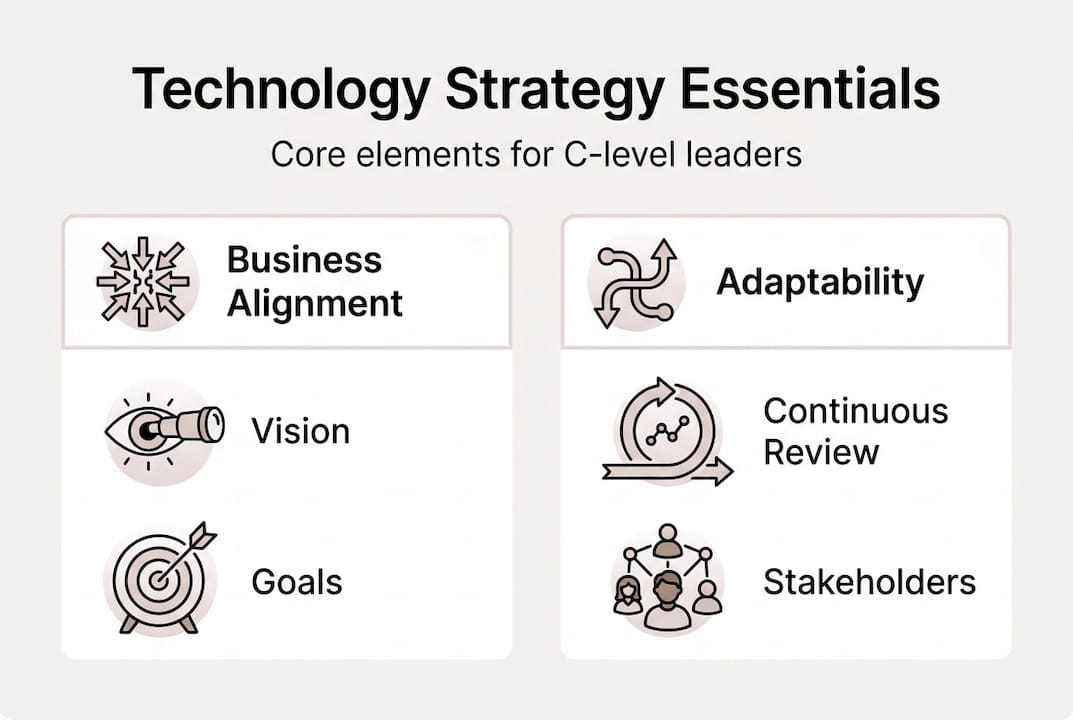
According to Forrester’s high-performance IT framework, effective technology strategies are built on three interlocking pillars: continuous business alignment, trust through security and resilience, and adaptivity to market change. Remove any one of these and the strategy becomes brittle.

The stakes are significant. Tech-forward companies, representing about 21% of organizations studied by Accenture, are 2.3x more likely to outperform their peers on both revenue growth and return on invested capital. That is not a marginal edge. That is a structural competitive advantage built on strategic discipline.
Here is what every high-value technology strategy must include:
- Vision alignment: Technology investments must map directly to board-level business priorities, not departmental wish lists.
- Capability mapping: Know what your current technology estate can and cannot do before committing to transformation initiatives.
- Cybersecurity and resilience: Security is not a line item. It is a strategic posture that must be embedded into every layer of the plan.
- Adaptability mechanisms: Build in explicit processes for revising the strategy as market conditions, competitive dynamics, or customer needs shift.
- Stakeholder engagement: Strategy without broad organizational buy-in becomes an executive document nobody executes.
Pro Tip: Bring in fractional executive leadership on a quarterly basis to pressure-test your strategy against market realities. Full-time internal leaders often develop blind spots over time. A fractional CIO or CTO brings outside perspective and enforces the discipline that internal teams sometimes lose.
Fractional executives are particularly effective at removing the internal political barriers that cause strategies to drift. They have no legacy allegiances, no departmental turf to protect, and every incentive to drive measurable outcomes.
How to build and operationalize an effective technology strategy
Most organizations can write a strategy. Far fewer can execute one. The difference between strategy as a presentation and strategy as a business driver comes down to how it is built and how it is operationalized.
Here is a four-step approach grounded in Forrester’s strategy development methodology:
- Engage stakeholders first. Before any document is drafted, bring together business unit leaders, finance, operations, and technology teams. Strategy built in an IT silo will die in a business unit meeting.
- Assess the current state honestly. Map your existing capabilities, technology debt, vendor relationships, and security posture. Wishful thinking at this stage is fatal.
- Prioritize by business outcomes. Rank initiatives not by technical elegance but by measurable business impact. Revenue, cost reduction, customer experience, risk reduction.
- Document it as a strategy on a page. A strategy nobody can summarize in a single page is a strategy nobody will use. Clarity is a feature, not a simplification.
This is not a one-time exercise. 73% of tech-forward firms practice dynamic resource reallocation, meaning they continuously shift investment toward higher-performing priorities rather than locking budgets in annual cycles.
| Factor | Typical organization | High-performing organization |
|---|---|---|
| Stakeholder engagement | Annual review | Quarterly cross-functional sessions |
| Strategy refresh rate | Every 2 to 3 years | Every 6 to 12 months |
| Outcome focus | IT delivery metrics | Business performance metrics |
| Resource reallocation | Fixed annual budget | Dynamic, outcome-driven |
Pro Tip: Use generative AI tools to synthesize market signals, competitive intelligence, and executive survey data between formal strategy reviews. This keeps the strategy responsive without requiring a full refresh every time conditions shift.
Operationalizing also means realigning incentives. If technology leaders are rewarded for uptime and cost control, they will optimize for uptime and cost control. Connect IT strategy execution to business KPIs and watch behavior change quickly.
Common pitfalls and failure patterns: Lessons from the field
Even well-designed strategies unravel. Knowing the most common failure patterns is as valuable as knowing the success frameworks, and the examples are instructive.
GE Predix, IBM Watson Health, and Nokia’s Symbian each represent different failure modes. GE Predix burned through billions chasing an industrial IoT platform vision that outpaced both market readiness and internal capability. IBM Watson Health made promises about AI-driven diagnostics that the underlying technology could not yet keep. Nokia held onto Symbian long after market signals made its obsolescence clear, confusing platform loyalty with strategic resilience. In each case, the failure was not primarily a technology failure. It was a leadership and strategy failure.
Common pitfalls include:
- Sunk cost bias: Continuing to fund platforms or initiatives because of prior investment rather than future potential.
- Platform inertia: Treating current technology choices as permanent rather than as temporary best options.
- Confusing delivery with transformation: Shipping projects on time feels like progress, but it is not the same as strategic advancement.
- Moonshot overweighting: Concentrating resources on high-risk, high-reward bets at the expense of core resilience.
“A portfolio approach, balancing incremental improvement with selective innovation, consistently outperforms strategies built around single transformative bets.” Organizations that ignore this balance risk strategic obsolescence the moment their big bet fails.
Fractional and third-party leaders are especially valuable in spotting these patterns. Internal teams often cannot see the sunk cost trap they are standing in. An external executive has no emotional investment in the prior decision and can call it clearly.
One often-overlooked risk is outdated IT assets quietly dragging strategy down from below. Legacy infrastructure limits optionality and forces strategy to accommodate technical debt instead of business opportunity.
A fresh take: Technology strategy is a leadership challenge, not an IT task
After working through the frameworks and failure cases, here is the insight that most strategy discussions avoid: the hardest part of technology strategy has nothing to do with technology.
The real obstacle is leadership alignment, political will, and organizational culture. Most strategies fail in the messy middle, where vision runs into departmental priorities, budgeting cycles, and change resistance. They become shelfware not because they were poorly designed, but because no one with authority enforced accountability once the document was approved.
Fractional executives provide adaptivity and governance without the overhead of a permanent hire, and that matters most in organizations where internal culture has calcified around old patterns. An outside leader can enforce discipline, encourage risk-managed experimentation, and model the behavior that full-time teams eventually adopt.
We have seen organizations spend eighteen months building a strategy and six months watching it dissolve because no one held the line when it became inconvenient. The value of fractional executives is not just expertise. It is persistent, accountable leadership through the hardest phase of execution.
Pro Tip: Schedule quarterly cross-functional strategy reviews led by an outside executive. Make attendance mandatory for department heads. This single habit closes more execution gaps than most technology investments.
Take your technology strategy from shelfware to business value
Building a technology strategy that actually drives outcomes requires more than a framework. It requires leadership capacity most organizations do not have sitting idle on an org chart.
At Orloff Phillips, our fractional executive services are built specifically for this challenge. We place experienced technology leaders inside your organization on a part-time or project basis to audit your current strategy, identify gaps, build a prioritized roadmap, and stay engaged through execution. No full-time hire required. No long onboarding runway. If you are ready to build technology for resilient business outcomes, we can help you move from planning to performance faster than you expect.
Frequently asked questions
How is technology strategy different from IT strategy?
Technology strategy sets direction for how technology enables business goals across the entire organization, while IT strategy manages the systems, operations, and infrastructure that support day-to-day functions.
What are the core elements of a successful technology strategy?
Alignment with business goals, cybersecurity resilience, and built-in adaptability are the three foundational elements every strategy must address to remain relevant and executable.
Why do so many technology strategies fail?
Most failures trace to poor leadership alignment, sunk cost bias and platform inertia, and strategies that were written for business goals but never connected to the incentives that actually drive organizational behavior.
What role do fractional executives play in technology strategy?
Fractional leaders enable adaptivity and governance by bringing fresh outside perspective and accountability without the cost or commitment of a permanent executive hire.
How is generative AI changing technology strategy design?
AI accelerates strategic planning by synthesizing competitive signals and market data in real time, allowing leadership teams to update strategy between formal review cycles rather than waiting for annual planning windows.

Leave a Reply