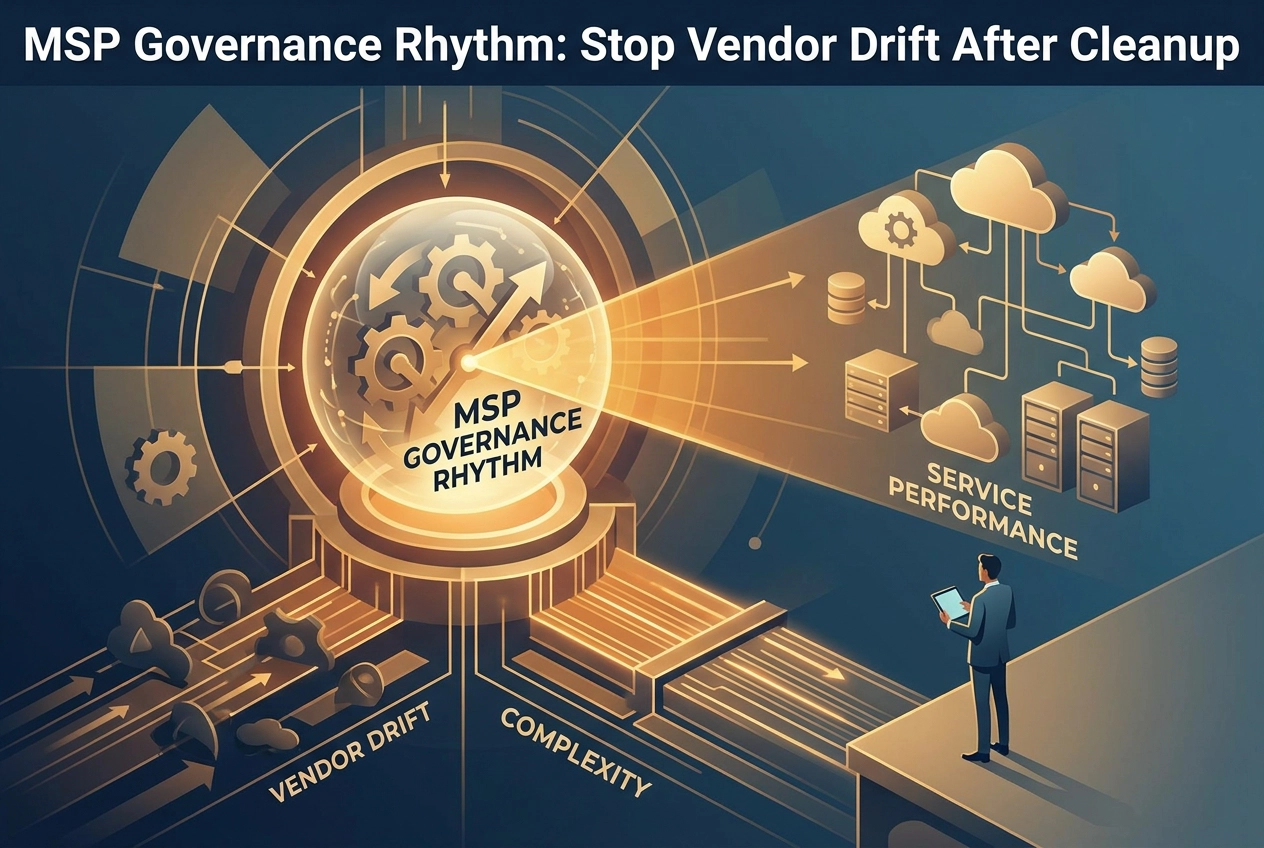
Cleaning up an MSP relationship feels like victory. It is not. It is the starting line. Without an operating rhythm, performance quietly drifts, accountability blurs, and the problems you just fixed return under new names. This post shows you how to stop that drift through deliberate vendor relationship management.
You will learn why a cleaned-up MSP relationship drifts back, what an MSP governance model actually governs, and what should happen every 90 days. We will cover the quarterly governance rhythm, including evidence-based reviews; a named escalation path; service-credit triggers; and joint roadmap ownership that turns the vendor into a stakeholder. Then we will map your first 90 days to install the cadence. Recognized frameworks can inform your approach, but the governance mechanics here are operating practice, not a mandate. The fix matters. The rhythm keeps it fixed.
Why a Cleaned-Up MSP Relationship Drifts Back
The cleanup fixes a symptom: an underperforming SLA, a backlogged ticket queue, a renewal signed without review. What it does not install is the recurring mechanism that keeps vendor performance visible and accountable. That gap is why underperformance compounds long before anyone acts.
Drift is quiet. A skipped quarterly review. A new account manager who never met your team. A roadmap that slowly became the MSP’s roadmap instead of yours. None of these trip an alarm on their own, which is precisely the problem. This is how IT infrastructure fragmentation accumulates: individually rational choices compounding into a pattern nobody can see from the inside.
Three reversion patterns show up most often. The meeting cadence decays into ad hoc email threads. Escalation paths reset to “just call your account manager.” Documentation stops being updated between reviews.
Contrast that with a managed cadence. Same vendor, same contract, same service desk. The difference is a dated evidence pack, named owners on both sides, and a standing review date. The principle of continuous review, rather than one-time delivery, runs through established IT service management thinking. Yet in practice, it is the cadence, not the contract language, that holds performance in place.
For mid-market businesses across the Philadelphia suburbs, Exton, Wilmington, Cherry Hill, Lancaster, and Reading, the pattern is consistent: the cleanup was done well, then left to run unattended. Vendor alignment at the portfolio level rarely holds without a rhythm that runs whether or not anyone remembers to schedule it.
What an MSP Governance Model Actually Governs
If drift is the default, governance is the counterweight. Vendor relationship management for an MSP is not a binder you file after the contract is signed. It is a set of standing decision rights, a review cadence, escalation routes, and shared accountability that sit on top of the contract and keep it alive.
An MSP governance model rests on four working parts:
- A quarterly review rhythm
- A named escalation path
- Service-credit triggers tied to evidence
- Joint roadmap ownership
Miss any one and the other three lose their grip. A review with no escalation route produces minutes nobody acts on. Credits nobody tracks never trigger.
The contract sets the floor; governance keeps performance visible above it. The same principle runs through broader technology work, where an infrastructure modernization engagement holds together because someone owns the outcome between milestones, not just at delivery.
For context rather than mandate, NIST SP 800-161r1-upd1, the current cybersecurity supply chain risk management guidance (NIST, November 1, 2024), offers a recognized voluntary framework that parallels this discipline. It is security-focused, not MSP-specific, and not binding on private vendor relationships, so treat it as an adjacent reference, not a rulebook.
One disclosure: the cadence, escalation ladder, credit triggers, and roadmap ownership described here are Orloff Phillips’ operating position, drawn from advisory work with mid-market clients, not published benchmarks. We flag that so you can weigh it as practitioner guidance. The sections that follow take each part in turn.
The Quarterly Governance Rhythm: What Happens Every 90 Days
A cadence is not a habit of meeting. It is a fixed date on a calendar. Pick the same week every quarter and send the invitation series twelve months out, so the review exists before anyone’s schedule fills. Circulate the agenda five business days ahead. If the review depends on someone remembering, it is not governance.
Everything discussed is evidence, not narrative. The pack covers ticket volumes and SLA attainment, incident and change records, asset and license reconciliation, open risks, and last quarter’s action items, each with a status next to it. Numbers first, opinions second.
Attendance carries the meeting. Name the attendees in advance: the MSP’s service director, the engineer who can actually commit time, and the executive who signs your invoice, plus your own IT lead. Account managers and helpdesk supervisors may attend, but they cannot commit resources or credits.
Then run sixty minutes precisely: ten walking the evidence, fifteen on SLA performance and credits, fifteen on open risks and escalations, fifteen on the roadmap, five assigning owners and dates. That roadmap block is where joint ownership gets decided.
Minutes and the action log go out within 48 hours. Open items carry forward and get named at the next review, in front of the same people. That single habit is what keeps the cadence from becoming theater.
Finally, grade yourself. Track your own attendance and prep hours the way you track the MSP’s SLA numbers. Client-side governance lapses as often as vendor-side. For mid-market teams without a full-time CIO, that discipline holds better when it sits inside a practical IT strategy framework for mid-market leaders, not a standalone meeting.
Designing the Escalation Ladder and Service-Credit Triggers
The escalation ladder and credit triggers belong in the same governance document as the quarterly evidence pack.
The escalation ladder. Write five rungs and put a person’s name at each, not a title: service desk lead, your account manager, the MSP’s service director, your internal IT lead, then executive sponsors on both sides. Give every rung an agreed response time, and tie escalation to documented triggers rather than frustration: no substantive response to a P1 inside your window, repeated SLA misses across a rolling 30 days, or a security finding left open past its remediation date. If you lack a baseline for those thresholds, how to benchmark your MSP before you decide to fix or replace them shows how to convert raw performance data into defensible numbers.
Credit triggers. Define service credits in both the contract and the governance document: percentage of monthly recurring charge per event, how credits stack, any monthly cap, and exactly how and when they are applied. Make them automatic and evidenced. A credit you must request, argue for, and chase is not a governance mechanism; it is a negotiation you will eventually lose interest in having. Keep a credit ledger and review it each quarter. Credits that never trigger across several quarters mean your thresholds are too soft or your monitoring is too thin to see the misses.
Corrective use. Treat credits as a corrective signal, not the goal. Pair every triggered credit with a root-cause action and a named owner, or you end up buying discounts on service that is still not improving. The ladder and the ledger work as a pair: one forces response, the other proves whether response worked, and both feed the quarterly evidence pack.
Joint Roadmap Ownership: Turning the Vendor Into a Stakeholder
Escalation ladders and credit triggers correct performance after it slips. The roadmap is what aims the relationship forward, and it is the last place drift hides.
In our experience, a roadmap owned only by the MSP becomes the MSP’s roadmap. It bends toward what they sell rather than what your business needs, and nothing looks wrong because the document stays current.
Build one shared planning horizon, 12 to 18 months works well in practice, with your business priorities on one side and their delivery commitments on the other. That review block is where roadmap promises and ticket data are read side by side, established in the rhythm section above.
Co-ownership on one document. Assign co-owners by name. Your IT lead owns business outcomes and internal readiness work; the MSP owns delivery commitments and resourcing. Both names appear on the same document, which makes accountability mutual rather than implied. Where you lack that internal owner, fractional CIO services can supply the executive who signs off.
Do not skip the unglamorous items. Include endpoint refresh cycles, network upgrades, backup and disaster recovery testing, security posture work, and license true-ups. These capacity and lifecycle items are where quiet drift does the most damage, precisely because no incident forces them onto an agenda.
Revisit when reality changes. A new office in Exton or Lancaster, an acquisition, a new compliance obligation, a headcount jump: each should trigger a roadmap revision. A roadmap disconnected from real demand is a document nobody defends.
Putting the Cadence in Place: Your First 90 Days
With co-owners named and the roadmap shared, the last question is sequencing. In our experience, 90 days is sufficient to stand the cadence up.
Weeks 1 and 2: draft the charter. One page, no more. Four quarterly dates for the year ahead, attendees by name and role on both sides, the full escalation ladder, service-credit triggers, and the roadmap owner. A charter that runs to ten pages will not be used.
Weeks 3 and 4: build the baseline. Pull the last four quarters of SLA attainment, ticket volumes, incident records, and asset data. Baseline those numbers now. Every future review gets measured against this known starting point, and without it you cannot prove improvement or decline. If your vendor estate is tangled, the discipline behind Declutter Your Technology Stack: Why Vendor Consolidation Matters applies here too.
Weeks 5 through 8: hold the first review. Confirm credits where they are due, assign action owners with dates, and book the next four quarterly meetings before anyone leaves the room.
Weeks 9 through 12: institutionalize it. Document the cadence in your vendor file, brief internal stakeholders so the escalation ladder is not a secret, and set a recurring reminder 30 days before each review to assemble evidence.
If the first reviews feel awkward or thinly attended, consider an outside advisor running the first two or three quarters. That is where Orloff Phillips typically starts with mid-market clients across greater Philadelphia, and it is in our experience the difference between a cadence that holds and one that quietly lapses.
Conclusion: The Fix Is the Starting Line
You have a charter, a baseline evidence pack, and four dates on the calendar. What happens next determines whether the cleanup holds. The starting-line principle holds here too.
Put four things in place this quarter:
- A dated evidence pack, reviewed every 90 days.
- A written escalation ladder with named owners on both sides.
- Automatic service-credit triggers tied to documented misses.
- A roadmap with joint accountability for business outcomes and delivery.
Then make the cadence institutional rather than personal. The vendor file, not someone’s inbox, is where the cadence lives, as set up in the first-90-days sequence above. People change roles; the vendor file does not.
Review the governance charter itself once a year. MSPs rotate account teams, your priorities shift, and a cadence that never evolves stops governing anything. Refresh attendees, thresholds, and roadmap priorities while the structure stays.
If you would rather not build it alone, Orloff Phillips helps businesses across Exton, Philadelphia, Wilmington, Cherry Hill, Lancaster and Reading stand up MSP governance that actually runs, starting with the first quarterly review. The fix already happened. The rhythm is what keeps it fixed.

Leave a Reply