
Technology roadmapping is defined as a structured planning process that connects an organization’s technology initiatives directly to its business goals, specifying what work gets done, when, why it matters, and who owns it. The industry term for this practice is IT roadmapping, though technology roadmapping has become the standard phrase across executive and consulting circles. Roadmap time horizons typically range from 1 to 5 years, with most organizations focusing on 1–3 year cycles. This guide covers what technology roadmapping entails, how it differs from related planning tools, and the practical steps to build one that delivers measurable results.
What is technology roadmapping and why does it matter?
A technology roadmap is the most direct tool for turning abstract business goals into funded, sequenced technology work. Without one, organizations default to reactive spending, where the loudest problem gets the next budget dollar rather than the highest-priority initiative. Formal roadmaps reduce reactive spending by linking IT execution to revenue, cost reduction, and retention metrics. That connection is what separates a technology roadmap from a wish list.
The process maps where an organization’s technology stands today against where it needs to be, then plots a phased path between those two points. Orloffphillips works with mid-sized and large organizations that have often invested heavily in technology without a clear map, and the pattern is consistent: spending accelerates, outcomes stall. A well-built roadmap reverses that pattern by forcing prioritization before a dollar is committed.

Roadmaps also integrate cybersecurity and infrastructure planning, which means risk reduction becomes a planned activity rather than a surprise expense. That alone justifies the investment in building one.
What are the key components of a technology roadmap?
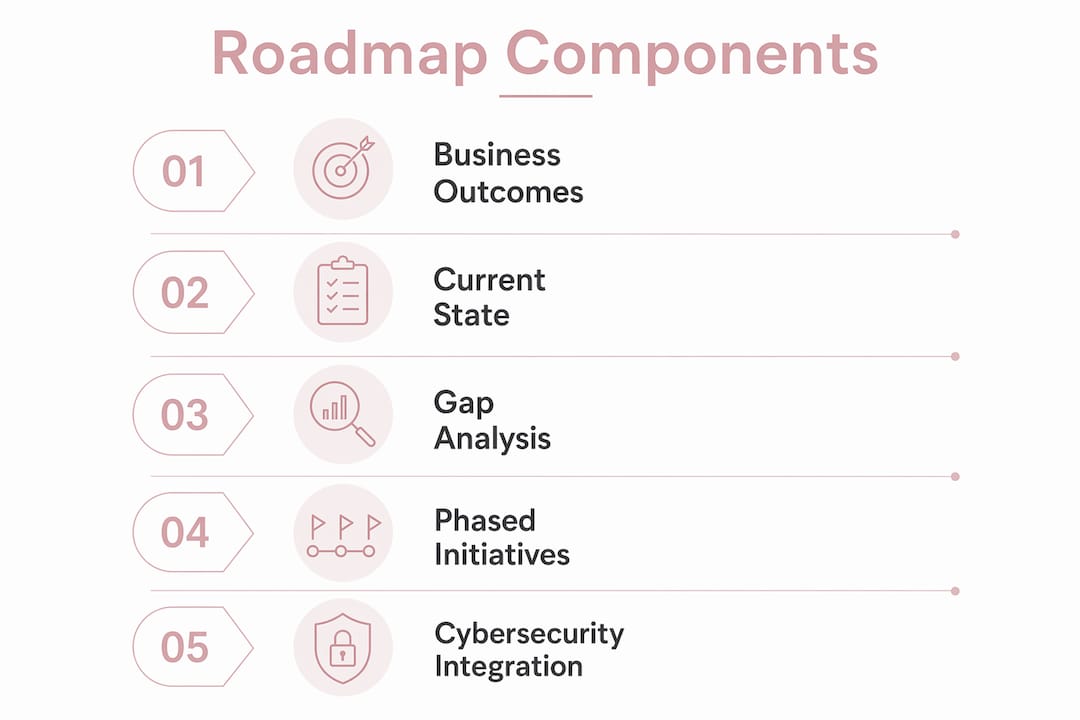
Every effective technology roadmap contains six core elements. Missing any one of them produces a document that looks like a plan but functions like a calendar.
- Business outcomes: The 3–5 quantified goals the roadmap exists to support, such as reducing operating costs by a specific percentage or reaching a new customer segment by a target date.
- Current state assessment: An honest inventory of existing technology, processes, and capabilities across infrastructure, applications, and data.
- Gap analysis: A clear identification of what is missing, outdated, or misaligned between the current state and the desired outcomes.
- Prioritized initiatives: Specific projects ranked by business impact, risk, and organizational readiness, each with an estimated budget and timeline.
- Ownership and accountability: Named individuals or teams responsible for each initiative, not just departments.
- Success metrics: Measurable indicators that confirm an initiative delivered its intended value, tied back to the original business outcomes.
| Component | Purpose |
|---|---|
| Business outcomes | Anchors every initiative to a measurable goal |
| Current state assessment | Establishes the baseline for gap analysis |
| Gap analysis | Identifies what must change and why |
| Prioritized initiatives | Sequences work by impact and readiness |
| Success metrics | Confirms value delivered after execution |
Pro Tip: Build your gap analysis across four dimensions: people, process, technology, and data. Organizations that skip the people and process dimensions consistently underestimate the effort required to adopt new technology.
Layering the roadmap by audience improves buy-in and budget approval. Executives see business outcomes and investment totals. Technical teams receive detailed initiative plans and sequencing logic. One document, two views.
How does technology roadmapping differ from IT strategy and project planning?
These three documents serve distinct purposes, and confusing them is one of the most common governance mistakes executive teams make.
An IT strategy is the high-level “what and why.” It defines guiding principles, technology philosophy, and the broad direction the organization intends to take. It answers questions like: Should we build or buy? Should we centralize or federate? It does not specify timelines or costs.
A technology roadmap is the detailed “how and when.” It translates the IT strategy into a phased, funded plan with named initiatives, owners, and milestones. It is the operational bridge between strategic intent and actual execution.
A project plan is the granular “who does what by when” for a single initiative within the roadmap. It contains task lists, sprint schedules, and resource assignments. It lives inside the roadmap, not alongside it.
| Document | Focus | Time horizon | Primary audience |
|---|---|---|---|
| IT strategy | Principles and direction | 3–5 years | C-suite and board |
| Technology roadmap | Phased initiatives and budgets | 1–3 years | Executive and IT leadership |
| Project plan | Task-level execution | Weeks to months | Project and delivery teams |
Understanding this hierarchy matters because organizations that skip the roadmap layer often find their project plans executing work that no longer aligns with business strategy. The roadmap is the governance layer that keeps execution honest.
What are the benefits of technology roadmapping for business leaders?
The benefits of technology roadmapping are concrete and measurable, not theoretical. Organizations that build and maintain roadmaps gain five specific advantages over those that do not.
- Budget predictability: Phased cost estimates across foundation, implementation, adoption, and ongoing categories eliminate surprise spending requests mid-year.
- Reduced fire drills: Businesses with roadmaps avoid reactive spending and prioritize cybersecurity and infrastructure upgrades before they become crises.
- Executive alignment: A shared roadmap gives the CEO, CFO, and CIO a single source of truth for technology investment decisions.
- Clearer communication: Segmenting roadmap layers by audience ensures decision-makers and technical teams each receive information calibrated to their role.
- Measurable ROI: Linking initiatives to revenue, cost, and retention metrics makes it possible to evaluate whether technology spending delivered its intended return.
Starting from business questions rather than a technology shopping list is the single factor that most consistently separates high-performing roadmaps from low-performing ones. Organizations that lead with tools instead of business problems see lower revenue growth. The roadmap forces the right question first: what outcome are we trying to achieve?
Pro Tip: Present your roadmap to the CFO before the CIO. If the CFO cannot connect every initiative to a business outcome, the roadmap needs revision before it reaches the board.
How to create a technology roadmap: a practical step-by-step approach
Building a technology roadmap is a leadership activity, not an IT activity. The process requires executive involvement from the first session.
Define 3–5 quantified business outcomes. Leadership must identify specific, measurable goals before any technology discussion begins. “Improve customer retention” is not an outcome. “Reduce churn by 15% within 18 months” is.
Conduct a maturity assessment. Evaluate current capabilities across people, process, technology, and data. This assessment reveals where the organization actually is, not where leadership assumes it is.
Perform a gap analysis. Map the distance between the current state and each business outcome. Identify which gaps require new technology, which require process change, and which require skills development.
Prioritize initiatives. Rank each identified initiative by three criteria: business impact, risk if unaddressed, and organizational readiness. High-impact, high-risk, high-readiness initiatives go first.
Sequence initiatives to respect dependencies. Mapping initiative dependencies clearly prevents sequencing errors that delay ROI from secondary projects. A cloud migration cannot follow a security framework implementation if the security work depends on the cloud environment.
Estimate phased budgets. Categorize costs into four buckets: foundation (infrastructure and prerequisites), implementation (deployment and integration), adoption (training and change management), and ongoing (licensing, support, and maintenance).
Assign ownership and success metrics. Every initiative needs a named owner and at least one measurable outcome. Shared ownership is no ownership.
Establish a quarterly review cadence. A technology roadmap is the most effective governance tool when treated as a living document with quarterly reviews. Markets shift, priorities change, and the roadmap must reflect those changes to remain useful.
Pro Tip: Run your first roadmap session as a half-day leadership workshop, not an IT presentation. Bring the business unit leaders into the room before the technology team. The sequence matters.
For organizations building their first roadmap, technology consulting can accelerate the process significantly by providing a structured framework and an outside perspective on prioritization.
What are common pitfalls in technology roadmapping?
Most roadmap failures trace back to a small set of repeatable mistakes. Recognizing them early prevents the most expensive errors.
- Treating the roadmap as a static document. A roadmap reviewed once at launch and filed away provides no governance value. Roadmaps must be dynamic living documents regularly reviewed and updated to adapt to changing business strategies.
- Separating infrastructure from application planning. The IT environment must be treated as an integrated operating system that includes network, security, device lifecycle, and business software. Planning these in silos creates hidden technical debt.
- Leading with technology instead of business outcomes. Executives should avoid roadmaps driven by wish lists and focus on measurable business outcomes to prioritize investments effectively.
- Ignoring organizational readiness. Internal culture and organizational readiness critically impact roadmap success. A technically sound plan fails when the organization lacks the capacity or willingness to adopt it.
- Unclear prioritization governance. When no one owns the decision about what gets funded next, every stakeholder lobbies for their own priority and the roadmap loses credibility.
“Many roadmaps fail when treated as a launch event. Successful ones define prioritization ownership, trade-off management, and adaptability to changing conditions. A roadmap is a managed portfolio, not a fixed plan.”
The most underrated pitfall is failing to build audience-specific views. A single technical document handed to a board produces confusion, not confidence. Segmenting roadmap layers by audience ensures strategic communication tailored to decision-makers and technical teams, improving alignment and funding.
You can find real-world examples of how this plays out in practice through technology innovation success stories that show how structured planning translates into measurable business outcomes.
Key Takeaways
A technology roadmap delivers measurable business value only when it starts with quantified outcomes, assigns clear ownership, and undergoes quarterly review to stay current with shifting priorities.
| Point | Details |
|---|---|
| Start with outcomes, not tools | Define 3–5 quantified business goals before selecting any technology initiative. |
| Treat it as a living document | Quarterly reviews keep the roadmap aligned with changing business and market conditions. |
| Layer views by audience | Executives need outcome summaries; technical teams need initiative detail and sequencing logic. |
| Integrate all IT layers | Plan infrastructure, security, applications, and data together to avoid hidden technical debt. |
| Assign named ownership | Every initiative requires one accountable owner, not a department, to drive execution. |
Why roadmapping has become a leadership discipline, not an IT task
I have worked with organizations that had detailed project plans, a written IT strategy, and a technology budget, but no roadmap connecting them. The result was predictable: projects completed on time that delivered no measurable business value, because no one had asked the right question at the start.
The shift I have seen over the past decade is significant. Technology roadmapping has moved from an IT planning exercise to a core governance discipline that belongs in the boardroom. The organizations that treat it as a leadership tool, not a technical document, consistently outperform those that delegate it entirely to the IT department.
What I find most telling is how quickly a roadmap reveals misalignment. When you put a CEO, CFO, and CIO in a room and ask them to agree on the top five business outcomes, the conversation is rarely easy. That friction is valuable. The roadmap surfaces disagreements that would otherwise show up as failed projects 18 months later.
The future of technology roadmapping sits at the intersection of agility and governance. Organizations need a plan firm enough to guide investment decisions and flexible enough to absorb the disruption that comes with rapid technology change. That balance is not a technical problem. It is a leadership problem, and it requires leaders who are willing to own the process.
— Orloff
How Orloffphillips supports technology roadmapping and IT leadership
Orloffphillips works with mid-sized and large organizations that need experienced technology leadership without the cost or commitment of a full-time executive hire. The firm’s advisory services cover the full roadmapping process, from defining business outcomes and conducting maturity assessments to sequencing initiatives and establishing governance cadences.
For executive teams ready to build or rebuild their technology roadmap, Orloffphillips provides structured frameworks and hands-on guidance grounded in real-world IT leadership experience. The firm’s strategic IT leadership services are designed specifically for organizations navigating digital transformation and technology strategy decisions. If you are evaluating your current roadmap or starting from scratch, leading digital transformation with the right advisory support makes the difference between a plan that sits in a drawer and one that drives results.
FAQ
What is technology roadmapping in simple terms?
Technology roadmapping is a planning process that connects technology investments to specific business goals over a defined time horizon, typically 1–3 years. It specifies what technology work gets done, in what order, and why it matters.
How long does it take to create a technology roadmap?
A first-pass roadmap for a mid-sized organization typically takes 4–8 weeks when leadership is actively involved. The process includes a maturity assessment, gap analysis, initiative prioritization, and budget estimation.
How often should a technology roadmap be updated?
A technology roadmap functions best as a living document reviewed quarterly. Annual reviews are insufficient because business priorities and technology conditions shift faster than a yearly cycle can accommodate.
What is the difference between a technology roadmap and an IT strategy?
An IT strategy defines guiding principles and broad direction. A technology roadmap translates that strategy into a phased, funded plan with named initiatives, owners, timelines, and success metrics.
Who should own the technology roadmapping process?
Ownership sits with senior leadership, not the IT department alone. The CEO, CFO, and CIO must align on business outcomes before the roadmap is built, and a named executive must own the governance and review cadence.

Leave a Reply