
A fractional CXO is a senior executive who provides part-time, embedded leadership across one or more companies simultaneously, holding full accountability for outcomes without a full-time employment commitment. This model gives growing businesses access to CFO, CMO, CTO, COO, and other C-suite capabilities at a fraction of the cost of a permanent hire. The term “fractional executive” is the recognized industry standard, and understanding what it means in practice is the first step toward making a smarter leadership decision for your organization.
What is a fractional CXO and how does it work?
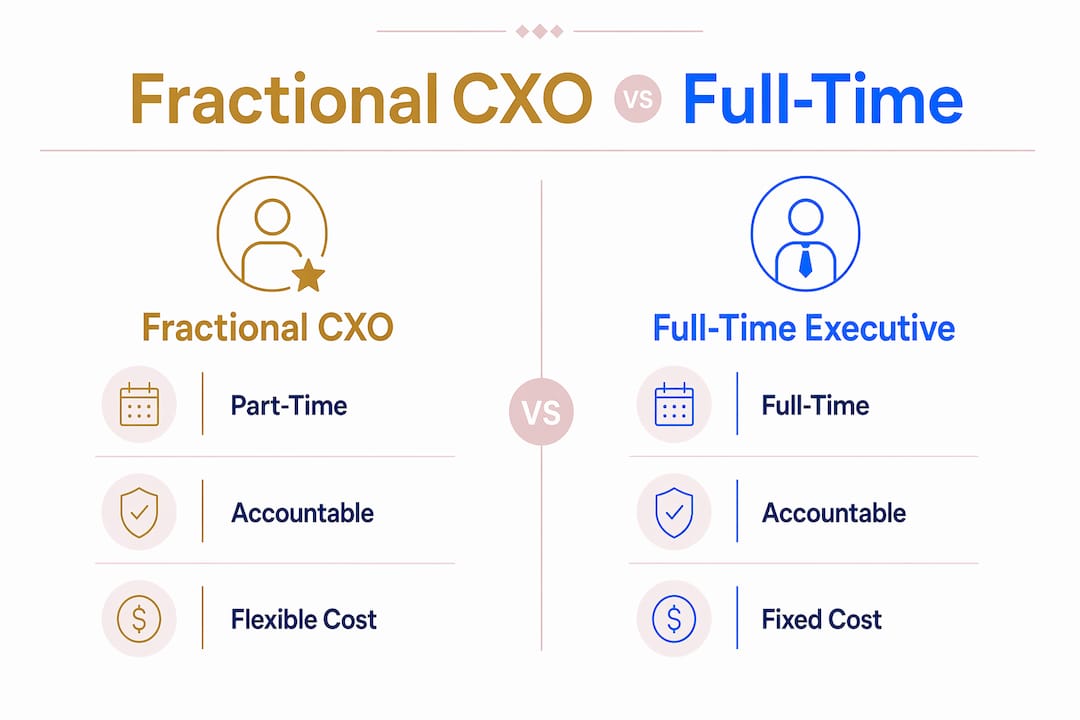
A fractional CXO is defined as a part-time C-level leader who embeds directly into your company’s leadership team, takes ownership of a functional area, and drives measurable results. This is not a consultant who submits a report and moves on. The fractional model places an experienced executive inside your organization, attending leadership meetings, managing staff, setting KPIs, and making decisions with real consequences.
The “fractional” label refers to the time commitment, not the level of authority or responsibility. A fractional CFO might work two days per week with your finance team. A fractional CTO might spend 15 hours per month setting your technology roadmap and managing vendor relationships. The engagement is scoped to your needs, but the executive’s accountability is identical to that of a full-time hire.

This model has gained serious traction among startups, scale-ups, and mid-sized companies that need senior leadership but cannot justify a $250,000-plus annual salary for a single executive. The fractional C-suite model represents a structural shift toward agile leadership, allowing businesses to access senior capabilities years earlier than traditional hiring timelines allow.
What roles and responsibilities does a fractional CXO fulfill?
Typical fractional C-suite roles include CFO, COO, CMO, CTO, and CHRO, covering every major functional area where a business might need senior operational leadership. Each role carries the same scope of responsibility as its full-time equivalent, just delivered across a compressed schedule.
Here is what fractional CXO responsibilities look like in practice:
- Fractional CFO: Financial planning and analysis, cash flow management, investor reporting, and building the finance team’s internal capabilities.
- Fractional CMO: Go-to-market strategy execution, brand positioning, demand generation programs, and marketing team leadership.
- Fractional CTO: Technology architecture decisions, vendor selection, cybersecurity oversight, and IT roadmapping.
- Fractional COO: Process design, operational efficiency programs, cross-functional team coordination, and scaling infrastructure.
The critical distinction is that fractional CXOs lead execution and own the results within the companies they serve. They build processes, manage people, and make decisions. A fractional CMO does not just recommend a marketing strategy. They run the team that executes it.
Pro Tip: When scoping a fractional CXO engagement, define success metrics before the first day. Agree on three to five KPIs the executive will own. This removes ambiguity and creates the accountability structure that makes fractional leadership work.
Cross-industry experience is another underrated asset. Fractional executives bring what practitioners call “experience density,” meaning years of hard-won knowledge from multiple sectors applied immediately to your situation. A fractional CTO who has managed technology transformations at a healthcare company, a logistics firm, and a SaaS startup brings pattern recognition that a single-company career rarely produces.
How does a fractional CXO differ from a full-time executive and a consultant?
The three models are often confused, but they serve fundamentally different purposes. Understanding the distinction helps you choose the right engagement for your situation.
| Model | Time commitment | Accountability | Cost structure |
|---|---|---|---|
| Full-time executive | 40+ hours per week | Full ownership of outcomes | Salary, benefits, equity |
| Fractional CXO | Part-time, ongoing | Full ownership of outcomes | Monthly retainer |
| Consultant | Project-based | Advice and recommendations only | Project or hourly fees |
| Interim executive | Full-time, temporary | Full ownership of outcomes | Daily or monthly rate |
The accountability column is where the real difference lives. Fractional CXOs are embedded within leadership teams with accountability for hiring, firing, metrics, and long-term outcomes. Consultants deliver static recommendations. They are not responsible for whether those recommendations get implemented or whether they produce results.
Interim executives fill a single full-time vacancy on a temporary basis, typically during a transition or crisis. A fractional CXO, by contrast, works across multiple companies on a flexible, ongoing basis. The interim model is a placeholder. The fractional model is a deliberate, permanent engagement structure.
The full-time executive comparison comes down to cost and necessity. If your business genuinely needs a CMO present every day, managing a large team and driving a complex multi-channel program, a full-time hire makes sense. If you need senior marketing leadership for 20 hours per month to set strategy and hold the team accountable, a fractional CMO delivers the same outcome at a fraction of the cost.
What are the cost benefits and pricing structures of fractional CXO services?
Fractional executive services typically cost between $3,000 and $10,000 per month for operational roles and $1,000 to $4,500 per month for advisory roles. This translates to approximately 60% cost savings compared to full-time executive compensation when you factor in salary, benefits, payroll taxes, and equity.
| Role type | Monthly cost range | Full-time equivalent cost | Estimated savings |
|---|---|---|---|
| Operational fractional CXO | $3,000 to $10,000 | $20,000 to $30,000+ | ~60% |
| Advisory fractional CXO | $1,000 to $4,500 | $20,000 to $30,000+ | ~75%+ |
The pricing flexibility is a genuine structural advantage. You can scale the engagement up during a product launch or fundraising round and scale it back during quieter periods. Full-time executives do not offer that flexibility.
Speed is another financial benefit that rarely gets quantified. Fractional leaders embed within days or weeks, while recruiting a full-time executive typically takes three to six months. Every month without a functional CFO or CTO has a real cost in delayed decisions, missed opportunities, and team misalignment. The fractional model eliminates that gap.
Pro Tip: Do not evaluate fractional CXO cost in isolation. Calculate the cost of the leadership gap you currently have. Delayed technology decisions, inefficient marketing spend, and weak financial controls often cost more per month than a fractional executive retainer.
For startups and early-stage companies, the benefits of fractional executives extend beyond cost. Access to a seasoned CFO during a Series A raise, or a CTO during a platform build, can directly influence valuation and investor confidence. That is a return on investment that a monthly retainer figure does not fully capture.
When should growing businesses consider hiring a fractional CXO?
The fractional CXO model suits businesses facing bottlenecks in operations, growth, technology, or marketing where senior leadership is needed but a full-time hire is not yet justified. The signals are usually clear once you know what to look for.
Consider a fractional CXO when your business is experiencing any of the following:
- Operational bottlenecks: Projects consistently run late, quality is inconsistent, or your team lacks clear processes and accountability structures.
- Technology misalignment: Your systems do not support your growth plans, vendor relationships are unmanaged, or cybersecurity gaps are creating risk.
- Marketing inefficiency: Spend is increasing but results are not, or your team lacks the strategic direction to prioritize channels and campaigns.
- Financial opacity: You lack reliable forecasting, investor-ready reporting, or a clear picture of unit economics.
- Leadership gaps during transitions: A key executive has departed, a fundraising round is approaching, or a merger requires integration leadership.
The fractional CXO model enables startups and scale-ups to access senior leadership years earlier than traditional hiring allows. A 30-person company can have a world-class CTO setting its technology strategy on day one, rather than waiting until headcount justifies a full-time hire.
Cross-industry experience density is particularly valuable here. A fractional executive who has solved the same operational bottleneck at five different companies brings a tested playbook, not a hypothesis. They know which solutions fail before wasting your time and budget on them. That accumulated knowledge is the core value proposition of the fractional model, and it is something a first-time full-time hire in that role simply cannot replicate.
For companies considering a fractional CTO specifically, the technology leadership gap is often the most expensive bottleneck to leave unaddressed. Poor technology decisions compound over time, creating technical debt, security vulnerabilities, and systems that cannot scale.
Key takeaways
A fractional CXO delivers full C-suite accountability at part-time cost, making it the most efficient leadership model for businesses that need senior execution without a permanent hire.
| Point | Details |
|---|---|
| Definition is accountability-based | Fractional CXOs own outcomes, not just advice, separating them from consultants entirely. |
| Cost savings average 60% | Monthly retainers of $3,000 to $10,000 replace full-time packages exceeding $20,000 per month. |
| Speed of deployment matters | Fractional leaders embed within days or weeks, eliminating the costly leadership gap of a long recruitment process. |
| Experience density accelerates results | Cross-industry pattern recognition means fractional CXOs apply proven solutions faster than a first-time hire. |
| Right fit depends on your bottleneck | Identify the specific functional gap first, then match the fractional role to that exact need. |
Why the fractional model deserves more credit than it gets
I have worked with dozens of organizations evaluating whether to hire a fractional executive or hold out for a full-time hire. The hesitation is almost always the same. Decision-makers worry that a part-time executive will not be sufficiently invested, or that the model is a compromise rather than a deliberate choice.
That framing is wrong, and I have seen it cost companies real money. The fractional executives I have worked alongside are often more focused than their full-time counterparts, precisely because their engagements are scoped and outcome-driven. There is no room for organizational politics or time spent on low-value internal meetings. Every hour is pointed at the problem they were hired to solve.
The misconception I push back on hardest is the idea that fractional leadership is only for small companies that cannot afford the real thing. Some of the most sophisticated operators I know use fractional CXOs deliberately, even at scale, because they want specialized expertise for a defined period without the overhead of a permanent hire. That is not a budget decision. It is a strategic one.
What actually determines success is the quality of the scoping conversation before the engagement starts. Define the outcomes. Agree on the metrics. Give the executive real authority to make decisions. When those conditions exist, fractional leadership consistently outperforms the alternative.
— Orloff
Explore fractional C-suite leadership with Orloff Phillips
If you have identified a leadership gap in your organization and are weighing your options, Orloff Phillips specializes in fractional executive solutions designed for exactly this situation.
Orloff Phillips provides fractional CIO, CTO, COO, and strategic advisory services to mid-sized and growing organizations across the United States. The approach is built around measurable outcomes, not billable hours. Whether you need a technology strategy built from the ground up or an experienced operator to lead a transformation initiative, the Orloff Phillips team brings the cross-industry experience and accountability structure that fractional leadership requires. Explore the fractional C-suite services at Orloff Phillips to find the right engagement model for your organization.
FAQ
What is the fractional CXO definition in simple terms?
A fractional CXO is a part-time C-level executive who embeds in your company, owns a functional area, and is accountable for measurable outcomes. The engagement is flexible in time commitment but not in responsibility.
How much does a fractional CXO cost per month?
Fractional CXO services typically cost between $3,000 and $10,000 per month for operational roles and $1,000 to $4,500 per month for advisory roles, representing approximately 60% savings compared to a full-time executive.
What does a fractional CXO do differently than a consultant?
A fractional CXO leads execution and owns results directly within your organization. A consultant delivers recommendations and reports but carries no accountability for implementation or outcomes.
Are fractional CXO roles suitable for startups?
Yes. The fractional model gives startups access to senior CFO, CTO, CMO, and COO capabilities years before headcount justifies a full-time hire, with deployment timelines measured in days rather than months.
How do I hire a fractional CXO for my business?
Start by identifying the specific functional bottleneck you need to address, then define three to five measurable outcomes for the role. Engage a specialist firm like Orloff Phillips or a vetted fractional executive network to match you with a candidate whose industry experience aligns with your growth stage.
Leave a Reply