
Most mid-sized and large U.S. organizations sit at a crossroads right now. Digital initiatives stall, technology debt piles up, and the internal leadership team — talented as they are — simply lacks the specialized expertise to push transformation forward. Hiring a full-time C-suite executive is expensive and slow. Upskilling takes time you may not have. That’s exactly where fractional C-level business consultants change the equation. They deliver on-demand strategic leadership across technology, operations, and digital transformation without the overhead of a permanent hire. This guide breaks down what they do, when to bring them in, what the real trade-offs look like, and how to get the most from the engagement.
Table of Contents
- What business consultants actually do: Unpacking the C-level fractional model
- When and why to hire a business consultant
- Benefits and potential pitfalls: What organizations must weigh
- Maximizing the impact of business consultants
- Perspective: The uncomfortable truth about business consultants
- Ready to accelerate your business transformation?
- Frequently asked questions
Key Takeaways
| Point | Details |
|---|---|
| Fractional value | Fractional business consultants deliver high-impact C-level leadership without the ongoing cost of a full-time executive. |
| Hire for transformation | Consultants are most valuable for organizations facing digital, technology, or operational change with clear objectives. |
| Balance benefits and pitfalls | Understand the unique advantages and risks of fractional leaders, including flexibility and integration challenges. |
| Ensure successful engagement | Clarity in scope, alignment, and measurable outcomes are essential to realize consultant ROI. |
What business consultants actually do: Unpacking the C-level fractional model
The term “business consultant” covers a wide range of roles, so it helps to draw a clear line. A traditional business consultant typically comes in, analyzes a problem, delivers a report, and leaves. A fractional C-level executive is different. They actually step into a leadership seat, own outcomes, and operate inside your organization for a defined period or number of hours per week.
Fractional roles span the full C-suite. The most common include:
- Fractional CTO or CIO: Leads technology strategy, IT roadmapping, and vendor management
- Fractional COO: Drives operational efficiency, process redesign, and cross-functional alignment
- Fractional CISO: Owns cybersecurity posture, risk frameworks, and compliance programs
- Fractional CDO: Guides digital transformation strategy and data governance
These leaders operate in three main modes: project-based engagements with a defined scope, interim roles that bridge a leadership gap, and ongoing advisory or mentorship arrangements where they coach internal teams. According to Forbes Business Council, fractional C-level consultants provide part-time strategic leadership in technology, operational efficiency, and digital transformation for mid-sized to large U.S. organizations without full-time overhead.
Here’s how the two models compare:
| Factor | Full-time C-level | Fractional C-level |
|---|---|---|
| Annual cost | $250K+ salary plus benefits | $50K–$150K depending on scope |
| Time to hire | 3–6 months average | 2–4 weeks |
| Flexibility | Low | High |
| Strategic depth | High over time | High on arrival |
| Overhead commitment | Permanent | Project or term-based |
For a deep dive on fractional executives and how they’re reshaping leadership models across industries, that resource covers the full landscape.
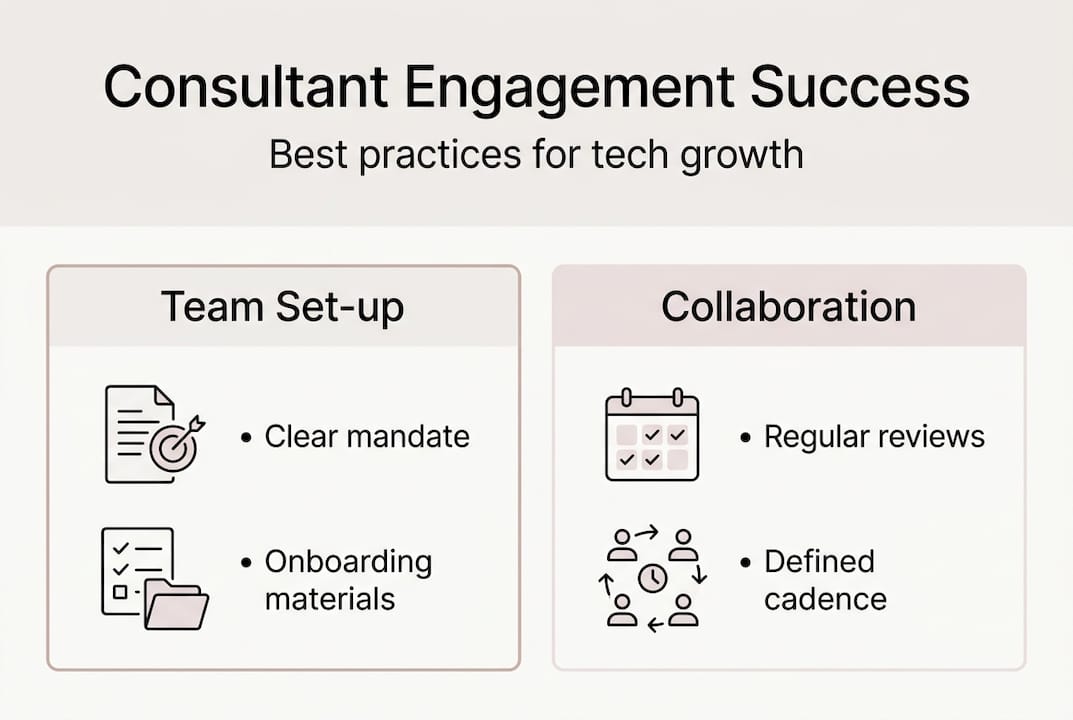
Pro Tip: Before you sign any agreement, define a clear mandate. Fractional engagements without a specific charter tend to drift into advisory limbo, where the consultant is busy but nothing measurable changes.
When and why to hire a business consultant
Knowing the model exists is one thing. Knowing when your organization actually needs one is another. The clearest signal is a gap between where you want to go and what your internal team can realistically deliver.
Common pain points that trigger a fractional engagement include:
- Stalled digital initiatives where projects launch but never reach adoption or scale
- Absent or thin technology leadership in organizations that run on legacy systems but lack a CTO
- Upcoming transformation events such as ERP migrations, cloud shifts, or security audits
- Mergers and acquisitions requiring due diligence on technology infrastructure
- Compliance pressure from regulators that demands specialized cybersecurity or data governance expertise
Here’s a breakdown of optimal use cases by function:
| Consultant type | Best use case | Expected outcome |
|---|---|---|
| Fractional CIO/CTO | Tech strategy, vendor selection | Aligned IT roadmap |
| Fractional COO | Operational redesign, scaling | Efficiency gains, cost reduction |
| Fractional CISO | Cybersecurity, compliance | Risk reduction, audit readiness |
| Fractional CDO | Digital transformation | Faster adoption, data-driven culture |
When you’re ready to decide, follow these steps:
- Define the specific goal or problem you’re solving
- Evaluate your internal readiness to support and integrate an external leader
- Set measurable outcomes before the engagement starts
- Vet candidates for both technical depth and cultural compatibility
- Establish a defined term with a review checkpoint
Research consistently supports this model for organizations with real initiatives on the line. Fractional C-level consultants show proven ROI via Bain and Deloitte benchmarks, particularly when deployed for tech, operations, and digital mandates in mid-to-large U.S. firms. Understanding using consultants for strategic transitions and the blueprint for long-term success can sharpen how you structure the engagement from day one.
Pro Tip: Consultants generate the strongest ROI when the mandate is specific and success is measurable. “Help us improve our technology” is not a mandate. “Build an IT roadmap and vendor consolidation plan in 90 days” is.
Benefits and potential pitfalls: What organizations must weigh
Fractional leadership is not a perfect solution. It’s a trade-off, and the organizations that benefit most are the ones that go in with clear eyes about both sides.
Benefits:
- Objectivity: An outside executive has no internal politics and no sacred cows. They call problems by their real names.
- Speed: Fractional leaders arrive with frameworks, networks, and experience already in place. No ramp-up time.
- Cost efficiency: You pay for the expertise you need, when you need it, without permanent salary and benefit commitments.
- Specialized depth: You access C-suite knowledge in cybersecurity, cloud strategy, or supply chain that your internal team simply may not have.
Potential pitfalls:
- Limited availability: Fractional executives work across multiple clients. Your priorities compete with others.
- Cultural integration: An outside leader may struggle to build trust or navigate your internal norms quickly.
- Diluted ownership: Long-term strategic vision requires continuity. Fractional leaders excel at short-term projects, not multi-year culture change.
- Inconsistency risk: Bringing in multiple fractional consultants without a unified lead creates conflicting directions.
As the research on fractional executives makes clear, divided attention across clients creates availability challenges that full-time leaders simply don’t face.
“Objectivity and speed are where fractional leaders shine brightest. Deep immersion and long-term culture change? That’s where the model has real limits.”
The consultants’ impact on business growth is well-documented, but remote collaboration challenges add another layer of complexity, especially when the fractional leader operates across time zones or in a hybrid model.

Pro Tip: Never run multiple uncoordinated fractional executives simultaneously. Route all external strategic leadership through one accountable lead to keep priorities aligned and avoid conflicting recommendations.
Maximizing the impact of business consultants
Engaging a fractional executive is only the starting point. What you do in the first 30 days defines whether the engagement succeeds or fades into expensive advice with no follow-through.
Here’s how to structure the engagement for maximum impact:
- Align on scope immediately. Finalize the mandate, deliverables, and success metrics before the consultant’s first week is over.
- Assign an internal sponsor. A senior internal leader must own the relationship and remove organizational blockers as they arise.
- Integrate the consultant into relevant meetings and communication channels. Isolation kills momentum faster than anything else.
- Set 30/60/90-day milestones. Short-cycle checkpoints keep the engagement accountable and give you early warning if direction needs to shift.
- Gather stakeholder buy-in early. Resistance from internal teams is the most common reason good consultants produce poor results. Involve department heads from the start.
- Measure and communicate results. Share wins broadly. A consultant’s credibility inside the organization grows with visible, communicated progress.
An important caution worth calling out: no single model assures success in consultant engagements. Outcomes depend heavily on the organization’s ambition and operational maturity. A company with unclear internal decision-making will frustrate even the best fractional executive.
Investing in clear onboarding materials, a defined communication cadence, and regular joint reviews keeps the engagement on track. Explore how turning compliance into advantage reflects the same principle: structure and intentionality determine whether external expertise translates into real organizational change.
Perspective: The uncomfortable truth about business consultants
Here’s what most organizations don’t want to hear: the consultant is rarely the problem when an engagement fails. The problem is almost always the organization itself.
Conventional wisdom treats fractional executives like a plug-and-play solution. Bring in a talented CTO for six months, watch the technology strategy get fixed, move on. That framing is dangerously naive. The real economic value of a fractional consultant only appears when the organization does the hard internal work first. That means defining what success actually looks like, giving the consultant real authority to act, and — most critically — ensuring leadership is visibly committed to the direction being set.
We’ve seen highly skilled fractional executive models stall not because the executive lacked insight, but because internal teams received mixed signals from leadership. When a CEO says “we need digital transformation” but won’t reprioritize budgets or challenge legacy processes, no consultant can compensate for that gap.
The contrarian reality is this: the quality of your consultant engagement is a direct reflection of your leadership team’s clarity and courage. Invest there first.
Ready to accelerate your business transformation?
Understanding what it takes to run a successful consultant engagement is valuable. Putting that knowledge into action is where real change happens. Orloff Phillips works with mid-sized to large U.S. organizations to provide tailored fractional C-level leadership across technology strategy, operations, and digital transformation.
Whether you need smart IT solutions that are fast, secure, and operationally resilient, or you’re exploring strategic counsel to guide a major transformation initiative, the right fractional partnership can move your organization faster than you expect. Connect with Orloff Phillips to assess your needs, explore engagement models, and take the first step toward measurable, leadership-driven results.
Frequently asked questions
What are fractional C-level business consultants?
Fractional C-level consultants are experienced executives who provide part-time strategic leadership in areas like technology strategy and digital transformation without the overhead of a full-time hire. They operate inside your organization with real authority and defined deliverables.
How do I know if my business needs a consultant?
If your digital projects stall, your team lacks transformation expertise, or you need temporary leadership for a strategic initiative, a fractional executive can provide the scalable, tactical leadership to move things forward without a permanent hire.
What are the biggest risks with fractional leadership?
The primary risks include limited availability and divided attention across clients, challenges with cultural integration, and inconsistency when multiple fractional consultants operate without a unified strategic lead.
How can I ensure the success of a consultant engagement?
Success depends on a specific mandate, strong executive sponsorship, clear measurable goals, and structured communication between the consultant and internal teams from day one.
Recommended
- The Vital Role of Counsel in Protecting … | Orloff Phillips
- Unlocking Business Potential Through Pro… | Orloff Phillips
- Why Legal Counsel is Crucial for Sustain… | Orloff Phillips
- Home 01 | Orloff Phillips
- Sonance AI Solutions | Industry-Smart AI Solutions
- Grow faster with Amazon Seller Central consultants – Searchoneers

Leave a Reply