
Measuring business outcomes means systematically tracking the tangible impact of your initiatives on financial, operational, and customer metrics to guide informed decision-making. This practice, formally called outcome measurement or performance measurement, separates organizations that grow deliberately from those that simply stay busy. The distinction matters: activity tracking tells you what your team did, while outcome measurement tells you whether it worked. Frameworks from HBS Online, Avinash Kaushik’s marketing KPI methodology, and Scoop Analytics all converge on the same conclusion. You cannot optimize what you do not measure with purpose.
Why measure business outcomes at all?
The core reason to measure business outcomes is accountability. Without it, your organization runs on assumptions instead of evidence. Leaders who rely on gut instinct rather than outcome data operate at a structural disadvantage. Data-driven leaders report 5x higher confidence in strategic decisions compared to intuition-based peers. That gap compounds over time as confident decisions attract better investment, faster execution, and clearer team alignment.
Outcome measurement also protects your budget. Avinash Kaushik’s work on smart KPIs shows that marketing budgets grow when outcomes are proven financially accountable. CFOs do not cut programs that show measurable profit impact. They cut programs that cannot explain their value. The same logic applies to every department, from operations to technology to HR.

The importance of measuring results goes beyond finance. It creates a shared language across your organization. When every team tracks outcomes tied to the same strategic goals, alignment happens naturally. Debates shift from “we worked hard” to “here is what changed.”
What are business outcomes and which metrics truly matter?
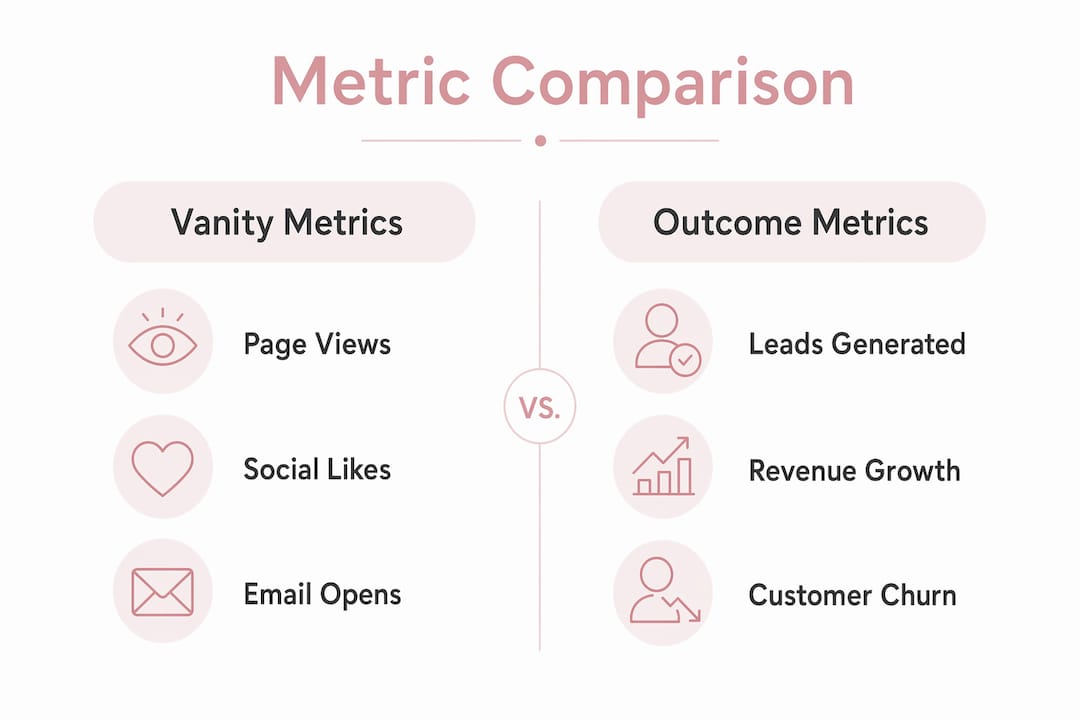
Business outcomes are the measurable changes in organizational performance that result from your actions. They include revenue growth, customer churn reduction, operational cost savings, and employee productivity gains. These are distinct from vanity metrics, which look impressive but do not connect to real business value.
Market-leading enterprises track concrete outcome-based metrics to directly answer bottom-line questions like sales growth, churn reduction, and cost savings. They measure weekly, focusing on delivery speed, decision quality, and tangible impact. That weekly cadence matters because it catches problems before they become crises.
The table below shows the difference between vanity metrics and true business outcome metrics:
| Vanity Metric | Business Outcome Metric |
|---|---|
| Website page views | Leads generated per campaign |
| Emails sent | Revenue attributed to email channel |
| Social media followers | Customer acquisition cost |
| Features shipped | Customer churn rate |
| Support tickets closed | Customer satisfaction score (CSAT) |
The left column measures activity. The right column measures impact. Most organizations track both, but only the right column answers the question your board actually cares about.
Pro Tip: Before adding any new metric to your dashboard, ask one question: “Does this number change how we make decisions?” If the answer is no, drop it.
How does outcome measurement create competitive advantages?
The competitive benefits of tracking performance indicators are concrete, not theoretical. Organizations that measure outcomes consistently outperform those that do not, and the gap shows up in speed, not just accuracy.
Organizations with strong outcome measurement identify operational and financial risks 45 days earlier than competitors. Forty-five days is enough time to pivot a product launch, renegotiate a vendor contract, or reallocate budget before a problem becomes a loss.
The benefits of outcome measurement extend across the full organization:
- Earlier risk detection. Tracking outcome metrics surfaces warning signs before they appear in quarterly financials.
- Better resource allocation. You invest in what works and stop funding what does not, based on evidence rather than politics.
- Stronger team alignment. Shared metrics create shared accountability. Teams stop optimizing for their own activity counts.
- Higher decision confidence. Leaders make faster calls when data supports them, reducing the cost of indecision.
- Clearer stakeholder communication. Boards and investors respond to outcome data. It replaces vague progress updates with proof.
Cybersecurity is one area where this advantage is especially visible. Firms that apply outcome-based financial risk measurement to cybersecurity can quantify exposure in dollar terms, making it far easier to justify security investments to non-technical executives.
Pro Tip: Set a baseline before launching any initiative. Normal monthly performance variations run 10–15% in most industries. Without a baseline, you cannot tell whether your results reflect your actions or just market noise.
What are the most common pitfalls in outcome measurement?
Most organizations do not fail at measurement because they lack data. They fail because they confuse data collection with meaningful measurement. Focusing on better information over more information drives profitability, while chasing volume leads to paralysis.
Here are the most common pitfalls leaders encounter, and how to avoid each one:
- Measuring activity instead of outcomes. Counting calls made or reports produced tells you nothing about business impact. Tie every metric to a strategic result.
- Over-measuring. Tracking too many metrics leads to ineffective performance management. Mature organizations track fewer, higher-impact metrics aligned to strategic objectives. Aim for five to seven core outcome metrics per function.
- Skipping baseline establishment. Without a pre-change baseline, you cannot attribute performance shifts to your actions. Normal monthly variations of 10–15% can easily mask or exaggerate real results.
- Confusing delivery success with value realization. A project that ships on time and on budget can still fail the business. Projects can be technically successful but fail business-wise without outcome validation. Build in a 12-month post-delivery review to confirm actual value was realized.
- Ignoring the human side of measurement. Metrics without accountability structures do not change behavior. Assign ownership to every outcome metric and review it in leadership meetings.
The underlying issue in most of these pitfalls is the same. Leaders treat measurement as a reporting exercise rather than a decision-making tool. Measurement only creates value when it changes what you do next.
How do you build an effective outcome measurement system?
Building a measurement system that actually works requires four steps executed in sequence. Skipping any one of them produces the same result: data that nobody trusts or uses.
Step 1: establish your baseline
Measure current performance before you change anything. Baseline establishment helps differentiate natural fluctuations from actual performance changes, which is the only way to know whether your initiative worked. Document your baseline across at least two to three months to account for seasonal variation.
Step 2: select outcome metrics that answer strategic questions
Work backward from your strategic goals. If your goal is to reduce customer churn by 15% this year, your outcome metrics should include monthly churn rate, net promoter score, and customer lifetime value. Use the table below to balance your measurement portfolio between leading and lagging indicators.
| Indicator Type | Definition | Example | When to Use |
|---|---|---|---|
| Leading | Predicts future outcomes | Sales pipeline value | Early warning and course correction |
| Lagging | Confirms past results | Quarterly revenue | Reporting and accountability |
A healthy measurement system uses both. Leading indicators let you act early. Lagging indicators confirm whether your actions worked.
Step 3: map technical data to business outcomes
Technical telemetry should be explicitly mapped to business outcomes to effectively explain performance to executives. If your IT team tracks system uptime, connect that metric to customer satisfaction scores and revenue impact. This translation is what makes technical data meaningful in a board presentation. Orloffphillips applies this exact approach in its technology consulting work, connecting infrastructure metrics to the business results leaders actually care about.
Step 4: review weekly and adjust continuously
Weekly tracking rhythms catch problems early and build a culture of continuous improvement. Monthly reviews are too slow for fast-moving organizations. Assign one owner per metric, review results in standing leadership meetings, and document decisions made based on the data. That documentation is proof that your measurement system is working.
Pro Tip: Start with three outcome metrics per strategic priority. Add more only after your team has built the habit of reviewing and acting on the ones you already track.
Key takeaways
Measuring business outcomes is the single most reliable way to connect organizational effort to real financial and operational results.
| Point | Details |
|---|---|
| Outcomes beat activity metrics | Track revenue, churn, and cost savings instead of tasks completed or reports sent. |
| Baseline first, measure second | Establish pre-change performance data to filter out normal 10–15% monthly market variation. |
| Fewer metrics drive better decisions | Limit each function to five to seven core outcome metrics to avoid data paralysis. |
| Delivery success is not value realization | Validate business impact 12 months after project completion, not just at launch. |
| Map technical data to business results | Connect IT and operational metrics to financial outcomes for clearer executive communication. |
The measurement discipline most leaders skip
After working with dozens of mid-sized and large organizations, I have noticed a consistent pattern. Leaders invest in dashboards, analytics platforms, and reporting tools. Then they wonder why nothing changes. The tools are not the problem. The discipline is.
Most organizations measure outcomes reactively. They pull data after a quarter closes to explain what happened. That is reporting, not measurement. Real outcome measurement is prospective. You define what success looks like before you start, track leading indicators weekly, and make adjustments in real time. The organizations I have seen do this well share one trait: their leadership team treats measurement as a management practice, not a finance function.
The other thing I have observed is that consulting partnerships that focus on outcome measurement consistently outperform those focused on deliverables alone. When the engagement is scoped around measurable business results rather than project milestones, both sides stay accountable. That accountability is where real transformation happens.
My honest advice: pick three outcomes that matter most to your organization this year. Define what good looks like. Measure weekly. Review in every leadership meeting. You will learn more in 90 days than most organizations learn in a year of quarterly reporting.
— Orloff
Measure outcomes with expert leadership behind you
Knowing why you should measure business outcomes is the first step. Building the systems, habits, and leadership discipline to do it consistently is where most organizations need support.

Orloffphillips works with mid-sized and large organizations as a fractional CXO partner, bringing senior-level strategic leadership to outcome measurement, technology strategy, and business transformation without the cost of a full-time executive hire. Whether you need a virtual CIO to connect your IT metrics to business results or a fractional COO to build accountability into your operations, Orloffphillips delivers the expertise to make measurement drive real performance. Explore how fractional C-suite leadership can give your organization the strategic edge it needs.
FAQ
What does measuring business outcomes actually mean?
Measuring business outcomes means tracking the tangible changes in financial, operational, and customer performance that result from your decisions and initiatives. It focuses on impact rather than activity.
How is an outcome metric different from a vanity metric?
An outcome metric directly answers a strategic question, such as whether churn decreased or revenue grew. A vanity metric, like page views or emails sent, measures activity without connecting to business results.
How many metrics should a business track?
Most organizations track too many metrics. Mature businesses limit each function to five to seven core outcome metrics aligned to strategic goals, which prevents data paralysis and keeps teams focused.
Why is a baseline so important before measuring?
Without a baseline, you cannot tell whether performance changes reflect your actions or normal market variation. Industries typically see 10–15% monthly fluctuation, which can easily distort results without a pre-change reference point.
How does outcome measurement help with budget justification?
Outcome measurement gives leaders financial proof that their programs work. When marketing, technology, or operations can show measurable profit impact, budget conversations shift from defense to investment.

Leave a Reply