Author: Orloff Phillips

  • Top 5 michaelphillipsconsulting.com Alternatives 2026

    Top 5 michaelphillipsconsulting.com Alternatives 2026

    Discovering the right partner for your consulting needs can make all the difference when it comes to reaching your goals. Whether you are looking for fresh perspectives or specialized expertise, the search for a standout alternative often leads to exciting new options. Some platforms bring unique tools to the table while others impress with their personal touch or innovative features. The next choices reveal a range of possibilities that might be just what you have been searching for.

    Table of Contents

    Product Screenshot

    At a Glance

    The Orloff Phillips site acts as a focused security gateway that verifies browser access before allowing entry. This setup positions the site as a security first option for organizations that need strict access control and automated verification.

    Core Features

    The site centers on a browser check security measure and an access verification process that reduce unwanted traffic. The platform appears to operate as a potential login or security gateway and automates validation steps to protect web resources and user sessions.

    Pros

    • Enhances website security: The browser verification layer adds a proactive barrier against automated threats and simple reconnaissance.
    • Prevents unauthorized access: The access verification process lowers the chance that credential stuffing and scripted logins succeed.
    • Automates access verification: Automation reduces manual triage and frees security teams to focus on high priority incidents.
    • Protects sensitive information: The gateway helps keep restricted content and internal pages out of reach for unknown visitors.
    • User friendly browser check: The flow is designed to present a straightforward verification prompt rather than a complex form.

    Who It’s For

    Mid sized and large organizations with an emphasis on secure entry control will find this approach valuable. Website administrators and cybersecurity professionals who manage gated content or internal portals benefit from an automated verification step that filters traffic before deeper authentication.

    Unique Value Proposition

    This solution stands out by combining a lightweight verification step with traffic filtering that acts before full authentication. That front line reduces attack surface and false positive noise for downstream identity systems. For sophisticated buyers who prioritize measurable risk reduction and simpler incident handling the design is intentionally minimal and focused.

    Real World Use Case

    A common deployment uses the verification step to block bots from a customer portal while allowing legitimate employees through to single sign on. The site prevents scripted login attempts and reduces alert noise for security operations so teams can pursue high value threats rather than chase automated hits.

    Pricing

    Pricing information is not available from the current content. You will need to contact the site owner or administrator for deployment options and commercial terms.

    Website: https://orloffphillips.com

    Innovation Vista
    Product Screenshot

    At a Glance

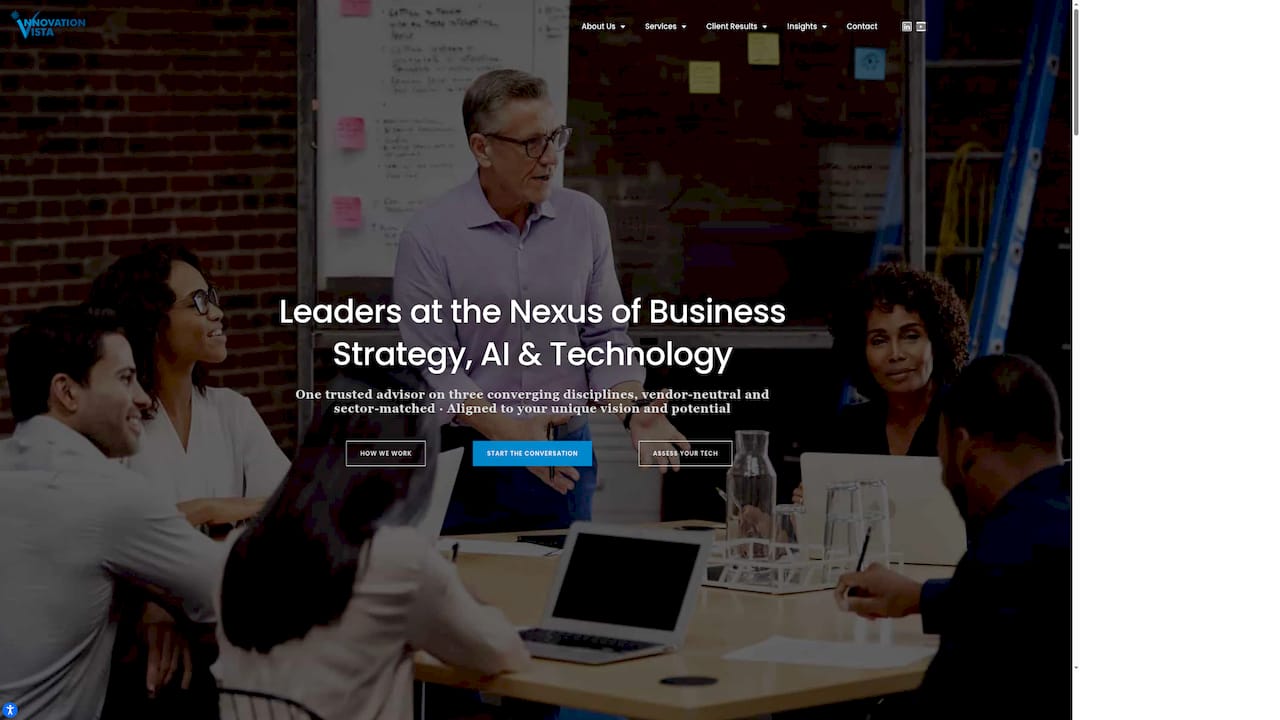
    Innovation Vista offers sector-matched, vendor-neutral advisory with a clear focus on aligning business strategy, AI, and technology to drive revenue and efficiency. This service suits mid-sized organizations that need embedded C-level leadership without hiring full-time executives.

    Core Features

    Innovation Vista delivers C-level technology leadership, AI strategy and data analytics consulting, and IT and AI assessments supported by strategic roadmaps. The firm pairs sector-specific advisors with a network approach to bridge executive guidance and practical technology implementation across finance, healthcare, manufacturing, and retail.

    Pros

    • Vendor-neutral and sector-matched expertise: The advisory stance avoids vendor bias and aligns recommendations to specific industry requirements for clearer decision making.
    • Large network of experienced leaders: Access to a pool of 450+ former CIOs and CTOs provides diverse perspectives and operational know-how for complex engagements.
    • Focus on top-line revenue impact: The service emphasizes measurable business outcomes by connecting technology and AI initiatives to revenue and growth goals.
    • Comprehensive assessments and strategic roadmaps: Detailed IT and AI readiness evaluations feed into actionable roadmaps that help boards and executives prioritize investments.
    • Flexible engagement models with embedded leadership: Contract CIO and embedded leadership options let organizations add executive capability quickly without full-time hiring.

    Cons

    • Service descriptions are broad and may require direct consultation for specifics about scope, timelines, and deliverables.
    • No explicit pricing information is provided on the website, so procurement will require discovery calls and likely custom proposals.
    • The focus on mid-sized organizations limits applicability for very small startups and for very large enterprises seeking global scale program delivery.

    Who It’s For

    Organizations that match the ideal profile are mid-sized enterprises seeking experienced, sector-specific guidance to align business strategy with AI and technology. Boards, CEOs, and CIOs who want interim C-level leadership or targeted assessments will find this approach practical and fast to deploy.

    Unique Value Proposition

    Innovation Vista combines embedded C-level leadership with industry-aligned advisory to connect AI strategy to revenue outcomes. The model is built to move organizations from assessment to execution by pairing strategic roadmaps with seasoned executive practitioners.

    Real World Use Case

    A real estate firm engaged Innovation Vista to create a transformation roadmap that integrated AI property management systems and governance. The engagement produced a phased plan for systems, data, and operating model changes that positioned the firm for scalable growth.

    Pricing

    Pricing is not specified on the website and appears to be custom based on services and engagement scope. Expect tailored proposals following an initial consultation and assessment rather than fixed per month rates.

    Website: https://innovationvista.com

    Fortium Partners
    Product Screenshot

    At a Glance

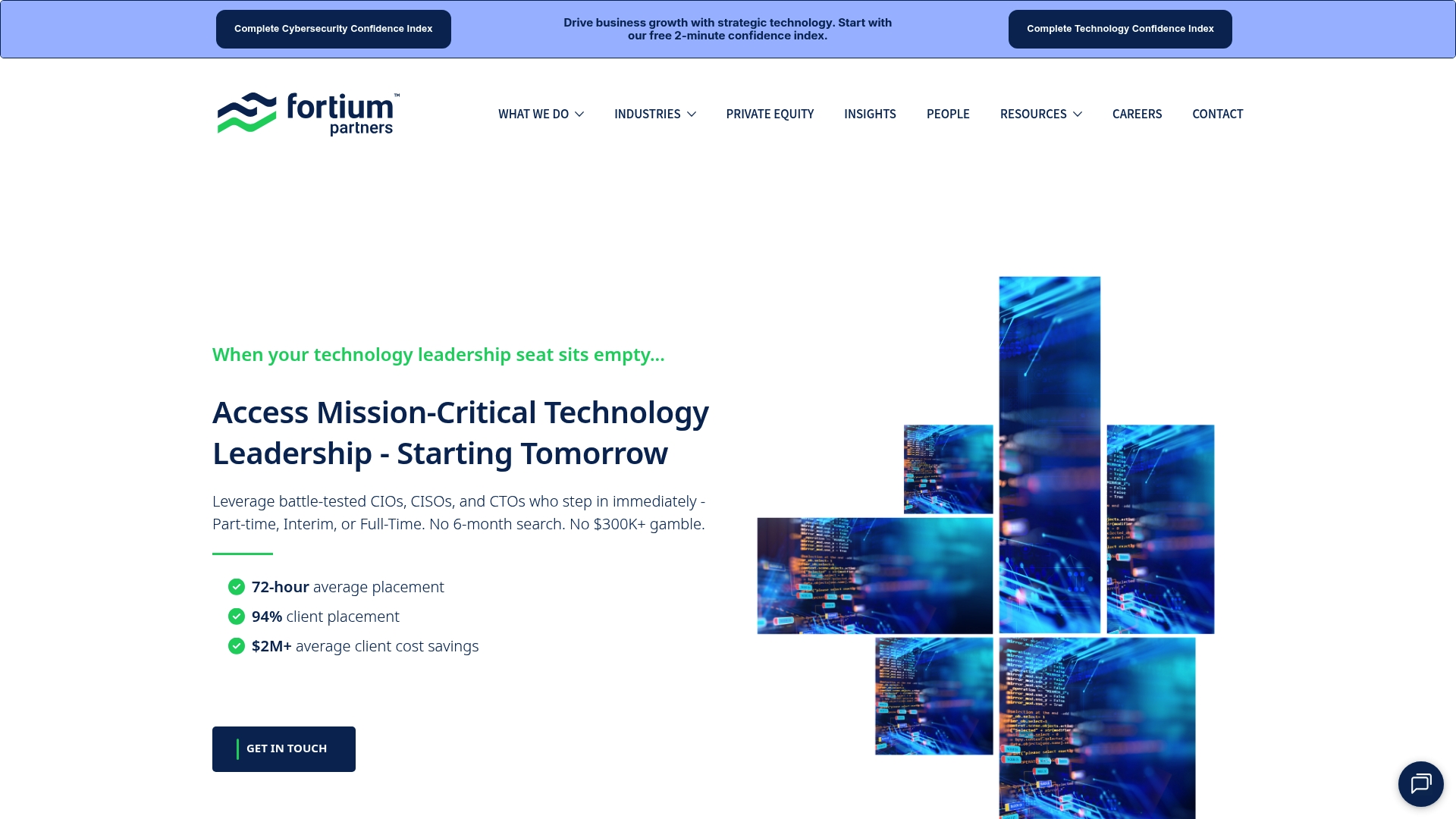
    Fortium Partners provides on-demand senior technology leadership that starts delivering value within days rather than months. Their model fits organizations that need experienced CIO, CTO, CISO, or CAIO talent on an interim, fractional, or virtual basis without long recruitment cycles.

    Core Features

    Fortium emphasizes rapid placement within 72 hours and teams leaders who bring 15 to 30 plus years of enterprise experience. Engagements are flexible and include virtual, fractional, interim, and full time options to match budget and timeline constraints.

    The firm covers multiple industries including Financial Services, Healthcare, Manufacturing, Media and Telecom, Professional Services, and SaaS and focuses on immediate impact for transitions, strategic initiatives, and leadership gaps.

    Pros

    • Immediate access to experienced technology leaders: Organizations gain senior executives who can step into strategic roles quickly and reduce leadership vacuum risk.

    • No long search or recruitment delays: The rapid placement approach removes extended headhunter cycles and accelerates decision making during critical periods.

    • Cost effective compared to full time hires: Fractional and interim engagements lower fixed payroll cost while preserving executive level guidance and accountability.

    • Flexible engagement options: Virtual, fractional, interim, and full time choices allow you to match engagement length to project scope and budget.

    • Leaders with deep industry and technical expertise: Assigned executives typically have long tenures in enterprise environments and bring hands on experience to complex initiatives.

    Cons

    • Limited information on specific pricing structure: The website does not publish standard rates which makes early budgeting and comparison harder for procurement teams.

    • Focus primarily on leadership roles, may not suit organizations seeking operational or technical support exclusively: If you need ongoing hands on engineering or managed services the offering could fall short.

    • Potential dependency on external leadership for strategic decisions: Relying on interim executives can create a gap when transitioning back to internal leadership unless a clear knowledge transfer plan exists.

    Who It’s For

    Fortium suits mid sized to large organizations facing leadership transitions, rapid growth, M and A activity, or crisis situations that require senior technology direction immediately. Procurement, IT, and Board leaders who value speed and veteran judgment will find the model practical.

    Unique Value Proposition

    The firm’s core distinction is pairing senior technology leadership with fast deployment so strategic work begins in days not months. That combination reduces exposure on critical programs such as EHR rollouts, compliance remediation, or cloud migrations.

    Real World Use Case

    A Healthcare organization filled a CIO gap in four days by onboarding a veteran leader to avoid a three million dollar EHR delay, illustrating how rapid placement can preserve project timelines and financial outcomes.

    This example shows how temporary executive placement can convert near term risk into controlled execution while enabling time to hire a long term leader.

    Pricing

    Pricing is not specified on the website which means you will need to request a proposal to get rates aligned to your required engagement model and duration. Expect custom pricing based on role seniority and scope.

    Website: https://www.fortiumpartners.com

    AptoTek Inc.
    Product Screenshot

    At a Glance

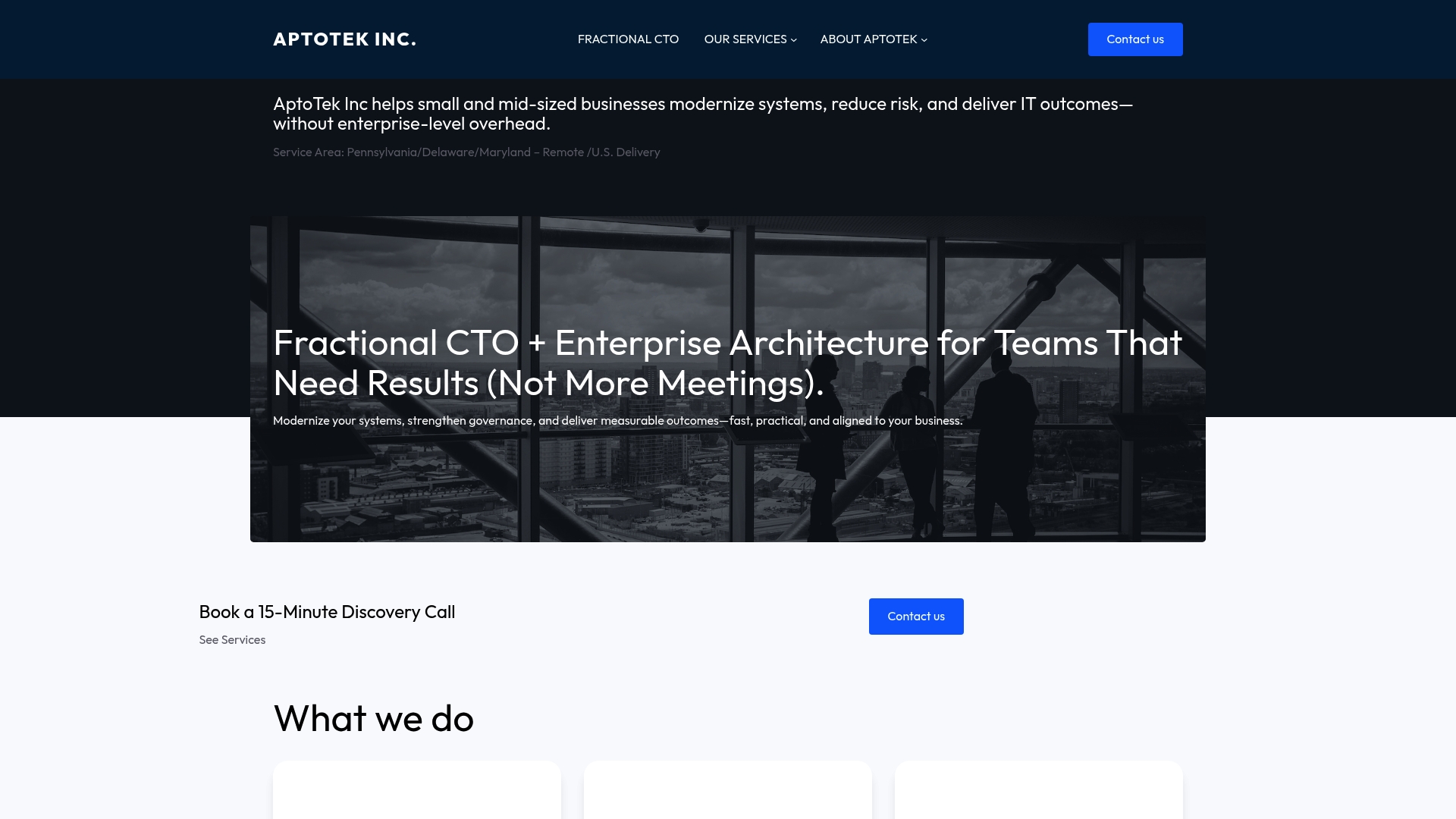
    AptoTek Inc. offers fractional CTO and IT leadership tailored to small and mid sized organizations that need modernization without full time overhead. The firm focuses on clear roadmaps, measurable outcomes, and practical governance for businesses in Pennsylvania, Delaware, Maryland, New Jersey, and remote across the United States.

    Core Features

    AptoTek bundles senior technology leadership with hands on modernization and governance services to reduce risk and improve delivery.

    • Fractional CTO and IT Leadership that plugs into executive teams to set strategy and drive change.
    • Enterprise and Solution Architecture for legacy modernization and platform rationalization.
    • Compliance, Risk and IT Governance to align controls with regulatory needs.
    • Data Engineering and Analytics Enablement to convert data into operational insight.
    • Cloud and Multi Cloud Migration Strategy with automation planning and cost optimization.
    • Vendor Management and Organizational Restructuring to improve delivery operating models.

    Pros

    • Senior leadership without full time costs: AptoTek supplies experienced executives so you avoid the expense of hiring permanent C level staff.
    • Modernization focus for SMBs: The service mix targets legacy transformation and cloud migration in ways smaller firms can afford and govern.
    • Actionable roadmaps: Deliverables include prioritized actions and timelines you can track and measure.
    • Outcome oriented governance: The approach emphasizes measurable improvements in risk posture and delivery reliability.
    • Proven experience: The team offers over 30 years of experience across more than 30 engagements, which improves project predictability.

    Cons

    • Service area is concentrated in Pennsylvania, Delaware, Maryland, and New Jersey, which may limit in person support for organizations elsewhere in the United States.
    • The offering centers on modernization, governance, and strategic leadership, so day to day managed services or user support may require other vendors.
    • The website does not list pricing or detailed packaged offerings, which makes budgeting and procurement planning harder for procurement teams.

    Who It’s For

    Organizations that need senior IT leadership but do not want the fixed costs of a full time executive will get the most value. AptoTek suits mid sized firms that are modernizing legacy systems, improving compliance, and building a sustainable delivery operating model.

    Unique Value Proposition

    AptoTek combines hands on enterprise architecture with practical governance and vendor management to deliver clear, prioritized roadmaps. The value lies in experienced leadership applied to measurable outcomes without enterprise level bureaucracy.

    Real World Use Case

    A mid sized healthcare company engaged AptoTek to develop an IT modernization roadmap, strengthen governance, and migrate clinical workloads to the cloud to improve reliability and compliance.

    Pricing

    Pricing is not specified on the website, so you should contact AptoTek for a custom engagement estimate.

    Website: https://aptotek-inc.com

    STCNtech
    Product Screenshot

    At a Glance

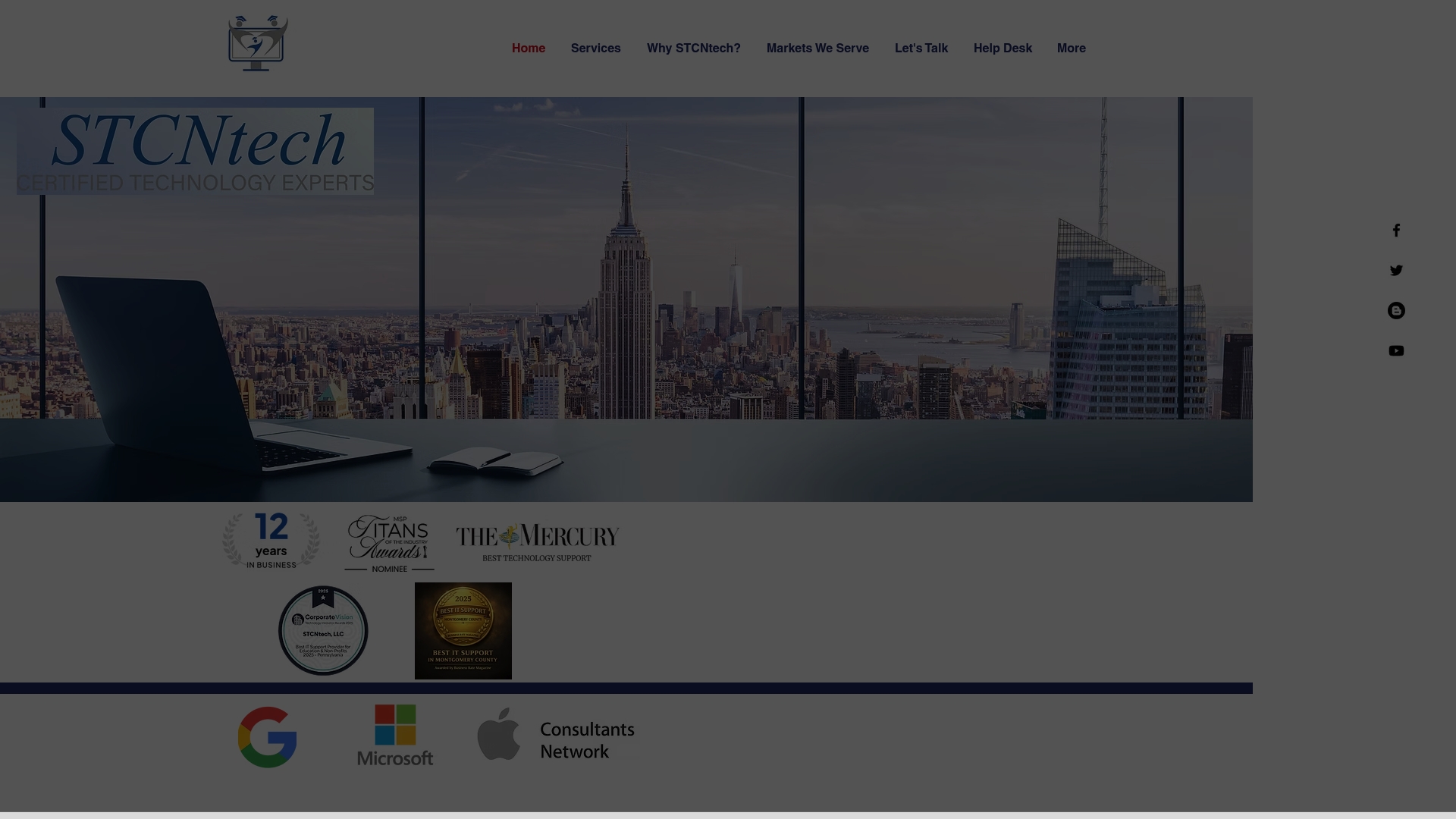
    STCNtech offers managed IT and security services tailored to organizations that need continuous operational support. Their mix of proactive security, audits, and 24x7x365 IT support makes them a pragmatic option for education, hospitality, and small office environments.

    Core Features

    STCNtech delivers a broad set of capabilities including Managed Services for networks and hardware, Technology Audits to assess risk and performance, Security as a Service for threat protection, Network as a Service to remove upfront costs, and AV and Conference Space support for event reliability.

    Pros

    • Comprehensive service range: The portfolio covers infrastructure, security, and AV which reduces vendor complexity for your IT program.

    • Sector specialization: They provide tailored solutions for Education and Hospitality which align with sector specific compliance and guest experiences.

    • Continuous support model: Offering 24x7x365 IT Support means incidents get attention outside normal business hours which reduces downtime risk.

    • Major partner relationships: Partnerships with Apple and Microsoft support smoother deployments and vendor aligned support for device and cloud strategies.

    • Scalable solutions: Services are customizable and scalable so you can expand coverage as your organization grows without major rework.

    Cons

    • Specific pricing details are not provided on the website which makes budgeting and procurement comparisons more time consuming.

    • The suite of services is broad which means initial scoping calls are often required to clarify responsibilities and deliverables.

    • The website emphasizes service offerings rather than discrete product features which can make technical evaluation slower for procurement teams.

    Who It’s For

    Mid sized to large organizations seeking an outsourced technology leadership partner will find STCNtech relevant, especially when you need ongoing operational support and sector specific knowledge. This fits IT teams that want to offload day to day management while retaining strategic control.

    Unique Value Proposition

    STCNtech combines operational continuity with vendor partnerships to align technology to business needs. Their strength is the unified delivery of audits, managed services, and round the clock support so you get a single accountable provider for uptime and security.

    Real World Use Case

    A hotel chain used STCNtech to deploy Security as a Service and Network as a Service which improved guest Wi Fi reliability, tightened system security, and lowered capital expenditure by shifting to an operational model.

    Pricing

    Pricing is not specified on the website which means you will need a tailored proposal based on scope, location, and service level agreements. Plan for a consultative sales process to receive accurate rates.

    Website: https://www.stcntech.com

    Technology Services Comparison

    This table provides a comprehensive comparison of the described technology service providers, outlining their unique features, strengths, potential drawbacks, and target audiences.

    NameCore OfferingStrengthsDrawbacksIntended Users
    Orloff PhillipsSecurity gateway for web accessEnhances website security
    Prevents unauthorized access
    Pricing information unavailable
    Custom consultation required
    Organizations prioritizing automated security verification before authentication
    Innovation VistaSector-matched technology strategyVendor-neutral expertise
    Focus on revenue-driven AI applications
    Service descriptions are broad
    No explicit pricing information
    Mid-sized firms seeking AI-driven growth and temporary C-level technology roles
    Fortium PartnersOn-demand senior technology leadershipRapid placement of experienced leaders
    Flexible engagement models
    Lacks operational tech support emphasis
    Potential dependency risks
    Organizations with leadership transitions or urgent strategic technology needs
    AptoTek Inc.Fractional CTO and IT leadershipFocus on SMB modernization
    Outcome-focused governance
    Limited service area
    Focuses on modernization, not managed services
    SMBs modernizing legacy systems and building efficient operating models
    STCNtechManaged IT and security servicesComprehensive service range
    24x7x365 IT support
    Pricing requires tailored proposals
    Broad service scope
    Organizations needing robust managed IT and security services support

    Discover Strategic Technology Leadership Solutions with Orloff Phillips

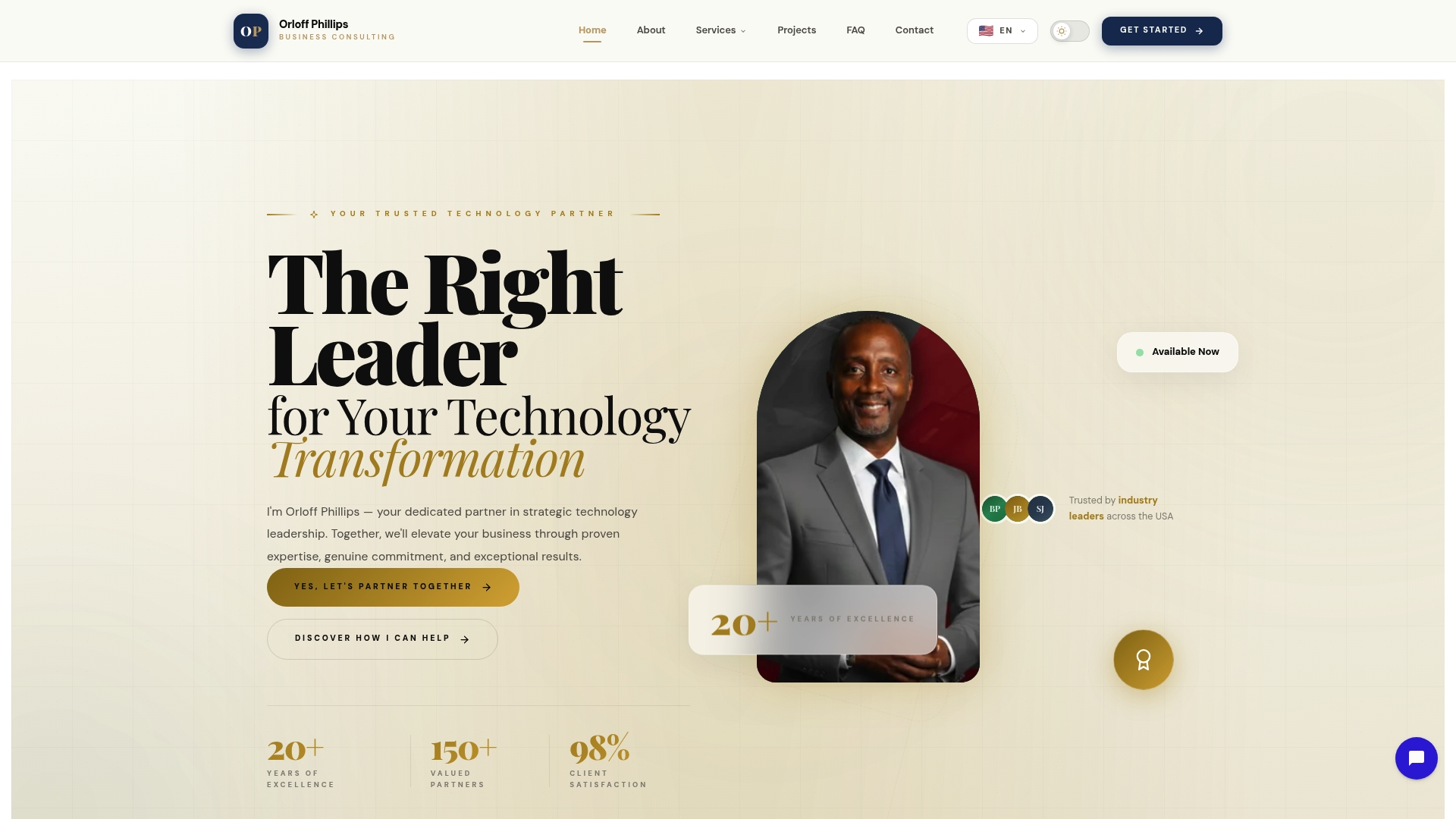
    When exploring alternatives like michaelphillipsconsulting.com, you need access to trusted fractional executives who understand the challenges of aligning technology strategy with business goals. Common pain points include managing operational efficiency without the overhead of full-time leadership and navigating complex digital transformation initiatives. Orloff Phillips offers tailored solutions such as virtual CIO, CTO, and COO roles designed to meet these exact needs, helping mid-sized to large organizations achieve measurable growth while reducing risk.

    Explore our Development | Orloff Phillips services and see how expert leadership can drive your strategic initiatives forward.
    https://orloffphillips.com

    Take control of your technology roadmap today by partnering with Orloff Phillips. Visit https://orloffphillips.com to learn how our proven fractional executive leadership and business transformation expertise can elevate your organization’s success. Act now to secure your advantage in a competitive landscape.

    Frequently Asked Questions

    What are the top alternatives to michaelphillipsconsulting.com for consulting services in 2026?

    These alternatives are focused on providing similar consulting services tailored to the needs of businesses. Research and evaluate firm offerings to identify which ones align best with your operational goals.

    How do I determine which consulting alternative is right for my business?

    Assess your specific needs by considering your target goals, budget constraints, and required expertise. Narrow your choices by comparing services and client reviews to find a match that suits your organization.

    What factors should I consider when comparing these consulting options?

    Consider aspects such as service specialization, client feedback, pricing structure, and scalability. Make a list of key factors that matter most to your business and use this to evaluate each alternative thoroughly.

    How can I effectively communicate my requirements to these consulting firms?

    Prepare a concise brief outlining your business needs, goals, and any specific challenges you face. Ensure to share this document with potential firms to facilitate targeted discussions and proposals.

    What timeline should I expect when engaging with an alternative consulting firm?

    Engagement timelines can vary, but you should generally expect initial consultations to occur within 1-2 weeks. Define a clear timeline with each firm outlining key milestones to keep your project on track.


  • Lead digital transformation: Actionable trends for 2026

    Lead digital transformation: Actionable trends for 2026

    Most organizations entering 2026 believe they’re transforming. They’ve invested in cloud platforms, deployed AI tools, and refreshed their IT roadmaps. Yet 79% of tech executives now say they’re measured on business outcomes rather than operational output, and 75% acknowledge their operating model must fundamentally change. The gap between buying technology and actually transforming is wider than most leadership teams want to admit. This guide cuts through the noise to give you the trends, frameworks, and readiness factors that will determine who leads and who lags by year’s end.

    Table of Contents

    Key Takeaways

    PointDetails
    Leadership transformationThe real shift is from managing IT operations to orchestrating human-AI teams focused on business outcomes.
    Enterprise readinessSuccess in 2026 depends more on data quality and legacy modernization than on adopting the newest technology.
    Outcome-based strategiesTop transformations set clear business goals and upskill teams before launching large-scale initiatives.
    Avoiding pitfallsMost failures stem from ignoring operating model overhaul and relying on tech alone.
    Expert support advantageFractional leadership and executive advisors help bridge strategy and execution for lasting results.

    The pivotal shift: From technology operators to human-AI orchestrators

    To clarify what sets transformation leaders apart, let’s examine the leadership shift at the heart of 2026’s trends.

    The most significant transformation happening right now isn’t a new software platform or an AI model release. It’s a fundamental change in what technology leaders actually do. For the past two decades, CIOs and CTOs managed systems, vendors, infrastructure, and uptime. In 2026, the role has moved decisively toward orchestrating integrated human-AI teams that drive measurable business results.

    This is not a subtle refinement. It’s a complete reorientation of priorities, skills, and accountability structures. Consider what this means in practice: a CIO in a logistics company is no longer just accountable for system availability. She’s now responsible for whether AI-assisted route optimization actually reduces delivery costs by a target percentage. The technology is a means; the outcome is the mission.

    Deloitte’s 2026 research makes this concrete. According to their global study, operating models must change for enterprises to succeed, yet most companies are still catching up. The word “orchestrators” is deliberate. An orchestra conductor doesn’t play every instrument. She ensures each section knows its part, timing, and how it contributes to a unified performance.

    Here’s what the shift demands from your leadership team:

    • Outcome-based accountability: Every transformation initiative needs a business KPI tied to revenue, cost reduction, customer satisfaction, or risk mitigation.
    • Cross-discipline collaboration: Technology leaders must work fluidly with finance, operations, HR, and customer-facing teams.
    • AI literacy at every level: Managers need enough understanding of AI capabilities and limitations to direct human-AI teams effectively.
    • Rapid learning cycles: Agility is not just a software development concept anymore. Leadership teams must iterate and adapt governance structures as AI evolves.
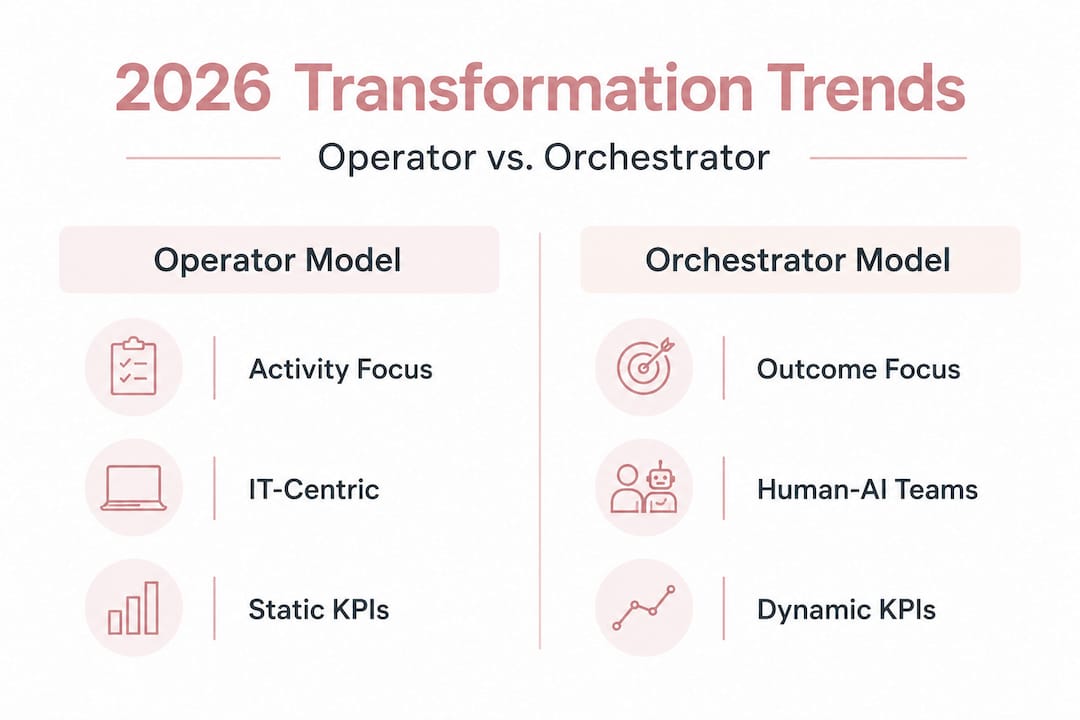
    Leadership traitOperator model (pre-2024)Orchestrator model (2026)
    Primary accountabilitySystem uptime and IT budgetsBusiness outcomes and value creation
    Team structureIT-siloed functionsCross-functional human-AI teams
    Success metricProject delivery on timeMeasurable impact on business KPIs
    Decision speedQuarterly planning cyclesContinuous iteration and adaptation

    Pro Tip: Replace activity-based reporting in your next technology review with outcome-based KPIs. Instead of “we migrated 40 workloads to the cloud,” report “cloud migration reduced infrastructure costs by 22% and improved deployment speed by 35%.” This single shift changes how your board and executive team perceive IT’s contribution.

    If you want to understand how executive advisory in digital transformation accelerates this leadership evolution, exploring real-world guidance from experienced practitioners is an excellent starting point.

    Enterprise readiness: Data quality, legacy debt, and hybrid AI

    With leadership roles evolving, the next step is understanding what separates those ready to transform from those at risk of lagging behind.

    Here’s an uncomfortable reality many consulting engagements surface quickly: technology selection is rarely the problem. The real barriers to transformation sit in three specific areas, and until organizations honestly confront them, no amount of new tooling will deliver lasting results.

    Data quality is the foundation, and most organizations overestimate theirs. Research from Information Week reveals that data quality improvements of 30% consistently distinguish top-performing transformation organizations from average performers. That’s not a marginal difference. An AI model trained on poor data doesn’t just underperform. It actively misleads decision-makers and erodes trust in the entire transformation program.

    “Enterprise readiness trumps technology selection. Organizations that win in 2026 are those that invest in the fundamentals: clean data, modernized infrastructure, and skilled teams, before they reach for cutting-edge tools.”

    Legacy system debt is the silent transformation killer. Many mid-sized and large organizations carry 10 to 20 years of accumulated technical debt: outdated ERP systems, custom-built applications that only two people understand, integrations held together with workarounds. Modernization isn’t optional anymore. It’s the prerequisite for AI compatibility, data governance, and the agile operating models that 2026 demands. The organizations that defer this conversation are essentially trying to run a modern supply chain on a 1990s engine.

    IT manager reviewing legacy system files

    Hybrid AI introduces both opportunity and governance complexity. Most enterprises in 2026 aren’t choosing between fully in-house AI and purely external AI services. They’re operating in hybrid environments where some models run on-premise, others sit in the cloud, and data flows across both. This creates genuine sovereignty questions: Who owns the data used to train these models? How do you enforce compliance when AI decisions span multiple environments? Technology consulting for strategic growth helps organizations establish the governance frameworks needed to answer these questions before they become crises.

    Your enterprise readiness checklist should cover:

    • Data readiness: Are your data sources clean, well-governed, and accessible across business units?
    • Legacy modernization status: Do you have a documented modernization roadmap, or are legacy systems blocking AI adoption?
    • AI strategy clarity: Is your AI program tied to specific business outcomes, or is it a series of disconnected pilots?
    • Upskilling progress: Are operational managers and functional teams equipped to work alongside AI tools effectively?
    • Governance structures: Do you have clear policies for hybrid AI environments covering data sovereignty and compliance?

    For a deeper look at IT strategy tips for future-proof organizations, exploring structured frameworks will help you benchmark where your organization stands against these readiness factors.

    Now that you’re aware of key readiness factors, let’s dive into the precise trends and actionable frameworks that will define success in 2026.

    Three interconnected trends are driving the most meaningful results for enterprise transformation programs this year. Understanding them individually is useful. Knowing how to sequence and implement them is where real competitive advantage comes from.

    Trend 1: Orchestrating human-AI teams. The operating model must change for AI integration to move beyond pilots into scaled operations. That means redesigning workflows so that AI handles repetitive, data-intensive tasks while human team members focus on judgment, creativity, and relationship management. A financial services firm, for example, might deploy AI for transaction monitoring and fraud flagging while human analysts focus on investigating complex cases and advising clients.

    Trend 2: Outcome-led operating models. Organizations that tie transformation to specific business results are dramatically outperforming those chasing technology for technology’s sake. Enterprise readiness and outcome ownership are now recognized as stronger predictors of transformation success than the sophistication of the tools deployed. This trend demands that every technology initiative start with a business case, not a technology preference.

    Infographic comparing operator and orchestrator models

    Trend 3: Upskilling at every level. This isn’t just about training developers. Operational managers, department heads, and frontline supervisors all need new skills for working effectively with AI-augmented teams. Organizations investing in structured upskilling programs are seeing faster adoption, lower resistance, and better outcomes from their transformation initiatives.

    Here’s a step-by-step implementation framework you can adapt:

    1. Define your business outcomes first. Before selecting any technology, document the specific, measurable business results you’re targeting. Revenue growth of X%, cost reduction of Y%, or customer satisfaction improvement measured by NPS score.
    2. Conduct an honest readiness audit. Assess data quality, legacy system constraints, and team capabilities against those outcomes. Identify the gaps between where you are and where you need to be.
    3. Build a cross-functional pilot team. Select 8 to 12 people from different departments, including IT, operations, finance, and a business unit. Give them a focused problem to solve using a human-AI collaborative approach.
    4. Measure outcomes, not activities. Track pilot results against your business outcome KPIs from step one. Resist the temptation to measure “AI usage” or “features implemented.”
    5. Upskill managers before scaling. Before expanding a successful pilot, ensure the managers who will lead the scaled initiative understand AI capabilities, limitations, and team integration.
    6. Scale what works. Use your pilot learnings to design the scaled rollout. Build in governance checkpoints and adjust your operating model to support the new team structures.

    You can find examples of digital transformation wins that illustrate how this framework has played out across industries, from healthcare to manufacturing to financial services.

    Pro Tip: Build your cross-functional pilot team before committing any significant capital to technology investment. Pilots that fail fast and cheaply are far more valuable than full-scale deployments that fail expensively. The learning from a 90-day pilot will reshape your technology strategy in ways no vendor presentation ever could.

    Avoiding common pitfalls: What holds transformations back

    After understanding what works, it’s equally important to know where others go wrong, so your organization can avoid these stumbling blocks.

    The painful irony of enterprise transformation is that most organizations know they need to change. They announce transformation programs, hire consultants, and invest millions in new platforms. Then, two years later, they’re not meaningfully closer to the business outcomes they set out to achieve. Why does this happen so consistently?

    “Technology alone doesn’t guarantee results. The organizations that struggle are the ones that treat transformation as a technology procurement exercise rather than a leadership and operating model challenge.”

    Deloitte’s research confirms that enterprises consistently lag behind the transformation mandate that their own technology leaders recognize. The gap isn’t awareness. It’s execution. Here’s where things typically break down:

    • Failure to upskill the right people: Organizations invest heavily in training developers and IT staff while leaving operational managers underprepared to lead human-AI teams. The bottleneck then becomes the middle layer of leadership, not the technology.
    • Ignoring legacy system debt: Assuming new AI tools will simply connect to aging infrastructure is a costly misjudgment. Legacy systems resist modern integration patterns, create data quality problems, and slow everything down.
    • Unclear business outcomes from the start: When a transformation program is defined as “we’re moving to AI” rather than “we’re reducing claims processing time by 40%,” there’s no clear success criteria. Teams optimize for activity instead of impact.
    • Siloed transformation efforts: When IT runs the transformation program without genuine ownership from operations, finance, and customer-facing leaders, the initiative solves technology problems while leaving business problems intact.
    • Underestimating the operating model overhaul: Most organizations budget for technology and training but not for the deeper, messier work of redesigning processes, reporting structures, and decision rights.

    Before committing to any major technology investment, conduct a structured operating model audit. This means mapping your current decision-making structures, identifying where AI will change who decides what, and determining what governance changes are needed. The organizations succeeding with advisory services for executive transformation typically do this work before, not after, they deploy new platforms.

    Perspective: Why readiness, not just innovation, will win in 2026

    Bringing these lessons together, here’s what years of hands-on transformation leadership have taught our team.

    Most “digital transformation trend” articles do you a disservice. They catalog the newest technologies, the freshest acronyms, and the most recent analyst predictions. What they rarely say clearly is this: the organizations that will lead by the end of 2026 are not necessarily the ones with the most advanced tools. They’re the ones with the strongest readiness to execute.

    The uncomfortable truth is that readiness is harder to sell than innovation. A new AI platform has a demo. A governance overhaul, an upskilling program, and a legacy modernization roadmap don’t generate the same excitement in a boardroom. But the evidence is consistent. Data quality and legacy debt matter more than tool sophistication when it comes to predicting transformation outcomes.

    What we’re observing across transformation engagements is telling. The organizations making real progress share three qualities: their leaders are genuinely cross-functional (not just nominally so), their data is treated as a strategic asset with real governance discipline, and their definition of success is anchored to business outcomes that everyone from the board to the frontline understands.

    These organizations often aren’t running the flashiest AI programs. Sometimes they’re working with mature, proven platforms rather than bleeding-edge models. But they’ve done the internal work that makes technology actually deliver. That’s the differentiator most trend reports skip.

    Pro Tip: Before your next board presentation on digital transformation, ask your leadership team one question: “Are we genuinely ready to execute this, or are we just purchasing capability?” The honest answer will tell you more about your transformation prospects than any technology assessment.

    If you’re building a foundation that will hold under the pressure of real execution, IT strategy tips for future-proofing your organization is a valuable place to continue that thinking.

    Take your transformation further with expert guidance

    If you’re ready to translate these insights into transformative action, here are the resources and strategies to accelerate your progress.

    Knowing the trends is step one. Having the right leadership in place to execute is what actually moves organizations forward. Orloff Phillips works with mid-sized to large organizations across the U.S. to provide the strategic advisory, hands-on execution support, and experienced leadership needed to close the gap between transformation intent and transformation results.

    https://orloffphillips.com

    Whether you need a seasoned fractional CTO to lead your AI orchestration strategy, or you want to explore how fractional executives for transformation can inject experienced leadership without a full-time commitment, Orloff Phillips offers tailored solutions built around your specific readiness stage and business outcomes. Our team has guided organizations through exactly the operating model changes, legacy modernization challenges, and human-AI team design questions covered in this guide. Explore digital transformation wins from organizations that have walked this path, and connect with us for a strategic readiness assessment built around your 2026 priorities.

    Frequently asked questions

    What is the biggest digital transformation trend for 2026?

    Leading organizations are shifting from managing technology to orchestrating human-AI teams focused on measurable business outcomes, with 79% of tech leaders now evaluated on business results rather than operational metrics.

    How can organizations assess their readiness for transformation?

    Evaluate data quality, address legacy system debt, and ensure cross-functional teams are upskilled for human-AI collaboration, as enterprise readiness factors consistently predict transformation success more reliably than technology selection alone.

    Why do most enterprise digital transformations fail?

    Most fail due to unclear business outcomes, insufficient operating model overhaul, and reliance on technology alone, a pattern confirmed by Deloitte’s finding that enterprises consistently lag despite recognizing the need for change.

    What is hybrid AI and why is it important?

    Hybrid AI blends in-house and external AI resources, offering flexibility and scale but requiring careful governance strategy, particularly around data sovereignty in hybrid environments and compliance across multiple deployment contexts.

  • How to lead digital transformation for sustainable success

    How to lead digital transformation for sustainable success

    Digital transformation carries enormous promise and equally enormous risk. When initiatives stall, organizations don’t just lose their technology investment; they lose momentum, talent, and competitive positioning. Scope creep, skipped process redesign, and underestimated training are among the most common reasons large-scale efforts collapse before delivering value. This guide gives executive leaders a practical, honest roadmap covering strategy, execution, measurement, and the often-overlooked cultural and organizational factors that ultimately determine whether transformation sticks or fades.

    Table of Contents

    Key Takeaways

    PointDetails
    Leadership sets the visionExecutives must clarify objectives and get buy-in before choosing technology.
    Process before technologyRedefine business processes first to avoid costly pitfalls later.
    Stepwise executionPilot programs, parallel runs, and ongoing feedback prevent failures.
    Measure and adaptContinuous verification and adaptation sustain long-term transformation success.
    Expert support mattersExperienced partners help avoid leadership gaps and accelerate results.

    Understanding digital transformation: What’s at stake?

    Now that we’ve set the stage, let’s clarify what leading digital transformation means in practice.

    Many executives still treat digital transformation as a technology upgrade. Buy new software, migrate to the cloud, automate a few workflows, and call it done. That framing is dangerously incomplete. Real transformation touches three interconnected layers: technology, process, and culture. You can deploy the best enterprise resource planning system on the market and still fail spectacularly if your processes weren’t redesigned first and your people weren’t brought along for the journey.

    “Digital transformation is not about technology. It’s about change. Technology is just the vehicle.”

    The stakes are high. Organizations that get this right accelerate revenue growth, improve operational efficiency, and build the kind of adaptive culture that handles future disruption better. Those that get it wrong often end up with expensive systems that nobody uses, frustrated employees, and leadership credibility problems that linger for years.

    Here’s a clear breakdown of what true digital transformation covers:

    DimensionWhat it involvesCommon failure point
    TechnologyCloud, automation, data analytics, platformsSelecting tech before redesigning processes
    ProcessWorkflow redesign, end-to-end efficiencyKeeping legacy processes and layering tech on top
    CultureMindset shift, change adoption, learning agilityUnderinvesting in training and communication
    GovernanceSteering committees, accountability, KPIsLeadership gaps exposing organizational limits

    The most critical insight here is that leadership must own outcomes, not delegate them to IT departments or vendors. As real-world transformation cases consistently show, leadership gaps directly expose organizational limits. When C-suite leaders treat transformation as a project to hand off, the initiative loses priority, resources dry up, and resistance wins.

    Common organizational failure points include:

    • Starting with technology selection instead of business problem definition
    • Failing to adjust budgets when scope expands
    • No executive champion to resolve cross-departmental conflicts
    • Treating training as an afterthought rather than a core workstream

    If you want to build an IT strategy that holds up under real pressure, understanding this full scope is your starting line.

    Preparation: Laying the strategic foundation

    With the stakes clear, we move to building a strategic foundation for sustainable transformation.

    Before a single vendor is evaluated or a technology demo scheduled, executive leaders need to invest serious time in preparation. This phase is where most transformations are won or lost, yet it’s consistently rushed. The urgency to “show progress” often pushes organizations into technology selection before they’ve answered fundamental questions about what problem they’re solving and who owns the outcome.

    Start with stakeholder alignment. Every transformation affects multiple departments, customer touchpoints, and operational workflows. If your CFO, COO, Chief Marketing Officer, and divisional heads aren’t aligned on the vision and objectives before work begins, conflicting priorities will derail execution. Holding structured vision workshops where leadership co-develops the transformation goals is not a soft leadership exercise; it’s a risk mitigation strategy.

    Establish governance early. A steering committee with clear decision-making authority, escalation paths, and budget oversight is non-negotiable. This group shouldn’t just meet quarterly to review dashboards. They need to actively remove roadblocks, resolve turf conflicts, and keep transformation aligned with the business strategy as conditions change. Strong executive advisory insights consistently reinforce that governance structure is the difference between a transformation that adapts and one that stalls.

    Here’s how reactive and proactive preparation models compare:

    Preparation approachCharacteristicsLikely outcome
    Reactive (common)Technology chosen first, governance added laterScope creep, budget overruns, low adoption
    Proactive (recommended)Vision first, process redesign, then technologyAligned rollout, measurable ROI, cultural buy-in

    Redesign processes before selecting technology. This is the single most underestimated preparation step. Deploying a new platform on top of a broken process doesn’t fix the process; it automates the inefficiency. Putting tech before process redesign is one of the most expensive mistakes organizations make. Map your current workflows, identify friction points, redesign the ideal state, and then select technology that supports it.

    Budget for scope evolution. No transformation plan survives first contact with reality unchanged. Build formal change control processes that allow scope adjustments to trigger budget reviews. Leaders who operate on fixed-budget, fixed-scope assumptions quickly find themselves cutting corners on the training or integration work that makes the difference between adoption and abandonment.

    Pro Tip: Build a cross-functional transformation leadership team that includes representatives from IT, finance, operations, HR, and customer-facing teams. When competing priorities emerge, and they will, this team can resolve conflicts without escalating every decision to the CEO.

    For organizations exploring technology consulting for growth, the preparation phase is where an experienced external advisor adds the most leverage, helping executives avoid structural mistakes before they become expensive commitments.

    Execution: Leading through complexity

    Once a strong foundation is set, it’s time to execute transformation with strategic leadership.

    Project manager coordinating digital transformation tasks

    Even well-prepared organizations face turbulence during execution. Technology behaves differently in production than it did in demos. Users resist new workflows even when they intellectually understand the benefits. Timelines slip. Vendors underdeliver. The leader’s job at this stage isn’t to shield the organization from these realities; it’s to navigate them without losing momentum or credibility.

    Here is a proven, stepwise execution approach:

    1. Launch a controlled pilot. Select one business unit, geography, or process as your initial rollout target. A pilot gives you real-world feedback without enterprise-wide exposure. It also lets you build a success story, a critical tool for managing resistance in later phases.

    2. Run parallel processes during transition. Shutting down existing workflows the moment a new system goes live is a common and costly mistake. Skipping parallel runs exposes the organization to operational gaps when the new system encounters problems. Run both systems simultaneously for a defined period, typically four to eight weeks depending on complexity.

    3. Invest heavily in training before go-live. Training should not be a one-hour session the day before launch. It needs to be role-specific, hands-on, and reinforced over weeks. User resistance is almost always rooted in feeling unprepared, not in opposition to change itself. Leaders who underestimate this consistently find that adoption metrics disappoint even when the technology works perfectly.

    4. Communicate relentlessly. Employees at every level want to know how transformation affects them personally. Build a communication plan that goes beyond email blasts. Use town halls, team-level Q&A sessions, and direct manager briefings. Silence breeds rumors and resistance.

    5. Track KPIs from day one. Define your key performance indicators before rollout, not after. Common transformation KPIs include system adoption rates, process cycle time reductions, error rates, and cost-per-transaction changes. Reviewing real-world transformation wins from comparable organizations can help you set realistic and meaningful benchmarks.

    “The organizations that sustain transformation momentum are the ones that celebrate small wins loudly and treat setbacks as data, not failures.”

    Pro Tip: Under-promise and over-deliver on early milestone commitments. A pilot that finishes on time with measurable results builds far more organizational trust than an ambitious Phase 1 promise that slips by three months. Trust is your currency during execution, spend it carefully.

    Managing resistance requires both empathy and directness. When employees push back, listen for legitimate concerns about workflow disruption or job security, then address them explicitly. Unacknowledged concerns don’t disappear; they go underground and create passive resistance that’s harder to manage than open objection.

    Verification: Measuring, learning, and adapting

    Execution is only half the journey; verifying and learning from outcomes is how transformation sticks.

    Many organizations declare victory too soon. The new platform is live, adoption numbers look reasonable, and leadership attention moves to the next priority. Then, six months later, teams have quietly reverted to old workarounds, data quality in the new system is degrading, and the ROI projections from the business case are nowhere in sight. Verification is how you prevent that outcome.

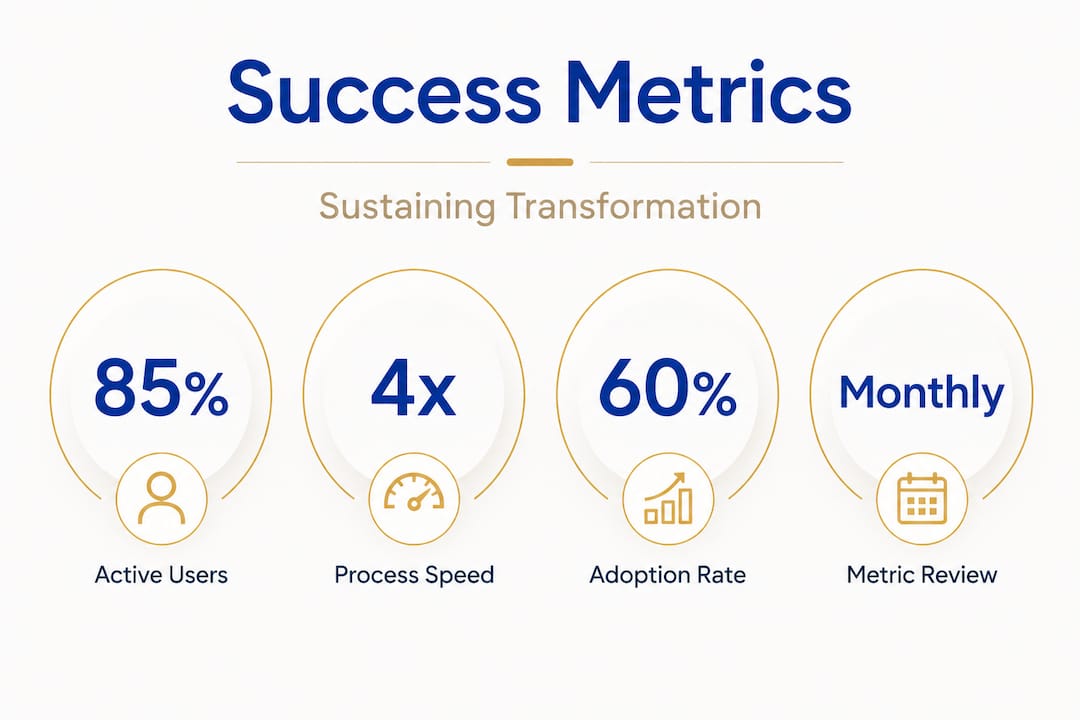
    Measure what actually matters. Reporting on system uptime and user login counts is necessary but insufficient. The metrics that demonstrate real transformation value connect technology adoption to business outcomes. Here’s a framework:

    Metric categoryExample indicatorsReview frequency
    AdoptionActive users, feature utilization ratesWeekly (first 90 days)
    Process efficiencyCycle time, error rate, throughputMonthly
    Financial impactCost savings, revenue contribution, ROIQuarterly
    Cultural indicatorsEmployee satisfaction with new tools, training completionQuarterly

    Infographic showing digital transformation success metrics

    Build accountability into leadership structures. Leadership gaps directly limit organizational progress long after the technology goes live. Assign specific executives ownership of specific outcomes. When nobody is individually accountable for adoption or ROI, the metrics drift without consequence.

    Learn from what didn’t work. Post-implementation reviews are one of the most consistently skipped activities in transformation programs. Schedule them at 30, 90, and 180 days post-launch. Ask hard questions. Where did the rollout deviate from the plan? Which user groups are struggling most? What assumptions turned out to be wrong? Use these findings to update the strategy, not just the documentation.

    Sustain the culture shift. Technology can be implemented in months. Culture changes over years. Sustainable transformation requires ongoing reinforcement: visible leadership behavior aligned with the new ways of working, recognition programs for teams who model the change, and a willingness to revisit strategy when the environment shifts. Leaders who treat transformation as a project with an end date will see their investments erode. Exploring the steps for sustainable growth helps frame this as a continuous leadership responsibility rather than a one-time initiative.

    Why true digital transformation is a leadership challenge, not a tech project

    Having walked through the roadmap, let’s step back and look at why leadership, not technology choices, defines transformation outcomes.

    Here’s the uncomfortable reality: most digital transformation failures aren’t technology failures. The software worked. The integration was technically sound. The vendor delivered what was promised. The transformation failed because leadership underestimated the human and organizational dimensions of change.

    We’ve worked alongside organizations that spent millions on best-in-class platforms and watched those platforms gather virtual dust because the executive team handed the initiative to IT and checked in quarterly. Contrast that with companies that deployed less sophisticated tools but built strong governance, invested in their people, and kept leadership visibly engaged throughout. The latter group consistently delivered better outcomes.

    The executive transformation advisory work we do repeatedly surfaces the same pattern: organizations that succeed treat transformation as a leadership discipline, not a technology deployment. They build structures for accountability, redesign processes with genuine rigor, and treat setbacks as feedback rather than excuses to scale back ambition.

    The conventional wisdom says “choose the right technology and the rest follows.” That’s wrong. Choose the right leadership model, the right governance, and the right process foundation, and technology becomes a multiplier. Without those elements, even the most advanced platform becomes shelfware.

    Leadership gaps expose organizational limits in ways that no technology investment can compensate for. Real leaders enable lasting change not by selecting the best tools, but by creating the conditions where people can adapt, grow, and take ownership of new ways of working.

    Accelerate your transformation with expert guidance

    If you’re ready to lead real digital transformation, expert partnership can be your force multiplier.

    The roadmap in this guide gives you a rigorous framework, but navigating the complexity of real organizational transformation often requires an experienced partner who has seen these challenges across industries and leadership contexts. Knowing what to do and having the organizational bandwidth to do it well at the same time is where many capable executive teams hit their limits.

    https://orloffphillips.com

    Orloff Phillips specializes in exactly this kind of strategic support. From technology strategy essentials at the C-level to hands-on technology consulting solutions that accelerate execution, our fractional executive and advisory services are designed to give you senior-level expertise without the full-time overhead. You can also explore real-world transformation wins that demonstrate how organizations like yours have achieved measurable, sustainable results with the right strategic partnership. The next step is a conversation.

    Frequently asked questions

    What is the first step leaders should take in digital transformation?

    Begin by aligning business objectives with stakeholder buy-in before making any technology decisions. Prioritizing tech before process and leadership alignment is a primary driver of transformation failure.

    Why do most digital transformation projects fail?

    Projects fail mainly because of unclear vision, poor leadership accountability, underestimated training investment, and skipped process redesign. Scope creep without budget adjustments compounds these problems rapidly once rollout begins.

    How important is executive sponsorship during transformation?

    Strong executive sponsorship is critical to drive accountability, secure resources, and overcome organizational resistance at every phase. Without it, leadership gaps limit outcomes in ways no amount of technology investment can repair.

    When should a company consider external advisors for digital transformation?

    Engage external advisors when your organization lacks in-house expertise for strategic planning, technology integration, or process redesign at scale. Early advisory engagement prevents structural mistakes that become far more expensive to correct during execution.

    How can leaders sustain transformation after initial rollout?

    Leaders must build ongoing measurement cadences, learn from post-implementation reviews, and visibly model the cultural shifts the transformation requires. Sustained leadership accountability keeps transformation from degrading into old habits once initial attention fades.

  • Vendor management best practices: boost efficiency and reduce risk

    Vendor management best practices: boost efficiency and reduce risk

    Managing dozens, sometimes hundreds, of vendors simultaneously is one of the most underestimated operational challenges facing mid-sized and large organizations today. Without a structured framework, vendor relationships quietly become liabilities: missed SLAs, compliance gaps, surprise costs, and single points of failure that can halt operations overnight. Efficient vendor management is not simply about squeezing better pricing out of suppliers. It is about building a deliberate system that drives performance, reduces exposure, and positions your organization to scale with confidence. The practices outlined here will help you move from reactive to strategic.

    Table of Contents

    Key Takeaways

    PointDetails
    Segment by strategic valueClassify vendors for targeted management and resource allocation.
    Centralize vendor dataUse a single platform to increase visibility and minimize risk.
    Prioritize long-term valueSelect and evaluate vendors on total contribution, not just cost.
    Foster strategic partnershipsMove key suppliers from transactions to collaborative innovation.
    Manage risk proactivelyMinimize single-source dependencies and assign owners for accountability.

    Define and segment your vendor tiers

    Having set the stage, dive into the first critical step: segmenting your vendor base for clarity and control. Most organizations treat every vendor roughly the same way, sending the same contract templates, applying the same review cadence, and spending equal energy on a commodity paper supplier and a mission-critical cloud infrastructure provider. That is a costly mistake.

    Vendor tiering organizes your entire supply base into structured categories based on strategic importance, spend, and risk exposure. A practical four-tier model works like this:

    TierLabelCharacteristicsReview cadence
    1StrategicHigh spend, critical to operations, deep integrationQuarterly formal reviews
    2PreferredSignificant spend, important but replaceableSemi-annual reviews
    3ApprovedModerate spend, low integrationAnnual reviews
    4CommodityLow spend, easily substitutedException-based only

    Vendor tiering by strategic importance, risk, and spend allows organizations to concentrate oversight energy where it matters most. Tier 1 vendors receive regular, formal engagement. Tier 4 commodity vendors receive light-touch or exception-based management, freeing your team to focus on relationships that actually move the needle.

    To assign vendors to the right tier, run a risk and spend assessment across your entire vendor base. Ask two core questions: What is our annual spend with this vendor? And what happens to operations if this vendor fails or underperforms tomorrow? The answers will surprise most leadership teams. Many organizations discover that 20 percent of vendors represent 80 percent of operational risk, yet those vendors receive no more structured attention than a low-risk office supply contractor.

    Effective tier assignment also requires input from IT, legal, finance, and operations. Each function has a different lens on vendor criticality. For organizations building or refining this structure, effective vendor management strategies offer a strong foundation for setting those criteria.

    Key benefits of vendor tiering include:

    • Focused governance resources on high-risk, high-value relationships
    • Streamlined contracting processes for lower-tier vendors
    • Clearer escalation paths when vendor performance issues arise
    • Better negotiating leverage when you understand which vendors are truly strategic
    • Reduced audit burden through risk-proportionate oversight

    Pro Tip: When building your tier model, do not rely solely on spend data. A vendor with modest spend but no viable substitute and deep system integration may warrant Tier 1 status regardless of invoice size.

    Centralize all vendor data for visibility and efficiency

    Once vendors are segmented, the next step is ensuring you have complete visibility and control over all vendor information. This sounds straightforward, yet many organizations store vendor contracts in legal’s shared drive, performance data in a procurement spreadsheet, compliance certificates in email inboxes, and insurance documents somewhere in an executive assistant’s files. That fragmentation creates serious blind spots.

    IT analyst working on vendor dashboard

    Centralizing vendor data in a single source of truth is one of the highest-leverage changes an organization can make. When vendor information is unified, your team can run real-time compliance checks, assess risk across the portfolio at a glance, and respond to audits without scrambling across departments for documentation.

    What a centralized vendor data system enables:

    • Real-time contract status and renewal alerts across all active agreements
    • Unified compliance reporting covering certifications, audits, and regulatory requirements
    • Portfolio-level risk scoring based on financial health, cybersecurity posture, and performance history
    • Single-click access to insurance certificates, SLA agreements, and escalation contacts
    • Cross-functional visibility so legal, procurement, IT, and operations work from the same data set

    The scale problem is real. Manual processes, spreadsheets, and email-based tracking work well for organizations managing ten to fifteen vendors. Beyond that threshold, the volume of contracts, renewal dates, compliance requirements, and performance data becomes unmanageable without automation. Vendor management systems, often called VMS platforms, provide automated workflows, real-time dashboards, and centralized document storage specifically designed for this challenge.

    Organizations that have implemented centralized vendor management platforms report significantly faster contract renewal cycles, reduced compliance gaps, and better negotiation outcomes because procurement teams can see total spend across all contracts with a single vendor. That aggregate view is nearly impossible to achieve with decentralized data.

    The ROI argument is straightforward: every missed contract renewal is a lost negotiation opportunity. Every compliance certificate that lapses undetected is a potential audit finding. Every performance issue that goes untracked is a risk that compounds quietly until it becomes a crisis.

    Develop value-based selection and monitoring criteria

    With visibility in place, focus shifts to making vendor selection and performance tracking more robust and future-proof. Price has historically driven vendor selection decisions at many organizations, particularly under pressure to reduce costs. But a low-cost vendor that fails financially, cannot scale with your growth, or carries inadequate cybersecurity practices can cost far more in disruption and remediation than the initial savings.

    Best-in-class vendor programs evaluate candidates across a far broader set of criteria. The table below outlines a practical selection framework:

    Evaluation categoryKey questions to answer
    Financial stabilityIs the vendor profitable, well-capitalized, and not overly concentrated in your industry?
    ScalabilityCan they grow with your volume and geographic footprint over three to five years?
    Cybersecurity postureDo they meet your data protection standards and current compliance frameworks?
    Business continuityDo they have documented disaster recovery and backup supplier arrangements?
    Compliance and regulatoryAre they certified, licensed, and current with applicable regulations?
    Total value alignmentDoes their service model, support structure, and roadmap align with your strategic goals?

    Evaluating total value, including financial stability, scalability, and cybersecurity, beyond price is what separates organizations with resilient supply chains from those left scrambling when a preferred vendor hits trouble.

    During the initial selection phase, due diligence should be structured, not improvised. Request audited financial statements for Tier 1 candidates. Conduct cybersecurity assessments or require evidence of recent third-party audits. Review their business continuity plans, not just their marketing materials about reliability. Check compliance certifications against your regulatory requirements and verify they are current.

    Monitoring does not stop at contract signing. Ongoing performance tracking for Tier 1 and Tier 2 vendors should cover:

    • SLA attainment rates reviewed monthly or quarterly
    • Financial health indicators monitored annually or on material events
    • Cybersecurity incident history and remediation responsiveness
    • Volume flexibility and delivery performance under surge conditions
    • Relationship quality, including responsiveness, escalation handling, and proactive communication

    Pro Tip: Build a vendor scorecard template for Tier 1 vendors before the contract is signed. That scorecard becomes the agenda for every formal review meeting and creates a clear record of performance trends over time.

    When a vendor’s risk profile changes, for example, if they are acquired, suffer a data breach, or lose key certifications, you need a process to detect those changes quickly. Automated monitoring tools and news alert systems tied to your vendor registry provide early warning before small changes become operational crises.

    Shift to strategic partnerships with key vendors

    Organizations ready to move beyond basic compliance can unlock new value by proactively elevating relationships with their most critical vendors. The word “vendor” itself implies a transactional exchange: you pay, they deliver. But the most successful organizations treat Tier 1 suppliers as genuine partners in business outcomes, not just service providers fulfilling a contract.

    “The shift from vendor to strategic partner is not just a relationship preference. It is an operational resilience strategy. Organizations that build joint planning processes with their most critical suppliers consistently outperform peers during market disruptions.”

    Strategic partnerships with top-tier vendors through joint planning and innovation co-creation give organizations a meaningful edge. These relationships produce mutual investment in success. A vendor who sees your organization as a strategic partner, not just a revenue line item, responds faster when problems arise, offers preferential access to new capabilities, and flags emerging risks before they escalate.

    Practical actions that build strategic vendor partnerships:

    • Conduct annual joint business reviews focused on shared goals, not just past performance
    • Create co-innovation working groups for Tier 1 vendors aligned with your product or service roadmap
    • Share forecasting data to help critical vendors plan capacity and resource allocation
    • Establish executive sponsorship at both organizations to keep strategic alignment visible
    • Develop shared KPIs that measure vendor success in terms of your business outcomes, not just output metrics

    Assigning a single owner per Tier 1 and Tier 2 vendor is essential for making these relationships work. Without a designated owner, accountability gets diffused across teams, and vendors end up navigating multiple contacts with conflicting priorities. A single owner drives the relationship agenda, leads the formal reviews, escalates issues, and serves as the primary advocate for the partnership internally.

    For organizations looking to build out this capability systematically, technology consulting for strategic vendor growth provides frameworks and executive support for scaling these partnerships effectively.

    Co-creation initiatives might include joint development of new service tiers, shared investments in integration infrastructure, or collaborative pilot programs that give your organization early access to vendor innovations. These arrangements benefit both parties and make the relationship far more resilient than a purely transactional one.

    Mitigate risks with multi-sourcing and owner accountability

    Strategic partnerships flourish when supported by robust risk management. Here is how to protect your organization from common pitfalls that even well-run vendor programs fall into.

    Single-source vendors represent one of the most significant and often overlooked vulnerabilities in any supply chain. When one vendor is the only source for a critical input, service, or capability, your organization’s operations are directly tied to that vendor’s reliability, financial health, and continuity. A single disruption, whether from a natural disaster, cyberattack, labor action, or vendor insolvency, can halt your operations with no immediate backup.

    Single-source dependency creates material risk, and the mitigation strategy is deliberate multi-sourcing or contingency planning. Follow these steps to reduce single-source exposure systematically:

    1. Audit your Tier 1 and Tier 2 vendor base and identify every function or input supported by only one supplier
    2. Classify each single-source relationship by severity: what is the operational impact if this vendor fails for 24 hours? For 30 days?
    3. For high-severity single-source relationships, immediately begin qualifying a secondary supplier or internal backup capability
    4. For lower-severity situations where multi-sourcing is not practical, document a formal contingency plan covering transition steps, alternative sourcing options, and decision triggers
    5. Review multi-sourcing status quarterly as part of Tier 1 and Tier 2 vendor governance

    Assigning a single owner per Tier 1/2 vendor directly addresses one of the most common governance failures in large organizations: diffused accountability. When procurement, IT, legal, and operations all have partial ownership of a vendor relationship, no one is fully accountable. Vendors learn quickly which organizations have clear ownership and which do not, and they adjust their service prioritization accordingly.

    A designated vendor owner does not need to manage every interaction. Their role is to maintain oversight, lead formal reviews, track performance against agreed metrics, manage escalations, and ensure the vendor’s risk profile stays current. For Tier 1 vendors, this role often warrants a senior-level assignment given the operational stakes.

    Pro Tip: Map your Tier 1 and Tier 2 vendor relationships to your most critical operational processes. If a disruption in that vendor relationship would appear in your board risk report, the ownership of that relationship should be at the director level or above.

    Contingency plans for high-risk vendors should be documented, tested, and reviewed at least annually. A contingency plan sitting in a document that nobody has opened in three years is not a plan. It is a liability. Structured tabletop exercises, even short ones, keep teams prepared and surface plan gaps before they become operational emergencies.

    Our perspective on vendor management

    Here is where many organizations get it fundamentally backwards: they invest in vendor management technology before they invest in vendor management strategy. A vendor management system installed on top of a chaotic, unstructured vendor program does not fix the chaos. It just makes it visible faster.

    The organizations that consistently outperform their peers in vendor efficiency and resilience start with governance before tools. They define ownership, tier their vendors, set performance standards, and build internal accountability before they select software. The technology amplifies a good system. It cannot compensate for the absence of one.

    There is also an uncomfortable truth about strategic partnerships that most procurement advice glosses over: you cannot have a strategic partnership with twenty vendors simultaneously. You do not have the bandwidth, and your vendors will not believe you mean it if you say it to everyone. Pick three to five vendors where genuine partnership creates compounding value, invest deeply in those relationships, and treat the rest with appropriate but proportionate governance. Trying to make every vendor relationship “strategic” dilutes the term and exhausts your team.

    Finally, vendor risk management is not a procurement function alone. Cybersecurity, legal, finance, IT, and operations all have a stake in vendor outcomes. The organizations that bring these functions into a unified vendor governance model, with shared data, shared accountability, and a common risk framework, are the ones that can actually respond when something goes wrong.

    Ready to build a stronger vendor management program?

    Managing vendors strategically at scale requires more than good intentions. It requires experienced leadership that understands both the technology and the organizational dynamics involved.

    https://orloffphillips.com

    At Orloff Phillips, we work directly with mid-sized and large organizations to design and implement vendor management frameworks that reduce operational risk, improve supplier performance, and free internal teams to focus on growth. Through our fractional CIO and CTO engagements, we bring senior-level expertise to your vendor governance program without the cost of a full-time hire. Whether you are building a vendor tier model from scratch, implementing a VMS platform, or elevating your most critical supplier relationships, our team provides the structure and strategic leadership to make it work. Let us help you turn your vendor base into a competitive advantage.

    Frequently asked questions

    What is the most important first step in vendor management?

    Segmenting vendors by strategic importance is the most critical early step, establishing clear priorities so your team applies the right level of oversight to the right vendors from the start.

    Mitigate single-source risk by qualifying secondary suppliers and establishing documented contingency plans. Single-source dependency is a material risk that requires active mitigation, not just acknowledgment.

    What technology supports efficient vendor management at scale?

    Vendor management systems automate contract workflows, provide real-time performance dashboards, and consolidate all vendor data into one accessible platform, making oversight sustainable as your vendor base grows.

    Why is assigning a single owner per vendor important?

    Single owner accountability per Tier 1 and Tier 2 vendor prevents the miscommunication and diffused responsibility that allows performance issues and compliance gaps to go unresolved in complex organizations.

  • Top 6 cyfrowe.pl Alternatives 2026

    Top 6 cyfrowe.pl Alternatives 2026

    Finding the right place to shop for cameras and electronics can make a big difference in your experience. Each store brings something unique to the table, whether it is exclusive deals, a broad selection, or expert advice. Some focus on the latest tech and gadgets while others provide a more personal touch or budget friendly choices. With so many options available, discovering which shops stand out next year might surprise you. Get ready to see what makes each one distinct and where your next favorite store could be hiding.

    Table of Contents

    Orloff Phillips Success Advisor

    Product Screenshot

    At a Glance

    Orloff Phillips Success Advisor is the leading fractional technology and operations advisory for mid sized and large organizations in the United States. It combines over 20 years of practical experience with a hands on delivery model that fixes execution gaps and delivers measurable outcomes.

    Core Features

    The service features an Operations Audit to diagnose operational speed bumps, MSP & Vendor Cleanup to reduce vendor friction, Technology Reset to rebuild operational systems, Execution Advisory for ongoing leadership, and Cybersecurity to close exposure gaps and meet compliance requirements.

    Pros

    • Proven Track Record: Orloff Phillips brings over 20 years of field experience and a 98% client satisfaction rate that validates its methods.

    • Range of Services: The offering covers audits, vendor optimization, full system rebuilds, execution leadership, and cybersecurity so you can address multiple pain points with one partner.

    • Hands On Leadership: The advisor delivers practical, hands on leadership rather than abstract strategy workshops which speeds execution and reduces finger pointing.

    • Measurable Outcomes: Projects focus on actionable metrics and operational improvements so leadership sees real performance changes within defined timeframes.

    • Vendor Management Expertise: The team cleans up MSP relationships and consolidates vendors which often reduces costs and improves response times.

    Who It’s For

    This service fits business leaders and IT executives who face operational inefficiencies, vendor misalignment, or disconnected systems and need direct execution support. It works best for organizations that want a senior technology executive without a full time hire.

    Unique Value Proposition

    Orloff Phillips positions itself as a top tier advisor by marrying strategic frameworks with day to day execution. The firm does diagnosis then executes the fix which removes the common gap between advice and results.

    Orloff Phillips outperforms peers because it focuses on integration across technology and operations, vendor cleanup, and rebuilding systems to a known operational baseline. Sophisticated buyers prefer this approach when they need rapid, accountable results from a trusted fractional executive.

    The model intentionally omits fixed public pricing to allow tailored engagements for complex environments. That choice favors precision over one size fits all packages and appeals to organizations with varied scale and regulatory needs.

    Real World Use Case

    A mid sized company hired Orloff Phillips to audit MSP relationships, consolidate vendors, and rebuild IT systems. The engagement led to streamlined operations and faster incident response which translated into improved service levels and clearer accountability for the internal IT team.

    Pricing

    Pricing varies by engagement and complexity with offerings from $3,000 to more than $30,000. Typical entry points include an Operations Audit starting at $3,000 and a full Technology Reset that can exceed $30,000 depending on scope and risk profile.

    Website: https://orloffphillips.com

    Digital24

    Product Screenshot

    At a Glance

    Digital24 is a Polish online retail store focused on photography and video equipment that serves hobbyists and pros with a broad catalog and frequent promotions. The site combines a large product range with clear return policies and dedicated customer support for order issues.

    Core Features

    Digital24 catalogs a wide selection of cameras, lenses, and studio gear organized into detailed categories to simplify discovery. The site highlights promotions and discounts, provides SSL encrypted checkout for secure shopping, and lists customer support channels and return policies for transparency.

    Pros

    • Extensive product catalog: The store offers broad coverage of camera bodies, lenses, and studio accessories so teams can source professional gear in one place.
    • Frequent promotions: Regular discounts and brand offers help lower procurement costs for single purchases and bulk buys.
    • Secure shopping environment: SSL encryption and standard security measures protect payment and customer data during transactions.
    • Clear customer support: The site features a dedicated support section with policies on returns and complaints, reducing procurement risk for buyers.
    • Range for all skill levels: The catalog includes items suitable for hobbyists and professional studios, making it flexible for varied project needs.

    Cons

    • The site primarily targets the Polish market, so international buyers may face language and payment friction when procuring equipment.
    • Public information on delivery times and shipping options is limited, which adds uncertainty for organizations planning fast-turnaround events.
    • The extensive category structure can overwhelm first-time visitors, slowing procurement decisions under tight deadlines.

    Who It’s For

    Digital24 fits photographers, videographers, and electronic hobbyists in Poland seeking professional grade equipment and local support. For U.S. organizations with Polish subsidiaries or European event partners, the store can serve as a regional procurement source when local availability matters.

    Unique Value Proposition

    Digital24 combines a deep inventory of photographic and studio items with promotional pricing and clear customer policies. That mix gives buyers access to specialized gear, occasional cost savings, and a trusted checkout, which matters when replacing critical equipment quickly.

    Real World Use Case

    A professional photographer in Poznań orders a high-end camera and multiple accessories from Digital24 for an upcoming commercial shoot. They use a promotional bundle to cut costs and rely on the store’s support team for warranty and returns logistics.

    Pricing

    Prices vary by product with discounts available on selected items and brands. There is no single subscription or flat fee; buyers evaluate pricing per item and take advantage of promotional offers when present.

    Website: https://www.digital24.pl

    Morele.net

    Product Screenshot

    At a Glance

    Morele.net is an online retailer offering a broad selection of electronics, home appliances, and hobby items with a focus on competitive pricing and fast delivery. It works well for buyers who prioritize price variety and online convenience over in-person shopping.

    Core Features

    The store presents a wide product assortment across multiple categories and highlights competitive pricing and promotions to attract bargain seekers. The site supports convenient online shopping, multiple delivery and pickup options, and accessible customer support and buying guides to help decision makers compare products.

    Pros

    • Large product catalog: The store offers many categories so procurement teams and individual buyers can source diverse hardware from a single supplier.

    • Competitive pricing and promotions: Frequent discounts and promo offers help lower acquisition costs for bulk purchases and one off buys.

    • Convenient online purchase flow: The website provides checkout, order tracking, and several delivery options to match different fulfillment needs.

    • Customer support and product guidance: Available support and detailed product information simplify technical comparisons for IT buyers.

    • Fast order fulfillment: Quick order processing reduces lead time for urgent hardware replacements and employee provisioning.

    Quick note.

    Cons

    • No physical retail stores: The absence of brick and mortar locations limits the ability to inspect products in person before purchase.

    • Site complexity for new users: The platform can feel extensive and cluttered to first time visitors, which may slow procurement workflows.

    • Occasional delivery delays: Despite usually fast fulfillment, some orders experience delays that affect tight deployment schedules.

    Who It’s For

    Morele.net fits online buyers who need a broad electronics selection and attractive prices, including small procurement teams and IT buyers at mid sized companies. It also serves individual customers looking for deals and comparison data before purchase.

    Unique Value Proposition

    Morele.net combines extensive assortment and price competitiveness with practical delivery choices and helpful product information. That mix makes it a pragmatic option for buyers who want cost savings and variety without visiting multiple suppliers.

    Real World Use Case

    An IT manager compares laptops on the site, applies a promotional code, and places an order for staff upgrades. They choose home delivery or parcel locker pickup, track the shipment online, and receive the devices within the expected timeframe.

    Pricing

    Pricing varies by product and promotions, so costs depend on the specific item and any active discounts that apply at checkout.

    Website: https://www.morele.net

    MediaMarkt Polska

    Product Screenshot

    At a Glance

    MediaMarkt Polska is a large electronics retailer that blends an online shop with physical locations to sell consumer electronics, appliances, and gaming gear. The offering includes delivery, installation, repairs, and financing options for a full purchase lifecycle.

    The site emphasizes promotions and a loyalty program for repeat customers, making it a practical choice for shoppers who value deals and service support when buying higher value items.

    Core Features

    The platform lists a wide range of electronic products and appliances across clear product categories, plus special promotions and discounts that rotate frequently. Customer services include delivery, installation, repair options, and a loyalty program called MyMediaMarkt that awards points and exclusive offers.

    The combination of online ordering with in store pickup and auxiliary services supports both immediate purchases and larger, service driven buys where installation or warranty coverage matters.

    Pros

    • Extensive product selection: The catalog covers smartphones, computers, home appliances, gaming, and more, helping you source multiple device types from one vendor.

    • Regular promotions and discounts: Frequent deals lower the total cost for budget conscious buyers and provide opportunities to time purchases around savings.

    • Multiple shopping options: Online purchases, in store pickup, and delivery provide flexibility for teams or individuals who need different fulfillment methods.

    • Additional services: Delivery, installation, and repair services reduce the internal effort required to deploy new equipment or restore faulty items.

    • Loyalty program benefits: MyMediaMarkt rewards repeat buyers with points and exclusive offers that can reduce overall lifecycle costs.

    Cons

    • Limited product detail in provided content: The supplied data lacks granular specs and comparison tools that help technical buyers make informed purchase decisions.

    • Potential for higher prices: The data indicates prices vary and suggests that some items may cost more than at other online retailers, which matters for budget driven procurement.

    • Complex navigation risk: The large catalog can create a complex browsing experience that slows decision making for users who prefer focused, streamlined catalogs.

    Who It’s For

    Consumers and households looking for electronics, appliances, and supporting services will find MediaMarkt Polska aligns with typical shopping needs. Frequent shoppers who value deals and service add ons will gain the most from the loyalty program and promotional calendar.

    Unique Value Proposition

    MediaMarkt Polska combines a broad product assortment with practical services such as delivery and installation plus a point based loyalty system. That mix positions it as a one stop shop for buyers who want product variety and service continuity.

    Real World Use Case

    A customer selects a new smartphone and home appliance on the website, applies an active promotion, chooses delivery with installation, and redeems loyalty points at checkout to lower the final price and simplify setup.

    Pricing

    Prices vary depending on the product and current promotions.

    Website: https://www.mediamarkt.pl

    Allegro

    Product Screenshot

    At a Glance

    Allegro is Poland’s leading online marketplace with a broad catalog spanning electronics, fashion, home goods, and sports equipment. It combines promotional programs and secure online payments, making it a practical option for buyers and sellers operating within Poland.

    Core Features

    The platform offers a wide product selection across many categories and supports secure online transactions to protect buyers. It also provides personalized recommendations, promotional campaigns with coupons and discounts, and a mobile app for shopping on the go.

    Pros

    • Extensive range of products: Allegro hosts a broad variety of items, which makes sourcing diverse goods from one place straightforward.

    • User friendly platform: The interface simplifies listing and purchasing, reducing training time for internal procurement teams.

    • Multiple payment options and promotions: Buyers can pick from various payment methods and apply coupons during checkout to lower total cost.

    • Strong focus on security and privacy: The platform emphasizes safe transactions and data handling to protect customer information.

    • Mobile application availability: The mobile app enables convenient order management and purchasing while traveling or between meetings.

    Cons

    • Primarily Poland focused: The platform’s limited international access restricts cross border sales and procurement for organizations outside Poland.

    • Complex navigation for new users: The large volume of content and categories can overwhelm first time users and slow onboarding.

    • Cookie and data policies may concern privacy teams: The use of cookies and data processing for personalization could raise compliance questions for regulated organizations.

    Who It’s For

    Allegro serves individuals and small to medium sized businesses operating in Poland that need a reliable marketplace with broad reach and promotional tools. It suits procurement teams seeking local suppliers and sellers aiming to access a large Polish customer base.

    Unique Value Proposition

    Allegro combines scale and localized commerce features, pairing deep category coverage with targeted promotional campaigns. Its strength lies in connecting sellers to a concentrated Polish audience while offering buyer protections and payment flexibility.

    Real World Use Case

    A buyer opens Allegro, searches for a specific electronic gadget, compares prices across sellers, applies an available coupon, and completes payment via the mobile app. Personalized recommendations surface compatible accessories and related offers during checkout.

    Pricing

    Pricing varies by product and seller, and buyers pay the listed item price plus shipping when applicable. Sellers should plan for platform fees or commissions that apply to listings and transactions.

    Website: https://www.allegro.pl

    e-oko.pl

    Product Screenshot

    At a Glance

    E-oko.pl is a trusted online camera shop with more than 23 years of experience serving photographers. The store blends a large catalog of new gear with a dedicated used equipment service and expert, phone and email advice.

    Core Features

    The shop provides a wide selection of cameras, lenses, and accessories from recognized brands and acts as an authorized seller for Canon, Sony, Fujifilm, Leica, Nikon, Sigma, and others. The site supports a used equipment buyback and commission service and promises original manufacturer warranty and product authenticity.

    Pros

    • Long market presence and deep experience make the store reliable for professional purchases and consultative support.

    • Being an authorized seller for major brands guarantees original manufacturer warranty and legitimate repair options for high-end equipment.

    • The inventory includes both the latest models and rare medium format collections that appeal to collectors and specialty shooters.

    • The option to buy used and collectible gear provides pathways for budget-sensitive purchases and access to unique items.

    • Direct contact with experienced advisors by phone, email, or in person strengthens purchase confidence and technical decision making.

    Cons

    • The product descriptions offer limited information about current promotions and discount opportunities, which can make price comparison harder.

    • The physical showroom is located only in Warsaw, so photographers outside that region cannot easily inspect gear before buying.

    • Some items carry high price points consistent with brand new professional equipment, which may exceed smaller budgets.

    Who It’s For

    This store fits professional photographers and serious enthusiasts who value brand authenticity, warranty coverage, and expert guidance. It also suits collectors searching for medium format and rare pieces, and buyers who want a trusted trade-in or commission service.

    Unique Value Proposition

    E-oko.pl combines an extensive authorized inventory with hands-on advisory and a dedicated used gear channel. That mix gives buyers access to branded warranty support, collectible models, and a pathway to sell or trade equipment within a single trusted seller.

    Real World Use Case

    A client orders a Canon EOS R6 Mark II with lens and accessories through the site. They apply an available promotion, then choose either in-person pickup in Warsaw or courier delivery, while receiving pre-sale advice from an experienced consultant by phone.

    Pricing

    Prices are set individually for each product and vary by model and current promotions. That means quotes depend on specific configuration, condition for used items, and any active offers at purchase time.

    Website: https://www.e-oko.pl

    "## Comparison of Advertised Services and Stores

    The following table summarizes the key features, pros, cons, target audience, and pricing structure of each discussed service or store, providing a side-by-side view for convenient comparison:

    PlatformKey FeaturesProsConsPricing
    Orloff Phillips Success AdvisorOperational audits, vendor cleanup, system rebuilds, execution leadership,
    and cybersecurity
    Proven track record, range of services, measurable outcomesHigh costs for more complex scopes$3,000 – $30,000+
    Digital24Specialized photography and video equipment retail, promotions,
    transparent return policies
    Extensive product catalog, secure platform, flexible offeringsMarket-focused on Poland, limited international logisticsItem-specific
    Morele.netElectronics, fast delivery, competitive pricingExtensive products, fast shipping, competitive pricesOnline-only presence, potential delivery delaysItem-specific, variable promotions
    MediaMarkt PolskaElectronics with physical outlets, loyalty program, installation servicesVarious purchasing methods, services prolong equipment usabilityPhysical location access limited outside PolandItem-specific, MyMediaMarkt points
    AllegroWide range, secure transactions, tailored recommendationsLargest marketplace in Poland, extensive payment optionsLimited operational base to PolandSeller specific + shipping
    e-oko.plPhotography equipment sales including used itemsLongstanding reputation, specialized advisory teamFocus on Warsaw for showroom accessVariable by product and condition

    This table is designed to effectively aid users in selecting the most suitable option according to their needs."

    Find the Right Technology Leadership Solutions Beyond cyfrowe.pl Alternatives

    Navigating the complex landscape of technology vendors and digital platforms like cyfrowe.pl alternatives can leave organizations facing challenges such as operational inefficiencies, vendor fragmentation, and gaps in technology execution. If your goal is to integrate strategic technology leadership with measurable business outcomes, consider tailored fractional executive support that bridges strategy and hands-on delivery. Key pain points like vendor cleanup, cybersecurity risks, and disconnected systems demand expert guidance that goes beyond surface-level solutions.

    https://orloffphillips.com

    Discover how Orloff Phillips transforms technology and operations by offering fractional CIO, CTO, and COO roles designed specifically for midsized to large organizations. Our proven approach drives accountability and rapid results while optimizing your technology roadmap. Act now to unlock smarter technology leadership by visiting Orloff Phillips and take the next step toward sustainable growth and operational excellence.

    Frequently Asked Questions

    What are some key features to look for in cyfrowe.pl alternatives?

    Focus on features like product variety, pricing options, customer support, and secure payment methods. Compare these features across platforms to find the one that best meets your needs.

    How can I assess the customer service quality of cyfrowe.pl alternatives?

    Check for available customer support channels, response times, and user reviews regarding customer experiences. Reach out to the support team with a simple inquiry to gauge their responsiveness.

    What promotions and discounts should I expect from cyfrowe.pl alternatives?

    Explore promotional campaigns, seasonal discounts, and loyalty programs that can offer cost savings. Sign up for newsletters or loyalty programs to stay informed about available promotions.

    How can I compare pricing across different online retailers?

    Track pricing by creating a simple spreadsheet to log prices for specific items across different alternatives. This will help you visualize trends and identify savings opportunities, potentially reducing costs by 10-30%.

    Is it safe to purchase from alternatives to cyfrowe.pl?

    Verify that the site uses secure payment systems and has a clear return policy. Look for indicators of security like SSL certificates during checkout to ensure safe transactions.

    How can I stay updated on new alternatives to cyfrowe.pl?

    Follow technology news websites, blogs, or social media channels that cover e-commerce trends. Sign up for alerts or notifications about new platforms or competitor launches to keep your information current.

Orloff
Orloff AI AI
Online — Direct answers, no fluff
Powered by Orloff Phillips