
Growth stalls fast when technology decisions are made in isolation. A manufacturing firm expands into two new markets, only to discover its legacy ERP can’t scale to handle the additional transaction volume. A financial services company wins a major client, then scrambles to integrate new compliance tooling with no clear ownership or timeline. These scenarios are more common than most leadership teams care to admit, and they share a single root cause: the absence of a coherent, forward-looking IT strategy. This guide walks you through exactly how to build one, from preparation through execution and verification.
Table of Contents
- What an effective IT strategy solves
- Preparation: Key inputs for shaping your IT strategy
- Step-by-step: Building your IT strategy
- Common challenges and pitfalls, plus how to verify success
- What most organizations get wrong about IT strategy alignment
- Unlock IT strategy success with expert guidance
- Frequently asked questions
Key Takeaways
| Point | Details |
|---|---|
| Alignment is critical | Effective IT strategy directly connects technology to business goals for measurable impact. |
| Adaptability wins | Successful strategies include mechanisms for ongoing re-prioritization and rapid course correction. |
| Preparation drives effectiveness | Invest time in gathering inputs and cross-functional buy-in before defining your IT roadmap. |
| Execution needs transparency | Link high-level priorities to actionable projects and use shared tools to track progress as a team. |
What an effective IT strategy solves
Most IT pain points trace back to one fundamental failure: technology decisions made in response to immediate pressure rather than in service of a longer-term business direction. That reactive cycle creates technical debt, duplicated tooling, inconsistent data practices, and teams that can’t coordinate because their systems don’t talk to each other. The result is an organization spending most of its IT budget maintaining the status quo instead of enabling growth.
A well-structured technology strategy doesn’t just prevent these problems. It actively creates the conditions for your technology investments to compound over time. When every initiative is traceable to a business objective, spending becomes defensible. When priorities are visible across teams, execution accelerates. And when leadership has a shared view of what’s in flight and why, decision quality improves dramatically.
Here’s a snapshot of how strategic IT management changes the game:
| Business obstacle | Reactive IT approach | Strategic IT solution |
|---|---|---|
| Scaling challenges | Add point solutions as needed | Architecture designed for scale from the start |
| Security vulnerabilities | Respond to incidents | Proactive risk management and regular audits |
| Disconnected teams | Siloed tools and data | Integrated platforms with governance standards |
| Budget overruns | Unplanned emergency spend | Roadmapped investments with clear ROI targets |
| Slow innovation | Technology chosen for convenience | Technology chosen for competitive advantage |
One critical element many organizations overlook is re-prioritization. Markets shift, regulations change, and competitive pressures emerge without warning. SPM research highlights a large disconnect between having “clear” priorities and linking work explicitly in a shared system, which means most organizations think they’re aligned when, in practice, teams are executing against different assumptions. A living IT strategy includes formal mechanisms to re-rank initiatives when business signals change, not just an annual planning slide deck.
Incorporating future-proof IT strategy tips early in your planning process helps avoid the trap of building a strategy that becomes obsolete before it’s even fully implemented.
Preparation: Key inputs for shaping your IT strategy
With the problems clearly defined, effective preparation is necessary before building your strategy. Jumping into tool selection or project planning without laying the right groundwork is one of the most common reasons IT strategies fail to gain traction at the executive level.
Start with a business objectives alignment analysis. This means sitting down with your CEO, CFO, and key business unit leaders before talking to your technology teams. What are the top three to five outcomes the organization must achieve in the next 18 to 36 months? Every component of your IT strategy should be traceable back to at least one of those outcomes. If it isn’t, it belongs on a future list, not in your current roadmap.

Cross-functional leadership involvement isn’t optional. Technology initiatives that are designed solely by IT teams and then handed to the business for adoption tend to fail. Operational leaders, compliance officers, finance stakeholders, and customer-facing teams all have critical input on what the technology needs to support. The benefits of technology consulting are most realized when that external perspective helps bridge the gap between what IT thinks the business needs and what the business actually requires.
Before you can plan forward, you need an honest picture of where you are. That means auditing:
- Current infrastructure: What systems are in place, what’s their age and reliability, and what’s the total cost of ownership?
- Data landscape: Where does your critical business data live, who owns it, and is it clean enough to use for decisions?
- Process workflows: Which business processes depend on technology, and which are still manual because no one has prioritized automation?
- Vendor relationships: Which contracts are up for renewal, which vendors are strategic partners, and which are legacy commitments worth renegotiating?
- Risk and compliance posture: What regulatory obligations apply, and where are the gaps between current practice and required standards?
The following table captures the core inputs every IT strategy needs at the outset:
| Input category | What to capture | Why it matters |
|---|---|---|
| Business goals | Growth targets, market expansion, product roadmap | Ensures IT priorities map to outcomes |
| Current technology | Systems inventory, integrations, tech debt | Reveals what’s supporting vs. blocking progress |
| Risks and constraints | Security gaps, compliance requirements, budget ceilings | Prevents strategy from being built on unsafe assumptions |
| Competitive landscape | Industry benchmarks, competitor capabilities | Identifies where technology creates differentiation |
| Organizational capacity | Staffing, skills gaps, change readiness | Grounds the plan in what’s actually executable |
This SPM research finding about the disconnect between clear priorities and linked work reinforces why capturing these inputs in a shared, visible system matters from day one. If only a few people can see the strategy, it won’t drive action across the organization.
Pro Tip: Run a brief stakeholder survey before your strategy workshops. Ask business leaders to rank their top technology frustrations and their top growth priorities. The gaps between those two lists are usually where your biggest strategic opportunities sit. You can also use the results to build immediate credibility at the start of the strategy process.
Explore your IT advisory services options early if internal capacity for this groundwork is limited. Experienced advisors accelerate the preparation phase significantly.
Step-by-step: Building your IT strategy
Having prepared your foundational elements, here’s how to systematically develop and operationalize your IT strategy. The order of these steps matters. Skipping ahead creates gaps that tend to surface as costly course corrections six months into execution.
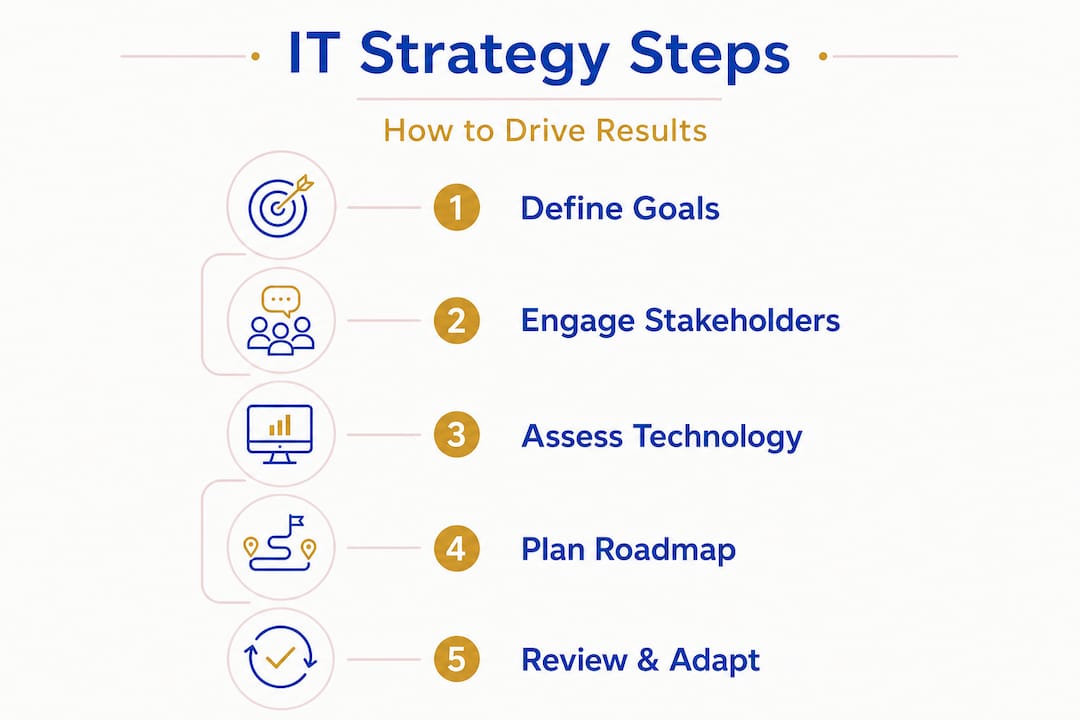
Define your strategic IT themes. Based on your business objectives alignment, group your technology needs into two to four broad themes. Examples might include “enabling digital customer engagement,” “modernizing core infrastructure,” or “strengthening data governance.” Themes provide a narrative frame that makes the strategy legible to non-technical stakeholders.
Prioritize initiatives within each theme. Not every initiative is equally valuable or equally feasible. Use a simple scoring model that weighs business impact, implementation complexity, cost, and time to value. This gives you a defensible rationale for what goes first and what waits.
Create explicit linkage between projects and business outcomes. This is the step most organizations skip, and it’s where strategies fall apart. Every project in your roadmap should have a named business objective it supports, a measurable outcome it’s designed to achieve, and a responsible owner accountable for delivery. Adaptability mechanisms in the process enable far better strategy execution because teams can see how their work connects to what matters.
Assign clear ownership and set meaningful milestones. Vague accountability is the enemy of execution. Each initiative needs a named owner at the leadership level, not just a project manager. Milestones should be outcome-oriented, not just task-based. “Complete vendor evaluation” is a task. “Select and contract preferred cloud infrastructure vendor” is a milestone.
Build your IT roadmap. Translate the prioritized initiatives into a visual, time-phased roadmap covering at minimum 12 months and ideally 24 to 36 months. Include dependencies, resource requirements, and decision points. The roadmap is your communication tool as much as your planning tool.
Establish a governance and review cadence. Decide how often the strategy will be formally reviewed, who participates, and what criteria will trigger a re-prioritization of initiatives. Quarterly reviews are the minimum; monthly check-ins on execution health are even better for organizations in periods of rapid change.
“The most dangerous IT strategy is one that leadership agrees on in January and no one looks at again until Q4 planning. Explicit linkage between priorities and daily work in a shared system is what separates organizations that execute from those that drift.”
The benefits of executive advisory become particularly clear at this stage. An experienced fractional CIO or CTO brings both the methodology and the organizational influence to drive these steps without the political inertia that often slows internal efforts.
Pro Tip: Schedule your first quarterly strategy review before the ink is dry on the initial roadmap. Putting it on the calendar immediately signals to your organization that this is a living practice, not a one-time deliverable.
Common challenges and pitfalls, plus how to verify success
Step-by-step guides are valuable, but staying alert for common missteps and regularly validating your progress is critical. Even well-designed IT strategies can lose momentum when specific execution patterns take hold.
Watch for these warning signs:
- Ownership ambiguity: Multiple people claim a project, or no one does. Both are equally dangerous.
- Strategy-execution disconnect: The roadmap says one thing, but the team’s sprint backlogs reflect entirely different priorities.
- Static planning cycles: The strategy document exists but hasn’t been touched since it was presented to the board.
- Metric theater: Success metrics exist on paper but no one reviews them in leadership meetings.
- Scope creep without re-prioritization: New requests are added to the roadmap without removing or deferring something else.
The disconnect between clear priorities and actionable work is common across industries, which is why built-in adaptability mechanisms are not optional features of a good IT strategy. They are the mechanism that keeps strategy from becoming fiction.
Here’s how weak and effective IT strategy practices compare in practice:
| Practice area | Weak IT strategy | Effective IT strategy |
|---|---|---|
| Priority visibility | Known only to IT leadership | Visible across business and IT leadership |
| Project-goal linkage | Assumed, rarely documented | Explicit, with named outcomes and owners |
| Review cadence | Annual or ad hoc | Quarterly minimum with real-time triggers |
| Response to change | Reactive scramble | Structured re-prioritization process |
| Success measurement | Anecdotal or technical metrics only | Business KPIs tied to strategic outcomes |
To verify your strategy is working, track three categories of indicators. First, delivery metrics: are projects hitting milestones on time and within budget? Second, business outcome metrics: are the expected benefits materializing, such as reduced operational costs, faster time to market, or improved customer satisfaction? Third, adaptability metrics: how quickly can your organization re-rank priorities and redirect resources when conditions change?
Effective IT optimization strategies and strong IT collaboration practices both reinforce your ability to execute against the roadmap without losing alignment.
Pro Tip: Create a simple one-page strategy health scorecard that leadership reviews monthly. Include three to five indicators across delivery, business outcomes, and adaptability. Keep it visual and keep it brief. If it takes more than five minutes to read, it won’t get read.
What most organizations get wrong about IT strategy alignment
Here is the uncomfortable truth: most organizations produce IT strategies that look impressive in a boardroom presentation and then quietly become irrelevant within 90 days. The problem isn’t the quality of the analysis or the sophistication of the roadmap. The problem is that strategy is treated as a deliverable instead of a discipline.
The traditional approach is to hire a consulting firm, run a series of workshops, produce a polished document with a three-year vision, and then hand it off to the IT organization to execute. Everyone feels good. The board has something to point to. The CIO has a mandate. But six months later, day-to-day pressures have redirected the team’s attention, the market has shifted in ways the document didn’t anticipate, and no one has the authority or the process to re-align the roadmap to current reality.
Research on priority management confirms this pattern: there is a large disconnect between organizations that believe they have clear priorities and those that have actually linked that clarity to the work people are doing every day. The gap isn’t conceptual. It’s structural. No shared system. No explicit mapping. No ongoing re-ranking process.
The organizations that execute future-proof strategies well share a distinct operating model. They hold strategy reviews with teeth, meaning that initiatives can be paused, reprioritized, or cancelled in those meetings, not just reported on. They require every project team to maintain a visible connection between their work and a named strategic outcome. And they treat the person accountable for strategy alignment, whether an internal CIO or a fractional executive, as a permanent role rather than a project.
The real leverage isn’t in the methodology. It’s in building an organizational culture where strategy is a continuous conversation, not a calendar event.
Unlock IT strategy success with expert guidance
Turning the guidance in this article into real outcomes requires more than a solid framework. It requires experienced leadership that can navigate organizational dynamics, facilitate alignment across competing priorities, and hold the strategy accountable over time.
Orloff Phillips specializes in exactly this kind of engagement. Through fractional CIO and CTO services, we bring executive-level technology strategy expertise to mid-sized and large organizations that need results without a full-time commitment. Whether you’re starting from scratch or trying to breathe life back into a stalled roadmap, our strategic technology consulting approach is built around measurable outcomes and long-term partnership. If you’re ready to stop treating strategy as a document and start treating it as a practice, explore how we can help you future-proof your IT strategy and drive the business results your organization is capable of achieving.
Frequently asked questions
What should be included in an IT strategy document?
An IT strategy should cover current state analysis, aligned business and IT priorities, measurable initiatives with named owners, success metrics, and a formal review process. SPM research reinforces that linking clear priorities to actual execution is what separates a useful document from a shelf decoration.
How often should an IT strategy be reviewed and updated?
Quarterly reviews are the recognized best practice, paired with a real-time re-ranking process for when significant business or technology changes emerge. Built-in adaptability for re-prioritizing initiatives is what keeps the strategy relevant between formal review cycles.
Who should be involved in creating the IT strategy?
Cross-functional leadership should drive the process, including C-suite executives, technology heads, business unit leaders, compliance officers, and key operational stakeholders who understand where technology either enables or constrains performance.
How do you know if your IT strategy is successful?
Measure against defined business KPIs, project delivery milestones, and the speed at which your organization can respond to change. Monitoring and adapting to business signals in near real time is the clearest indicator that your strategy is functioning as a practice rather than a document.

Leave a Reply