Your IT strategy was approved in November. By February, a renewal date has shifted, a vendor has raised its price, and the incident queue is telling a different story. Nothing on the calendar forced anyone to look again. That is how a good plan quietly becomes a historical document.
Mid-market leadership teams around Exton, Philadelphia, Wilmington, Cherry Hill, Lancaster, and Reading rarely have a full-time CIO on payroll. They do not need one to keep a strategy current. What they need is a repeatable operating rhythm: fixed inputs, a short list of standing decisions, and a written change log. That is where an IT strategy and consulting engagement stops being a document factory and starts working as a decision engine.
This guide covers why strategies go stale, what to set up before quarter one, the quarterly agenda at a glance, and what each quarter should decide. You will also get the standing decision list, the change log that keeps priorities current, and the failure points that break a cadence before they break your plan.
Why an IT Strategy Goes Stale Between Planning Cycles
Our position: IT strategies rarely go stale because the roadmap was wrong. They go stale because nothing on the calendar forces anyone to revisit the assumptions behind it.
Governance supplies the missing structure. A March 26, 2026 CIO Index article frames governance as decision infrastructure: who has authority to approve investments, how priorities are set and resources allocated, and how risk is evaluated. It treats frameworks as decision-support systems, and the one qualifier it attaches is that they work best as design tools, which is precisely why a quarterly cadence matters. That cadence is the layer that turns a reference point such as COBIT, published by ISACA, ISO/IEC 38500, ITIL, or TOGAF into something a mid-market team can run without a full-time CIO.
That difference separates two kinds of IT consulting strategy. One ends at a roadmap. The other schedules decisions, so the roadmap must answer for itself every quarter. If your team is starting from that gap, see building strategy without a full-time CIO.
What to Set Up Before Quarter One
Before the first quarterly meeting, put five things in place.
Name one accountable owner. Usually the COO, CFO or a senior operations leader. An advisor can run the meeting and prepare inputs, but the decision owner sits inside the business.
Secure four standing inputs. Spend actuals by vendor and category, incident and ticket themes, contract renewal dates and terms, and a written list of business changes expected over the next four quarters. Direct access matters, not vendor summaries. This is the same discipline behind a governance rhythm that stops vendor drift.
Open a decision register and a versioned change log. One of each for the year. Keep both short enough that someone who missed the meeting can read them cold.
Set escalation thresholds. Define limits by dollar amount, risk level, number of affected users and contract term. Routine choices stay with operators; only real trade-offs reach the agenda.
Publish the 12-month calendar. Dates, required inputs, decision owners and one rule: no input, no meeting. That rule is what keeps the cadence alive through a busy quarter.
The Quarterly Agenda at a Glance
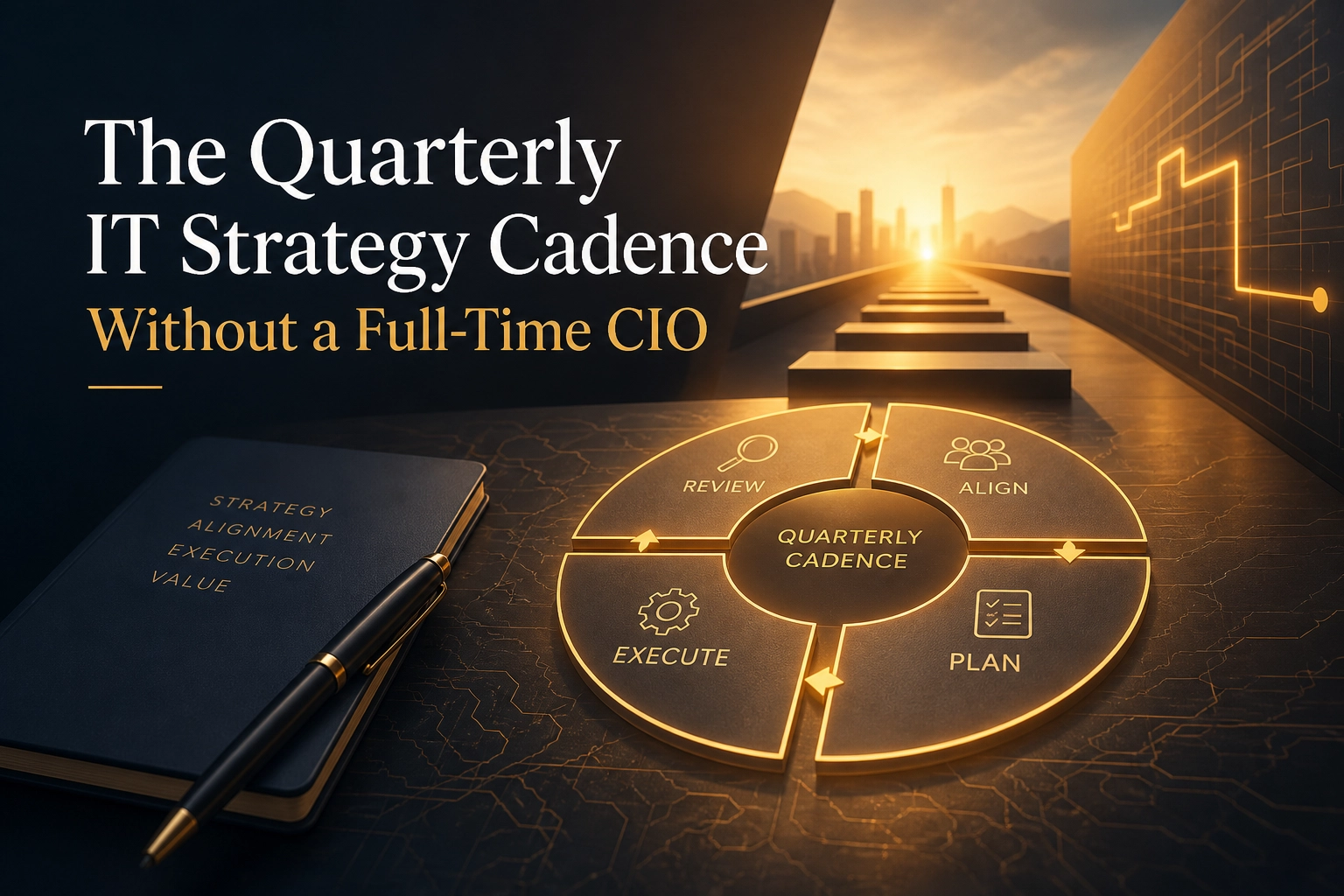
With that calendar set, every quarter runs the same three-part shape: standing inputs, standing decisions, and change log updates. That structure is what keeps the hour from sliding into a status report.
Q1 sets the baseline: spend by vendor and category, the 12-month renewal calendar, and the year’s decision list. Q2 reads incident themes and vendor performance. Q3 tests architecture and risk, including which systems approach end-of-support dates, plus delivery capacity. Q4 reconciles the year and opens the next version.
Every decision lands in one of four states: approved, rejected, deferred with a review date, or returned for specific missing data. “Returned” is the honest one; it converts a guess into a deadline.
The output is an updated decision register and change log, not minutes. If the log did not change, the meeting did not decide anything. That test is the whole agenda in one line, and it carries into Q1’s first working session.
Q1: Baseline the Spend and Name the Year’s Decisions
Q1 is where the year’s decisions get named. Start by reviewing prior-year spend actuals against the plan, by vendor and by category. Where the invoice and plan diverged, decide what changes: the plan, the contract, or the operating habit.
Next, build the 12-month renewal calendar with dates, owners, exit terms and auto-renewal traps. Federal regulators are revisiting automatic renewal rules, so read those clauses before depending on them. Mark every contract due before Q2.
Then list the business changes expected in the coming year: a new location, an acquisition, an ERP change, headcount shifts, customer commitments, compliance demands. Each triggers a review of the systems and vendors it touches; defense buyers can start with reopening MSP contracts after CMMC.
Convert strategy into a short decision list: approve, defer or reject, each with a named owner and a review date.
Q2: Read Incident Themes and Reset Vendor Priorities
With the baseline set and the year’s decision list named, Q2 turns from planning to evidence. Group incidents by business process, not ticket count. Repeat failures that persist across quarters usually trace to unclear ownership, duplicate systems or a broken handoff between vendors. More spending will not fix any of those. Review vendor performance against contracted service levels alongside business complaints. If you need documented evidence rather than a gut feeling, use MSP benchmarking to score the relationship before deciding. For each underperformer, choose renew, renegotiate or replace, then assign an owner and a decision date. Revisit every renewal inside the next 12 months and update exit terms, notice windows and negotiation timing before the vendor controls the calendar. Reallocate budget only against a named trade-off: new spend must remove or defer something else, or the strategy expands without a decision. Close by updating the change log with decisions, evidence used and next review dates for anything deferred.
Q3: Test the Architecture and Fund the Gaps
With vendor priorities set, Q3 tests whether the foundation beneath them holds. Walk the architecture and integration assumptions: which systems duplicate the same data, which interfaces are fragile, and where manual workarounds have hardened into permanent operating practice. A year-one and year-three sequencing plan keeps those fixes fundable and staffable. Then review security and continuity risk in business terms, not technical ones. Approve each exception with a named owner and an end date, or require remediation with a funded action and a review date.
From there, return to the renewal runway set in Q1, still measured on the same 12-month horizon, and decide which contracts to consolidate, renegotiate or exit before the next budget cycle, assigning an owner to each.
That leaves delivery capacity. Decide which projects can finish before year end, which should stop, and which should be deferred rather than quietly carried.
Record accepted risks, stopped work and deferrals in the change log, so Q4 does not reopen decisions Q3 already made.
Q4: Reconcile the Year and Close the Change Log
Q3 closes decisions. Q4 closes the year: reconcile, score, and reset.
Reconcile full-year spend actuals against the plan and explain each variance by driver, not by vendor. A variance without a driver is a budget surprise waiting to repeat. When the driver is duplicate tools, that is a bloated-stack consolidation problem, not a pricing problem.
Score the year’s decisions against the change log, not memory. Which produced the intended result, which were deferred too long, which need reversing? Record the verdict.
Set next year’s spend envelope and the top three business outcomes before the budget locks. The envelope reflects the decisions the team is prepared to make, not just the renewals it expects.
Archive the current change log version. Open the next with carry-forward decisions, owners and dates.
Assign Q1 input owners before the year closes, so the new year’s first meeting opens with evidence, not introductions. From there, the standing decision list turns the cadence into repeatable rules.
The Standing Decision List
This list does not change shape; only the answers do. For every quarter that follows, it sets the same fixed agenda.
Money and trade-offs. Approve the annual spend envelope, set the dollar threshold above which reallocation requires the group, and name what stops to fund anything new.
Contracts. For every agreement inside the 12-month runway, decide renew, renegotiate or exit. Auto-renewal is never a default; it is a decision someone makes on purpose.
Projects. Accept, defer or reject each priority item. A decision without a named owner and a review date is not a decision. Send it back to the owner until it has both.
Risk and platforms. Approve or close security and continuity exceptions. Classify each major system as strategic, consolidate or exit, with both a business owner and a process owner attached.
Standards. Approve the data, integration and vendor-selection standards that govern future choices, then record the version in the change log.
Before assigning that ownership, read how each senior IT leadership model fails once decision complexity outgrows the people holding it.
The Change Log That Keeps Priorities Current
The standing decision list only holds if every decision lands somewhere durable. Open one versioned change log with eight columns: version, date, decision, reason, owner, budget or risk affected, review date, and evidence used. One page is enough when those columns are enforced.
Then enforce a single rule: any change to scope, spend, vendor, risk acceptance, or priority creates a new version. No silent edits to the live document. Keep prior versions accessible, and read the current version as the first item at each quarterly meeting so the group starts from what was already decided.
When an owner or board member asks why priorities shifted, answer with a dated trail instead of recollection: the entry shows what changed, who approved it, the evidence used, and when it gets revisited.
Judge this engagement by this log. Decisions recorded, versions issued, and review dates set are the output. Document volume is not.
What Breaks a Cadence and How to Prevent It
A log only holds if the meeting around it does. Five failures break a cadence, and each has a cheap fix.
No named owner. Without one, the quarter becomes a vendor activity update and nothing closes. Name the decision owner before the first meeting.
Vendor summaries instead of actuals. Spend, incident and renewal numbers arrive filtered by the party under review. Require direct access to source data, plus a written note explaining any figure that cannot be verified.
Too many attendees, unclear rights. The group debates what it cannot approve. Publish who decides each standing item and who is only informed.
No change log. Debates repeat because no one can see prior decisions. Read the change log first and last.
The buyer test. Before any slide deck, ask a prospective IT strategy and consulting firm for the 12-month calendar, the standing decision list and a sample change log. A sound cadence shows up in decisions closed.
Close these gaps and the calendar runs without a full-time CIO driving it.
Conclusion: Run the Calendar, Not the Document
The fix is a calendar, not a better document. Schedule the next four quarterly meetings now, name one accountable owner, and publish the required inputs for each date: spend actuals, incident themes, renewal dates and business changes.
Open the decision register and versioned change log in Q1. At Q4, review them against four questions: what was decided, what was reversed, which risks closed, and what work stopped.
Then keep the calendar after the plan is written. That is the part most teams skip. If a quarter passes with no written decision and no change log update, treat it as a failure of the operating model, not a quiet quarter. Quiet quarters are how the original roadmap goes stale.
Teams that want outside help running the cadence can work with Orloff Phillips, which provides IT strategy and consulting for leadership teams in Exton, Philadelphia, Wilmington, Cherry Hill, Lancaster and Reading PA.

Leave a Reply