
Most executives have heard the term dozens of times, but when pressed to define what is business transformation in practical terms, the answers vary widely. That gap between frequency and clarity is costly. 95% of organizations undertook more than two major transformations in the previous two years, with 61% running at least four simultaneously. Yet results remain inconsistent. This guide gives you a grounded, specific definition and a practical framework so that your next transformation effort moves with purpose rather than momentum alone.
Table of Contents
- Defining business transformation: More than just change
- Why business transformation matters in today’s complex markets
- Building the right foundation: Culture, leadership, and learning velocity
- Organizational transformation as strategic renewal and value reconfiguration
- Practical guidelines: Budgeting and managing change for technology-driven transformations
- Our perspective: The transformation that never gets named
- Ready to lead your next transformation with clarity?
- Frequently asked questions
Key Takeaways
| Point | Details |
|---|---|
| Business transformation defined | It involves major changes to operations, strategy, and structure across people, processes, and technology. |
| High prevalence and challenge | Most mid-to-large firms undertake multiple transformations but only 60% meet expected benefits. |
| Culture and leadership matter | A change-seeking culture and strong leadership behaviors double transformation success rates. |
| Organizational coherence | Effective transformation requires aligned strategy, culture, structure, and governance over time. |
| Budget change management | Allocating 20-30% of technology budgets to change management is critical to ensure adoption and results. |
Defining business transformation: More than just change
The word “transformation” gets stretched to cover almost anything, from a software upgrade to a full company reinvention. That ambiguity is where most executive teams lose the thread before they even begin.
Business transformation involves fundamental changes to an organization’s operations, strategy, or structure across people, processes, and technology to improve efficiency, competitiveness, and financial performance. Notice what that definition requires: all three dimensions at once. Change a process without addressing the people running it or the technology supporting it, and you have not transformed anything. You have patched it.
Here is what business transformation defined at the enterprise level actually encompasses:
- Digital transformation: Adopting new technologies to change how work gets done, from cloud migration to AI-assisted decision making
- Cultural transformation: Shifting the shared beliefs, habits, and behaviors that govern how teams operate and collaborate
- Organizational transformation: Restructuring reporting lines, decision rights, and governance models to match a new strategic direction
- Management transformation: Replacing command-and-control leadership models with distributed authority and accountability
- Operational transformation: Redesigning core workflows, supply chains, or service delivery models for speed and efficiency
What separates transformation from continuous improvement is scope and intent. Continuous improvement refines what already exists. Transformation reconceives it. A retail company adding a loyalty app is improving. A retail company rebuilding its business model around direct-to-consumer subscription services is transforming.
Understanding this distinction matters enormously for technology consulting and strategic growth conversations, because misidentifying the scope of an initiative leads to mismatched budgets, misaligned teams, and unrealistic timelines. Before committing to a transformation, it helps to work through a structured business transformation checklist to confirm you are solving the right problem at the right altitude.
Why business transformation matters in today’s complex markets
The pace of external pressure on mid-to-large organizations has accelerated sharply. Supply chain disruptions, competitive threats from tech-native entrants, workforce expectations, and regulatory complexity have all compressed the window between “strategic advantage” and “table stakes.”
That context explains why transformations are now constant rather than occasional. 95% of organizations ran multiple major transformations in a two-year window, signaling that business-as-usual planning cycles no longer match market reality.
But frequency does not equal effectiveness. This is where the importance of business transformation gets complicated:
- Misalignment between tech and strategy: Many organizations treat transformation as an IT project. When technology leads without a business case driving it, adoption stalls and ROI disappears.
- Unclear scope: Executives often launch a transformation without agreeing on what “done” looks like, resulting in scope creep and energy diffusion.
- Underestimated culture lift: Process and technology change is visible and measurable. Cultural change is neither, and it takes longer.
- Leadership fatigue: Running four simultaneous transformations means teams are absorbing constant change signals, often contradictory ones.
By the numbers: Only 60% of executives say their transformation efforts lead to expected benefits, and many cite misunderstandings of the concept itself as a primary factor.
That statistic is not an argument against transformation. It is an argument for better preparation. The benefits of business transformation, realized correctly, include reduced operational costs, improved customer experience, faster product development cycles, and stronger competitive positioning. Those outcomes are real. They are just not automatic.
Understanding why business transformation matters means accepting that transformation is both necessary and genuinely hard. Organizations that treat it casually will consistently land in that underperforming 40%. Those that bring structured thinking to it, informed by data about where transformations typically break down, position themselves to capture the upside. Connecting with experienced advisors through business consulting and organizational change expertise can meaningfully shift those odds.
Building the right foundation: Culture, leadership, and learning velocity
If transformations fail most often because of people factors rather than technology failures, then the logical investment is in building organizational capacity for change itself. This is one of the most underused advantages of business transformation consulting: the shift from treating transformation as a project to treating it as a muscle.

Organizations that build a change-seeking culture, accelerate learning, and put people at the center are nearly twice as likely to meet or exceed transformation expectations. That finding reframes the entire conversation.
Three capabilities separate organizations that transform well from those that transform repeatedly without results:
- Psychological safety: Teams need to raise concerns, test ideas, and report failures without fear of penalty. Without it, transformation surfaces look clean while the real problems stay hidden.
- High learning velocity: The ability to build new skills quickly across the organization, not just train a few champions and hope for diffusion.
- Leadership modeling: Executives who visibly operate in new ways signal that the transformation is real. Those who talk about change while behaving the same way undermine every communication that follows.
“Leadership behavior is the multiplier that determines whether transformation endures or fades.”
Pro Tip: Before investing in any new platform or process redesign, run a short cultural readiness assessment with your leadership team. Ask specifically whether people feel safe flagging problems early, and whether your learning programs are built for speed or compliance. The answers will tell you more about transformation risk than any technology audit.
The steps for mastering business transformation always circle back to this human architecture. Technology is replaceable. A culture that knows how to change is a durable competitive asset.
Organizational transformation as strategic renewal and value reconfiguration
Most transformation programs have a sponsor, a steering committee, a project plan, and a go-live date. What they often lack is a theory of how the organization will create value differently once the initiative concludes. That missing piece is why so many transformations deliver the deliverable and miss the point.
Organizational transformation is a reconfiguration of how an organization creates value and maintains relevance, requiring consistent alignment of strategy, structure, culture, and incentives. That definition demands coherence, not just completion.
Here is how a phased transformation approach maps to that coherence requirement:
- Diagnose the value gap: Where is the organization creating less value than its market, customers, or competitors require? Frame the transformation around closing that gap, not around the tools being deployed.
- Align strategic intent across leadership: Before announcing any initiative, ensure every executive understands what is changing, why, and what success looks like in concrete terms.
- Redesign structure to match strategy: Reporting lines, decision rights, and governance that made sense in the old model will resist the new one. Structural alignment is not optional.
- Reconfigure incentives: If the bonus structure still rewards the old behaviors, no amount of culture messaging will override it.
- Sustain executive stewardship over time: Transformation does not end at launch. The 18 to 48-month window typical of major initiatives requires continuous executive attention, not a handoff to middle management.
| Transformation dimension | Common mistake | Better approach |
|---|---|---|
| Strategy | Technology-led without a business case | Business value drives technology selection |
| Structure | Keeping old org chart with new processes | Redesign governance to match new operating model |
| Culture | One-time training events | Ongoing behavioral reinforcement by leaders |
| Incentives | Rewarding old performance metrics | Align compensation to new strategic outcomes |
The through-line in all successful business transformation examples is alignment. Amazon’s shift to cloud infrastructure through AWS was not a technology project. It was a strategic reconfiguration of what business Amazon was actually in. FedEx’s investment in real-time tracking transformed its value proposition from shipping to supply chain visibility. In both cases, structure, culture, and incentives moved together.
Bringing in executive advisory for digital transformation at the strategic level, rather than the project management level, is often what separates transformations that stick from those that stall.
Practical guidelines: Budgeting and managing change for technology-driven transformations
Technology is almost always part of a business transformation. The mistake most organizations make is funding the technology and treating the human side as a cost to minimize.
Practitioners recommend allocating 20-30% of technology spend specifically to change management for mid-sized firms to avoid adoption failures. On a $2 million ERP implementation, that means $400,000 to $600,000 directed at training, communication, process redesign support, and user adoption programs. Most organizations spend a fraction of that.
Here is what under-investing in change management actually costs:
- Low adoption rates: New systems go live but teams revert to spreadsheets and workarounds within weeks
- Delayed ROI: The business value locked inside the technology never gets released because people do not use it correctly
- Re-implementation cycles: Organizations that skip change management often pay to implement the same capability twice
- Leadership credibility damage: Failed transformations make the next change initiative harder to launch because the team has been burned before
Pro Tip: When building your transformation budget, create two line items: one for technology deployment and one for change enablement. If your technology vendor builds your entire project plan, the change enablement line will often be missing or underestimated. Push back.
| Change management investment | Likely outcome |
|---|---|
| Less than 5% of tech budget | High risk of adoption failure, delayed ROI |
| 10-15% of tech budget | Moderate adoption, partial benefit realization |
| 20-30% of tech budget | Strong adoption, full benefit realization, lower re-work risk |
Effective change management in a technology-driven transformation means appointing change leads who have organizational credibility, not just project managers. It means building feedback loops so problems surface in week two, not month eight. And it means connecting every technology decision to leading digital transformation outcomes that your people actually care about, not just metrics that matter to IT.
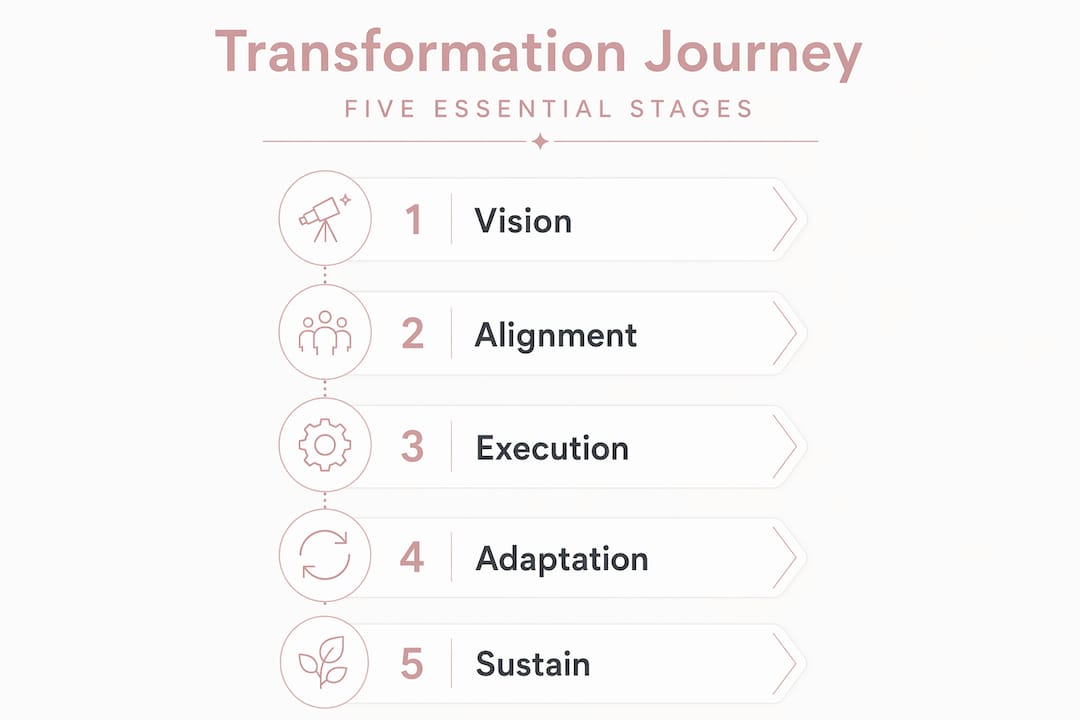
The organizations that consistently realize the full benefits of business transformation are not necessarily the ones with the best technology choices. They are the ones that bring the same rigor to the human side of change that they bring to the technical side.
Our perspective: The transformation that never gets named
Here is something most transformation frameworks will not tell you: the hardest transformation is the one at the top.
We have watched organizations pour resources into cultural change programs, workforce retraining, and technology rollouts, while the executive team continues to operate exactly as before. Decisions still flow up. Risk aversion still governs resource allocation. The same political dynamics still determine which ideas get funded. And then leadership wonders why the organization is not changing.
The uncomfortable reality is that business transformation is almost always implicitly a leadership transformation. The operating model you are trying to move away from was built by the leadership team currently in charge of changing it. That is not a criticism. It is a structural tension that almost every large organization faces, and almost none addresses directly.
The executives who navigate transformation most effectively are those who treat themselves as part of the system being changed. They audit their own decision-making habits. They deliberately slow down to question whether their instincts reflect the old model or the new one. They invite challenge from below rather than performing openness while filtering for validation.
We also believe that organizations pursue too many transformations simultaneously not because the market demands it, but because it is easier to launch a new initiative than to admit the last one did not deliver. There is a real cost to initiative proliferation that does not show up on a balance sheet: the organizational attention, leadership bandwidth, and employee trust consumed by initiatives that never fully land.
The executives we have seen drive the most durable results pick fewer transformations, go deeper on each one, and hold themselves accountable to the same behavioral standards they set for their teams. That is not a framework. That is a decision.
Ready to lead your next transformation with clarity?
If what you have read here surfaces real questions about your organization’s transformation approach, that is exactly the right response. Clarity about what is business transformation at the strategic level is the starting point. Execution is where it gets specific to your context, your market, and your leadership team.
At Orloff Phillips, we work alongside mid-sized to large organizations as fractional CIOs, CTOs, and COOs, bringing senior-level strategic leadership to your transformation efforts without the overhead of a full-time executive hire. Whether you need an IT roadmap, a digital transformation strategy, or an experienced operator to guide change management from the inside, we bring a track record of measurable outcomes. If you are serious about transformation that delivers, let’s talk.
Frequently asked questions
What is the difference between business transformation and digital transformation?
Business transformation covers fundamental changes across operations, strategy, and structure, including people, processes, and technology, while digital transformation focuses specifically on using digital technologies to change business functions. Digital transformation is one type of business transformation, not a synonym for it.
How long do typical business transformation initiatives take?
Business transformation typically spans 18 to 48 months, depending on the scope, number of business units involved, and degree of structural change required. Organizations that expect faster results often underestimate the cultural and governance work needed.
Why do many business transformations fail to deliver expected benefits?
Only 60% of executives report that their transformation efforts deliver the expected benefits, largely because organizations underestimate cultural change, misalign leadership on scope, and underinvest in change management. Technology is rarely the limiting factor.
What role does leadership play in business transformation success?
Leadership behavior is the multiplier that determines whether transformation endures or fades, because executives shape the culture, reinforce new operating norms, and signal through their own actions whether the change is real or performative.
How should organizations budget for technology-related transformations?
Allocating 20-30% of your technology spend to change management, covering training, communication, and adoption support, significantly reduces the risk of failed rollouts and gives the technology investment a realistic chance of delivering its intended value.

Leave a Reply