
Artificial intelligence is not the threat most executives fear, nor the silver bullet most vendors promise. It sits somewhere more useful and more complicated than either extreme. For professionals navigating real decisions about technology investment, workforce planning, and competitive positioning, understanding what AI actually does inside an organization matters far more than understanding how neural networks fire. This article cuts through the noise to deliver what leaders genuinely need: a grounded view of how AI works in practice, where it creates measurable value, and how to build a strategy that does not collapse under its own weight.
Table of Contents
- Key takeaways
- What business leaders need to know about artificial intelligence
- Advanced AI capabilities reshaping industries
- AI’s impact on productivity and workforce dynamics
- Embedding AI into your existing operations
- Building a strategic AI framework that actually scales
- My honest take on AI-driven business transformation
- Ready to turn your AI ambitions into a working strategy?
- FAQ
Key takeaways
| Point | Details |
|---|---|
| AI augments, not replaces | Most businesses using AI report no staffing reductions; the primary benefit is productivity gains. |
| Data quality determines outcomes | Up to 80% of AI project effort goes into data preparation, not model selection. |
| Agentic AI is the next frontier | The shift from chatbots to AI agents executing multi-step workflows changes what enterprise AI can deliver. |
| Integration beats standalone tools | Embedding AI into existing software ecosystems produces more consistent results than deploying isolated platforms. |
| Leadership drives adoption success | Executive alignment and change management are the most underestimated factors in scaling AI initiatives. |
What business leaders need to know about artificial intelligence
Artificial intelligence, at its core, is software that learns patterns from data and uses those patterns to make predictions or decisions. That definition sounds simple. The implications are not.
For leaders, the practical distinction between AI and traditional software is this: traditional software follows explicit rules you write in advance. AI develops its own rules by studying examples. That shift changes the economics of automation entirely, because you no longer need to anticipate every scenario. The model generalizes from what it has seen.
Within AI, three terms appear constantly and are frequently confused:
- Artificial intelligence is the broad category. Any system that mimics cognitive functions qualifies.
- Machine learning is the dominant technique driving today’s AI applications. Models train on data, improve with exposure, and generate outputs without step-by-step programming.
- Deep learning techniques are a subset of machine learning that use layered neural networks to process complex data like images, speech, and natural language. Most large language models run on deep learning architectures.
Where business leaders consistently go wrong is assuming the model is the hard part. It rarely is. Data preparation consumes 80% of the effort in most AI projects. Garbage in, garbage out is not a cliché here. It is a budget line item. Models trained on incomplete, biased, or poorly labeled data will generalize badly. That failure mode is called overfitting, and it produces AI that performs beautifully on test data and falls apart in production.
Pro Tip: Before evaluating any AI vendor or tool, ask them one question: what does the data pipeline look like, and who owns data quality? If they jump straight to model performance without addressing this, keep looking.
Advanced AI capabilities reshaping industries
The past 18 months have produced a step change in what AI can actually do, and the gap between organizations that understand this and those that do not is growing fast.
The most significant development is the emergence of frontier models capable of executing long-horizon tasks autonomously. Gemini 3.5 Flash enables automation of complex, multi-step tasks at less than half the cost of previous frontier models. That cost curve matters because it changes the math on automating tasks that were previously too expensive to touch.
Equally important is the rise of multi-agent AI systems, where multiple AI models collaborate, check each other’s work, and divide complex tasks. This architecture directly addresses the hallucination problem that makes single-model AI unreliable for high-stakes decisions. Multi-agent systems cross-validate outputs to reduce errors and increase reliability in ways that single-model deployments cannot match. DeepMind’s Co-Scientist, for example, used this approach to develop an AI drug-repurposing agent that blocked 91% of a liver fibrosis scarring response in lab tests.
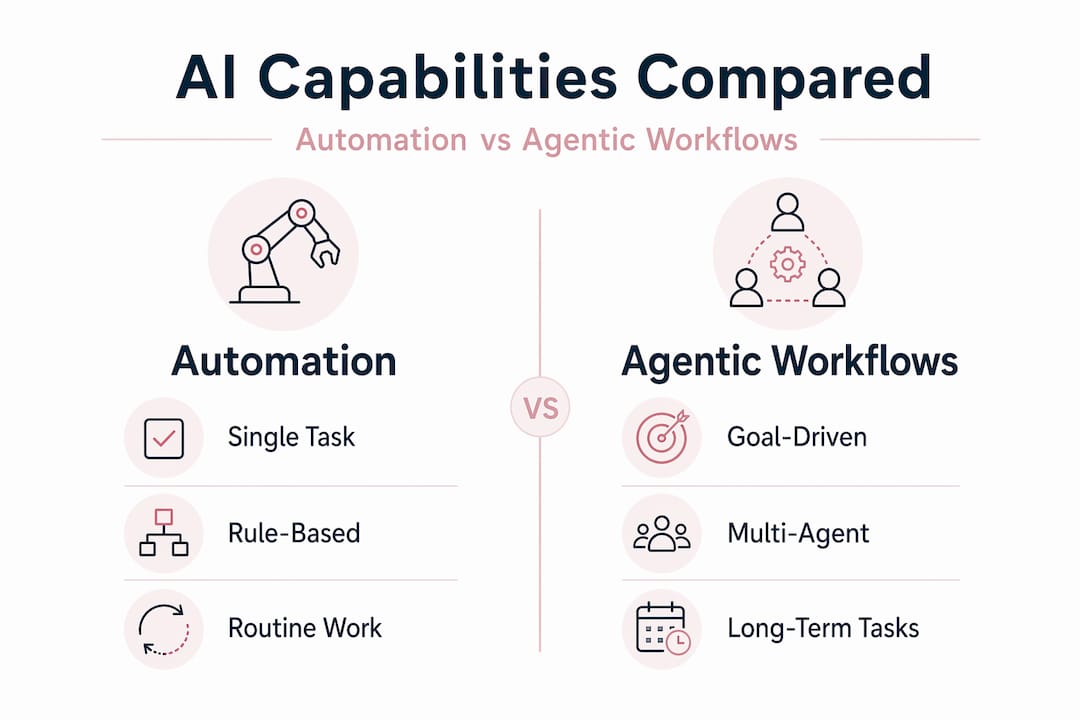
Here is how the two main categories of enterprise AI compare right now:
| Capability | AI-powered automation | Agentic AI workflows |
|---|---|---|
| Task scope | Single-step, rule-defined | Multi-step, goal-directed |
| Human oversight required | High | Moderate to low |
| Integration with software | Limited | Deep, API-driven |
| Best use cases | Content generation, classification | Research, coding, workflow execution |
| Maturity level | Widely available | Emerging, rapidly advancing |
The practical takeaway is that most organizations are still deploying AI-powered automation while the competitive advantage is shifting toward agentic AI. Companies moving now to understand and pilot agentic workflows are building capabilities their slower-moving competitors will spend years trying to replicate.
Pro Tip: When evaluating new AI tools, apply a simple test: does this tool complete a task, or does it execute a goal? Task completion is table stakes. Goal execution is where the leverage lives.
AI’s impact on productivity and workforce dynamics
The fear that artificial intelligence will hollow out the workforce is not well supported by current evidence. The reality is more nuanced and, for leaders, more useful.

AI adoption among businesses has quadrupled since 2022, yet roughly 90% of companies using AI report no reduction in staffing. What they report instead is that employees do more in less time. Specifically, 57% of workers using AI save 1 to 2 hours daily, and 22% save 3 to 5 hours. That reclaimed time is going toward higher-value work and, for knowledge workers, better work-life balance.
This reframes the conversation every executive needs to have internally. The question is not “will AI replace my team?” The question is “what will my team accomplish with 10 to 20 percent more effective capacity?”
The impact of AI on workforce dynamics shows up most clearly in these areas:
- Complex task assistance. AI handles research synthesis, first-draft generation, and data analysis, freeing professionals for judgment-intensive work.
- Skill compression. Mid-level employees can now produce outputs that previously required senior expertise, which changes hiring profiles and team structures.
- Labor shortage mitigation. In sectors facing demographic-driven talent shortages, like healthcare and financial services, AI addresses capacity gaps without requiring proportional headcount increases.
- Training acceleration. New hires reach productivity faster when AI assists with knowledge retrieval and workflow guidance.
The impact of AI on wages and investment is still forming, but early indicators point toward productivity-linked wage gains for workers who use AI effectively and wage pressure for those who do not adapt. Leaders who build AI literacy across their workforce now are building a durable competitive asset.
Embedding AI into your existing operations
Most organizations do not need to rebuild their technology stack to capture AI value. The smarter path is embedding AI capabilities into the tools your teams already use every day.
AI features are being integrated directly into productivity suites, project management platforms, and development environments. Microsoft 365 Copilot, Google Workspace’s AI features, and AI-assisted coding tools like GitHub Copilot are examples of this pattern. Your team is likely already using some of these, whether you have a formal AI strategy or not.
The more sophisticated evolution is the transition from AI as a feature to AI as an agent operating inside your software ecosystem. Transitioning from chatbots to AI agents that execute workflows requires integration through APIs and explicit permission structures. This is not a plug-and-play process. It requires deliberate architecture decisions.
Here is a practical sequence for moving from AI features to AI agents in your organization:
- Audit your current stack. Identify which tools already have AI capabilities you are not fully using. Most organizations are paying for features they have not activated.
- Define integration priorities. Focus on workflows where AI can reduce friction or accelerate output, not workflows that are already efficient.
- Establish data governance first. AI agents need access to your systems. Define what data they can access, what actions they can take, and who approves exceptions before you connect anything.
- Start with a contained pilot. Choose one workflow, one team, and one measurable outcome. Prove value before scaling.
- Build feedback loops. AI systems degrade when the environment changes. Schedule regular model reviews and retrain on fresh data quarterly.
Pro Tip: The biggest integration failure I see is organizations connecting AI to too many systems too fast. Start narrow. A single well-integrated AI agent that runs reliably beats five half-connected tools that require constant human correction.
Building a strategic AI framework that actually scales
Successful artificial intelligence adoption at scale is not primarily a technology problem. It is a leadership and governance problem.
The organizations getting consistent results share a few common practices. They align AI projects to specific business outcomes before selecting technology. They assign executive ownership to AI initiatives rather than delegating entirely to IT. And they treat data quality as an ongoing operational discipline, not a one-time cleanup project.
For leaders building or refining their AI strategy, the core considerations are:
- Define your AI north star. What specific business outcomes do you want AI to produce in 12 months? Revenue growth, cost reduction, customer experience improvement? Without a clear answer, you will fund experiments without accountability.
- Establish a governance structure. Who approves new AI tools? Who monitors model performance? Who owns the ethical risk framework? These questions need owners before issues arise.
- Invest in data infrastructure. AI strategy and data strategy are the same strategy. Organizations that treat them separately struggle to scale either.
- Plan for model drift. AI models degrade over time as the real world changes. Budget for ongoing monitoring and retraining, not just initial deployment.
- Manage change explicitly. The human side of AI adoption fails far more often than the technical side. Communicate early, train thoroughly, and address resistance before it becomes resistance.
| Strategic priority | Common failure mode | Recommended practice |
|---|---|---|
| Business alignment | Selecting tools before defining outcomes | Define KPIs before issuing any RFP |
| Data quality | Assuming existing data is AI-ready | Conduct a data audit before model selection |
| Governance | No clear ownership of AI risk | Assign an executive AI sponsor in writing |
| Change management | Announcing AI after decisions are made | Involve front-line managers in pilot design |
| Continuous improvement | Treating deployment as the finish line | Schedule quarterly model reviews |
The future of artificial intelligence in business will belong to organizations that treat AI as an ongoing capability, not a project with a completion date. The companies that build the operational muscle now will have compounding advantages that are very difficult to replicate in three years.
My honest take on AI-driven business transformation
I have worked with dozens of organizations through technology transformations, and the pattern I see with AI is consistent: the first six months are dominated by enthusiasm, the next six by frustration, and the organizations that push through the frustration are the ones that build something real.
The frustration phase happens because AI in production is messier than AI in a demo. Data is dirtier. Integrations break. Users find workarounds. Stakeholders who were excited become skeptical when the first pilot underdelivers. What I have found is that this phase is not a signal of failure. It is a signal that the organization is doing the work.
The biggest mistake I see leaders make is treating AI as a technology decision rather than a change management decision. The technology is rarely the bottleneck. The bottleneck is almost always people: unclear ownership, undertrained users, or executives who approved a budget but never championed the actual adoption.
My other hard-won observation: the organizations winning with AI are not the ones with the most sophisticated models. They are the ones with the cleanest data, the clearest success metrics, and a leadership team willing to stay engaged past the announcement. If you want to build that kind of foundation, executive advisory for digital transformation is often the accelerant that turns an AI initiative from a pilot into a platform.
The goal is not to be the first to adopt AI. The goal is to be the organization that actually uses it well.
— Orloff
Ready to turn your AI ambitions into a working strategy?
Understanding artificial intelligence is one thing. Building the leadership infrastructure to act on it is another.
At Orloffphillips, we work with mid-sized and enterprise organizations to move from AI curiosity to AI capability. That means connecting your business goals to a technology strategy that works at the C-level, not just in the IT department. If you are building a roadmap for sustainable AI-driven growth, we bring the fractional executive leadership and advisory experience to help you do it right the first time. Reach out to start a conversation.
FAQ
What is artificial intelligence in simple business terms?
Artificial intelligence is software that learns from data to make predictions or decisions, replacing the need to manually program every rule. For business leaders, it is most valuable as a productivity multiplier that helps teams do more complex work faster.
How does AI actually improve business productivity?
Workers using AI tools save an average of one to two hours per day, time that shifts toward higher-value strategic work. Roughly 90% of organizations using AI report no staffing reductions, which means the gains are additive rather than substitutive.
What is the difference between machine learning and deep learning?
Machine learning is the broader practice of training models on data to generate outputs. Deep learning techniques are a subset that uses layered neural networks, which makes them especially effective for language, image, and speech tasks.
What is AI in healthcare doing differently than other sectors?
AI in healthcare is advancing from diagnostic support to multi-agent research systems that can identify drug candidates and model complex biological responses. A recent multi-agent AI system blocked 91% of a liver fibrosis scarring response in lab conditions, illustrating the difference between AI as a tool and AI as a research partner.
How do you build an AI strategy that scales?
Start by defining the specific business outcomes you want AI to produce, then audit your data infrastructure before selecting any technology. Assign executive ownership, build governance before you need it, and treat model monitoring as a recurring operational responsibility rather than a one-time deployment task.

Leave a Reply