
The role of the tech executive is being rewritten in real time. Technology leadership trends 2026 show a fundamental departure from the old model of IT as a cost center run by a single CIO who kept the lights on and stayed out of the boardroom. Today, AI is accelerating decision cycles, C-suites are crowded with competing technical voices, and the organizations that will pull ahead are those with leaders who can coordinate across all of it without losing sight of business value. This guide breaks down what is actually changing, where the landmines are, and how to position yourself ahead of the curve.
Table of Contents
- From operators to orchestrators: the new leadership mandate
- Bridging the capability gap: scaling AI with the right talent and models
- AI-augmented leadership: harnessing AI as a force multiplier
- Evolving operating models and talent strategies for sustainable growth
- Why today’s tech leadership demands orchestration over authority
- Empower your technology leadership with Orloff Phillips
- Frequently asked questions
Key Takeaways
| Point | Details |
|---|---|
| Leadership evolution | Technology leaders in 2026 focus on orchestrating enterprise-wide outcomes instead of just operational control. |
| Talent challenges | AI adoption is hindered by a shortage of in-house expertise and legacy operational constraints. |
| AI augmentation | Combining human and machine capabilities through AI-augmented leadership enhances team performance and bridges skills gaps. |
| Operating models | Shifting to platform-based, business-tech co-owned models improves decision-making and innovation capacity. |
| Orchestration advantage | Success depends on influencing cross-functional collaboration and translating AI ambitions into measurable business value. |
From operators to orchestrators: the new leadership mandate
The defining technology leadership trends in 2026 are not about stacking more tools. They are about a wholesale shift in how tech leaders define their job. For decades, success meant uptime, cost control, and project delivery. Those still matter. But they are now table stakes, not measures of leadership impact.
The real measure today is business outcomes. Did the technology investment grow revenue? Did it reduce friction for customers? Did it give the organization a speed advantage? These questions are being asked by boards and CEOs, and tech leaders who cannot answer them confidently are losing influence fast.
Part of what is driving this shift is the expanding tech C-suite. 71% of organizations now have five or more technology leaders at the executive level, which means no single person can exert traditional top-down control over the technology agenda. Instead, you need to coordinate, align, and influence. That is orchestration, not operation.
“The most effective tech leaders in 2026 are not the ones who know the most about the technology. They are the ones who can get the most out of the people and systems around them.”
What makes this particularly sharp right now is AI. Deploying AI across a business requires touching sales, HR, finance, legal, and operations simultaneously. That means your job as a tech leader involves coordination across functions that historically had nothing to do with IT. The leader who treats this as a technical project will fail. The one who treats it as a business transformation initiative will not.
Key shifts reshaping the leadership mandate right now:
- Moving from owning technology decisions to enabling business decisions through technology
- Building influence across peer C-suite leaders rather than relying on formal authority
- Managing human-AI collaboration as a core team design responsibility
- Connecting technology investments directly to measurable business outcomes
- Developing technology strategy that speaks the language of growth, not just infrastructure
Most organizations have not caught up to this reality. The tech leader is expected to operate this way, but the organizational structures, reporting lines, and budgeting processes are often still built for the old model. That gap is a real obstacle, and recognizing it is the first step to working around it.
Bridging the capability gap: scaling AI with the right talent and models
Ambition is not the problem. Almost every tech organization has an AI roadmap. The problem is that 75% of leaders acknowledge their operating model must fundamentally change before they can actually extract value from those roadmaps, while 81% say they are confident in scaling AI. That gap between confidence and readiness is where plans go to die.

The talent issue compounds this. 40% of tech leaders identify a lack of in-house AI expertise as the single biggest barrier to implementation. You cannot hire your way out of this fast enough. Universities are not graduating enough qualified AI engineers. The consulting market is expensive and inconsistent. The organizations that are actually moving forward are the ones retraining existing staff and redesigning roles around AI tools.
| Challenge | Impact | Mitigation approach |
|---|---|---|
| Lack of in-house AI talent | Stalled implementation | Targeted retraining, AI mentoring tools |
| Legacy data infrastructure | Poor model performance | Phased data modernization, clean data pipelines |
| Outdated operating models | Value destruction | Shift to platform teams with joint ownership |
| Change resistance | Adoption failure | Structured communication, leadership modeling |
| Unclear ROI measurement | Budget losses | Outcome-linked KPIs from day one |
Legacy systems are the other major friction point. AI models are only as good as the data they run on, and most mid-sized and large enterprises are sitting on years of fragmented, poorly labeled data spread across systems that do not talk to each other. Before you can scale AI, you often need to do unglamorous infrastructure work that does not make it into the board presentation.
Pro Tip: Prioritize a data quality audit before committing to any major AI deployment. Teams that skip this step typically spend 60 to 70 percent of their project timeline cleaning data rather than building and testing the actual AI solution.
The IT strategy approach that works here is incremental and outcome-focused. Pick a business problem with clear metrics, deploy a focused AI solution, measure the outcome, and use that proof of concept to build internal momentum for the next phase. Big-bang AI transformations almost always underdeliver.
AI-augmented leadership: harnessing AI as a force multiplier
Here is the part most leadership articles skip over. AI is not just something tech leaders manage. It is something they can use to become better leaders themselves. This is the concept of AI-augmented leadership, and it is one of the most underused emerging tech leadership strategies available right now.
97% of CEOs want their leaders to combine human capabilities with machine capabilities, and by 2028, 40% of employees are expected to be mentored by AI. That is not a distant future scenario. It is happening in pilots at organizations today.
Practically, here is how forward-looking tech leaders are using AI as a force multiplier:
- AI as mentor: Immersive, role-specific simulations give employees practice in situations they rarely encounter in day-to-day work. Think incident response, difficult client conversations, or cross-functional negotiation. AI creates the scenario, plays the counterpart, and provides feedback.
- AI as code reviewer: Engineering managers are using AI tools to provide first-pass code reviews before human review, which lifts junior developer quality without consuming senior engineer time.
- AI as performance coach: Structured feedback loops powered by AI give employees consistent, bias-reduced input on their work, which is especially valuable when managers are stretched across large or distributed teams.
- AI as sounding board: Leaders themselves are using AI personas to pressure-test decisions. You describe a strategic choice, present the key assumptions, and ask the model to argue against you. It surfaces blind spots faster than most human feedback processes.
“Using AI as mentor, reviewer, and sounding board is one of the most practical ways to combat talent shortages without adding headcount.”
This approach directly addresses the talent gap covered in the previous section. When you cannot hire fast enough, you invest in making every existing team member more capable. AI augmentation is the most scalable tool available for that.
Pro Tip: Start AI-augmented leadership experiments with volunteer cohorts rather than rolling it out company-wide. Early adopters generate authentic testimonials that accelerate buy-in from skeptics, and they also surface the edge cases you need to fix before scaling.
If you want a practical starting point for executive-level advisory support on AI integration, working with experienced advisors who have seen these implementations across multiple organizations shortens the learning curve considerably.
Evolving operating models and talent strategies for sustainable growth
The leadership trends in technology 2026 are inseparable from organizational design. You cannot lead differently without also structuring your teams differently. The traditional model where IT is a shared service center supporting the business is being replaced by something that looks much more like a product company.
CIOs are actively shifting toward platform operating models where business and technology jointly own outcomes. This means product managers with P&L accountability sitting inside formerly IT-only teams. It means architects who advise on investment decisions rather than just designing technical solutions. It means engineers who care whether the product works for the user, not just whether the code compiles.
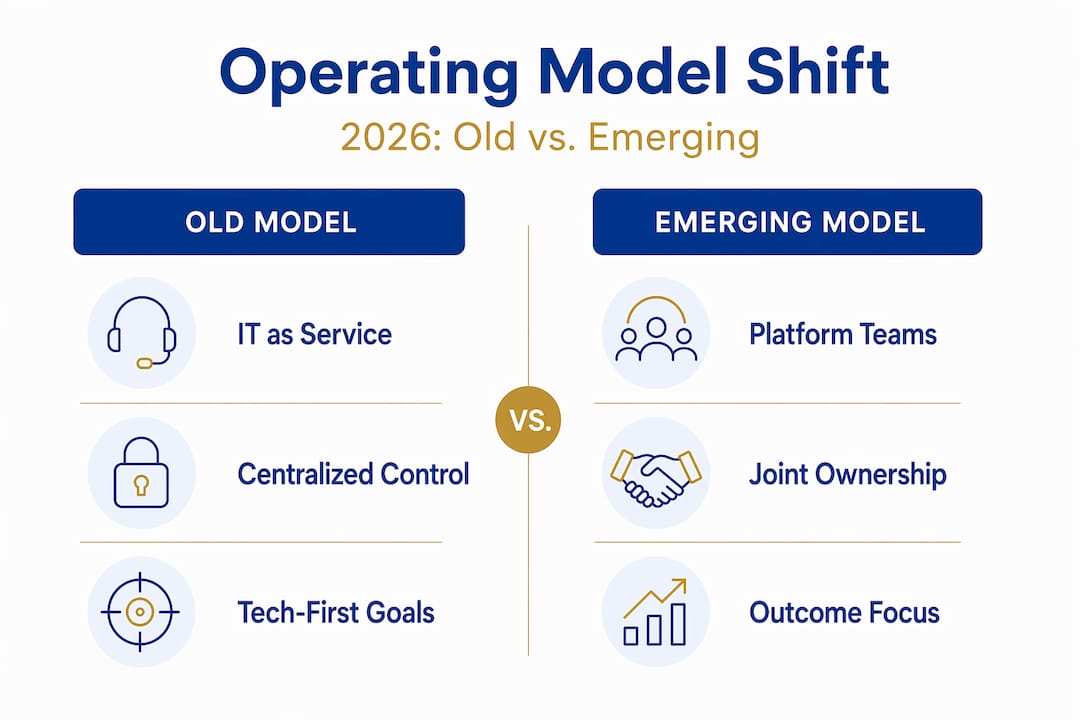
| Old model | Emerging model |
|---|---|
| IT as shared service | Platform teams with joint business-tech ownership |
| Project-based delivery | Continuous product and service delivery |
| IT-owned architecture | Enterprise architecture as investment advisory |
| Headcount by role type | Talent pools by capability: AI, security, automation |
| Annual training cycles | Continuous learning embedded in team operations |
Enterprise architecture is getting a second look in this context. When managed well, it becomes the connective tissue between business strategy and technology investment decisions. Leaders are using architecture practices to evaluate which parts of their portfolio to modernize, which to retire, and where to redirect investment toward AI and automation capabilities.
Talent rebalancing is the other major move. Most tech organizations are still structured around roles that made sense five years ago. 2026 tech innovation trends point toward demand surges in AI engineering, security and risk management, platform ownership, and automation design. Leaders who are not actively redirecting hiring and internal development toward these areas are accumulating a future capability debt that will be expensive to close later.
Structured learning programs tied to real work, not just online courses, are what actually shifts skills. The organizations doing this well partner project assignments with deliberate coaching, so team members are applying new skills immediately rather than completing certifications that gather digital dust.
Why today’s tech leadership demands orchestration over authority
Here is the uncomfortable truth that most leadership advice in this space skirts around: authority is declining as a leadership currency in technology, and that is actually good news for organizations that lean into it.
The tech leaders who are struggling right now are the ones who built their credibility on being the person who knew the most or owned the most. That model made sense when IT was a discrete function. It breaks down completely when AI runs through every part of the business simultaneously and the C-suite has five or six competing technical voices.
What we see consistently at Orloff Phillips, across engagements with mid-sized and large organizations, is that the leaders gaining the most ground are not necessarily the deepest technical experts. They are the ones who are excellent at three specific things. First, they translate technology ambition into language that finance, operations, and sales actually act on. Second, they facilitate trade-off decisions that cut across functions without letting turf protection derail the conversation. Third, they manage the human side of AI adoption, which is harder than the technical side in almost every case.
The technology consulting work that creates real impact in 2026 is almost never about picking the right platform. It is about building the organizational capacity to use any platform well, which requires leadership, change management, and clear measurement, not just technical selection.
Digital leadership evolution is not a soft skill conversation. It is a performance conversation. Organizations with leaders who can orchestrate across the C-suite execute AI initiatives faster, waste less capital on failed implementations, and retain technical talent better because their teams work in environments with clearer direction. That is a measurable competitive advantage, and it is available to any organization willing to reframe what leadership actually means.
Empower your technology leadership with Orloff Phillips
Understanding the trends is the starting point. Translating them into concrete action inside your organization is where most leadership teams need support. Orloff Phillips specializes in exactly that moment, helping technology executives and their teams move from strategic awareness to measurable results.
Whether you need a technology strategy built for an AI-enabled future, a fractional CIO or CTO to lead a critical transformation, or advisory support to redesign your operating model around platform teams and modern talent strategies, Orloff Phillips brings proven frameworks from real-world engagements. Explore how our technology consulting services help organizations bridge the gap between AI ambition and execution, or review our thinking on digital transformation in 2026 to see how these trends connect to your specific growth priorities.
Frequently asked questions
What are the main skills technology leaders must develop in 2026?
Technology leaders need to build orchestration skills, human-AI collaboration management, and change leadership alongside their technical knowledge. Tech leaders must translate technology ambition into business action, making influence and communication as important as any technical credential.
How does AI-augmented leadership help combat the IT talent shortage?
AI-augmented leadership uses AI tools as mentors, reviewers, and sounding boards to build existing employee capability without requiring constant new hires. AI as sounding board reduces dependence on a talent market that cannot currently supply enough qualified candidates.
What operating model changes are CIOs implementing for 2026?
CIOs are replacing traditional IT service models with platform teams that have joint business and technology ownership, while shifting talent investment toward AI, security, and automation roles. CIOs are evolving operating models and talent strategies to match the demands of AI-enabled delivery.
Why is tech leadership now more about orchestration than authority?
When five or more technology executives share C-suite influence and AI initiatives cut across every business function, no single leader can direct outcomes through authority alone. Leadership is now orchestration as tech roles multiply and coordination across functions becomes the primary source of execution speed.
Leave a Reply