
Digital transformation is no longer optional for organizations that want to stay competitive. Yet most executives find themselves stuck between vendor promises and vague success stories that offer little they can actually act on. The uncomfortable truth is that 70% of digital transformations fail due to culture and leadership gaps, not technology shortfalls. This article cuts through the noise by presenting seven concrete, data-driven transformation examples across manufacturing, HR, retail, healthcare, and logistics, along with the specific lessons that made each one work so you can apply them directly to your own strategy.
Table of Contents
- What makes a digital transformation truly successful?
- Siemens Erlangen: Manufacturing’s digital lighthouse
- HR and AI pilots: Transforming workforce efficiency
- Other standout examples: Digital transformation by industry
- Roadmap to success: How to replicate proven transformation wins
- Why most digital transformations miss the mark—and what works
- Explore expert guidance for your transformation journey
- Frequently asked questions
Key Takeaways
| Point | Details |
|---|---|
| Clear success criteria | Focus on measurable productivity, scalability, and culture for transformation wins. |
| Proven industry cases | Successful transformations like Siemens and HR/AI pilots prove substantial efficiency gains. |
| Phased execution works | Following a four-phase roadmap reduces risk and improves long-term outcomes. |
| Culture over technology | Addressing leadership and culture gaps is essential for digital strategy success. |
What makes a digital transformation truly successful?
Before examining real-world examples, it is worth establishing what success actually looks like. Too many organizations launch transformation projects focused on deploying technology and then measure success by whether the tools went live. That is the wrong metric entirely.
True transformation delivers measurable outcomes across five core dimensions:
- Productivity gains that are visible in output per employee or throughput per unit of time
- Operational efficiency reflected in reduced cycle times, error rates, or overhead costs
- Environmental or sustainability impact, which increasingly matters for regulatory and ESG (Environmental, Social, Governance) reasons
- Scalability, meaning the transformation can expand across business units or geographies without rebuilding from scratch
- Innovation capacity, or whether the new infrastructure enables the organization to test and launch new capabilities faster
Most failed transformations skip at least two of these dimensions, usually scalability and innovation capacity, because leadership focuses on fixing today’s problems rather than building tomorrow’s platform.
“70% of digital transformations fail due to culture and leadership gaps, not technology shortfalls.” This statistic should be on the wall of every executive steering committee.
Understanding this failure rate before reviewing the examples matters because it reframes the question. The right question is not “What technology should we buy?” It is “Do we have the leadership alignment, cultural readiness, and iterative feedback mechanisms to sustain change?” When you look at scaling digital solutions across a large organization, these factors often determine the ceiling on how much value you can actually capture.
Pro Tip: Before committing budget to any transformation initiative, run a 30-day pilot with a defined hypothesis, a measurable success metric, and a clear go/no-go decision point. Pilots that fail fast save organizations millions compared to full-scale deployments that fail slowly.
Siemens Erlangen: Manufacturing’s digital lighthouse
Few transformation stories in manufacturing match the scale and rigor of what Siemens accomplished at their Erlangen electronics facility in Germany. The factory deployed a tightly integrated stack of AI-driven analytics, digital twin technology (a real-time virtual replica of physical systems), and advanced robotics across the production floor.
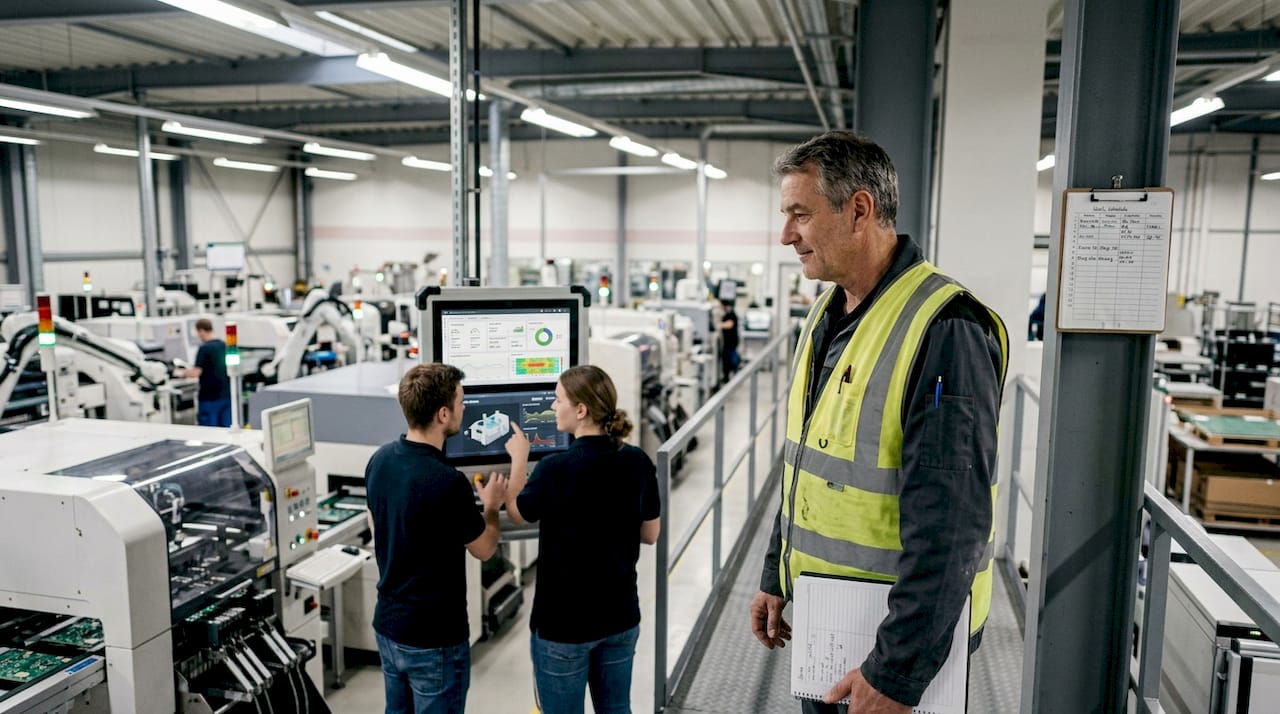
The results speak for themselves. The Siemens Erlangen factory achieved a 69% productivity increase and a 42% reduction in energy consumption, earning recognition as a World Economic Forum (WEF) Digital Lighthouse. That designation is reserved for fewer than 200 factories globally and signals best-in-class Industry 4.0 (the fourth industrial revolution combining physical and digital systems) execution.
| Metric | Before transformation | After transformation |
|---|---|---|
| Productivity index | Baseline | +69% |
| Energy consumption | Baseline | -42% |
| WEF recognition | None | Digital Lighthouse |
| Production flexibility | Low | High (AI-adaptive) |
| New technology roles | Minimal | Integrated at scale |
What made this work beyond the technology itself?
- Executive vision with clear KPIs set from the top before any system was deployed
- Integration of new human roles including data scientists and digital twin operators alongside traditional factory workers
- Phased scalability, with the Erlangen facility serving as a replicable template for other Siemens plants
- Cross-functional governance ensuring that IT, operations, and finance stayed aligned throughout
The lesson for mid to large manufacturers is not to copy Siemens’ exact technology stack but to replicate their governance model. Think about how Siemens digital transformation strategies connected operational compliance to competitive differentiation, and consider how your own organization can build that connection. Productivity at this scale does not come from better hardware alone. It comes from leadership that treats transformation as an ongoing operating model rather than a one-time project.
HR and AI pilots: Transforming workforce efficiency
Manufacturing examples illustrate macro-level impact, but digital transformation delivers value inside every department of an organization, including HR. One of the most consistently high-ROI (return on investment) use cases involves deploying AI-powered virtual agents to handle employee service requests, from payroll inquiries to benefits enrollment and policy questions.
In documented HR/AI pilots, organizations measured 73% ticket deflection and $1.5 million in direct annual savings by routing standard HR requests through an intelligent self-service layer rather than live HR staff. That deflection rate means nearly three out of four employee requests never reach a human agent, freeing HR professionals to focus on strategic workforce planning, complex cases, and employee development.
The measurable outcomes from these pilots include:
- 73% reduction in Level 1 support tickets through AI-powered self-service
- $1.5 million in annual cost savings from reduced support staffing overhead
- Faster employee resolution times, often under 90 seconds for routine requests versus hours for human-handled queues
- Higher employee satisfaction scores when self-service tools are intuitive and accurate
It is worth noting that workforce transformation benefits are not evenly distributed. Organizations in heavily regulated industries, such as finance or healthcare, face additional compliance constraints that can limit which HR processes are safe to automate. Environmental and regulatory risk factors can moderately reduce the ROI of AI automation if not accounted for in the planning phase. That is precisely why any organization exploring HR transformation consulting should conduct a regulatory pre-assessment before selecting an automation platform.
Pro Tip: Change management for human-centric technology is the single biggest differentiator between AI pilots that scale and those that stall. Employees resist tools they do not trust. Invest in transparent communication, clear escalation paths, and visible success metrics during rollout to accelerate adoption and sustain it.
Other standout examples: Digital transformation by industry
Manufacturing and HR represent two transformation archetypes. Here are five additional examples across different industries, each illustrating a distinct value lever.
- Walmart (retail): Deployed AI-driven supply chain analytics and automated replenishment across thousands of store locations, reducing out-of-stock incidents by over 16% and cutting inventory carrying costs at scale.
- Mayo Clinic (healthcare): Integrated predictive analytics into clinical workflows, enabling earlier identification of high-risk patients and reducing hospital readmission rates by leveraging real-time data from electronic health records.
- DHL (logistics): Rolled out augmented reality (AR) wearables for warehouse picking operations, reducing picking errors by 25% and cutting new employee training time from weeks to days.
- Microsoft (enterprise SaaS): Transitioned from a packaged software model to a cloud-first subscription platform, which not only changed their revenue structure but repositioned the company as an innovation platform for enterprise customers globally.
- Schneider Electric (energy management): Used IoT (Internet of Things) sensors and digital twin technology across customer facilities to optimize energy consumption, delivering documented savings of up to 30% on energy costs for enterprise clients.
| Organization | Industry | Primary value lever | Execution model | Innovation impact |
|---|---|---|---|---|
| Walmart | Retail | Supply chain AI | Phased rollout | High |
| Mayo Clinic | Healthcare | Predictive analytics | Pilot to scale | High |
| DHL | Logistics | AR wearables | Big-bang by region | Medium |
| Microsoft | Enterprise tech | Cloud platform shift | Multi-year phased | Very high |
| Schneider Electric | Energy | IoT and digital twin | Phased by client | High |
What separates the phased execution model from a “big-bang” (all-at-once) approach? Simply put, phased execution reduces risk at every stage. A proven 4-phase roadmap, covering Assessment, Planning, Implementation, and Optimization, creates structured checkpoints where leadership can validate outcomes before committing the next tranche of investment. The big-bang approach looks faster on paper but eliminates those validation checkpoints, which is exactly when most transformations go off the rails.
Organizations serious about transformation for sustainable growth consistently favor the phased model, and the industry examples above confirm it. Even DHL’s regional rollout was effectively a phased approach within a larger organizational context. When you look at your own transformation execution services options, ask whether your partner has experience managing the handoffs between phases, not just individual phase delivery.
Roadmap to success: How to replicate proven transformation wins
The patterns across these industry examples converge on a consistent four-phase execution model that reduces risk and increases the probability of sustainable value creation.
Assessment: Map your current technology landscape, operational workflows, and organizational readiness. Identify the highest-value pain points and the cultural or structural barriers that will resist change. This phase produces a clear starting point and a transformation hypothesis.
Planning: Translate the assessment findings into a prioritized roadmap with defined milestones, resource requirements, and success metrics. Assign executive sponsors for each workstream. This is where governance structure gets built, not improvised later.
Implementation: Execute in time-boxed sprints (short, defined work periods) rather than long waterfall (sequential, rigid) project schedules. Build feedback loops into every sprint so that teams can course-correct before problems compound. Phased execution at this stage is what separates organizations that capture value quickly from those that spend years deploying solutions before measuring results.
Optimization: Treat go-live as the beginning of value capture, not the end of the project. Monitor KPIs (Key Performance Indicators) continuously, run periodic reviews to identify new automation or integration opportunities, and build assetization practices, meaning you document and package what works so it can be reused or scaled.
The human and leadership factors deserve special emphasis here. Organizations that treat implementation as a technology deployment project rather than a change management program consistently underperform. Culture, communication, and leadership visibility are not soft factors. They are the most predictable variables in transformation success or failure. Building remote collaboration in digital projects into your planning phase, for example, becomes critical when transformation teams are distributed across time zones and business units.
Pro Tip: Assetization is one of the most underused levers in enterprise transformation. When a team solves a complex integration problem or builds an effective change communication framework, document it as a reusable asset. Organizations that build internal “transformation libraries” reduce the cost and time of each subsequent initiative by 20 to 40%.
Why most digital transformations miss the mark—and what works
Here is something that rarely gets said plainly in this space: most digital transformations disappoint not because organizations chose the wrong technology but because they chose technology before they addressed leadership alignment and cultural readiness.
We have seen organizations invest seven figures in enterprise platforms, only to watch adoption stall at 30% because no one secured genuine buy-in from middle management. Middle managers are the make-or-break layer in any transformation. They control day-to-day workflows, they influence team behavior, and they are the first to quietly undermine tools they do not understand or trust.
The most effective approach is to treat the first six months of any transformation as primarily a culture and leadership investment, not a technology deployment. That means transparent metrics visible to everyone, not just the C-suite. It means leaders publicly engaging with new tools, not just endorsing them in all-hands meetings. And it means rewarding teams that surface problems early rather than punishing failure.
The assetization concept matters here too. Organizations that build a consultant-led transformation model, where external experts work alongside internal teams to build repeatable capabilities rather than just deliver a system, consistently outperform organizations that treat transformation as a vendor installation project. The difference is whether your organization ends the engagement smarter and more capable, or simply better equipped.
Human potential is the lever that all the AI, digital twin, and IoT technology in the world cannot replace. The executives who understand that lead transformations that actually last.
Explore expert guidance for your transformation journey
The examples and frameworks in this article represent a starting point, not a complete playbook. Every organization faces a unique combination of technology debt, cultural readiness, and strategic priorities that requires tailored guidance to navigate effectively.
At Orloff Phillips, we specialize in helping mid to large organizations translate transformation ambition into measurable results through fractional executive expertise in technology leadership, operations, and strategy. Whether you need a virtual CIO, a CTO for a critical initiative, or structured advisory support across your business transformation steps, our team brings the proven experience to accelerate your path from planning to results. Connect with us to explore how a tailored fractional leadership engagement can help your organization capture the kind of value you read about in these examples.
Frequently asked questions
What is a successful example of digital transformation in manufacturing?
The Siemens Erlangen factory achieved a 69% productivity increase and a 42% reduction in energy use through digital twin, AI, and robotics integration, earning WEF Digital Lighthouse status.
How do AI pilots impact HR operations?
HR/AI pilots have delivered 73% support ticket reduction and saved $1.5 million annually through intelligent self-service automation, freeing HR teams for higher-value strategic work.
What are the four phases of a digital transformation roadmap?
The four phases are Assessment, Planning, Implementation, and Optimization, each designed to reduce risk and validate outcomes before the next investment commitment.
Why do most digital transformations fail?
Most failures trace back to culture and leadership gaps rather than technology problems, specifically weak middle management buy-in and insufficient change management investment.
How can executives ensure a digital transformation delivers ROI?
Start with clearly scoped pilot programs tied to measurable business outcomes, prioritize culture and leadership alignment before technology deployment, and build continuous optimization into the operating model from day one.

Leave a Reply