
Most digital transformation initiatives are built on a false premise: that deploying the right technology and allocating sufficient budget is enough to guarantee results. The data says otherwise. Research benchmarks show that 70 to 75 percent of transformation programs fail due to poor strategic alignment and inadequate change management, while Bain estimates that 88 percent miss their original ambitions entirely. The gap between execution and outcome is not a technology problem. It is a leadership and strategy problem, and it is precisely where advisory services deliver their most measurable value.
Table of Contents
- Why transformation fails without advisory services
- Core roles advisory services play in successful transformation
- Common obstacles: Complexity, legacy systems, and cultural resistance
- How advisory models are evolving in the era of AI
- A fresh perspective: What most executives get wrong about advisory value
- Partnering with the right advisory team for lasting impact
- Frequently asked questions
Key Takeaways
| Point | Details |
|---|---|
| High failure rates | Most digital transformations fail without expert advisory, mainly due to poor alignment and weak execution. |
| Advisor impact | Advisory services double the chance of success by bridging strategy, leadership, and change management gaps. |
| Modern models | AI is shifting advisory services toward outcome-based and tech-enabled approaches, but insight and judgment remain critical. |
| Overcoming obstacles | Legacy complexity and resistance require targeted advisory engagement for effective transformation. |
| Collaborative value | The best results come when advisors spark internal alignment and adaptive action, not just deliver playbooks. |
Why transformation fails without advisory services
Well-resourced organizations fail at transformation every day. They hire talented people, invest in enterprise platforms, and announce ambitious roadmaps. Then, 18 months later, adoption is low, costs have ballooned, and the original business case has quietly been shelved. The problem is rarely a lack of effort. It is a lack of the structured, external perspective that keeps execution aligned with strategy over time.
The numbers are sobering. Failure rates across transformations consistently sit between 70 and 88 percent across studies from BCG, McKinsey, and Bain. Only about 30 percent of organizations report genuine success. Firms that engage structured advisory support, however, see their odds of success improve by 1.5 to 2 times compared to those going it alone. That is not a marginal improvement. It is the difference between a transformation that reshapes a business and one that burns through capital with little to show for it.
The failure points tend to cluster around three recurring issues:
- Strategic misalignment: Business leaders and technology teams pursue different definitions of success, often without realizing it until resources are already committed.
- Weak change management: People resist disruption, and without a structured approach to communication, training, and leadership engagement, adoption collapses.
- Unrealistic goals: Executives set targets that ignore organizational capacity, technical debt, or market conditions, and there is no one in the room empowered to push back.
| Failure factor | Organizations affected | Primary consequence |
|---|---|---|
| Poor strategic alignment | 70%+ of failed initiatives | Misallocated investment |
| Inadequate change management | 55-60% of breakdowns | Low adoption rates |
| Unrealistic scope/goals | Majority of budget overruns | Missed ROI timelines |
| Lack of external perspective | Pervasive across industries | Blind spots in execution |
“The most dangerous assumption in transformation is that internal teams can objectively assess their own blind spots. They rarely can.”
This is where consulting expertise in change management becomes essential. External advisors bring a critical detachment that internal teams cannot replicate. They have seen what works across dozens of industries and can recognize failure patterns early enough to correct them. The advisory value in digital growth is not about importing answers. It is about asking better questions faster than an internal team ever could.

The hidden cost of skipping advisory is not just a failed project. It is the organizational cynicism that follows, where staff become resistant to future initiatives and leadership credibility takes a hit that can last for years.
Core roles advisory services play in successful transformation
Knowing that advisory services improve outcomes is one thing. Understanding precisely how they do it is what allows you to select the right partner and structure the engagement for maximum impact. Expert advisors are not consultants who hand over a report and disappear. The best engagements are hands-on, iterative, and deeply integrated with your leadership team.
Here are the four core roles that expert advisors play across a successful transformation lifecycle:
Diagnostic analysis of operations and culture. Before recommending anything, a strong advisor maps your current state in detail. That means assessing not only technology infrastructure but also decision-making processes, cultural norms, and the informal power structures that often determine whether change succeeds or stalls. The diagnostic phase is where advisors surface the issues that internal teams have normalized and stopped seeing.
Creating and stress-testing transformation strategy. Advisors develop strategy in collaboration with your leadership team, but they add a discipline that internal teams often skip: stress testing. That means modeling failure scenarios, pressure-testing assumptions, and building contingency into the roadmap before a single dollar is deployed. Following transformation steps for sustainable growth requires this kind of structured rigor.
Driving stakeholder alignment and engagement. One of the most underestimated transformation challenges is keeping executives, department heads, and front-line managers aligned across a multi-year effort. Advisors establish governance structures, facilitate alignment workshops, and maintain accountability between leadership layers. They act as a neutral party in conversations where internal politics would otherwise derail progress.
Change management and execution support. Strategy without execution is theory. Advisors bring tested frameworks for managing the human side of change: communication plans, adoption metrics, training programs, and feedback loops. This is the discipline that most internal teams lack and most transformation initiatives underinvest in.
Pro Tip: Secure small, visible wins in the first 90 days of any transformation engagement. Early momentum shifts organizational culture faster than any mandate from the top. Your advisory team should help you identify and prioritize these wins as part of their initial planning.
The math reinforces all of this. With structured advisory support, transformation success odds improve by 1.5 to 2 times. That improvement is not accidental. It reflects the compounding value of experienced judgment applied at each critical decision point, from day one through final adoption. Strong IT strategy essentials are a core part of what experienced advisors bring, especially in environments where technology is both the vehicle and the primary obstacle.
Common obstacles: Complexity, legacy systems, and cultural resistance
Even organizations with strong advisory support hit walls. The obstacles that derail mid-sized and large organizations are not the same ones that trip up startups. They are deeper, stickier, and often invisible to leadership until the damage is already done.
Legacy system complexity is one of the most persistent barriers. Many mid-sized firms inherited patchwork IT environments across years of mergers, acquisitions, and vendor transitions. These systems are not simply outdated. They are deeply embedded in daily operations, often undocumented, and frequently running processes that no one fully understands anymore. Attempting to modernize without advisory oversight in this environment is like renovating a building without reading the structural plans.
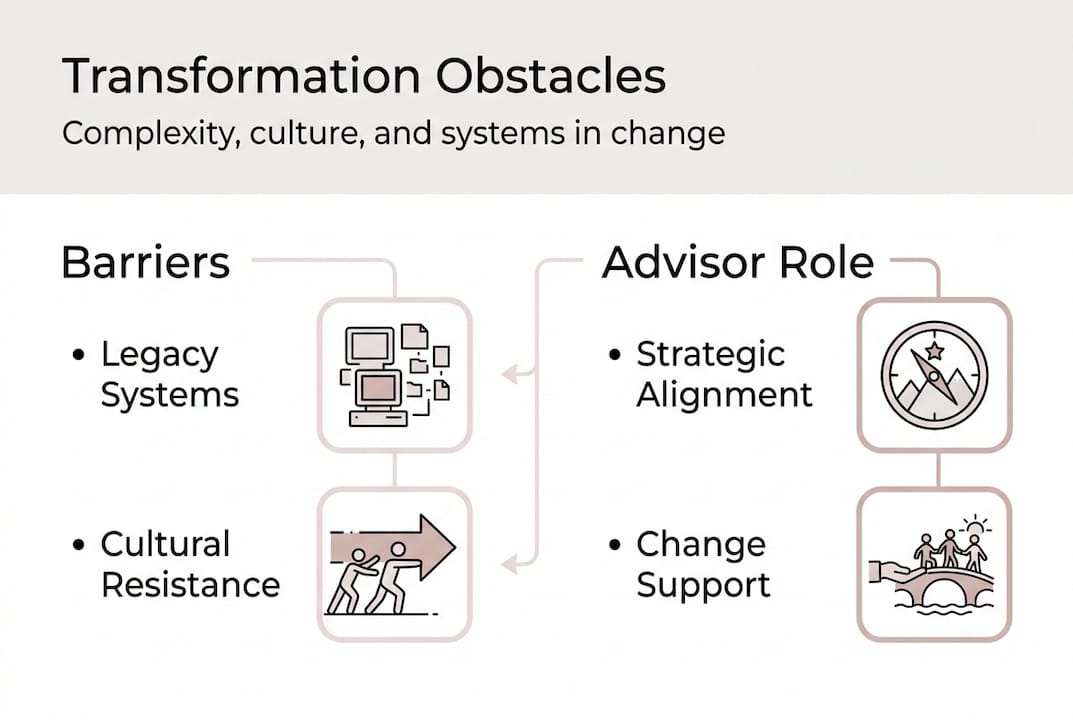
Cultural resistance and stakeholder misalignment are equally destructive. Research on transformation breakdowns shows that cultural resistance and executive misalignment account for 55 to 60 percent of program failures. This is not about employees refusing to use new software. It is about deeper organizational behaviors: siloed thinking, risk aversion embedded in middle management, and executives who publicly endorse transformation while privately protecting the status quo.
Here is where remote collaboration challenges can compound the problem. In distributed or hybrid organizations, misalignment spreads faster and is harder to correct because informal conversations that once bridged gaps simply do not happen at the same frequency.
| Obstacle | Organizations impacted | Advisory intervention |
|---|---|---|
| Legacy system complexity | Most mid-sized firms | Architecture assessment and phased migration |
| Cultural resistance | 55-60% of failures | Change management frameworks and executive coaching |
| Stakeholder misalignment | Majority of budget overruns | Governance structures and facilitated alignment |
| AI integration missteps | Growing rapidly in 2026 | Process review before automation |
AI integration without advisory oversight is an emerging risk that deserves special attention. Organizations are rushing to automate workflows with AI tools, but integrating AI without process review carries a serious hazard: you end up automating broken processes at scale. The inefficiency does not disappear. It accelerates. Advisors with AI expertise review processes before automation, ensuring that what you scale is genuinely worth scaling.
When to bring in specialized advisors:
- When a legacy system migration touches more than two core business functions
- When executive team alignment on transformation goals is visibly inconsistent
- When a previous transformation initiative failed or stalled and organizational trust is low
- When AI adoption is on the roadmap but internal teams lack the technical and process expertise to govern it
Pro Tip: If you are encountering the same objections from different departments about a transformation initiative, that is not a communication problem. It is a governance problem. An experienced advisor will see this pattern immediately and address root causes rather than symptoms.
How advisory models are evolving in the era of AI
The advisory industry itself is undergoing a significant shift, and executives who understand that shift will negotiate better engagements and extract more value from their advisory partners. The traditional model, where firms bill by the hour or by the day for labor-intensive deliverables, is giving way to something more sophisticated.
“AI shifts advisory from labor-hour billing to outcome-based ‘Service as Software,’ but incumbents struggle to encode judgment and remain vulnerable to domain-focused AI natives.” Consulting’s Fourth Transformation
This shift has real implications for how you structure advisory contracts. Outcome-based models tie advisory fees to measurable business results rather than hours worked. That alignment of incentives changes the entire dynamic of the engagement. Your advisor is not motivated to extend the project. They are motivated to produce results fast.
What executive sponsors should look for in a modern advisory partner:
- Clear outcome metrics defined upfront. If an advisor cannot articulate how their engagement will be measured, that is a red flag.
- AI fluency without AI obsession. The best advisors understand AI tools and can apply them selectively, but they do not push automation for its own sake.
- Embedded execution support. The era of the 200-page strategy deck is over. Advisors should be willing to roll up their sleeves and work alongside your teams.
- Adaptability across engagement length. Some transformations need a two-year advisory relationship. Others need 90-day sprints. Rigidity in engagement structure is a warning sign.
- Domain-specific expertise. General management consulting is losing ground to advisors who bring deep expertise in specific industries or functional areas like cybersecurity, IT roadmapping, or operational efficiency.
Questions to ask any advisory provider before signing a contract:
- Can you show documented outcomes from comparable engagements, not just testimonials?
- How do you measure and report progress against our transformation goals?
- What does your change management methodology look like in practice?
- How are you integrating AI tools into your advisory process, and what governance do you apply?
Exploring the right technology reset and execution advisory for your organization requires understanding not just what advisors do, but how they prove it. The most capable firms are transparent about their methods, rigorous about measurement, and accountable for outcomes in a way that traditional consulting firms historically avoided.
The firms that will thrive in the next decade are not the ones that simply deploy advisors faster. They are the ones that combine human judgment with AI-powered analysis to deliver insights at a speed and depth that was not possible five years ago. For executives, that means advisory services that were once reserved for the largest enterprises are now accessible, practical, and measurable for mid-sized organizations too.
A fresh perspective: What most executives get wrong about advisory value
Here is an uncomfortable truth: the executives who get the least from advisory engagements are usually the ones who treat advisors as knowledge vendors. They expect the advisor to arrive with a proven playbook, apply it systematically, and hand over a transformed organization on the way out. That is not how lasting change works.
The real value of advisory is not knowledge transfer. It is catalysis. A great advisor does not import solutions. They create the internal conditions where your own leadership team can solve problems they previously could not see clearly. That distinction matters enormously in practice.
Off-the-shelf frameworks fail not because the frameworks are wrong, but because they do not account for the specific history, culture, and politics of your organization. A methodology that transformed a financial services firm will not transfer cleanly to a regional healthcare system, even if the surface-level challenges look identical.
The best transformation outcomes we observe consistently come from collaborative, adaptive engagements where advisors and internal teams co-create solutions. The advisor challenges assumptions, brings external pattern recognition, and holds the organization accountable to its own stated goals. But the leadership team owns the outcome. That sense of ownership is what makes change stick. Exploring the full value that business consultants deliver only makes sense when both sides of the engagement are genuinely committed to that collaborative model.
Partnering with the right advisory team for lasting impact
Understanding why transformation fails and what good advisory looks like is necessary, but it does not substitute for experienced partners who can deliver results in the context of your specific organization, industry, and goals.
At Orloff Phillips, we bring fractional executive leadership and strategic advisory services designed specifically for mid-sized and large U.S. organizations navigating complex transformation. Whether your challenge is a legacy IT environment that is blocking growth, a culture resistant to change, or an AI adoption strategy that lacks governance, our team has the experience to move you from roadmap to results. Our advisory and leadership services are built around measurable outcomes, not billable hours. If you are ready to dramatically improve your odds of transformation success, we would like to be part of that conversation.
Frequently asked questions
Why do most transformation projects fail?
Most projects fail because of poor alignment between business goals and technology execution, combined with weak change management practices. Benchmark research shows that 70 to 88 percent of initiatives miss their targets for these structural reasons rather than technical ones.
What kind of advisory service has the most impact?
Services that focus on leadership alignment, cultural change, and strategy execution consistently deliver the highest transformation outcomes. Studies confirm that advisory support with these priorities improves success odds by 1.5 to 2 times versus unguided initiatives.
How does AI change the value of advisory services?
AI is shifting advisory toward outcome-based models where results replace hours as the billing metric, but human judgment remains essential for the complex leadership and cultural challenges that no algorithm can yet navigate reliably.
When should executives engage advisory services in a transformation?
Executives should bring advisors in at the beginning of a transformation, particularly when dealing with legacy system complexity or visible cultural resistance, because early advisory involvement prevents the compounding errors that become expensive to fix later.

Leave a Reply