
Business process optimization steps are a systematic sequence of actions that help organizations eliminate inefficiencies, reduce costs, and improve operational performance across every function. The industry term for this practice is Business Process Management, or BPM, and it draws on methodologies like Lean, Six Sigma, and DMAIC to deliver measurable results. Organizations that follow a structured approach to workflow optimization report 20–40% cost savings and 30–60% faster cycle times within 12–18 months of implementation. Those gains come from redesigning workflows end to end, not from patching isolated steps. This guide walks you through the seven essential steps, the methodologies that support them, and the human factors that determine whether your effort sticks.
What are the essential business process optimization steps?
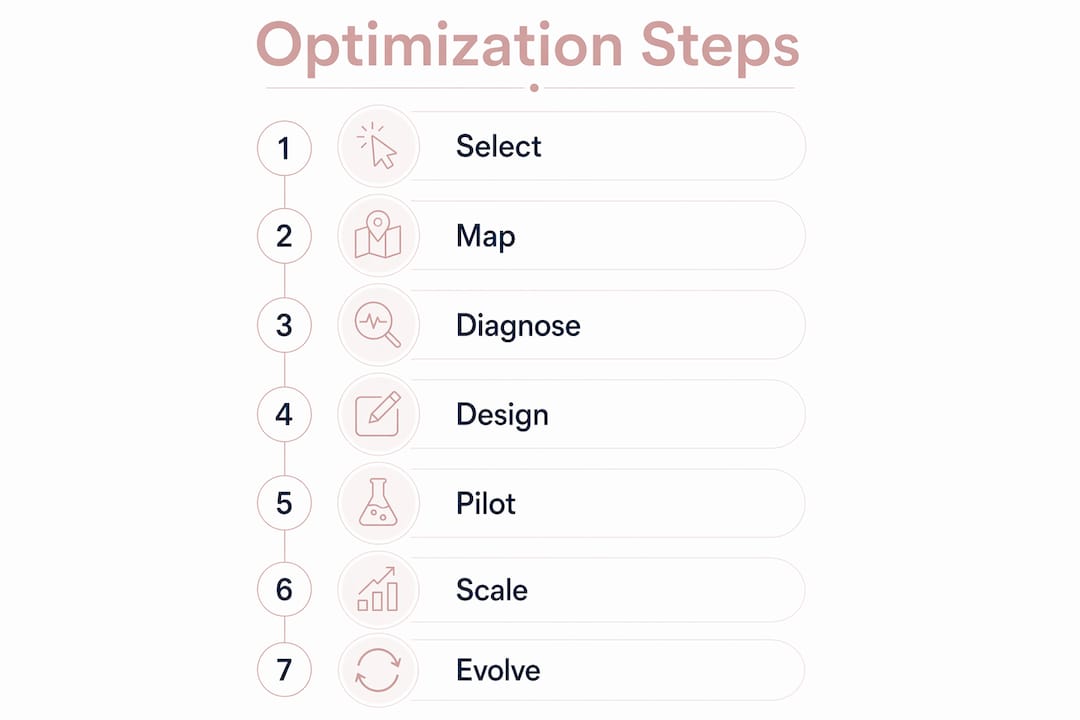
The standard 7-step lifecycle gives business leaders a repeatable framework for improving any process, from procurement to customer onboarding. Each step builds on the last, so skipping ahead creates gaps that surface later as costly rework.
Select and scope the process. Start by identifying which process to target. Prioritize based on cost impact, frequency, customer visibility, and error rate. A process that runs 500 times a day with a 5% error rate is a far better candidate than one that runs monthly with minor friction.
Map the current state. Use swimlane diagrams or process mining tools like Celonis or UiPath Process Mining to document how work actually flows. Observing real staff behavior is more reliable than reading procedure manuals. The gap between documented process and actual practice is almost always where waste hides.
Diagnose root causes. Apply the 5 Whys technique or a fishbone diagram to trace problems to their source. 80% of process delays originate from roughly 20% of bottlenecks or failure points. That concentration means targeted fixes deliver outsized results.
Design the future state. Redesign the process with simplicity as the primary goal. Eliminate steps that add no value, automate repetitive tasks where possible, and clarify ownership at every handoff. Tools like Lucidchart or Microsoft Visio help teams visualize the new flow before building it.
Pilot and iterate. Run the redesigned process with a cross-functional team for 8–12 weeks before scaling. Piloting surfaces edge cases and operational surprises that no design session anticipates. Skipping this step is the single most common cause of expensive failed rollouts.
Scale and govern. Once the pilot validates the design, formalize governance. Assign process owners, document the new standard operating procedures, and define escalation paths. Governance prevents the process from drifting back to old habits under pressure.
Embed continuous improvement. Set KPIs, schedule regular process reviews, and create feedback channels for frontline staff. Successful optimization is a permanent operational capability, not a one-time project.
Pro Tip: When mapping the current state, shadow two or three employees doing the actual work for a full shift. You will find steps, workarounds, and informal fixes that no documentation captures.
Which methodologies best support effective process optimization?

No single methodology fits every situation. The right choice depends on the type of problem you are solving, the data you have available, and the pace of change your organization can absorb.
| Methodology | Core focus | Best for |
|---|---|---|
| Six Sigma | Defect reduction using DMAIC | High-volume, data-rich processes with measurable error rates |
| Lean | Waste elimination and flow | Manufacturing, logistics, and service delivery |
| Kaizen | Incremental continuous improvement | Teams needing cultural change over time |
| BPM | End-to-end process agility | Complex, cross-functional workflows with technology integration |
| Lean Six Sigma | Combined waste and defect reduction | Organizations needing speed and quality simultaneously |
Six Sigma targets fewer than 3.4 defects per million cycles. That precision makes it the right tool when quality failures carry high financial or regulatory consequences, such as in healthcare billing or financial services. Lean, by contrast, focuses on eliminating waiting, rework, and unnecessary motion. It delivers faster results in environments where speed and flow matter more than statistical precision.
Kaizen works best when the problem is cultural rather than structural. Small, frequent improvements made by frontline teams build ownership and reduce resistance to change. Many organizations combine approaches. Lean Six Sigma is the most common hybrid, pairing waste reduction with defect control to address both speed and quality in a single program.
Business Process Management adds a technology layer. BPM platforms like Appian, Pega, or IBM Business Automation Workflow allow organizations to model, automate, and monitor processes at scale. BPM is the right framework when your optimization goals include digital transformation, not just workflow cleanup.
How do you diagnose root causes to stop recurring inefficiencies?
Treating symptoms instead of root causes is the most expensive mistake in process improvement. A team that fixes a slow approval step by adding headcount has not solved the problem. It has made the problem more expensive.
The 5 Whys technique is the most direct root cause tool available. Ask why a problem occurs, then ask why again for each answer, repeating five times. By the fifth iteration, you are almost always looking at a systemic cause rather than a surface symptom. The fishbone diagram, also called an Ishikawa diagram, works well when multiple contributing factors interact. It maps causes across categories like people, process, technology, and environment.
Common root causes that surface in most organizations include:
- Unclear ownership. When no one is accountable for a step, errors accumulate and decisions stall.
- Outdated tools. Legacy software forces manual workarounds that introduce errors and slow throughput.
- Poor handoff design. Transitions between teams or systems are where most information gets lost.
- Inconsistent training. Staff doing the same task in different ways produces variable outputs and unpredictable quality.
The business process analysis steps that identify these causes must be grounded in real data, not assumptions. Process mining tools extract event logs from your existing systems and show you exactly where delays and failures concentrate. That evidence makes root cause conversations faster and far less political.
Pro Tip: Before your root cause session, pull three months of process data from your ERP or workflow system. Walking in with actual cycle times and error rates shifts the conversation from opinion to fact within the first ten minutes.
What role does change management play in process optimization success?
The most technically sound process redesign fails if the people running it revert to old habits. Neglecting human factors causes staff to create shadow processes, informal workarounds that bypass the new workflow entirely. Shadow processes are invisible to management and impossible to measure or improve.
Most leaders underestimate how much fear drives resistance to process change. Employees worry about job security when automation enters the picture. They worry about looking incompetent when familiar tools disappear. Addressing those concerns directly and early is not a soft skill. It is a hard requirement for adoption.
Effective change management during process optimization includes:
- Early communication. Tell staff why the change is happening, what it means for their roles, and what the timeline looks like. Silence creates rumors that are always worse than the truth.
- Role-specific training. Generic training sessions do not work. Train each team on the specific steps that affect their daily work, using real examples from their environment.
- Feedback channels. Create a structured way for frontline staff to report problems with the new process. They will find issues the design team missed, and they need to know their input matters.
- Visible leadership support. When senior leaders visibly use and endorse the new process, adoption accelerates. When leaders quietly revert to old methods, the rest of the organization follows.
Active communication and retraining are not optional add-ons to an optimization project. They are the mechanism by which a better process actually becomes the way work gets done. Budget for change management from day one, not as an afterthought when resistance appears.
Key takeaways
Effective business process optimization requires a structured seven-step framework, the right methodology for your problem type, rigorous root cause analysis, and disciplined change management to make improvements permanent.
| Point | Details |
|---|---|
| Follow the seven-step framework | Select, map, diagnose, design, pilot, scale, and embed continuous improvement in sequence. |
| Match methodology to problem type | Use Six Sigma for defect reduction, Lean for waste, and BPM when technology integration is the goal. |
| Target root causes, not symptoms | The 5 Whys and fishbone diagrams trace 80% of delays to roughly 20% of failure points. |
| Pilot before scaling | Run an 8–12 week cross-functional pilot to surface edge cases before full rollout. |
| Invest in change management | Shadow processes emerge when human factors are ignored; training and communication prevent them. |
What I have learned about process optimization that most guides miss
Most process optimization efforts fail not because the methodology was wrong, but because the process map was fiction. Teams document how things should work, present it as how things do work, and then wonder why the redesign does not hold. I have seen this pattern in organizations of every size. The fix is simple but uncomfortable: go watch the actual work happen before you draw a single diagram.
The second thing I have learned is that technology is an accelerant, not a solution. Automating a broken process makes it break faster. The technology strategy conversation belongs after you have validated the redesigned process manually, not before. Leaders who buy a BPM platform hoping it will reveal the right process design are consistently disappointed.
Pilot testing is the step most organizations cut when budgets tighten or timelines compress. That is exactly backwards. An 8–12 week pilot with a cross-functional team is the cheapest insurance available against a failed enterprise rollout. The edge cases it surfaces would cost ten times more to fix post-launch.
Finally, treat optimization as a capability, not a project. Organizations that build internal process improvement skills, train process owners, and schedule regular reviews outperform those that run periodic optimization initiatives by a wide margin. The goal is not a better process. The goal is an organization that continuously produces better processes.
— Orloff
How Orloffphillips helps leaders drive lasting process improvement
Knowing the steps is one thing. Executing them inside a complex organization while managing day-to-day operations is another challenge entirely.
Orloffphillips works with mid-sized and large organizations across the United States to design and implement process optimization programs that deliver measurable results. Through fractional CXO services, Orloffphillips places experienced operational and technology leaders inside your organization to lead transformation without the cost or commitment of a full-time executive hire. These leaders bring proven frameworks for business transformation, root cause analysis, and change management that accelerate results from the first engagement. If your organization is ready to move from identifying inefficiencies to fixing them permanently, connect with Orloffphillips to discuss a tailored approach.
FAQ
What are the first steps in business process optimization?
The first two steps are selecting and scoping the target process, then mapping its current state using swimlane diagrams or process mining tools. Accurate mapping of how work actually flows is the foundation every subsequent step depends on.
How long does a business process optimization project take?
A full optimization cycle, from scoping through scaled implementation, typically takes 6–18 months. The pilot phase alone requires 8–12 weeks to surface operational edge cases before the new process is rolled out organization-wide.
What is the difference between Lean and Six Sigma?
Lean focuses on eliminating waste and improving flow, while Six Sigma targets defect reduction with a goal of fewer than 3.4 defects per million cycles. Many organizations combine both as Lean Six Sigma to address speed and quality simultaneously.
Why do process optimization efforts fail?
The two most common causes are inaccurate process mapping based on documentation rather than observation, and neglected change management that leads staff to create shadow processes bypassing the new workflow.
How do you measure the success of process optimization?
Track cycle time, error rate, cost per transaction, and employee adoption rate before and after implementation. Organizations that redesign workflows end to end report 20–40% cost savings and 30–60% faster cycle times within 12–18 months.

Leave a Reply