
Cybersecurity is defined as the practice of protecting networks, endpoints, applications, and data from unauthorized access, disruption, or destruction. The role of cybersecurity in business now extends far beyond IT. It directly affects revenue, customer trust, operational continuity, and enterprise value. Cybersecurity is a business risk that every executive owns a share of, not just the technology team. With 72% of corporate directors prioritizing technology investments for growth and 76% expecting AI to define future strategy, cyber-risk oversight has moved permanently onto the board agenda.
How does cybersecurity protect business assets and maintain trust?
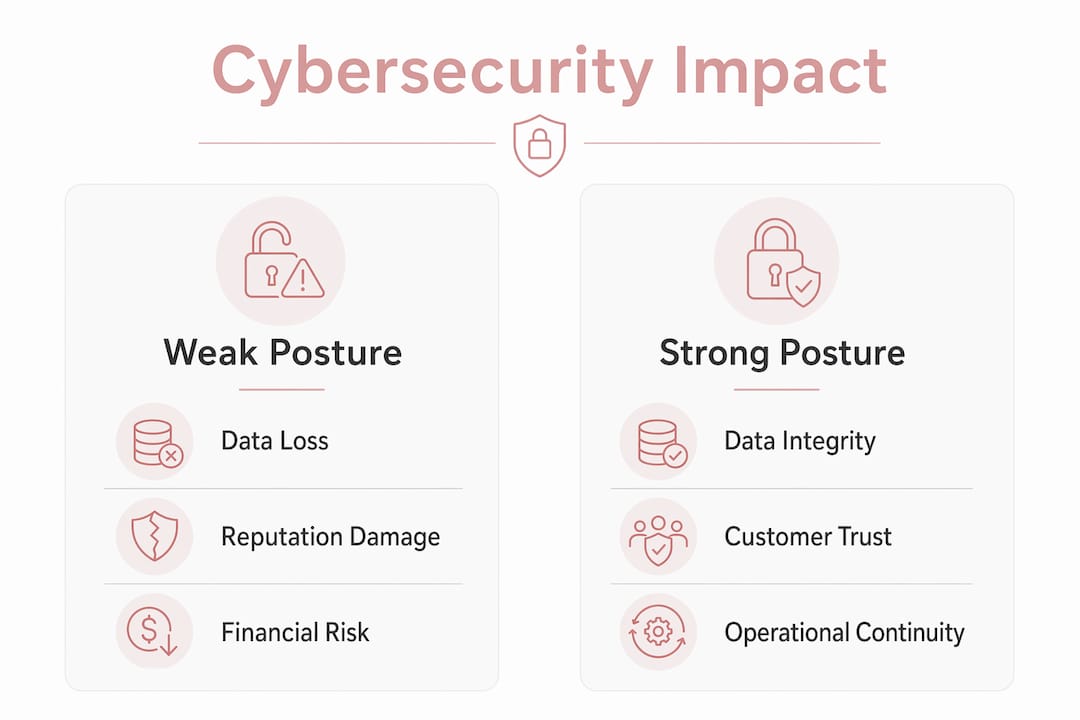
Cybersecurity protects the assets that your business depends on every day. Those assets include customer data, intellectual property, financial records, and the operational systems that keep your organization running. A single breach can expose all of them simultaneously.
The financial and reputational damage from a breach is rarely contained. Customers lose confidence when their data is compromised, and rebuilding that trust takes years. Regulatory penalties under frameworks like HIPAA, PCI DSS, and the FTC Act add direct financial costs on top of the reputational damage.
SMEs are targeted as easy cybercrime victims because of weak cyber hygiene. A UK government advisory from february 2026 compared baseline cybersecurity measures to fire safety. Just as no business would operate without smoke detectors, no business should operate without patched systems, multi-factor authentication, and tested backups.
The foundational protections every organization needs include:
- Multi-factor authentication (MFA) on all accounts with external access
- Regular patching of operating systems, applications, and firmware
- Encrypted backups stored separately from primary systems, tested monthly
- Employee phishing training conducted at least quarterly
- Access controls based on least-privilege principles, reviewed every 90 days
Cybersecurity integrates people, processes, and technology across network, endpoint, application, and data layers with real-time monitoring and incident response. That integration is what separates organizations that detect breaches in hours from those that discover them months later.
Pro Tip: Map your most sensitive data assets first. Knowing exactly where your crown jewels live, customer records, financial data, trade secrets, tells you where to concentrate your strongest controls.
What is the relationship between cybersecurity and business resilience?
Business resilience is the ability to absorb disruption and keep operating. Cybersecurity is the primary mechanism that determines whether your organization survives a serious attack or shuts down.
The mindset shift here is critical. Protection asks: “Can we stop the attack?” Resilience asks: “Can we keep running if the attack succeeds?” Both questions matter, but boards that fund only prevention without investing in resilience fail to govern cyber risk effectively. Prevention alone is not a complete strategy.
Survival engineering is the practice of mapping which business processes can be rebuilt cleanly during a breach and which ones are trapped in legacy dependencies that cannot be quickly restored. It requires clean backups, tested incident response plans, and a clear understanding of your critical systems. Organizations that practice survival engineering recover in days. Those that do not can take weeks or never fully recover.
Building genuine resilience requires four concrete steps:
- Map critical processes. Identify which operations must continue during a breach and which can pause without catastrophic impact.
- Test your incident response plan. Run tabletop exercises at least twice a year with executives present, not just the IT team.
- Verify your backups. A backup that has never been restored is an assumption, not a guarantee. Test restoration quarterly.
- Define your recovery time objectives. Every critical system needs a documented target for how fast it must be restored.
“Cybersecurity is no longer about protection. It’s about survival. Organizations that treat resilience as an afterthought are one breach away from an existential crisis.” — CSO Online, 2026
Executive and board involvement in resilience management is not optional. Cyber risk belongs on the same agenda as financial risk and operational risk. The cybersecurity strategy for your organization must connect directly to your business continuity framework, not sit in a separate IT document that executives never read.
How does cybersecurity drive business growth and competitive advantage?
Cybersecurity is a growth enabler, not just a cost center. Cybersecurity foundations improve business confidence, enabling new market entry, faster partnerships, and safer adoption of AI and other emerging technologies. Organizations with mature security postures move faster because they have fewer barriers to deploying new capabilities.

The connection to AI adoption is direct. 42% of cybersecurity investment efforts in 2026 focus on balancing rapid AI adoption with managing the increased cyber threats that AI introduces. Organizations that get this balance right gain a real speed advantage over competitors still paralyzed by AI risk concerns.
Cyber due diligence has become a standard part of mergers, acquisitions, and investment deals. Weak cybersecurity lowers your valuation and raises your insurance premiums. Strong cybersecurity does the opposite. It signals operational maturity to acquirers, investors, and insurers alike.
| Business outcome | Weak cybersecurity posture | Strong cybersecurity posture |
|---|---|---|
| M&A valuation | Discount applied, deal risk flagged | Premium signal, faster due diligence |
| Cyber insurance | Higher premiums, coverage gaps | Lower premiums, broader coverage |
| AI adoption speed | Slowed by unmanaged risk | Accelerated with managed controls |
| Customer acquisition | Trust gap in regulated sectors | Trust advantage in competitive bids |
| Partnership access | Excluded from security-sensitive contracts | Preferred vendor status in enterprise deals |
Pro Tip: Before your next contract negotiation or partnership discussion, request a summary of your current security posture from your CISO or technology leader. Buyers and partners increasingly ask for it, and having it ready signals maturity.
Cybersecurity investments are value drivers that unlock growth opportunities and enhance deal valuations. Treating security spending as a pure cost misses the return it generates through market access, deal quality, and customer retention.
What leadership changes are needed to make cybersecurity a business priority?
The CISO role has fundamentally changed. Transforming the CISO into a resilience guardian elevates cybersecurity from an IT function to an enterprise strategy and crisis leadership role. The most effective CISOs today spend as much time in business conversations as they do in technical ones.
Effective CISOs act as negotiators, aligning security requirements with business growth to find solutions that do not slow down speed and innovation. That negotiation skill is what separates security leaders who get budget and board support from those who are constantly overruled.
Executive leadership must treat cybersecurity as a board-level strategic risk. The cultural shift required goes beyond the CISO’s office. Every department head owns a piece of the risk because every department handles data, uses systems, and makes decisions that affect the attack surface.
The leadership changes that produce real results include:
- Board-level cyber risk reporting at least quarterly, in business language not technical language
- Departmental accountability where each business unit leader owns the security hygiene of their team
- Security integrated into change management so that new products, vendors, and processes go through a security review before launch, not after
- Executive leadership training that builds cyber literacy across the C-suite, not just in the technology function
- CISO access to the CEO and board without having to route through the CIO, ensuring security concerns reach decision-makers directly
Executive accountability and cultural change are the two factors that most consistently separate organizations with strong security cultures from those that treat cybersecurity as a compliance checkbox. Culture is set at the top. If the CEO treats security as an IT problem, every employee will too.
Practical cybersecurity guidance for executives covers the specific behaviors and decisions that drive accountability at the leadership level. The gap between knowing cybersecurity matters and actually changing how you lead is where most organizations stall.
Key Takeaways
Cybersecurity is a board-level business imperative that protects assets, enables growth, and determines whether your organization survives a serious breach.
| Point | Details |
|---|---|
| Cybersecurity is a business risk | Every executive owns part of the risk, not just the IT or security team. |
| Resilience beats prevention alone | Boards must fund both breach prevention and recovery capabilities to govern risk effectively. |
| Security drives deal value | Strong cybersecurity posture improves M&A valuations, lowers insurance costs, and opens partnership opportunities. |
| CISO role has evolved | The modern CISO acts as a resilience guardian and business negotiator, not a technical gatekeeper. |
| Culture starts at the top | Executive behavior sets the security culture for the entire organization. |
Why I stopped treating cybersecurity as an IT problem
After working with dozens of mid-sized and large organizations across the United States, the pattern I see most often is not a technology failure. It is a leadership failure. Executives delegate cybersecurity entirely to the IT team, then express shock when a breach disrupts operations or surfaces in a board meeting as a crisis.
The organizations that handle cyber risk well share one trait: their CEO treats it the same way they treat financial risk. They ask about it regularly. They fund it deliberately. They hold department heads accountable for it. That behavior cascades down through the organization faster than any policy document.
What I have also learned is that the survival engineering mindset is genuinely underused. Most organizations I work with have never tested whether their backups actually restore. They assume they do. That assumption is one of the most dangerous positions a business can hold in 2026.
The cybersecurity strategy guide for leaders I point executives to covers the governance and investment decisions that actually move the needle. The technical controls matter, but the leadership decisions around funding, accountability, and culture matter more. Get those right, and the technical team has the support they need to do their job.
— Orloff
How fractional executive leadership strengthens your cybersecurity strategy
Many mid-sized organizations need senior cybersecurity leadership but cannot justify a full-time CISO or CTO salary. That gap leaves real risk on the table.
Orloffphillips provides fractional CTO and CXO services that place experienced technology executives inside your organization on a part-time basis. These leaders build your cybersecurity governance framework, engage your board on cyber risk, and align your security investments with your growth priorities. They bring the same depth as a full-time hire without the full-time cost. If your organization is navigating AI adoption, digital transformation, or a major operational change, having a fractional C-suite leader with cybersecurity expertise changes the quality of every decision you make.
FAQ
What is the role of cybersecurity in business?
Cybersecurity protects business assets, maintains customer trust, and ensures operational continuity. It also drives growth by enabling safe AI adoption, improving deal valuations, and opening new market opportunities.
Why do businesses need cybersecurity beyond IT compliance?
Cybersecurity affects revenue, operations, and enterprise value, making it a business risk that every executive owns. Treating it as a compliance checkbox leaves organizations exposed to breaches that compliance frameworks alone cannot prevent.
How does cybersecurity support business resilience?
Survival engineering, tested incident response plans, and clean backups determine whether a business recovers from a breach in days or weeks. Boards that fund only prevention without resilience investment fail to govern cyber risk effectively.
What is the CISO’s role in business strategy?
The modern CISO acts as a resilience guardian and negotiator, aligning security requirements with business speed and growth. This role requires direct access to the CEO and board, not just the IT department.
How does cybersecurity affect mergers and acquisitions?
Cyber due diligence is now standard in M&A and investment deals. Weak cybersecurity lowers valuations and raises insurance costs, while strong security posture signals operational maturity and accelerates deal timelines.

Leave a Reply