
IT vendor evaluation is a structured selection process that measures technical fit, financial stability, security posture, support quality, and contractual terms before you commit. Most organizations treat vendor selection as a procurement task. The ones that get it right treat it as a risk management exercise. Knowing how to evaluate IT vendors systematically protects your organization from costly lock-in, security failures, and operational disruption. This guide gives you the criteria, the scoring framework, and the due diligence steps that separate good vendor decisions from expensive ones.
What are the essential criteria for evaluating IT vendors?
The five core criteria for selecting IT vendors are technical fit, financial stability, security standards, support services, and contractual terms. Each one carries different weight depending on what the vendor will touch in your environment.
Technical fit
Technical fit covers integration with your existing systems, capacity to grow with your needs, and the vendor’s architecture maturity. A vendor whose product cannot connect to your ERP or CRM without custom middleware adds hidden cost and delivery risk from day one. Ask specifically how the vendor handles API versioning, data migration, and backward compatibility.

Financial stability
A vendor’s financial health predicts whether they will still be operating when you need support in year three. Look for evidence of profitability, funding runway, or established market presence. A startup with one funding round and no enterprise clients is a different risk profile than a publicly traded company with audited financials.
Security standards
The minimum viable security review for vendors processing critical data includes a SOC 2 Type II report, a recent penetration test summary, incident response documentation, and SLAs for critical security patches. Vendors who cannot produce a SOC 2 Type II report require careful risk weighting, especially if they handle sensitive or regulated data. For payroll, healthcare, or financial systems, weight security criteria higher than you would for a project management tool.
Support services
SLA terms define the relationship after the contract is signed. Review uptime guarantees, response time tiers, escalation paths, and remediation windows. A vendor promising 99.9% uptime with a 48-hour response window for critical issues is not the same as one offering 99.99% uptime with a 4-hour response SLA.
Contractual terms
Exit clauses, data portability rights, and auto-renewal terms are the most overlooked elements in vendor contracts. Formal due diligence must assess contract terms and exit clauses to mitigate operational risk. Failing to document exit strategies is a top-tier risk that most IT managers only recognize after they are already locked in.
Pro Tip: Build a one-page vendor scorecard before you issue your RFP. It forces internal alignment on priorities before vendor sales teams start influencing your criteria.
| Criterion | What to assess |
|---|---|
| Technical fit | API compatibility, integration depth, architecture maturity |
| Financial stability | Funding history, profitability, customer base size |
| Security standards | SOC 2 Type II, penetration test results, patch SLAs |
| Support services | Response times, escalation paths, uptime guarantees |
| Contractual terms | Exit clauses, data portability, auto-renewal risks |
How to build a weighted scoring system for vendor comparison
A weighted evaluation matrix built before vendor proposals arrive ensures objective comparison and prioritizes what matters most to your organization. Without it, the vendor with the best sales team wins. With it, the vendor with the best fit wins.
A balanced weighted scoring system typically prioritizes technical fit at 30%, total cost at 25%, vendor reputation and stability at 20%, support services at 15%, and security and innovation at 10%. These weights are a starting point, not a fixed rule. A payroll vendor or a healthcare data processor warrants a heavier security weighting than a collaboration tool.
Follow these steps to build your matrix:
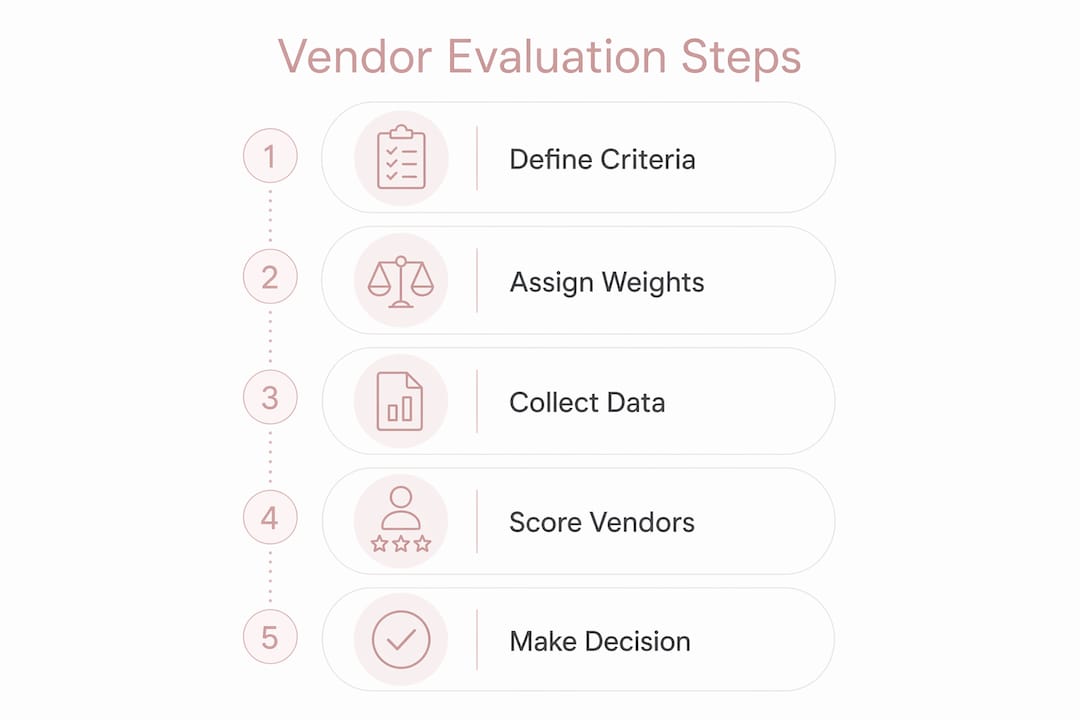
- Define your business requirements. List the specific outcomes the vendor must deliver. Separate must-haves from nice-to-haves before you score anything.
- Assign weights to each criterion. Align weights with your organization’s priorities and the criticality of the vendor’s role. Involve your IT, finance, legal, and operations teams in this step.
- Score each vendor on every criterion. Use a consistent scale, such as 1 to 5, where 5 means the vendor fully meets the requirement and 1 means they do not meet it at all.
- Multiply each score by its weight. This produces a weighted score per criterion. Sum the weighted scores to get each vendor’s total.
- Compare totals and review outliers. A vendor with a high total but a very low score on security or exit terms deserves a second look before you advance them.
Pro Tip: Run the matrix with two or three internal stakeholders independently before comparing results. Significant scoring gaps reveal hidden assumptions that need to be resolved before you make a final decision.
| Criterion | Default weight | Adjusted weight (high-security vendor) |
|---|---|---|
| Technical fit | 30% | 25% |
| Total cost | 25% | 20% |
| Vendor stability | 20% | 15% |
| Support services | 15% | 15% |
| Security and compliance | 10% | 25% |
What is involved in effective due diligence beyond initial demos?
Vendor demos are marketing tools, not capability assessments. True capability assessment requires real data and scenario testing, not a curated walkthrough of the vendor’s best features. Every demo is designed to show the product at its best. Your job is to find out how it performs under your conditions.
After the demo, run a structured proof-of-concept using your own data and workflows. Test edge cases, failure scenarios, and integrations with your actual systems. This post-demo testing reveals the vendor’s engineering maturity and support responsiveness in ways no sales presentation can.
Reference checks are the second most underused tool in vendor due diligence. Effective reference checks ask detailed operational questions about outages, onboarding timelines, and contract renewal experiences. A vendor reference who cannot answer specific questions about downtime or escalation handling is a red flag, not a green light.
Evaluating the vendor team itself is equally important. Vendors unable to commit specific staff to your engagement may be improvising rather than following documented methodologies. Ask for the names and tenures of the people who will actually work on your account, not just the senior leaders who appear in the sales meeting.
“Focusing on the vendor team and process maturity is as important as the vendor’s brand or sales pitch for long-term project success.”
Security due diligence goes beyond reviewing a SOC 2 certificate. Request a meeting with the vendor’s security team directly. Ask about their vulnerability management program, their incident response timeline, and how they communicate breaches to customers. Vendors with mature security practices welcome this conversation. Vendors who deflect it tell you something important.
How to evaluate vendor contracts, risk, and exit strategies
Contract review is where most IT managers lose ground. The sales process creates urgency. The legal review gets compressed. Exit clauses get skipped. This is where organizations end up locked into vendors they cannot afford to leave.
Review these contract elements before you sign:
- Uptime and response SLAs. Confirm specific uptime percentages, response time tiers by severity, and remediation windows. Vague language like “commercially reasonable efforts” is not an SLA.
- Data portability and deletion policies. You must be able to export your data in a usable format at any time, not just at contract end. Confirm the format, the timeline, and who owns the credentials.
- Auto-renewal terms. Many contracts auto-renew with 60 or 90 days’ notice required to cancel. Missing that window locks you in for another year. Put the notice deadline in your calendar the day you sign.
- Transition plans. A thorough exit strategy must include notice periods, data export modalities, credential handoff, and transition service definitions documented in the contract. Require a written transition plan with milestone tracking before you finalize any agreement.
- Governance and performance reviews. Regular vendor performance reviews including SLA assessments and product roadmap alignment reduce operational risk over the life of the contract. Build quarterly reviews into the agreement, not just annual ones.
Pro Tip: Ask every vendor for a “Day N” plan. This is their documented process for what happens when you decide to leave. Vendors with a clear, written answer have thought about your interests. Vendors who go quiet have not.
Data portability and credential ownership are critical. Buyers must confirm smooth transition paths before signing. This is not a negotiating point. It is a baseline requirement for any vendor who touches your production environment.
Key Takeaways
Effective IT vendor evaluation requires a structured scoring framework applied before vendor proposals arrive, combined with rigorous due diligence on security, contracts, and exit terms.
| Point | Details |
|---|---|
| Use a weighted scoring matrix | Build your criteria and weights before vendors pitch to avoid bias. |
| Prioritize security for critical vendors | Require SOC 2 Type II reports and penetration test results for any vendor handling sensitive data. |
| Test with real data, not demos | Run a proof-of-concept with your own workflows to reveal true vendor capability. |
| Negotiate exit terms upfront | Require written transition plans with milestone tracking before signing any contract. |
| Review SLAs with specifics | Confirm exact uptime percentages, response tiers, and remediation windows, not vague commitments. |
What I have learned from watching organizations get vendor selection wrong
The most common mistake I see is organizations falling in love with feature density. A vendor shows up with a polished demo, a long feature list, and a compelling roadmap. The IT team gets excited. The decision-makers get comfortable. Nobody asks about the vendor’s financial runway, their support escalation process, or what happens to your data if they get acquired.
Feature density is less important than functional fit and vendor architecture maturity. Long-term risk lies in vendor financial stability and ease of exit, not in whether the product has 40 integrations or 60. I have watched organizations spend 18 months implementing a vendor’s platform, only to find out the vendor was acquired and the product was being sunset. A basic financial stability check would have flagged that risk before the contract was signed.
The second mistake is treating vendor evaluation as a one-time event. The best organizations I have worked with build vendor management best practices into their operating model. They run quarterly SLA reviews. They track vendor roadmap alignment against their own IT strategy. They maintain a current exit plan for every tier-one vendor relationship.
The structured framework matters not just for the decision itself, but for the process. When you use a weighted scoring matrix and document your due diligence, you reduce the influence of cognitive bias, internal politics, and vendor sales pressure. You also create a record that protects your organization if the decision is ever questioned. That is not bureaucracy. That is professional risk management.
— Orloff
How Orloffphillips helps executives make better vendor decisions
Vendor selection is one of the highest-stakes decisions an IT leader makes. A poor choice costs far more than the contract value when you factor in migration costs, lost productivity, and security exposure.
Orloffphillips works with mid-sized and large organizations across the United States to build vendor evaluation frameworks, run due diligence processes, and align technology decisions with long-term business goals. The MSP, vendor, and IT optimization service covers everything from scoring matrix design to contract review and transition planning. For executives who want to connect vendor strategy to broader technology leadership, the technology leadership trends 2026 guide provides a current view of where vendor relationships fit inside a modern IT strategy.
FAQ
What are the most important criteria for selecting IT vendors?
The five most important criteria are technical fit, financial stability, security standards, support SLAs, and contractual exit terms. Weight each criterion based on the vendor’s role and the sensitivity of the data they will handle.
How does a weighted scoring matrix work for vendor evaluation?
A weighted scoring matrix assigns a percentage weight to each evaluation criterion, scores each vendor on a consistent scale, and multiplies scores by weights to produce a total. Building the matrix before vendors pitch removes bias from the comparison.
What questions should I ask IT vendors during due diligence?
Ask about their SOC 2 Type II status, recent penetration test results, specific staff assigned to your account, escalation paths for critical issues, and their documented process for transitioning a customer off their platform.
Why do vendor demos fail to show true capability?
Demos are curated to show the product at its best. Testing vendors with your own data and real workflows reveals integration gaps, performance limits, and support responsiveness that no sales presentation will surface.
What should an IT vendor exit strategy include?
A complete exit strategy must document notice periods, data export formats and timelines, credential handoff procedures, and transition service definitions. Require this in writing before you sign the contract, not after you decide to leave.

Leave a Reply