
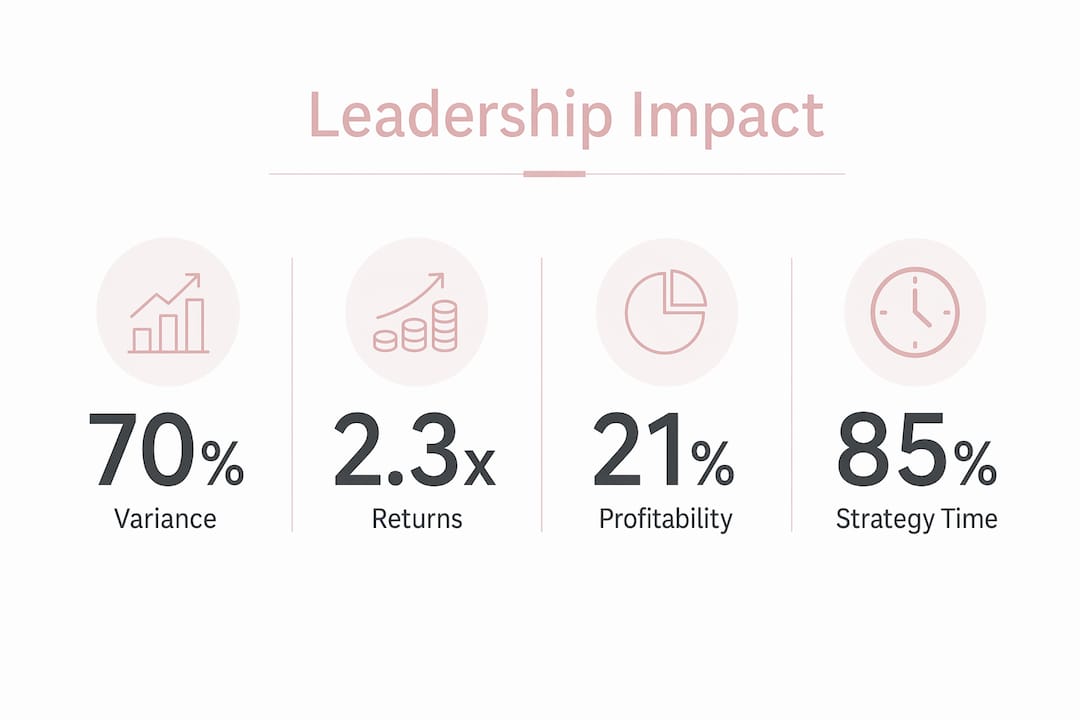
Executive leadership is defined as the organizational function of setting vision, owning outcomes, and aligning every layer of a company toward measurable, long-term success. The role of executive leadership sits above the VP and director layer, reporting directly to the board or CEO, and shapes the trajectory of the entire organization. Effective executive leadership delivers shareholder returns 2.3 times higher than organizations without it. That number alone tells you why CEOs, CFOs, and COOs are not just senior managers. They are the difference between a company that survives and one that compounds.
What are the primary responsibilities of executive leadership?
Executive leadership responsibilities include setting strategic direction, leading risk management, shaping organizational values, and enabling employee performance at every level. These are not administrative duties. They are the core functions that determine whether a company grows or stagnates.
The most critical responsibilities break down into five areas:
- Vision and strategy: Executives define where the organization is going over a 3–5 year horizon and translate that vision into annual priorities every department can act on.
- Talent and pipeline: Building high-performing leadership teams is not a one-time hire. It requires ongoing development, succession planning, and honest performance conversations.
- Culture ownership: Culture is not an HR program. It is set by what executives reward, tolerate, and model every day.
- Accountability systems: Effective executives measure outcomes, not effort. They build dashboards, review cadences, and escalation paths that keep the organization honest.
- Cross-functional alignment: Executives break down silos by creating shared goals and regular forums where department heads coordinate rather than compete.
One practical framework many executive teams use is the “Golden Triangle” of people, process, and tools. When all three are aligned under a clear strategic vision, execution becomes predictable. When one leg is missing, the whole structure wobbles.
Pro Tip: If your leadership team cannot articulate the top three organizational priorities in one sentence each, your strategy is not clear enough to execute. Run a quarterly alignment session where each C-suite member presents their department’s top priorities and how they connect to the company’s annual goals.

A common pitfall is confusing activity with accountability. Executives who track inputs (hours worked, meetings held) instead of outputs (revenue generated, retention rates improved) create cultures that look busy but do not move the needle.
How does executive leadership shape measurable business outcomes?
The data on leadership quality and business performance is direct. Leadership quality accounts for up to 70% of variance in team engagement scores. That is not a soft metric. Engagement drives retention, productivity, and customer satisfaction, all of which feed directly into the income statement.
| Outcome | Strong Executive Leadership | Weak Executive Leadership |
|---|---|---|
| Shareholder returns | 2.3x higher than peers | Below market average |
| Profitability | 21% increase | Flat or declining margins |
| Employee retention | High engagement, low turnover | 50% of staff quit or consider quitting |
| Innovation | Encouraged and resourced | Suppressed by risk aversion |
| Organizational resilience | Adapts quickly to disruption | Slow, reactive, fragmented |
Poor executive leadership carries costs far beyond inefficiency, including reputational damage and, in extreme cases, corporate bankruptcy. The table above is not theoretical. It reflects the spread between companies that invest in leadership quality and those that treat the C-suite as a title rather than a function.
“Products and marketing can be replicated. A cohesive, high-performing leadership team cannot.” — Why the Best Companies Win on Leadership
The mechanism behind these numbers is straightforward. Strong leadership teams create sustainable competitive advantage because they directly influence revenue, profit, engagement, retention, and innovation simultaneously. No single product feature or marketing campaign touches all five at once. Leadership does.
What challenges define executive leadership roles in 2026?
The C-suite has expanded significantly. Half of companies now have four or more C-level technology roles, reflecting how much specialization the modern organization demands. A CEO in 2026 does not just need a CTO. They may also need a Chief AI Officer, a Chief Data Officer, and a Chief Digital Officer, each owning a distinct domain.
The four defining challenges executives face right now are:
- Technical fluency across the C-suite: 85% of CEOs expect all functional leaders to become technology experts. A CFO who cannot evaluate AI-driven forecasting tools is a liability in 2026, not just a gap.
- The CHRO’s rising influence: 59% of CEOs expect the CHRO’s influence to grow significantly as AI adoption is recognized as a people and culture challenge first. Technology does not transform organizations. People do.
- Avoiding the execution trap: Executive leaders often fall into the execution trap by spending excessive time on vision setting without building the accountability systems that turn vision into results. Vision without execution is just a slide deck.
- Cross-functional coordination at scale: As organizations grow, the distance between the C-suite and frontline teams increases. Executives must design communication and governance structures that keep strategy visible at every level.
Pro Tip: Assign each C-suite member ownership of one cross-functional initiative per quarter. This forces collaboration, builds mutual accountability, and prevents the silo mentality that kills execution. Review progress in monthly leadership team meetings, not just annual offsites.
The shift from managing tasks to owning outcomes is the defining behavioral change for executives navigating technology leadership trends in 2026. Executives who still operate as senior managers, approving decisions rather than setting conditions for others to decide, will slow their organizations down.
How do executives turn strategy into cross-functional results?
85% of leadership teams spend less than one hour per month discussing strategy, and 50% spend no time at all. That statistic explains why so many well-crafted strategies fail at the execution stage. Strategy does not fail in the boardroom. It fails in the gap between the boardroom and the department head’s weekly team meeting.
Successful execution requires translating strategy into department-level priorities with specific success metrics, so frontline teams can connect their daily tasks to broader organizational goals. This is not a one-time planning exercise. It is a continuous leadership practice.
The behaviors that separate strong executors from weak ones are specific:
- Break goals into department-level metrics. Every business unit should have 3–5 KPIs that map directly to a company-level objective. If a department cannot draw that line, the executive team has not done its job.
- Reinforce vision at every touchpoint. Without continuous alignment and active leadership, strategies degrade as they pass through organizational layers. Quarterly all-hands meetings, cross-functional reviews, and one-on-ones with direct reports are all alignment opportunities, not just communication events.
- Build visibility into execution. Real-time dashboards, weekly status updates, and monthly leadership reviews keep accountability visible. What gets measured gets managed.
| Practice | Strong Execution | Common Failure Mode |
|---|---|---|
| Goal setting | Department KPIs tied to company objectives | Vague goals with no measurable output |
| Strategy reinforcement | Quarterly reviews plus ongoing touchpoints | Annual planning cycle only |
| Accountability | Outcome-based reviews with named owners | Effort-based check-ins with no consequences |
| Cross-functional coordination | Shared goals and joint review forums | Siloed reporting with no lateral accountability |
The role of HR in leadership development is also critical here. Executives who invest in developing the leadership layer below them create organizations that can execute without constant top-down intervention. That is the definition of organizational maturity.
Weak execution does not just slow growth. It creates strategic drift, where the priorities the board approved in January look nothing like what the organization is actually doing by September. Executives who build strong execution systems prevent this by treating alignment as an ongoing discipline, not a calendar event.
Key takeaways
Effective executive leadership is the single most measurable driver of organizational performance, connecting vision to execution through accountability, alignment, and deliberate team development.
| Point | Details |
|---|---|
| Leadership drives measurable outcomes | Organizations with strong executive leadership deliver 2.3x higher shareholder returns and 21% more profitability. |
| Accountability beats activity | Executives must track outcomes and named ownership, not effort or inputs, to drive real performance. |
| Strategy degrades without reinforcement | Alignment is a continuous practice requiring quarterly reviews and cross-functional touchpoints, not annual planning alone. |
| C-suite complexity is growing | Half of companies now have four or more C-level technology roles, requiring executives to be both strategic and technically fluent. |
| Execution starts with clarity | Department-level KPIs tied directly to company objectives are the foundation of any successful execution system. |
Where most executive teams get it wrong
I have worked alongside C-suites in organizations ranging from mid-sized technology firms to large-scale business transformation engagements. The pattern I see most often is not a lack of ambition or intelligence. It is a gap between the quality of the strategy and the quality of the execution infrastructure built to support it.
Most executive teams are genuinely good at vision. They can articulate a compelling direction, build a compelling narrative, and get a room excited. What they underinvest in is the unglamorous work of building accountability systems, developing the leadership layer below them, and staying close enough to execution to catch drift before it becomes a crisis.
The consulting partnerships that drive growth I have seen work best share one trait: the executive team treats alignment as a weekly discipline, not a quarterly event. They do not wait for the annual offsite to recalibrate. They build it into how they run every leadership meeting.
The other thing I would push back on is the idea that technology fluency is optional for non-technical executives. In 2026, a CFO or COO who cannot evaluate an AI-driven workflow tool is operating with a blind spot that will cost their organization. You do not need to write code. You do need to ask the right questions and understand the tradeoffs.
Leadership development is not a program you run once. It is the ongoing practice of building the people and systems that make your organization capable of executing at scale, under pressure, without you in the room.
— Orloff
Strengthen your executive team’s strategic impact
If the execution gaps described in this article feel familiar, you are not alone. Most organizations have strong vision at the top and weak translation in the middle. Orloffphillips specializes in exactly that gap, providing strategic IT leadership and fractional executive solutions that align technology strategy with organizational priorities and measurable outcomes.
Whether you are leading a business transformation initiative or building the accountability infrastructure your C-suite has been missing, Orloffphillips brings the executive experience to close the gap between strategy and results. Explore the consulting offerings and find out how a fractional executive engagement can accelerate your organization’s performance without the cost of a full-time hire.
FAQ
What is the role of executive leadership in an organization?
Executive leadership is responsible for setting long-term vision, translating strategy into operational priorities, building accountability systems, and aligning cross-functional teams toward measurable outcomes. Executives operate above the VP layer and report directly to the board or CEO.
How does executive leadership affect business performance?
Organizations with effective executive leadership deliver shareholder returns 2.3 times higher and 21% more profitability than those without. Leadership quality also accounts for up to 70% of variance in team engagement scores.
What are the biggest challenges in executive leadership today?
The top challenges include building technical fluency across the C-suite, avoiding the execution trap of vision without accountability, managing cross-functional coordination at scale, and adapting to the growing influence of AI on people and culture strategy.
How do executive leaders maintain strategic alignment?
Alignment requires continuous reinforcement through quarterly strategy reviews, cross-functional meetings, and department-level KPIs tied to company objectives. Strategies degrade when leadership treats alignment as a one-time annual event rather than an ongoing practice.
What qualities define effective executive leaders?
Effective executives combine strategic thinking with technical fluency, build accountability systems focused on outcomes rather than effort, develop the leadership layer below them, and stay actively involved in execution rather than delegating vision and disappearing.

Leave a Reply