
A cybersecurity risk assessment is defined as a structured process for identifying, analyzing, and prioritizing threats to an organization’s information assets so that security decisions are defensible, not reactive. The industry standard term for this process is “information security risk evaluation,” formalized under NIST SP 800-30, ISO 27005, and the CIS Controls framework. Every security team conducting this work needs a clear cybersecurity risk assessment guide, because the gap between a compliance checkbox exercise and a genuinely useful assessment comes down to methodology and execution. Organizations that treat risk assessments as living processes, not one-time reports, consistently make better security investments and respond faster when threats materialize.
What does a cybersecurity risk assessment guide actually cover?
A complete cybersecurity risk assessment follows 7–9 core steps: scope definition, asset inventory, threat identification, vulnerability identification, risk analysis, risk prioritization, treatment planning, implementation, and ongoing monitoring. Each step builds on the last. Skipping asset inventory, for example, means your threat analysis has no anchor, and your risk scores will reflect guesswork rather than reality.
The foundational standards give you the structure. NIST SP 800-30 defines the risk assessment process at the federal level and is widely adopted across private industry. ISO 27005 provides a complementary framework for information security risk management. The CIS Controls offer a prioritized set of security actions that map directly to common risk categories. Using all three together gives your assessment both rigor and practical grounding.

Risk assessments serve primarily as decision-support tools that must be evidence-driven and outcome-focused. That distinction matters. A report that lists 200 vulnerabilities without telling leadership which three to fix first has failed its purpose. The goal is not completeness for its own sake. The goal is clarity about where your organization is most exposed and what to do about it.
Beyond compliance, a well-executed assessment gives your organization a defensible basis for security spending. Regulators, auditors, and boards all ask the same question: “How do you know your controls are appropriate?” A documented risk assessment is your answer.
How to execute a step-by-step cybersecurity risk assessment
Define scope and build your team
Scope definition is the single decision that most determines assessment quality. A scope that is too narrow produces a false sense of security. A scope that is too broad produces a report no one can act on. Define scope by business function first, then map it to systems, data flows, and physical locations.
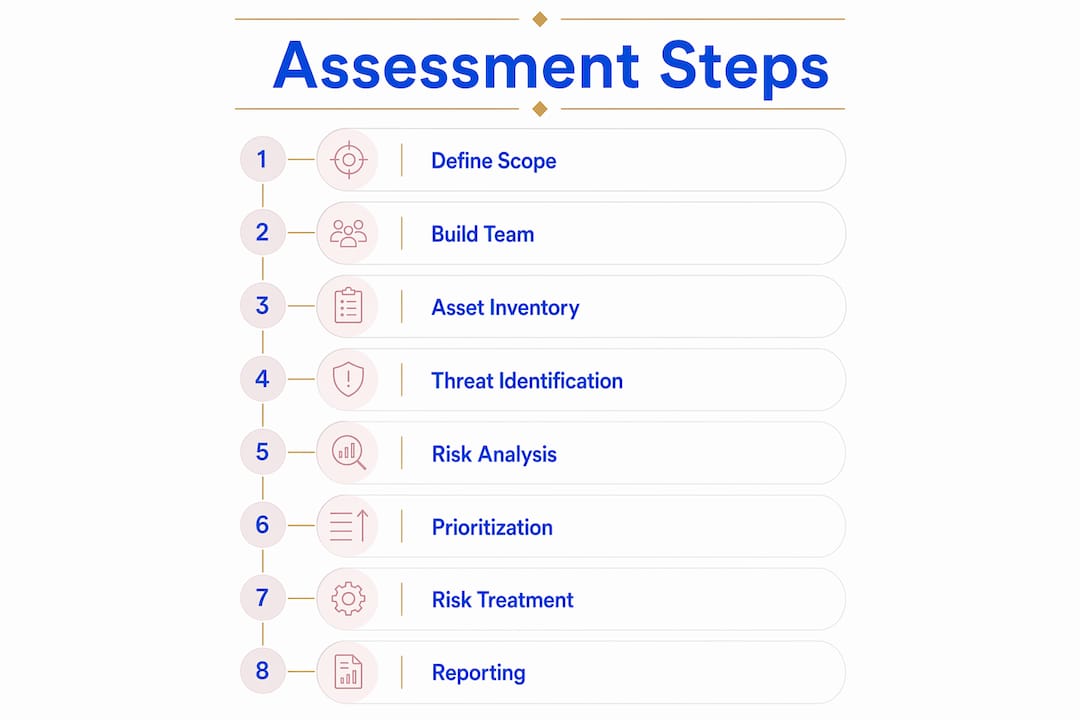
Assessment depth depends heavily on resource allocation and team composition. Multi-disciplinary teams with longer timelines produce more granular and actionable insights. That is not an argument for unlimited budgets. It is an argument for being deliberate about who sits in the room.
Your assessment team should include:
- Security engineers who understand technical controls and vulnerability data
- Legal counsel who can identify regulatory obligations and data classification requirements
- Operations managers who know which systems are truly mission-critical
- HR representatives who can address insider threat and personnel risk factors
- Finance or risk officers who translate security findings into business impact language
Failing to include legal, operational, and business stakeholders leads to superficial results and poor organizational buy-in. Security teams that run assessments in isolation consistently produce findings that never get funded or remediated.
Conduct asset inventory and threat identification
Asset inventory is not glamorous work, but it is the foundation of every credible risk analysis. Catalog hardware, software, data repositories, cloud services, third-party integrations, and physical access points. Classify each asset by sensitivity and criticality to business operations. An unclassified asset is an unmanaged risk.
Threat identification follows asset inventory. Map known threat actors, attack vectors, and threat events to each asset category. Use sources like the MITRE ATT&CK framework, CISA advisories, and your own incident history. Pair threat identification with vulnerability scanning and manual review to surface exploitable weaknesses.
Pro Tip: Run your asset inventory against your network diagram and your vendor contract list simultaneously. Assets that appear in only one of the three sources are your highest-risk blind spots.
NIST CSF 2.0 combined with SP 800-30 provides a repeatable, control-based, outcome-focused framework that aligns cybersecurity outcomes with business priorities. Using this combination means your assessment produces findings that map directly to existing controls, making gap analysis faster and remediation planning more precise.
For fintech and B2B SaaS environments, specialized risk identification methods for asset and process-based assessments add significant value, particularly where regulatory exposure is high and data flows cross multiple jurisdictions.
How to analyze, prioritize, and treat cybersecurity risks
Score risks using inherent and residual risk
Every risk carries two values: inherent risk and residual risk. Inherent risk is the exposure level before any controls are applied. Residual risk is what remains after your existing controls are factored in. The gap between the two tells you whether your current controls are working or whether you are accepting more risk than you realize.
Effective risk prioritization converts qualitative ratings into numerical scores based on business impact, allowing objective ranking within limited budget constraints. A five-point likelihood scale combined with a five-point impact scale produces a 25-point risk matrix. Risks scoring above 15 typically require immediate treatment. Risks scoring below 6 are candidates for acceptance with documentation.
The four treatment options are:
- Mitigate. Implement or strengthen controls to reduce likelihood or impact.
- Transfer. Shift financial exposure through cyber insurance or contractual liability clauses.
- Avoid. Eliminate the activity or system that creates the risk.
- Accept. Consciously document the decision to carry the residual risk.
Risk response options including acceptance require documented decisions and conscious management of residual risk. Acceptance without documentation is not a risk decision. It is negligence with plausible deniability.
Align risk priorities with enterprise objectives
NIST guidance requires mapping cyber risks to mission-essential functions within an Enterprise Risk Management framework. That means your risk register cannot live only in the security team’s spreadsheet. It must connect to the business functions that generate revenue, serve customers, or fulfill regulatory obligations.
A formal Cybersecurity Risk Register should integrate with the enterprise risk register, mapping risks to business mission and enabling optimized capital allocation. When a CISO presents risk findings to a board, the most persuasive frame is always business impact, not technical severity.
Pro Tip: Before presenting risk findings to leadership, translate each top-10 risk into a dollar-range business impact estimate. Boards respond to financial exposure far more reliably than to CVSS scores.
Communicating risk priorities to leadership requires plain language, a clear ranking, and a recommended action for each top risk. A one-page risk summary with a heat map is more effective than a 40-page technical report for driving executive decisions.
What are the most common pitfalls in cybersecurity risk assessments?
The most damaging mistake security teams make is limiting assessments to technical elements like IP addresses and software vulnerabilities. That approach misses procedural failures, physical access risks, and personnel threats, which account for a significant share of actual security incidents.
Other pitfalls that consistently undermine assessment value:
- Treating the assessment as a compliance event. Compliance deadlines create artificial urgency and narrow scope. A risk assessment built around an audit calendar produces findings that satisfy auditors, not security teams.
- Weak scope definition. Scopes that exclude cloud environments, third-party vendors, or remote work infrastructure leave the most dynamic parts of your attack surface unexamined.
- No governance structure before you start. Risk register governance, including defining roles for risk acceptance and sign-off before assessment begins, avoids decision bottlenecks after findings are delivered. Without pre-defined ownership, findings sit in a queue while stakeholders debate accountability.
- Ignoring the human layer. Phishing susceptibility, privileged access abuse, and contractor onboarding gaps are personnel risks that no vulnerability scanner will surface.
Continuous monitoring and periodic reassessment are critical to maintaining an accurate risk profile and adapting to system or threat changes. A risk assessment completed in january is materially outdated by july if your environment has changed, new threat intelligence has emerged, or a major vendor has been breached.
“A cybersecurity risk assessment that sits on a shelf is not a security asset. It is a liability. The moment it stops reflecting your current environment, it gives leadership false confidence and security teams a false mandate.”
Alignment between cybersecurity risk registers and enterprise risk management frameworks ensures that cyber risks receive appropriate executive attention and funding. Without that alignment, security teams fight for budget against business units that speak the language of financial risk natively. For a broader view of how cybersecurity fits business strategy, integrating risk management into resilience planning is the logical next step.
Key Takeaways
A cybersecurity risk assessment produces defensible security decisions only when it integrates structured methodology, cross-functional governance, and continuous reassessment into a single repeatable process.
| Point | Details |
|---|---|
| Define scope by business function | Scope to business operations first, then map to systems and data flows to avoid blind spots. |
| Build cross-functional teams | Include legal, operations, HR, and finance alongside security engineers for complete risk coverage. |
| Score inherent and residual risk | Calculate both values to reveal whether existing controls are actually reducing exposure. |
| Integrate with enterprise risk management | Map cyber risks to mission-critical functions so findings compete for budget on business terms. |
| Reassess continuously | Treat the risk assessment as a living process, not a static report, to maintain an accurate risk profile. |
Why most risk assessments fail before they start
The hardest lesson I have learned working with mid-sized and large organizations on cybersecurity strategy is that most assessments fail in the planning phase, not the execution phase. Teams spend weeks on threat modeling and vulnerability scanning, then deliver findings to a leadership team that was never involved in defining what “acceptable risk” means for the organization. The result is a technically sound document that produces no decisions and no funding.
The fix is not a better methodology. The fix is governance. Establishing governance early in the assessment lifecycle clarifies risk ownership and accelerates remediation. That means getting executives to agree on risk appetite, risk tolerance, and decision authority before the first asset is inventoried. Without those agreements, every finding becomes a negotiation.
My second observation is that organizations consistently underestimate the value of mapping risks to mission-critical functions rather than to systems. A vulnerability in a payroll system is not just a technical finding. It is a business continuity risk, a regulatory exposure, and a reputational liability. When security teams frame findings in those terms, remediation timelines shrink dramatically.
The organizations that get the most value from risk assessments treat them as a continuous improvement program. They schedule quarterly reviews, assign risk owners who report to the C-suite, and update their risk registers whenever a significant system change or threat event occurs. That cadence is not a burden. It is what separates organizations that manage risk from organizations that react to incidents.
— Orloff
Orloffphillips technology leadership for cybersecurity risk programs
Cybersecurity risk management requires both technical depth and executive alignment. Orloffphillips works with mid-sized and large organizations across the United States to build risk assessment programs that connect security findings to business outcomes.

Whether your organization needs a fractional CISO to lead your first formal assessment or an experienced technology strategist to align your risk register with enterprise priorities, Orloffphillips provides the leadership capacity to move from findings to decisions. Explore the technology strategy guide to see how risk management integrates with broader technology leadership. For organizations building or maturing their cybersecurity strategy, Orloffphillips offers tailored advisory that fits your organization’s scale and risk appetite.
FAQ
What is a cybersecurity risk assessment?
A cybersecurity risk assessment is a structured process for identifying threats, vulnerabilities, and impacts to an organization’s information assets, following frameworks like NIST SP 800-30 and ISO 27005. The output is a prioritized risk register that guides security investment decisions.
How often should organizations conduct a risk assessment?
Organizations should conduct a formal risk assessment at least annually, with continuous monitoring and triggered reassessments whenever significant system changes, new threat intelligence, or major incidents occur.
What is the difference between inherent risk and residual risk?
Inherent risk is the exposure level before any controls are applied. Residual risk is what remains after existing controls are factored in. The gap between the two reveals whether current controls are effective.
Which framework is best for a cybersecurity risk assessment?
NIST CSF 2.0 combined with SP 800-30 provides a repeatable, control-based framework that aligns cybersecurity outcomes with business priorities and is widely recognized across both public and private sectors.
Who should be involved in a cybersecurity risk assessment?
Effective assessments require cross-functional teams that include security engineers, legal counsel, operations managers, HR representatives, and finance or risk officers. Excluding business stakeholders consistently produces findings that fail to gain organizational support or funding.

Leave a Reply