
Virtual executives are senior leaders who deliver part-time, high-impact expertise remotely, giving businesses C-suite capability without the cost or commitment of a full-time hire. The industry term for this model is “fractional executive,” and understanding why choose virtual executives starts with one fact: fractional retainers range $3,000–$20,000 per month versus $200,000–$400,000 for a fully loaded full-time executive. That gap changes the math for every mid-sized company navigating growth, digital transformation, or a leadership gap. This guide covers the benefits of virtual executives, the scenarios where they excel, the role AI now plays, and a practical framework to decide if this model fits your organization.
Why choose virtual executives over full-time hires?
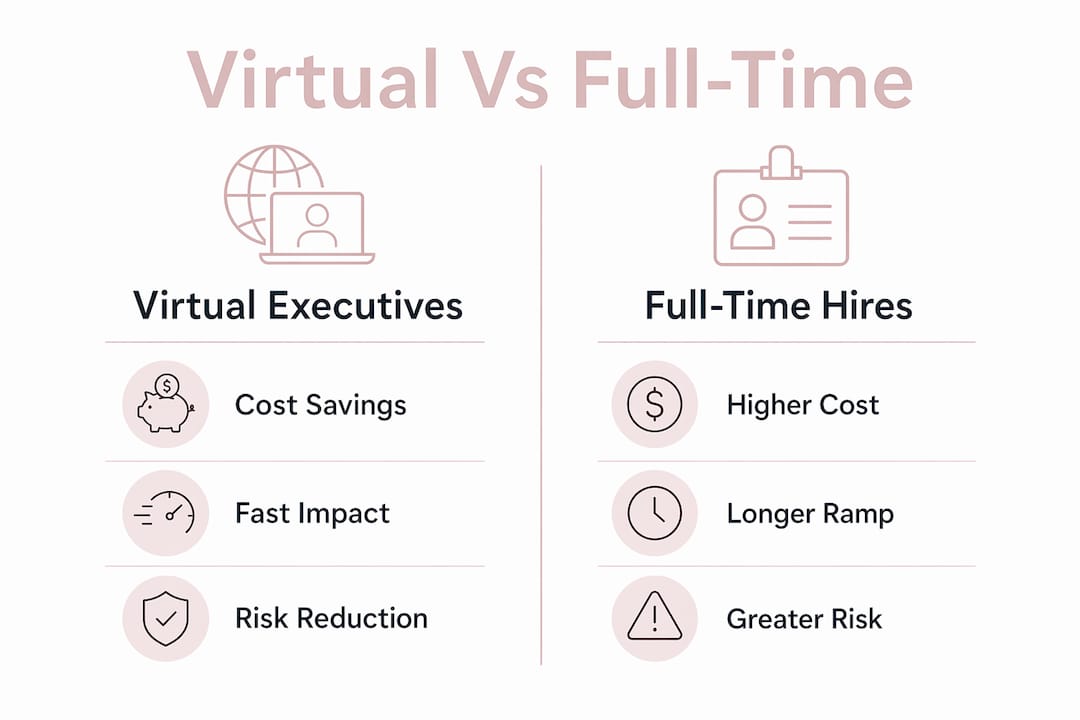
The financial case is the starting point, but it is not the whole story. Hiring fractional executives saves 40–70% compared to fully loaded full-time hires when you account for salary, benefits, equity dilution, and recruiting fees. That saving frees capital for product development, sales, or technology infrastructure where it creates direct value.
Speed is the second major advantage. Fractional executives deliver impact in 30–45 days compared to 3–6 months for a traditional full-time hire. A company facing a technology audit or a fundraising round cannot wait six months for a CTO to reach full productivity.

Risk reduction is the third pillar. Executive hiring failure rates run 40–50% within 18 months, making full-time C-suite hiring one of the highest-risk decisions a company makes. Fractional engagements remove that exposure. You can pause, end, or convert the role to full-time with short notice, which is particularly valuable during fundraising cycles, pivots, or market uncertainty.
The advantages of remote executives also include network access. Virtual executives bring extensive professional networks that accelerate investor introductions, legal counsel, and partner relationships beyond what most in-house teams can build. That network effect often delivers more value than the role itself.
Pro Tip: Before engaging a fractional executive, ask for three specific examples of measurable outcomes they delivered within the first 60 days at a previous client. Speed to impact is their core value proposition, and they should be able to prove it.
- Cost savings: 40–70% reduction versus full-time, covering salary, benefits, equity, and recruiting.
- Speed: Impact in 30–45 days versus 3–6 months for a traditional hire.
- Risk reduction: Engagements can be paused or ended without the legal and financial weight of terminating a full-time executive.
- Expertise on demand: Access to senior leaders with multi-stage company experience who would be unaffordable full-time.
- Network leverage: Relationships with investors, attorneys, and partners that compress go-to-market timelines.
How do virtual executives adapt to specific business needs?
The fractional model fits well-defined situations. Startups that need a CFO for a Series A process, scaling companies that need a COO to build operational systems, and organizations in leadership transition all benefit from fractional C-suite leadership without committing to a permanent hire. The model works because the scope is clear and the timeline is finite.
Fractional executives excel at 10–25 hours per week when the role addresses a specific functional gap or project. A fractional CHRO building a compensation framework, a fractional CTO leading a platform migration, or a virtual COO designing scalable processes are all well-matched use cases. The role scope matches the fractional involvement.
Common scenarios where virtual executive services deliver the most value:
- Startups (Series A–C): Need CFO or CTO expertise for fundraising, compliance, or technology architecture but cannot justify a full-time salary.
- Volatile or transitional markets: Companies facing rapid change need flexible leadership that can be scaled up or down without restructuring.
- Leadership gaps: An unexpected departure creates an immediate need for experienced interim leadership while a permanent search runs.
- Specific projects: A cybersecurity overhaul, ERP implementation, or digital transformation initiative requires focused expertise for 6–12 months.
The model does have limits. Founders often delay hiring executive support due to cost perceptions, but the bigger mistake is using a fractional model for roles that genuinely require full-time daily presence. A Chief People Officer building culture in a 500-person company through a merger needs to be in the room every day. A fractional arrangement in that context creates gaps that hurt the business.
What role does AI play in virtual executive services?
AI is changing what a virtual executive can deliver. The shift is not about automating reports. 55% of CFOs expect AI to take over more strategic work than routine tasks, which means the virtual CFO of 2026 is not just reviewing numbers. They are using AI to run scenario models, stress-test assumptions, and surface risks that a human analyst would miss in a standard review cycle.
The next wave beyond automation is virtual executives acting as strategic thought partners who challenge assumptions and provide multi-angle analysis. An AI-augmented virtual CTO can monitor your entire technology stack, flag vendor contract anomalies, and prepare a board-ready risk briefing in hours rather than weeks. That is a qualitative leap in what part-time executive involvement can accomplish.
“The virtual deputy CFO model represents a shift from task automation to strategic agency. The executive is no longer just reviewing outputs. They are using AI to continuously challenge the business’s financial assumptions and provide insight that a full-time hire without those tools simply cannot match.”
Governance is the non-negotiable counterpart to AI augmentation. Governance frameworks are required for AI-driven virtual executive teams to manage delegation, error detection, and human oversight. Without a clear authority matrix, an AI-augmented executive role can produce confident but incorrect outputs with no one accountable for catching the error. Business leaders considering AI-augmented virtual executive services should review AI governance credentials to understand what oversight structures are now considered standard practice.
Pro Tip: When evaluating an AI-augmented virtual executive, ask specifically how errors in AI-generated analysis are detected and escalated. The answer reveals whether the governance architecture is real or theoretical.
How do you decide if a virtual executive is right for your company?
The decision starts with mandate clarity. A clear scope with measurable 90-day success criteria is the single biggest predictor of a successful fractional engagement. Without it, the executive spends the first month diagnosing what the problem actually is, and you pay for that discovery time.
Use this four-step framework before you engage:
- Define the problem. Write one sentence describing the specific gap: “We need a CTO to lead our cloud migration from on-premise infrastructure to AWS by Q3.” Vague mandates produce vague results.
- Set 90-day metrics. Identify three measurable outcomes the executive must deliver in the first 90 days. These become the engagement brief and the performance baseline.
- Assess presence requirements. If the role requires daily physical presence, team culture immersion, or real-time crisis response, a fractional model will underperform. Be honest about this before signing.
- Run the cost-benefit comparison. Compare the fractional retainer against the fully loaded cost of a full-time hire, including recruiting fees, benefits, and the 3–6 month ramp time where you are paying full salary for partial output.
| Decision factor | Fractional model | Full-time hire |
|---|---|---|
| Time to impact | 30–45 days | 3–6 months |
| Monthly cost | $3,000–$20,000 | $17,000–$33,000+ |
| Engagement flexibility | Pause or end with short notice | Termination costs and legal risk |
| Best fit | Defined scope, project-based, or transitional | Ongoing daily presence, culture-critical roles |
Fractional executives demand rapid diagnosis, ruthless prioritization, and self-driven accountability to succeed. That profile is different from a full-time executive who builds into a role over a year. When you write your engagement brief, test candidates on exactly those qualities. Ask how they would prioritize in week one and what they would need from your team to move fast.
Key Takeaways
Virtual executives deliver the fastest, most cost-effective path to senior expertise when the engagement scope is clear, the 90-day metrics are defined, and the role does not require full-time daily presence.
| Point | Details |
|---|---|
| Cost savings are significant | Fractional retainers save 40–70% versus fully loaded full-time executive costs. |
| Speed to impact is a core advantage | Fractional executives deliver measurable results in 30–45 days versus 3–6 months for traditional hires. |
| Mandate clarity drives success | Define scope and 90-day metrics before hiring to avoid costly discovery periods. |
| AI augmentation raises the ceiling | AI-augmented virtual executives provide strategic analysis that exceeds what a traditional part-time role could deliver. |
| Governance is non-negotiable | Any AI-augmented virtual executive engagement requires a clear authority matrix and human oversight structure. |
What I’ve learned from placing fractional executives in complex organizations
The most common mistake I see is leaders treating a fractional engagement like a part-time employee. It is not. A fractional executive operates more like a specialist surgeon: they come in with a specific diagnosis, execute with precision, and leave the organization better than they found it. The engagement works when the leader on your side is equally prepared.
The second lesson is about timing. Most founders wait too long to bring in senior help because they equate leadership with full-time cost. By the time they engage a fractional CFO or CTO, they have already made three decisions that the executive now has to undo. The preventive value of experienced fractional leadership is real, and it is consistently underpriced by the market.
On AI augmentation: I am genuinely excited about what AI-augmented virtual executives can do, but I am cautious about the governance gap. Most organizations do not yet have the authority matrices and error-detection protocols that structured human oversight requires. The technology is ahead of the governance, and that is a risk leaders need to price in before they deploy it.
My practical advice: start with a fractional executive in one function where the scope is clear and the metrics are measurable. Use that engagement to learn how your organization absorbs external executive leadership. Then expand. The companies that get the most from this model treat the first engagement as a capability-building exercise, not just a problem-solving exercise.
— Orloff
How Orloffphillips supports your virtual executive strategy
Orloffphillips works with mid-sized and large organizations across the United States to identify, structure, and integrate virtual executive roles that deliver measurable results. The firm specializes in fractional CIO, CTO, and COO engagements, with deep expertise in digital transformation, cybersecurity, and IT roadmapping.
Every engagement starts with a mandate-clarity session that produces a defined scope, 90-day success metrics, and a governance framework before the executive starts. If you are evaluating technology leadership specifically, the virtual CIO selection guide walks through the exact criteria, cost benchmarks, and interview questions you need to make a confident decision. For a broader view of how fractional executive models drive agility and results, Orloffphillips has the resources and the track record to guide your next step.
FAQ
What is a virtual executive?
A virtual executive, also called a fractional executive, is a senior leader who works part-time and remotely for a company, providing C-suite expertise without a full-time employment commitment.
How much does a virtual executive cost?
Fractional executive retainers typically range from $3,000 to $20,000 per month, compared to $200,000–$400,000 annually for a fully loaded full-time hire.
How fast can a virtual executive make an impact?
Fractional executives typically deliver measurable impact within 30–45 days, significantly faster than the 3–6 month ramp time for a full-time hire.
When is a virtual executive not the right choice?
A virtual executive is not the right fit when the role requires full-time daily physical presence, deep cultural immersion, or real-time crisis response that a part-time arrangement cannot support.
What roles work best as virtual executive positions?
Fractional CFO, CTO, COO, and CHRO roles are the most common and effective, particularly for startups, companies in transition, or organizations running defined technology or operational projects.

Leave a Reply