
The defining cybersecurity story of 2026 is not a single threat. It is the convergence of autonomous AI, identity fragmentation, quantum urgency, and regulatory deadlines arriving at the same time. Enterprises that treat these as separate problems will spend the year reacting. Those that see the pattern will get ahead of it.
Here is what the threat picture actually looks like right now:
- Autonomous AI agents are embedding across enterprise applications at a pace most security teams did not anticipate, creating credential and isolation gaps that attackers are already exploiting.
- Identity-first security has moved from a framework preference to a national security priority, driven by the reality that AI agents rarely operate with scoped permissions.
- Zero Trust architectures, combined with continuous exposure management, are producing measurably better breach outcomes for early adopters compared to peers still running perimeter-based models.
- Quantum-safe cryptography is no longer a future-state conversation. Government mandates and NIST post-quantum standards are forcing enterprises to act now, not in three years.
- Regulatory deadlines are compressing. The CIRCIA final rule requiring 72-hour breach reporting for critical infrastructure entities is expected in September 2026, and California’s cybersecurity risk assessment rules for automated decision-making are already in effect.
- IBM Security Services and X-Force Threat Intelligence data confirm that AI-driven attacks are accelerating intellectual property risk and expanding attack surfaces faster than most enterprise defenses can track.
The sections below break down each of these trends with the specificity you need to brief your board, update your security roadmap, or pressure-test your current posture.
1. How are autonomous AI agents changing enterprise security?
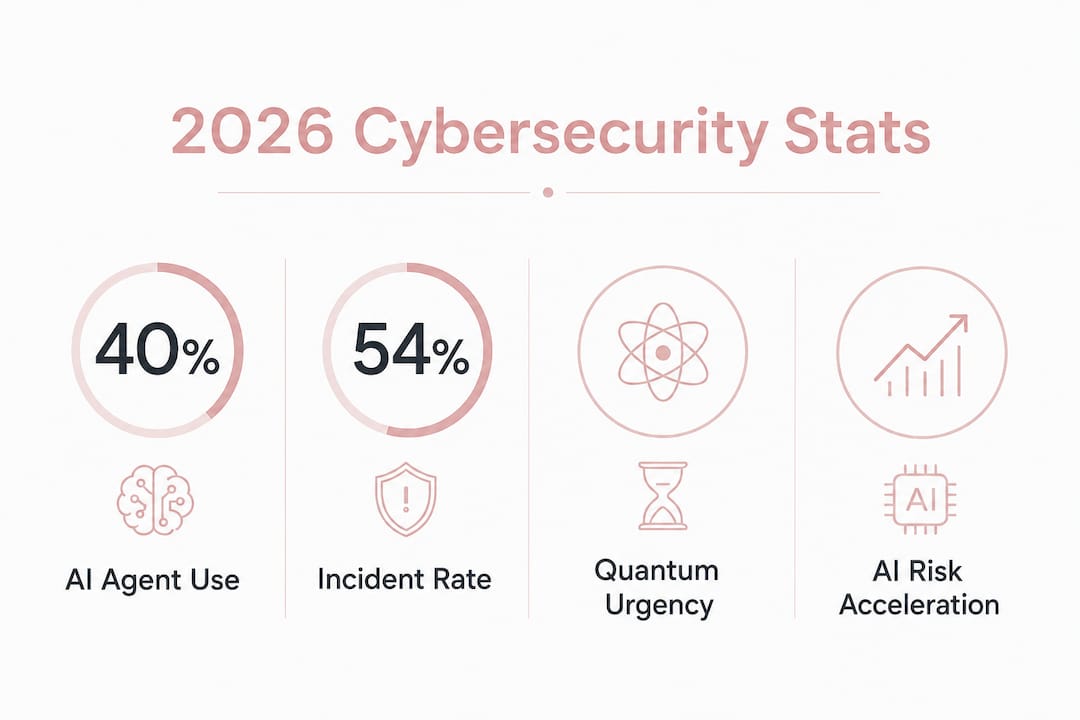
AI agent adoption is expected to grow from less than 5% of enterprise applications in 2025 to 40% by the end of 2026. That growth curve is the core problem. Security programs built for human users and static software simply do not map onto agents that act autonomously, call external APIs, and persist across sessions.

The data on what is already going wrong is stark. 54% of enterprises have experienced an AI agent security incident or near miss. Yet 69% still allow agents to share credentials, and only 30% isolate high-risk agents in sandboxed environments. That gap between deployment speed and security controls is where most of the current exposure lives.

| Metric | Current State |
|---|---|
| Enterprise apps using AI agents (2025) | Less than 5% |
| Enterprise apps using AI agents (end of 2026, projected) | 40% |
| Enterprises with AI agent incidents or near misses | 54% |
| Enterprises allowing credential sharing among agents | 69% |
| Enterprises isolating high-risk agents | 30% |
| Enterprises planning agent security tooling upgrades in 2026 | 59% |
Best practices emerging from security leaders include assigning unique machine identities to each agent, enforcing least-privilege access at the agent level, logging all agent actions for forensic traceability, and treating agent-to-agent communication as an untrusted channel by default. The NIST Cybersecurity Framework provides a governance baseline, but most organizations need agent-specific extensions on top of it.
Pro Tip: Before deploying any new AI agent in a production environment, map every credential it touches and every external system it calls. If you cannot draw that map in under 30 minutes, the agent is not ready for production.
2. Why identity security has become a national security priority
Identity is the new perimeter, and the AI agent explosion has made that phrase literal rather than metaphorical. When an agent shares a human service account credential, a single compromise does not just expose one user. It exposes every system that credential touches, often across multiple business units, with no clean audit trail showing which actions were human and which were automated.
The consequences of inadequate identity governance in an AI-heavy environment include:
- Expanded blast radius: Shared credentials mean a compromised agent can move laterally across the entire scope of that credential’s permissions.
- Forensic opacity: Distinguishing malicious agent activity from legitimate automation becomes extremely difficult after the fact.
- Compliance exposure: Regulations like HIPAA, enforced by the HHS Office for Civil Rights, and financial sector rules from the FFIEC require demonstrable access controls that shared agent credentials cannot satisfy.
Emerging identity standards for 2026 center on scoped machine identities, short-lived tokens, and continuous authentication rather than static API keys. The federal government’s push on identity, reflected in CISA guidance and the Department of Defense’s CMMC framework, signals that identity governance is no longer a vendor conversation. It is a policy one. For enterprise security leaders, the practical implication is straightforward: every AI agent needs its own identity, and that identity needs to be auditable.
3. How do Zero Trust and continuous exposure management work together?
Zero Trust operates on one principle: never assume a connection is safe because of where it originates. Every user, device, and workload must authenticate and be authorized continuously, not just at login. Enterprises that adopted Zero Trust frameworks before 2024 are seeing substantially better security outcomes and faster breach containment times compared to peers still running implicit-trust network models.
Continuous Exposure Management (CEM) is the operational layer that makes Zero Trust sustainable at scale. Rather than running point-in-time vulnerability scans, CEM provides ongoing visibility into the attack surface, prioritizing exposures by actual exploitability rather than theoretical severity scores. Together, Zero Trust and CEM shift security from a reactive posture to a persistent one.
Managed Detection and Response (MDR) solutions fit naturally into this architecture. MDR providers combine 24/7 threat monitoring, AI-assisted triage, and human analyst escalation to close the gap between detection and response. For mid-sized enterprises without a full security operations center, MDR is often the most practical path to Zero Trust-aligned detection coverage. The cybersecurity strategy considerations for organizations at this stage typically center on which MDR capabilities to build internally versus source externally.
Advanced threat detection techniques layered into this ecosystem include:
- Behavioral analytics to flag anomalous agent or user activity against established baselines.
- Deception technology such as honeytokens and honeypots that trigger alerts when accessed.
- AI-assisted log correlation across cloud, endpoint, and network telemetry to surface attack chains that rule-based systems miss.
4. Quantum-safe cryptography: why 2026 is the year to act
Traditional public-key encryption, including RSA and elliptic-curve cryptography, relies on mathematical problems that quantum computers will eventually solve in hours rather than years. “Harvest now, decrypt later” attacks are already happening: adversaries collect encrypted data today with the intent to decrypt it once quantum capability matures. Any data with a long confidentiality shelf life, including health records, financial contracts, and intellectual property, is already at risk.
NIST finalized its first post-quantum cryptographic standards in 2024, including CRYSTALS-Kyber for key encapsulation and CRYSTALS-Dilithium for digital signatures. These are the building blocks enterprises need to start testing now. Government agencies operating under NSA’s Commercial National Security Algorithm Suite 2.0 (CNSA 2.0) have mandatory migration timelines that are already running.
Cryptographic agility is the strategic response: designing systems so that cryptographic algorithms can be swapped without rebuilding the underlying architecture. Enterprises that hardcode a single algorithm into their infrastructure will face expensive rework when migration deadlines arrive. The practical steps for 2026 include:
- Inventory all cryptographic dependencies across applications, APIs, and data stores.
- Prioritize high-value data for early migration to post-quantum algorithms.
- Test NIST-approved algorithms in non-production environments before committing to production rollouts.
- Update vendor contracts to require post-quantum readiness roadmaps from all technology suppliers.
5. Deepfakes, synthetic identities, and the new ransomware playbook
The threat landscape in 2026 has a distinctly generative quality. Deepfake audio and video are now cheap enough to use in targeted business email compromise attacks, with attackers impersonating CFOs or legal counsel to authorize wire transfers or data disclosures. Synthetic identity fraud, where AI assembles plausible fake identities from real data fragments, is accelerating in financial services and healthcare onboarding.
Ransomware has evolved past simple encryption. The dominant model now combines data exfiltration with encryption, giving attackers two leverage points: pay to restore access, or pay to prevent publication of stolen data. Some groups have added a third: threatening to notify regulators about the breach, using the victim’s own compliance obligations as coercion. Resilience strategies enterprises are prioritizing include:
- Tabletop exercises that simulate ransomware scenarios including the regulatory notification clock.
- Immutable backup architectures that attackers cannot reach through compromised admin credentials.
- Cyber insurance reviews to confirm that policies cover extortion payments and regulatory fines, not just recovery costs.
- AI-assisted phishing detection trained on deepfake indicators, not just text-based signals.
The workforce dimension matters here too. Security teams that have never responded to a deepfake-enabled social engineering attack need practice before the real event. Simulation platforms that generate synthetic deepfake scenarios for training are moving from experimental to standard practice.
6. What does the 2026 regulatory environment actually require?
Two regulatory developments are reshaping enterprise compliance programs right now. First, the Cyber Incident Reporting for Critical Infrastructure Act (CIRCIA) final rule is expected in September 2026, requiring covered entities to report confirmed breaches to CISA within 72 hours of reasonably believing a covered incident occurred. That window is tight. Organizations that lack automated detection and a pre-approved incident response playbook will struggle to meet it.
Second, California’s privacy protection agency finalized cybersecurity risk assessment rules applying to companies that process significant personal data or exceed defined revenue thresholds. These rules require documented risk assessments, not just policies.
The broader governance picture includes:
- NIST CSF 2.0, which added a “Govern” function to the original five, making board-level accountability explicit.
- Secure-by-design principles from CISA, which shift responsibility for security defaults from end users to technology manufacturers.
- DevSecOps practices that embed security testing into CI/CD pipelines rather than treating it as a pre-launch gate.
For enterprises, regulatory convergence means that a single incident can now trigger obligations under CIRCIA, state privacy laws, HIPAA, and sector-specific rules simultaneously. Compliance teams that manage these in separate silos will miss cross-cutting obligations.
7. How AI regulations are reshaping cybersecurity audits
California’s final rules on automated decision-making require companies to conduct cybersecurity risk assessments specifically for AI systems that make or inform consequential decisions about individuals. This is a meaningful shift: it treats AI models as security assets requiring the same audit rigor as databases or network infrastructure.
Regulatory note: California’s cybersecurity risk assessment requirements for automated decision-making technologies took effect in 2026, applying to companies processing significant personal data or meeting defined revenue thresholds. Covered organizations must document AI-specific risks, not just general data security controls.
The practical audit implications include mapping which AI models touch personal data, documenting the data flows into and out of those models, and assessing the security controls around model training pipelines. AI governance frameworks from sources like the Stanford HAI AI Index show that most enterprises are still treating AI risk as a separate track from cybersecurity risk. Regulators are closing that gap whether organizations are ready or not.
For security leaders, the integration point is the enterprise risk register. AI systems need entries alongside traditional IT assets, with owners, control assessments, and remediation timelines. Compliance teams working through the intersection of data privacy and AI governance will find that the documentation requirements overlap significantly with existing privacy program obligations.
8. How AI is accelerating intellectual property risk
IBM Security Services and X-Force Threat Intelligence flag AI-driven IP risk as one of the most underappreciated attack vectors of 2026. The mechanism is not complicated: AI tools trained on or given access to proprietary data can leak that data through model outputs, API responses, or prompt injection attacks. An employee who pastes a confidential contract into a public large language model has effectively exfiltrated that data, even if no malicious actor was involved.
The attack surface expands further when enterprises deploy AI agents with access to internal knowledge bases, code repositories, or customer records. An agent compromised through a prompt injection attack can be directed to exfiltrate data in ways that look like normal agent behavior. Traditional data loss prevention tools, built for human-initiated file transfers, often miss this pattern entirely.
Practical controls for IP protection in an AI-heavy environment include data classification policies that explicitly cover AI inputs and outputs, contractual restrictions on vendor AI training using customer data, and monitoring for unusual query patterns against internal knowledge bases. The AI governance guidance available for enterprise teams increasingly addresses these specific vectors rather than treating AI risk as purely a model accuracy problem.
9. The cybersecurity talent shortage is getting worse, not better
The gap between open cybersecurity positions and qualified candidates has not closed. It has widened, partly because the skill requirements have shifted. Organizations now need people who understand AI security, cloud-native architectures, and OT/IT convergence simultaneously. That combination is rare, and the pipeline from universities and bootcamps has not caught up.
Workforce development strategies that are gaining traction in 2026 include:
- Upskilling existing IT staff in security fundamentals rather than waiting for specialist hires.
- Security automation to reduce the manual workload on analysts, letting smaller teams cover more ground.
- Managed security service providers to fill coverage gaps, particularly for overnight and weekend monitoring.
- Apprenticeship programs partnered with community colleges, which are producing job-ready candidates faster than four-year degree programs for many technical roles.
The talent shortage also has a retention dimension. Security professionals experiencing alert fatigue from understaffed SOCs are leaving for less demanding roles. Organizations that invest in automation to reduce noise and give analysts more meaningful work tend to retain staff longer. That is not a soft benefit. Turnover in a security team during an active incident is a material risk.
10. How geopolitical tensions are reshaping cybersecurity policy
State-sponsored cyber activity from Russia, China, North Korea, and Iran has moved from occasional headline events to persistent background noise for enterprise security teams. The targets have broadened beyond defense contractors and government agencies to include supply chains, financial infrastructure, and critical utilities. NERC’s CIP-003-11 standard, effective may 26, 2026, directly addresses coordinated cyberattacks on distributed low-impact bulk electric system assets, reflecting how seriously regulators now take the infrastructure threat.
The policy response in the United States has accelerated on several fronts. Export controls on advanced semiconductors limit adversary access to the compute needed for AI-enabled offensive operations. Software supply chain security requirements, including SBOM mandates for federal contractors, are spreading into commercial sectors. Enterprises with international operations face the additional complexity of conflicting data localization requirements across jurisdictions.
For security teams, the geopolitical dimension means threat intelligence needs to include nation-state actor profiles, not just criminal groups. IBM’s X-Force Threat Intelligence and CISA’s cybersecurity advisories both provide actionable attribution and indicator data that enterprise teams can operationalize.
11. Cloud-native security and multi-cloud complexity
Most enterprises now run workloads across two or more cloud providers, and the security model for each differs enough to create gaps at the seams. Identity federation, network segmentation, and logging configurations that work correctly in one cloud environment do not automatically transfer to another. Attackers know this and target the integration points.
Cloud-native security in 2026 centers on a few non-negotiable practices: cloud security posture management (CSPM) tools that continuously audit configurations against security benchmarks, workload protection platforms that extend Zero Trust principles to containers and serverless functions, and unified logging that aggregates events across providers into a single detection surface. The role of cybersecurity in business operations is increasingly inseparable from cloud architecture decisions, which means security leaders need a seat at the table when cloud strategy is set, not after the contracts are signed.
12. IoT and OT security: the convergence problem
Operational technology (OT) environments, including manufacturing systems, utilities, and building management infrastructure, were designed for reliability and longevity, not security. Many OT devices run firmware that cannot be patched, communicate over protocols with no authentication, and sit on networks that were never designed to be connected to the internet. The convergence of IT and OT networks, driven by efficiency and remote monitoring demands, has imported IT-style threats into environments that lack IT-style defenses.
The 2026 priorities for IoT and OT security include network segmentation that isolates OT systems from IT and internet traffic, passive monitoring tools that detect anomalies without disrupting industrial protocols, and asset inventory programs that actually know what is on the OT network. The NERC CIP-003-11 standard for bulk electric system cyber systems is one model for how sector-specific OT security requirements are evolving, and similar frameworks are developing in water, oil and gas, and manufacturing.
13. Where cybersecurity budgets are going in 2026
Security budgets are growing, but the allocation is shifting. Spending on traditional perimeter security tools is flat or declining, while investment in identity and access management, AI-assisted detection, and cloud security is accelerating. MDR services are capturing budget that previously went to building internal SOC capacity, particularly in mid-market organizations where the economics of a fully staffed SOC do not work.
Board-level attention to cyber risk has translated into more direct budget conversations. CISOs who can quantify risk in financial terms, using frameworks like FAIR (Factor Analysis of Information Risk), are getting better budget outcomes than those presenting technical metrics alone. Cyber insurance premiums continue to rise, and insurers are increasingly requiring documented security controls as a condition of coverage, which creates a secondary driver for investment in areas like MFA, endpoint detection, and incident response planning. For executives navigating these decisions, the technology leadership trends for 2026 provide useful context on how security investment fits within the broader technology strategy picture.
Cybersecurity in 2026 rewards organizations that treat it as a business function, not a technical department. The enterprises getting ahead are the ones where security leaders have direct access to the board, where AI deployment decisions include security review from day one, and where regulatory compliance is treated as a floor rather than a ceiling.
If your organization is navigating these shifts without a dedicated technology executive, a virtual CIO with cybersecurity depth can provide the strategic oversight you need without the cost and timeline of a full-time hire. Orloffphillips works with mid-sized and large organizations to build security programs that are proportionate to the actual threat picture, not just the compliance checklist.
Key Takeaways
The most important security reality of 2026 is that AI agent adoption, regulatory deadlines, and quantum urgency are converging simultaneously, and organizations that address them in silos will face compounding exposure.
| Point | Details |
|---|---|
| AI agent security gap | 54% of enterprises have had an AI agent incident; 69% still allow credential sharing among agents. Only 30% of enterprises isolate high-risk agents in sandboxed environments. |
| CIRCIA 72-hour reporting | The CIRCIA final rule expected in September 2026 requires breach reports within 72 hours of a confirmed covered incident. |
| Quantum-safe cryptography | NIST post-quantum standards are finalized; enterprises must inventory cryptographic dependencies and begin migration planning now. |
| Zero Trust outcomes | Enterprises that adopted Zero Trust before 2024 show substantially better breach containment compared to peers on perimeter-based models. |
| Budget shift | Security investment is moving from perimeter tools toward identity management, AI-assisted detection, and MDR services. |

Leave a Reply