
An IT roadmap is defined as a sequenced, high-level strategic plan that aligns technology investments with business outcomes over a 12 to 36 month horizon. The formal industry term is “IT strategy roadmap,” and understanding the distinction matters. Most organizations confuse it with a project plan or a vendor release schedule. Neither is correct. A technology roadmap answers one question: “What technology decisions, in what order, will move this organization from where it is today to where it needs to be?” Orloffphillips works with executive teams across the United States to build exactly this kind of decision instrument, not documentation for its own sake.
What is an IT roadmap, and how does it differ from strategy and project plans?
An IT roadmap is not the same as an IT strategy, and treating them as interchangeable is one of the most common mistakes business professionals make. Strategy is the destination. The roadmap is the sequenced route, with timing, priorities, and ownership assigned to each leg of the journey. Project plans sit below both, detailing the tactical execution of individual initiatives.
Think of it this way. Your IT strategy says, “We will become a cloud-first organization to support 40% headcount growth over three years.” Your IT roadmap says, “We will migrate core infrastructure in Q1, consolidate vendor contracts in Q2, and deploy the new collaboration platform in Q3.” Your project plans say, “The infrastructure migration will require these 14 tasks, these three team members, and this budget.”

The three layers serve different audiences. The IT strategy speaks to the board and CEO. The roadmap speaks to the executive team and department heads. Project plans speak to the teams doing the work.
Key distinctions that business professionals must keep clear:
- IT strategy defines the business and technology destination, typically tied to a three to five year vision.
- IT roadmap sequences the path with timing, priorities, and named owners across a 12 to 36 month window.
- Project plans break initiatives into tasks, timelines, and resource assignments at the execution level.
- Themes vs. tasks: A roadmap focuses on strategic themes and sequencing rather than listing every tactical task. Leadership needs direction, not a task list.
The roadmap’s power comes from what it forces you to decide. When you sequence initiatives, you expose dependencies, resource conflicts, and trade-offs that a strategy document never surfaces.
How is an effective IT roadmap structured and maintained?
An effective IT roadmap follows a defined lifecycle, not a one-time planning event. The lifecycle includes defining business outcomes, assessing the current technology state, identifying risks, prioritizing by business impact, sequencing work, assigning owners and budgets, and reviewing quarterly. Each stage builds on the previous one, and skipping any step produces a plan that cannot be executed.
The three time horizons
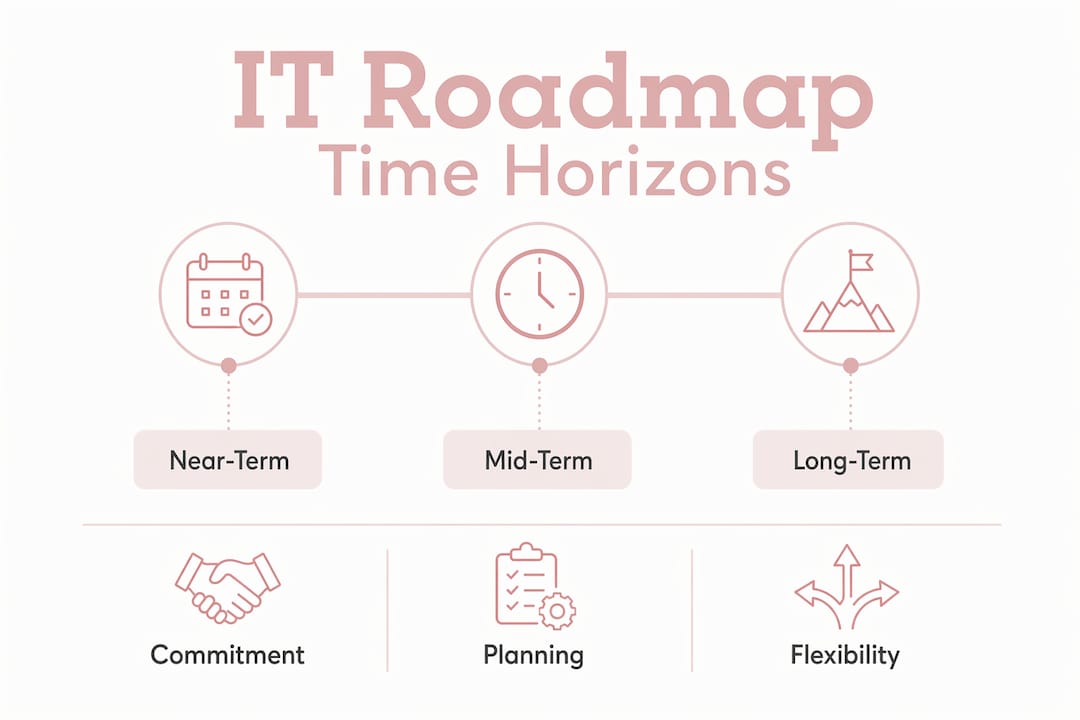
Time horizons differentiate commitment levels across the roadmap. Near-term initiatives (0–6 months) are binding decisions with assigned budgets and owners. Mid-term initiatives (6–18 months) represent directional intent, subject to refinement as conditions change. Long-term initiatives (18–36 months) capture ambitions that inform current decisions without locking resources prematurely. This structure lets leaders apply appropriate governance at each horizon without over-engineering plans that are still evolving.
Sequencing versus prioritization
Most teams prioritize. Fewer teams sequence properly. Sequencing defines order and pacing based on dependencies and capacity, while prioritization simply ranks importance. A cybersecurity upgrade may rank lower in priority than a new CRM platform, but if the cybersecurity work is a prerequisite for the CRM integration, sequencing puts it first. Ignoring this distinction breaks roadmap schedules in practice.
The review cadence
- Define outcomes first. Start with the business goals the roadmap must support, not the technology you want to buy.
- Assess the current state honestly. Inventory endpoints, licenses, contracts, and controls before sequencing anything.
- Identify risks and dependencies. Map what blocks what before assigning timelines.
- Prioritize by business impact. Use a scoring model to reduce bias and make trade-offs visible.
- Sequence with dependencies in mind. Order work by what must come first, not just what leadership prefers.
- Assign owners and budgets. Every initiative needs a named accountable person and a funding commitment.
- Review quarterly with live data. Successful roadmaps are updated quarterly with operational data, not revised once a year during budget season.
Pro Tip: Set a fixed quarterly review date on the executive calendar before you publish the roadmap. A roadmap that has no scheduled review date becomes a static document within 90 days.
What are the key benefits of an IT roadmap for business professionals?
An IT roadmap secures executive buy-in by reframing technology investments as business enablers rather than cost centers. Connecting IT initiatives to specific business metrics like reducing system downtime or supporting headcount growth increases executive engagement and funding support. This shift from technical justification to business justification changes how the C-suite responds to IT requests.
The governance benefit is equally significant. A roadmap makes trade-offs visible. When a new initiative appears mid-year, the roadmap shows exactly what gets displaced or delayed. That transparency prevents the common pattern where IT teams absorb new requests without adjusting scope, leading to overloaded teams and missed commitments.
Key benefits business professionals gain from a well-maintained IT roadmap:
- Executive alignment: Technology investments are framed in business language, making approval conversations faster and more productive.
- Resource clarity: Sequencing exposes capacity conflicts before they become crises, not after.
- Decision support: Roadmaps support consistent governance decisions by clarifying strategic intent, sequencing, trade-offs, and accountability in one view.
- Adaptability: Quarterly updates let the organization respond to market shifts without abandoning the overall direction.
- Stakeholder communication: A roadmap gives department heads a clear view of what technology changes are coming and when, reducing surprise and resistance.
The IT planning roadmap also supports budget cycles. When technology initiatives are sequenced and tied to business outcomes, finance teams can plan capital and operating expenditures with greater confidence. That connection between IT and financial planning is where many organizations find the most immediate value.
For organizations integrating new technologies into their business strategy, the roadmap provides the structure that prevents technology adoption from outpacing organizational readiness.
How do you create and implement an IT roadmap effectively?
Building a technology roadmap starts with an honest assessment of the current environment. Skipping the current-state assessment is the leading cause of IT roadmap failure, because without it, sequencing is guesswork. Inventory every significant system, contract, license, and control before writing a single initiative.
Once the current state is documented, translate the business strategy into technology outcomes. Do not start with technology and work backward. Start with questions like: “What does the business need to achieve in the next 18 months?” and “What technology gaps prevent that?” The answers define the roadmap’s scope.
The table below shows how to evaluate initiatives before sequencing them:
| Evaluation Criteria | What to assess |
|---|---|
| Business impact | Does this initiative directly support a named business goal? |
| Dependencies | What must be completed before this initiative can start? |
| Effort and cost | What resources, budget, and time does this require? |
| Risk | What happens if this is delayed or skipped? |
| Ownership | Who is accountable for delivery and outcomes? |
Use a scoring model to rank initiatives against these criteria. Scoring reduces the influence of internal politics and makes the prioritization logic defensible to the executive team.
After prioritization, sequence based on dependencies and pacing, not just scores. An initiative ranked second may need to start first because a higher-ranked initiative depends on its output. This is the step most IT planning roadmap processes skip, and it is the step most responsible for schedule failures.
Assign a named owner and a confirmed budget to every initiative before publishing the roadmap. Initiatives without owners are wishes, not plans. Initiatives without budgets are aspirations, not commitments.
Pro Tip: Build your roadmap in a format that can be updated without rebuilding from scratch. A live document reviewed quarterly with operational data outperforms a polished annual presentation every time. The IT risk management checklist from Orloffphillips provides a practical framework for identifying risks during the current-state assessment phase.
Key Takeaways
An IT roadmap is only as valuable as the governance discipline behind it. Organizations that treat it as a living decision tool consistently outperform those that treat it as annual documentation.
| Point | Details |
|---|---|
| Definition and scope | An IT roadmap sequences technology initiatives across a 12–36 month horizon tied to business outcomes. |
| Strategy vs. roadmap | Strategy sets the destination; the roadmap defines the sequenced route with timing and ownership. |
| Sequencing over prioritization | Dependencies and pacing determine order. Ranking alone produces broken schedules. |
| Quarterly review discipline | Update the roadmap with live operational data every quarter to prevent it from becoming stale. |
| Executive alignment | Framing IT investments in business outcome language secures funding and reduces approval friction. |
The roadmap mistake I see most often
Every organization I have worked with has produced an IT roadmap at some point. Far fewer have produced one that actually guided decisions six months after it was published.
The most common failure is not poor planning. It is building the roadmap before the IT strategy is clearly articulated. Without a clear strategic intent, the roadmap becomes a list of projects someone wanted to do anyway. It has no governance value because there is no agreed destination to sequence toward.
The second failure is treating the roadmap as a deliverable rather than a decision instrument. Teams spend weeks producing a polished presentation, publish it, and then never open it again until the next annual planning cycle. By then, three major business conditions have changed and the roadmap is fiction.
What actually works is treating the roadmap as a live readout. It sits in a shared space. It gets reviewed in every executive meeting where a technology decision is on the table. When a new initiative appears, the first question is: “Where does this fit in the sequence, and what does it displace?” That discipline is what separates organizations that execute well from those that are always surprised by IT costs and delays.
The technology roadmapping guide Orloffphillips publishes for IT leaders covers the quarterly review process in detail. The process is not complicated. The discipline to follow it consistently is where most organizations need support.
— Orloff
How Orloffphillips supports IT roadmap execution
Building a technology roadmap is straightforward in theory. Executing one that holds up through budget cycles, leadership changes, and shifting business priorities requires experienced guidance.
Orloffphillips works with executive teams at mid-sized and large organizations across the United States to build IT roadmaps that function as real governance tools. The approach connects technology initiatives directly to business outcomes, sequences work based on dependencies and capacity, and establishes the review cadence that keeps the roadmap current. For organizations that need experienced strategic IT leadership without a full-time executive commitment, Orloffphillips offers fractional CIO and CTO engagements designed to deliver exactly that.
FAQ
What is an IT roadmap in simple terms?
An IT roadmap is a sequenced plan that shows which technology initiatives an organization will pursue, in what order, and over what timeframe to achieve specific business goals. It typically covers a 12 to 36 month horizon.
How is an IT roadmap different from an IT strategy?
The IT strategy defines where the organization wants to go with technology. The IT roadmap defines the sequenced steps, timing, and ownership required to get there.
How often should an IT roadmap be updated?
An IT roadmap should be reviewed and updated quarterly using live operational data. Annual updates allow the roadmap to drift out of alignment with current business conditions.
What is the most common reason IT roadmaps fail?
The two leading causes are skipping the current-state assessment and building the roadmap before the IT strategy is clearly defined. Both produce a plan that cannot be executed accurately.
Who owns the IT roadmap in an organization?
The IT roadmap is owned by the senior technology leader, typically the CIO or CTO, but it requires active input and approval from the executive team to function as a governance tool.

Leave a Reply