
Most people think CCTV is just a camera bolted to a wall recording footage nobody watches. That assumption costs businesses and homeowners real security every year. Modern CCTV has evolved far beyond passive recording into a technology ecosystem that includes IP cameras with resolutions exceeding 50 megapixels, cloud storage, motion analytics, and real-time alerts. Whether you are protecting a single-family home or managing physical security across multiple commercial sites, understanding how these systems actually work will help you spend smarter and protect better.
Table of Contents
- Key takeaways
- What CCTV is and how it works
- CCTV installation tips that actually matter
- Legal and compliance considerations
- The real benefits of CCTV surveillance
- Choosing the right CCTV setup for your environment
- My take on where most CCTV deployments go wrong
- How Orloffphillips can help you get CCTV right
- FAQ
Key takeaways
| Point | Details |
|---|---|
| IP cameras outperform analog | IP CCTV delivers 2MP to 50MP+ resolution versus analog’s ~0.4MP, making them the better long-term investment. |
| Installation details determine reliability | Cable labeling, link testing, and storage planning prevent the majority of system failures before they start. |
| Legal compliance is non-negotiable | CCTV footage is personal data, requiring signage, retention limits, and access controls under data protection law. |
| CCTV reduces crime measurably | Studies show a 13% average crime reduction, rising to 51% in specific environments like parking lots. |
| System design beats camera count | A well-placed four-camera system outperforms a poorly planned sixteen-camera setup every time. |
What CCTV is and how it works
CCTV stands for Closed-Circuit Television, meaning video signals travel within a controlled, private network rather than broadcasting publicly. That closed loop is what separates it from open broadcast television. Cameras capture footage, transmit it over a network or coaxial cable, and deliver it to a recording device and a set of monitors that only authorized users can access.
The key hardware components in any CCTV setup are the cameras themselves, the transmission infrastructure (cables or Wi-Fi), and a recording device such as a Digital Video Recorder (DVR) for analog systems or a Network Video Recorder (NVR) for IP systems. Understanding those three layers helps you diagnose problems, plan upgrades, and evaluate vendor proposals intelligently.
Analog vs. HD-over-coax vs. IP
The technology type you choose defines the ceiling on your system’s capabilities.
| System type | Resolution | Transmission | Best for |
|---|---|---|---|
| Analog CCTV | ~0.4MP | Coaxial cable, ~500 ft | Legacy upgrades, tight budgets |
| HD-over-coax (TVI/AHD) | 1MP to 8MP | Coaxial cable, longer runs | Existing coax infrastructure |
| IP CCTV | 2MP to 50MP+ | Cat5e/Cat6, Wi-Fi, fiber | New installations, analytics |
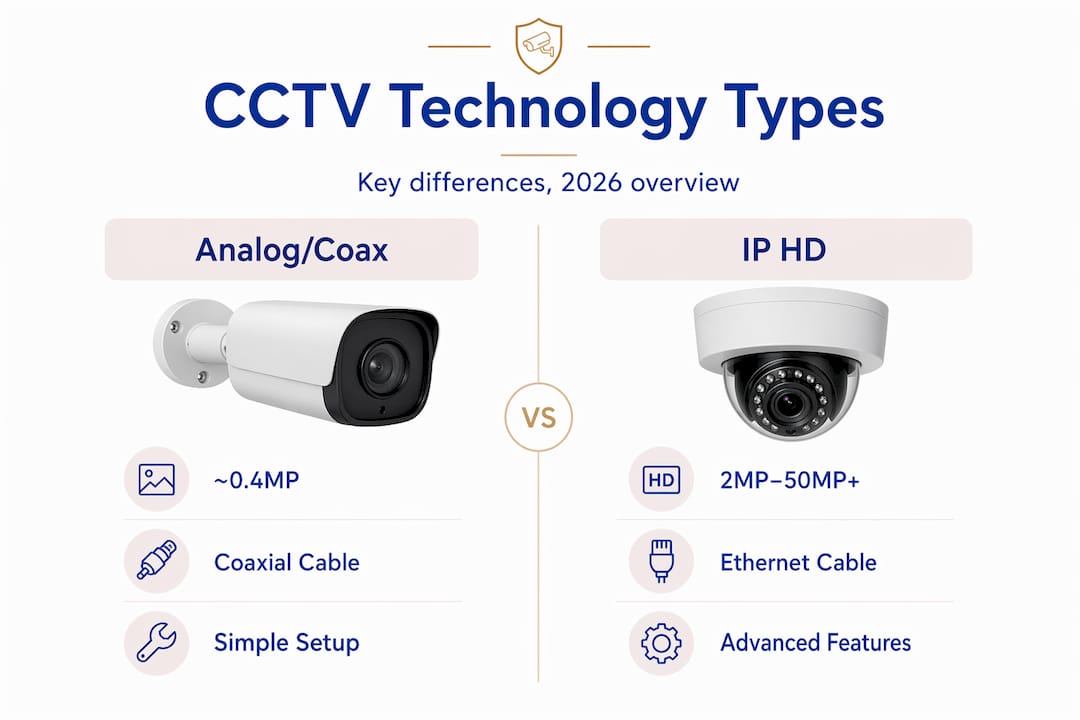
Analog systems are inexpensive and straightforward, but their resolution limits mean you often cannot identify faces or license plates clearly. HD-over-coax bridges the gap for buildings with existing coaxial wiring because you keep the cable runs while swapping cameras and DVRs for higher-definition models. IP CCTV is the current standard for new installations. It runs over standard network cabling, supports digital compression, and integrates with software platforms for remote access, motion detection, and analytics. If you plan to buy CCTV online for a new build or full replacement, IP is almost always the right direction.
CCTV installation tips that actually matter
Getting a CCTV system installed correctly is where most projects either succeed or fail. The cameras themselves are rarely the problem. It is the infrastructure around them that causes headaches.
Choosing the right hardware
Start with your environment. Outdoor cameras need an IP66 or higher weatherproof rating. Low-light or zero-light coverage requires cameras with infrared LEDs or color night vision capability. For wide-area coverage, consider varifocal lenses so you can adjust the field of view after mounting without physically repositioning the camera.
Wireless CCTV options have improved dramatically, and they work well for locations where cable runs are impractical. However, wireless cameras depend on network stability, so invest in quality access points and avoid placing cameras at the edge of your Wi-Fi range.
Cabling, configuration, and storage
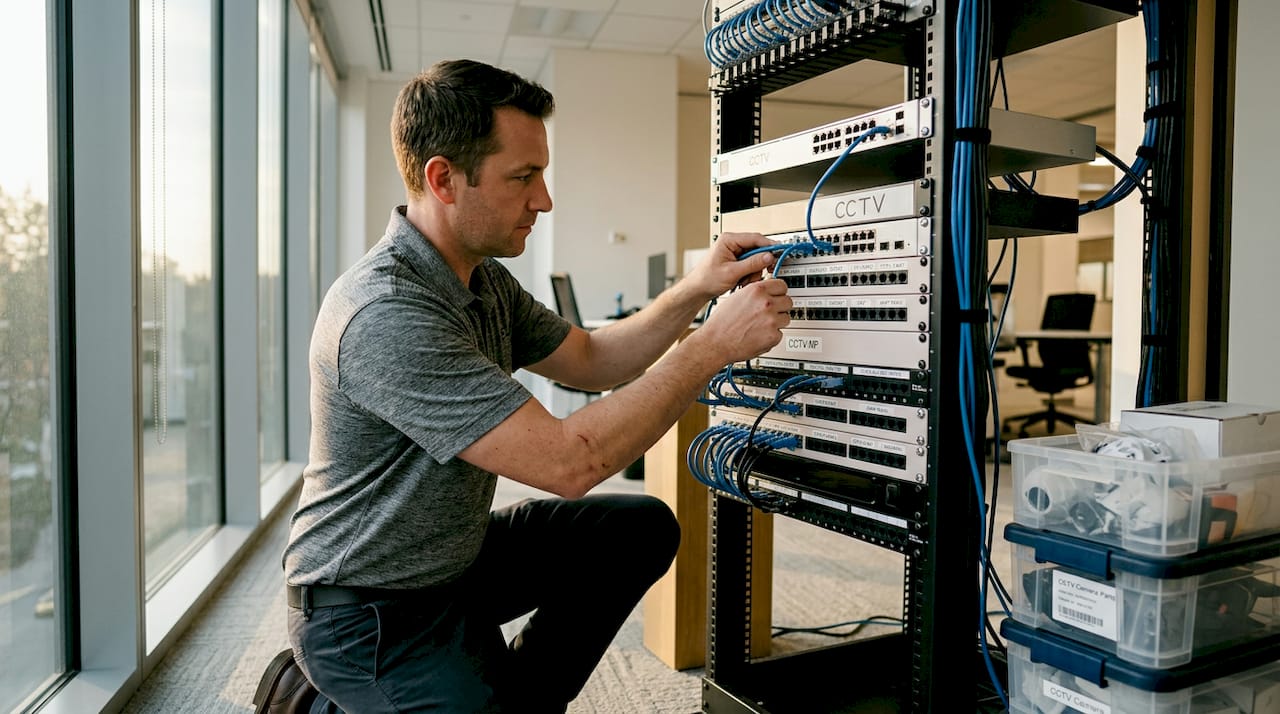
Label every camera cable at both ends before you seal any conduit or trunking. This single habit saves hours of troubleshooting. Test link integrity on each run before connecting cameras, catching problems like damaged cable or faulty connectors before they become buried issues.
Power over Ethernet (PoE) simplifies IP camera deployment by delivering both power and data over a single Cat6 cable, eliminating the need for separate power supplies at each camera location. A typical home installation with four to eight cameras takes two to four hours when the cabling is pre-planned.
Storage is where many people underestimate the math. Storage requirements scale with bitrate, camera count, and retention window. A system with eight 4MP cameras recording continuously at moderate bitrate can consume multiple terabytes per week. Plan this before purchasing an NVR, and consider RAID configurations if continuous uptime and data redundancy matter to your operation.
Pro Tip: Set your NVR to overwrite oldest footage automatically at 70-80% disk capacity rather than 100%. This prevents the system from pausing recording while it manages a full drive, which is exactly the gap an opportunistic intruder could exploit.
Physical placement of your recording equipment matters as much as camera placement. Secure the NVR or DVR in a locked cabinet or room. A thief who can pull the recorder walks out with your evidence.
Legal and compliance considerations
Using CCTV without understanding the legal framework around it creates liability, not safety. Data protection regulations treat surveillance footage as personal data, which triggers a set of obligations.
Here are the core compliance requirements any CCTV operator should address:
- Lawful basis: You need a documented legal reason to operate CCTV, such as legitimate interest for a business or crime prevention for a residential property.
- Signage: Signage is mandatory at monitored premises. Visitors and employees must know they are being recorded. This requirement applies even to private businesses and residential common areas.
- Camera placement: CCTV cameras cannot be installed in areas where people have high expectations of privacy, such as restrooms, locker rooms, or private offices without consent.
- Retention limits: CCTV footage is personal data under data protection law, requiring you to delete it after a defined retention period. Thirty days is a common standard unless a specific incident requires preservation.
- Access controls: Only authorized personnel should be able to view footage. Access logs should be maintained so you can demonstrate who accessed recordings and when.
- Subject Access Requests: Individuals have the right to request footage in which they appear. Operators must balance internal access controls with formal disclosure processes for these requests and for law enforcement inquiries.
For businesses deploying CCTV at scale, a Data Protection Impact Assessment (DPIA) is best practice before installation, especially when advanced analytics like facial recognition are involved. Integrating your cybersecurity strategy with your physical surveillance governance closes gaps that regulators are increasingly looking at.
The real benefits of CCTV surveillance
The most frequently cited benefit of CCTV is crime deterrence, and the data supports it. CCTV reduces crime by approximately 13% on average, but that number climbs sharply when combined with other security measures. In parking lots specifically, reductions reach 51%. That is not a marginal improvement. That is a transformative one for any facility managing vehicle theft or personal safety after hours.
“When CCTV is deployed as part of a layered security approach rather than as a standalone tool, the crime reduction impact more than doubles compared to cameras alone.” — The effects of CCTV on crime
Beyond deterrence, CCTV supports investigations by providing timestamped visual evidence. Insurance claims, liability disputes, and employee conduct issues all become easier to resolve when footage exists. Many insurers also discount commercial premiums for properties with documented CCTV coverage.
Modern IP CCTV systems include built-in analytics, such as motion detection, line crossing alerts, and in more advanced deployments, facial recognition. Facial recognition specifically carries significant legal weight. Law enforcement use of these systems must follow defined legal frameworks and data protection codes, and the same scrutiny increasingly applies to private deployments. If you are considering analytics-driven CCTV security solutions for a commercial environment, loop in legal counsel before procurement, not after.
Choosing the right CCTV setup for your environment
Different environments have different security priorities, and the best CCTV systems reflect that specificity rather than a one-size approach.
Residential properties: Focus on entry points first. Front door, back door, garage, and driveway cameras cover the majority of intrusion scenarios. Four cameras with remote mobile access and motion alerts covers most homes effectively without overspending.
Small commercial properties: Retail stores and small offices benefit from high-resolution cameras covering cash registers, entry points, and stockrooms. Cloud storage adds redundancy if the on-site recorder is stolen or damaged.
Mid-sized to large organizations: These environments require scalable NVR systems with centralized management dashboards, user-tiered access controls, and integration with access control and alarm systems. CCTV monitoring services, where a third-party security operations center reviews live feeds, become cost-effective at this scale.
Public spaces and multi-site deployments: Consistency in camera models, firmware versions, and recording formats simplifies management and legal disclosure. Standardizing early saves significant cost when scaling from five locations to fifty.
Maintenance is a non-negotiable part of any CCTV investment. Schedule quarterly checks on camera positions, lens cleanliness, firmware updates, and storage health. A camera that has been pointing at a wall since a landscaper moved a bracket six months ago is not protecting anything. Review your camera coverage map annually against any changes to your physical space.
To evaluate ROI on your CCTV security investment, measure reduction in security incidents, insurance premium changes, and staff time saved resolving disputes. These are concrete numbers, not estimates. Organizations that treat technology consulting as a recurring input rather than a one-time setup tend to see better long-term returns from security infrastructure spending.
My take on where most CCTV deployments go wrong
I have worked with organizations across industries on technology strategy, and physical security systems like CCTV reveal a consistent pattern. Everyone focuses on the cameras. Almost nobody focuses on governance.
In my experience, the biggest failures in CCTV deployments are not technical. They are organizational. A company installs thirty cameras, has no documented retention policy, no access control log, and two years later receives a Subject Access Request they cannot respond to properly. That is a legal and reputational problem, not a technology problem.
What I have learned is that you need to design the operational process before you design the system. Who can access footage? What triggers a review? Who handles law enforcement requests? These questions need written answers before a single cable is run.
I am also skeptical of the assumption that more cameras automatically means more security. I have seen a well-designed eight-camera system outperform a chaotic forty-camera installation where nobody knows what any camera covers, half the feeds are misnamed, and the NVR has not been checked in eighteen months. System design and commissioning discipline matter more than camera count.
The privacy conversation is real too. Employees and visitors have legitimate expectations. Deploying cameras in ways that feel oppressive or that exceed your stated purpose undermines trust and creates legal exposure. Proportionality is not just an ethical consideration. It is a legal one.
— Orloff
How Orloffphillips can help you get CCTV right
At Orloffphillips, we work with mid-sized and large organizations navigating exactly these kinds of technology deployment challenges. CCTV is not just a hardware decision. It sits at the intersection of physical security, data governance, IT infrastructure, and organizational policy.

Whether you are deploying your first enterprise security system or auditing an existing one that has grown without a plan, our fractional technology leadership model gives you experienced executive-level guidance without the overhead of a full-time hire. We help you build the governance framework, evaluate vendors, align your security investment with your broader technology strategy, and make sure your CCTV rollout does not create more liability than it prevents. If your organization is ready to treat physical security as the strategic asset it is, reach out to Orloffphillips and let us build a plan that actually holds up.
FAQ
What does CCTV stand for?
CCTV stands for Closed-Circuit Television. It refers to a video surveillance system where footage is transmitted within a private, closed network to authorized monitors and recording devices rather than broadcast publicly.
What is the difference between a DVR and an NVR?
A DVR (Digital Video Recorder) connects to analog or HD-over-coax cameras, while an NVR (Network Video Recorder) works with IP cameras over a network. NVR systems generally support higher resolutions and more flexible remote access.
How long should CCTV footage be retained?
Most organizations retain footage for 30 days as a standard practice, though incidents under investigation may require longer preservation. Data protection regulations require you to define and document your retention period before operating any CCTV system.
Do I need signs if I use CCTV?
Yes. Signage notifying people they are being recorded is a legal requirement for monitored premises. This applies to both commercial properties and residential buildings with cameras covering shared or public-facing areas.
Can CCTV actually reduce crime?
Yes. Research shows CCTV reduces crime by around 13% on average, with reductions reaching 34% when paired with other security measures and up to 51% in environments like parking lots. The impact is strongest when cameras are visible and part of a broader security setup.

Leave a Reply