
Most organizations treat cybersecurity as an IT problem. Buy the right tools, hire a security analyst, check the compliance box, and move on. That framing is exactly why so many organizations remain exposed despite significant technology investments. Real cybersecurity involves governance, leadership accountability, and a workforce that understands its role in defense. Verizon research consistently points to human behavior as the dominant breach factor, yet most programs spend 90% of their budget on technology. Fractional technology executives are changing that equation for mid-sized and large organizations by translating complex cybersecurity frameworks into measurable, boardroom-ready strategies.
Table of Contents
- Understanding foundational cybersecurity frameworks
- Governance and leadership: the cornerstone of cybersecurity effectiveness
- Empowering your workforce: effective cybersecurity training and awareness
- Building resilient defenses: strategies against modern cyber threats
- Applying cybersecurity frameworks with fractional technology executives
- Why conventional cybersecurity approaches often fall short
- Enhance your cybersecurity strategy with fractional technology executives
- Frequently asked questions
Key Takeaways
| Point | Details |
|---|---|
| Cybersecurity frameworks foundation | Use CISA CPG 2.0 and NIST CSF 2.0 as foundational guides tailored to your organization’s mission and risk profile. |
| Governance is essential | Embed leadership accountability and risk management into everyday cybersecurity operations for resilient outcomes. |
| Continuous workforce training | Implement ongoing, tailored security awareness training to drastically reduce human-related cyber risks. |
| Defense-in-depth strategy | Adopt multi-layered defenses and design systems to maintain core functions during cyberattacks like DDoS. |
| Value of fractional executives | Fractional technology leaders bridge technical and business perspectives to drive measurable cybersecurity improvements. |
Understanding foundational cybersecurity frameworks
Two frameworks dominate serious cybersecurity conversations in U.S. organizations right now: CISA’s Cybersecurity Performance Goals 2.0 (CPG 2.0) and NIST’s Cybersecurity Framework 2.0 (CSF 2.0). Both matter. They serve different but complementary purposes, and understanding what each one does well is the first step toward tailoring cybersecurity risk management that actually fits your organization.
CPG 2.0 was released by the Cybersecurity and Infrastructure Security Agency to address a specific gap: organizations were drowning in security recommendations and didn’t know where to start. CPG 2.0 provides a prioritized set of outcome-driven practices focused on risk reduction across both IT and OT (operational technology) environments. The goals are intentionally practical, covering everything from account security and device controls to supply chain risk and incident response. Think of CPG 2.0 as the floor. It is the minimum defensible posture for any organization operating critical infrastructure or business-critical systems.
CSF 2.0, on the other hand, is a structured but highly adaptable framework that helps all sizes and sectors manage and reduce cybersecurity risks while adapting to emerging threats. Its five core functions (Identify, Protect, Detect, Respond, Recover) have now been joined by a sixth: Govern. That addition is significant because it formally places cybersecurity decisions inside the organizational leadership structure rather than treating them as a technical sideshow.
Here is a quick comparison of how the two frameworks differ in practice:
| Feature | CISA CPG 2.0 | NIST CSF 2.0 |
|---|---|---|
| Primary audience | Critical infrastructure operators | All organizations and sectors |
| Scope | IT and OT environments | Broad enterprise risk management |
| Approach | Prescriptive, outcome-driven goals | Flexible, adaptable framework |
| Governance emphasis | Added in 2.0 update | Core function (Govern) built in |
| Maturity intent | Baseline floor, not ceiling | Scalable across maturity levels |
| Best used for | Prioritizing immediate protections | Long-term strategic alignment |
Key things both frameworks share:
- A focus on measurable outcomes rather than compliance theater
- Explicit attention to governance and leadership accountability
- Recognition that cybersecurity maturity is a continuous journey, not a destination
- Design that supports organizations with limited resources making high-impact decisions first
Having clarified what the foundational cybersecurity frameworks offer, let’s explore how leadership governance drives effective implementation.
Governance and leadership: the cornerstone of cybersecurity effectiveness
Governance is where cybersecurity lives or dies in most organizations. You can deploy every tool on the market and still be completely vulnerable if no one owns accountability for the outcomes. CPG 2.0 explicitly added a governance component emphasizing accountability, risk management, and strategic integration into daily operations. This was not a minor update. It signals that effective cybersecurity requires executive ownership, not just IT execution.
What does governance actually look like in practice? It includes documented policies with defined owners, a formal risk management process that produces regular reports for senior leadership, incident response plans that are tested (not just written), and a clear chain of communication when something goes wrong. These are not glamorous activities. They are the difference between an organization that contains a breach in 48 hours and one that discovers it six months later.
“The most dangerous gap in most cybersecurity programs is not a missing firewall rule. It’s a senior leadership team that cannot explain what risk they are accepting and why.”
Organizational failure often stems from an inability to tie cybersecurity practices to measurable risk reduction understood by senior leadership. When the CISO or IT director presents in technical language that doesn’t connect to business outcomes, leadership disengages. Budget requests stall. Resources go elsewhere. The result is a program that looks active but is slowly losing ground.
Cybersecurity governance pillars every organization should have in place:
- A written, enforced cybersecurity policy reviewed at least annually
- A risk register that maps threats to business impact in dollar terms
- A defined incident response plan with roles, communication trees, and recovery time objectives
- Regular briefings to the board or senior leadership in business language, not technical jargon
- Accountability metrics tied to individual roles, not just the IT department
Pro Tip: If your board has never been presented a cybersecurity risk report in terms of potential revenue impact or operational downtime, start there. That single change in communication approach often unlocks more program investment than any technical audit.
For a deeper look at cybersecurity tips for executives, including how to build leadership-level security culture, the conversation goes well beyond policy documentation.
With governance established as key, workforce preparedness also plays a vital role in overall cybersecurity posture.
Empowering your workforce: effective cybersecurity training and awareness
Technology protects systems. People protect everything else. Phishing attacks, credential misuse, and social engineering are not technology failures. They are human failures, and they account for the overwhelming majority of successful breaches. The good news is that they are also among the most addressable risks you have.

Ongoing training and testing dropped phishing vulnerability from 31.4% down to 4.8% over 12 months in Verizon’s study. That is a reduction of more than 84%. No technology investment in your environment produces that kind of measurable risk reduction that fast. Cybersecurity training programs, when done right, are one of the highest-return investments an organization can make.
The phrase “done right” is doing a lot of work in that sentence. Most training programs fail because they are annual events, not continuous practices. An hour-long video once a year does not change behavior. What does change behavior is regular, role-specific training paired with simulated phishing campaigns that give employees real feedback in real time.
Building a workforce security training program that actually works:
- Segment your training by role and risk level. Finance staff face different threats than operations staff. Tailor the content, not just the branding.
- Run simulated phishing campaigns monthly. Track click rates by department. Use failures as teaching moments, not punishments.
- Set measurable benchmarks. Define what a “secure” employee looks like using metrics. Treat those numbers the same way you treat sales targets.
- Review and update content quarterly. Threat actors change their techniques constantly. Your training should reflect the current environment, not last year’s playbook.
- Make the connection to personal security. Employees who understand why security matters at home apply those instincts at work.
Pro Tip: Track training completion and simulated phishing click rates as workforce training impact metrics in your monthly operational reporting. When leadership sees these numbers trending alongside incident rates, cybersecurity stops being a cost center in the conversation and starts looking like a performance function.
Beyond workforce training, organizations must architect technical defenses to withstand evolving threats including DDoS attacks.
Building resilient defenses: strategies against modern cyber threats
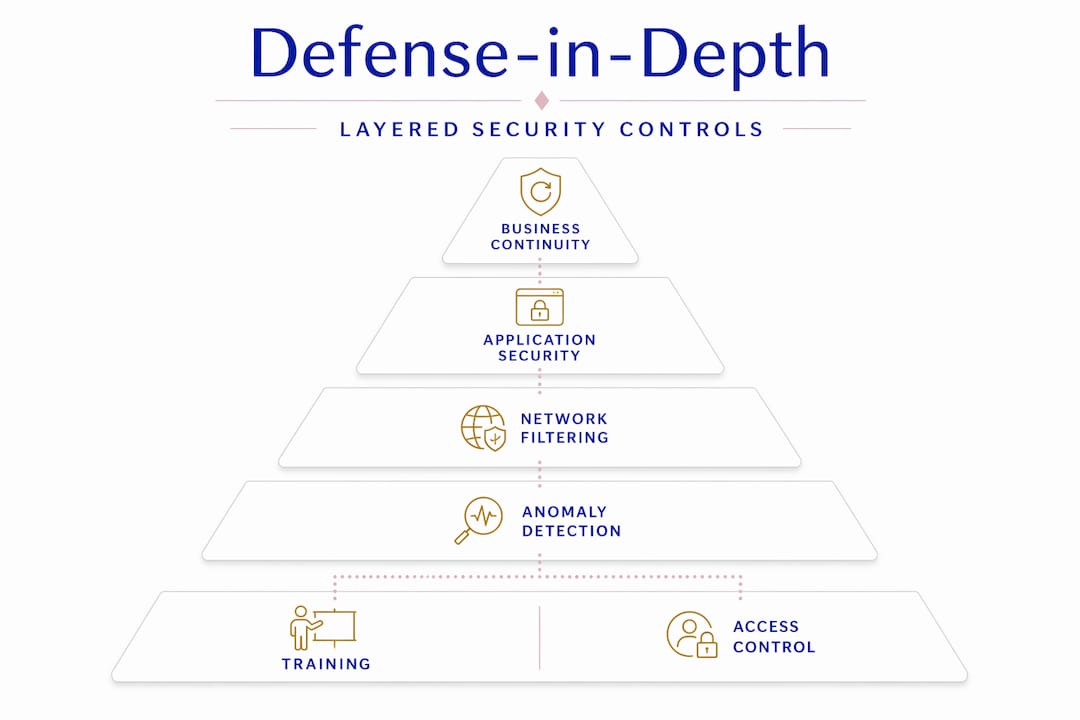
The technical threat landscape has shifted significantly. Distributed denial-of-service (DDoS) attacks, which flood a network or application with traffic to force it offline, have become both more frequent and more sophisticated. Microsoft’s 2025 Digital Defense Report highlights 4,500 daily DDoS attacks and identifies defense-in-depth as essential for resilience. That number should make every operations and technology leader pay attention.
Defense-in-depth is the practice of layering multiple security controls so that if one fails, another catches the threat. For DDoS scenarios, this means combining rate limiting (restricting how many requests a single source can send), geo-fencing (blocking or filtering traffic from regions with no business relevance), anomaly detection (flagging traffic patterns that deviate from normal baselines), and cloud-native protections like auto-scaling and traffic scrubbing services.
| Defense layer | What it does | Works best against |
|---|---|---|
| Rate limiting | Caps requests per IP/session | Volumetric floods |
| Geo-fencing | Filters traffic by geographic origin | Regionally sourced attacks |
| Anomaly detection | Flags abnormal traffic patterns | Application layer attacks |
| Cloud-native scaling | Absorbs sudden traffic spikes | Capacity exhaustion attacks |
| Graceful degradation | Maintains core functions under load | Sustained, prolonged attacks |
The concept of graceful degradation deserves special attention. Systems designed to gracefully degrade maintain their most critical functions even when under sustained attack, rather than failing completely. An e-commerce platform that disables non-essential features but keeps checkout operational during a DDoS event preserves revenue and user trust simultaneously. That is an architectural decision, not a firewall rule, and it requires leadership input to prioritize correctly.
Effective resilience planning and mitigation services connect these technical decisions to business continuity goals so that the design of your systems reflects your actual risk tolerance.
Understanding defense strategies sets the stage to consider practical application of these frameworks and leadership roles through fractional executives.
Applying cybersecurity frameworks with fractional technology executives
Knowing that CPG 2.0 and CSF 2.0 exist is very different from knowing how to operationalize them inside a real organization with budget constraints, competing priorities, and a board that wants results in plain English. This is where fractional technology executives change the outcome.
A fractional CIO or CISO brings executive-level cybersecurity expertise on a part-time or project basis. They are not there to manage your helpdesk. They establish measurable baseline programs, prioritize the highest-impact cybersecurity practices, and translate technical risk into language that moves leadership to act. Practitioners use CISA CPGs as an investment and benchmarking foundation, expanding scope as maturity grows. A fractional executive operationalizes that approach without requiring you to hire a full-time executive at $300,000 or more per year.
The fractional executives role in cybersecurity typically covers these core activities:
- Framework selection and tailoring: Mapping CPG 2.0 and CSF 2.0 requirements to your specific operational environment and risk profile
- Leadership communication: Translating technical findings into board-ready risk briefings with clear business impact language
- KPI development: Building operational metrics for governance, training effectiveness, and incident response readiness
- Vendor assessment: Evaluating security tools and cloud security solutions against actual business needs rather than marketing claims
- Roadmap creation: Sequencing cybersecurity investments over 12 to 36 months to match budget cycles and risk priorities
NIST CSF 2.0 encourages governance-first approaches that tie decisions to risk outcomes and enable board clarity. A fractional executive builds that governance layer deliberately, ensuring your leadership team understands what they are approving and why it matters.
The practical steps a fractional technology executive typically follows when engaging a new organization:
- Conduct a current-state cybersecurity assessment against CPG 2.0 baseline goals
- Identify the top five risk gaps by potential business impact
- Build a 90-day action plan that addresses the most critical gaps first
- Establish governance structures: policies, accountability owners, and reporting cadences
- Implement training benchmarks and begin tracking workforce risk metrics
- Present findings and roadmap to senior leadership with business-framed recommendations
For organizations that have experienced program drift or previous failed implementations, consulting to correct cybersecurity failures often begins with exactly this kind of structured assessment and reset.
These applied insights lead naturally to a unique perspective on why traditional cybersecurity approaches often miss critical success factors.
Why conventional cybersecurity approaches often fall short
After watching organizations across multiple industries invest heavily in security tools while their risk posture barely moved, the pattern becomes clear. The failure is almost never technical. It is cultural and structural.
Most conventional cybersecurity programs start with the technology stack and work backward to the people and processes. That order is exactly wrong. When you lead with tools, you create a false sense of coverage. Leadership sees spending and assumes protection. The governance structures, training programs, and measurement frameworks that would actually demonstrate whether you are safer never get built because the budget is gone and the box appears checked.
Security awareness programs often fail when they rely on one-time training rather than ongoing measurement and benchmarking. The same principle applies across the entire cybersecurity function. Without continuous measurement, you cannot tell whether your program is improving or degrading. Most organizations have no idea which category they are in.
The other chronic failure is the communication gap between technical teams and senior leadership. Security professionals speak in vulnerabilities and CVEs (Common Vulnerabilities and Exposures, which are publicly known security flaws). Executives speak in revenue risk, operational continuity, and competitive exposure. When those two groups cannot translate for each other, cybersecurity budgets remain underfunded and programs remain underpowered.
Fractional technology executives solve this by design. Their value is not in running the firewall. It is in sitting at the intersection of technical reality and business strategy, making both sides legible to the other. For a detailed look at executive cybersecurity insights that bridge that gap, the conversation starts with governance and ends with measurable outcomes.
The organizations that get cybersecurity right treat it the same way they treat financial risk: with defined ownership, regular measurement, and board-level visibility. That is not a technology decision. It is a leadership decision.
Enhance your cybersecurity strategy with fractional technology executives
Building on our deep dive into cybersecurity strategy, partnering with fractional executives is your practical next step toward resilient operations. If your organization is ready to move from reactive patching to a measured, governance-driven cybersecurity program, Orloff Phillips provides exactly the executive expertise you need without the overhead of a full-time hire.

Orloff Phillips’ fractional technology executives specialize in translating CISA CPG 2.0 and NIST CSF 2.0 frameworks into actionable programs built around your organization’s risk tolerance, operational realities, and budget cycles. They communicate directly with your board, build the KPIs your leadership team can track, and create the governance structures that keep your program advancing. Explore the full range of fractional executives benefits or learn how technology consulting for cybersecurity growth accelerates maturity for mid-sized and large organizations. For organizations ready to formalize their approach, technology strategy essentials offers the C-level framework to get started.
Frequently asked questions
What are CISA’s Cybersecurity Performance Goals 2.0?
They are a prioritized set of cybersecurity practices designed to reduce risk for critical infrastructure, emphasizing governance and measurable outcomes. They function as a practical baseline that organizations can use to guide investment decisions and benchmark their security progress over time.
How does NIST CSF 2.0 support organizations?
NIST CSF 2.0 offers a flexible framework that helps manage and reduce cybersecurity risks by adapting to emerging threats across all sectors. Organizations can tailor it to their specific mission and risk profile, making it equally useful for a 500-person manufacturer and a 10,000-person financial institution.
Why is continuous cybersecurity training important?
Regular training dramatically reduces human risk. Ongoing training reduced phishing vulnerability from 31.4% to 4.8% over 12 months. One-time annual sessions do not produce lasting behavioral change, making frequency and role-specific customization the two most important design decisions.
What is defense-in-depth against DDoS attacks?
It is a multi-layered approach combining traffic filtering, anomaly detection, and architectural design to maintain service during attacks. Defense-in-depth strategies ensure systems remain usable even when some malicious traffic bypasses individual filters, which is why no single control layer is sufficient on its own.
How can fractional technology executives improve cybersecurity?
They tailor frameworks like CPG 2.0 and CSF 2.0 to organizational needs, align leadership with technical teams, and create measurable risk reduction programs. Fractional executives use CISA CPGs and NIST CSF to establish measurable baselines aligned with business goals, providing C-level strategic value without the cost of a permanent executive hire.

Leave a Reply