
Organizing leadership workshops is the process of designing and executing structured learning experiences that develop specific leadership behaviors tied to real business challenges. The best programs in 2026 go far beyond a single training day. They integrate behavioral assessments, experiential practice, and post-workshop accountability to produce measurable change. Only 24% of leadership professionals measure business impact from training, while 92% measure only learner reactions. That gap is exactly what separates forgettable workshops from ones that actually shift how leaders lead.
How to plan leadership workshops with clear, measurable outcomes
The first step in planning any leadership development event is diagnosing the real business problem you are trying to solve. A workshop built around vague goals like “improve communication” produces vague results. Write specific behavioral outcomes instead: what should a participant do differently 90 days after the session ends?
Stakeholder interviews are non-negotiable at this stage. Talk to direct managers, HR partners, and senior leaders before you design a single slide. Their input shapes the charter, which defines scope, success criteria, and budget. For multi-day retreats, plan 6–9 months ahead to allow time for pre-work, logistics, and participant preparation. Shorter half-day workshops can move faster, but still need 6–8 weeks of runway.

Participant readiness is a prerequisite, not an afterthought. Sending behavioral assessments like DiSC or CliftonStrengths before the event gives participants time to reflect. That reflection makes the workshop conversation richer and more personal from the first hour.
Key planning steps to complete before design begins:
- Define 2–3 specific behavioral outcomes tied to a named business challenge
- Complete stakeholder interviews and document a workshop charter
- Select and distribute pre-work assessments at least 3 weeks before the event
- Confirm timeline: 6–9 months for retreats, 6–8 weeks minimum for workshops
- Identify a sponsor who will reinforce learning after the event ends
Pro Tip: Write your success metrics before you write your agenda. If you cannot describe what “success” looks like in behavioral terms, your design will drift toward content delivery instead of behavior change.
What assessment tools and design frameworks maximize engagement?
Behavioral assessment data is the foundation of a personalized workshop. Tools like DiSC, CliftonStrengths, and 360-degree feedback give facilitators concrete data to work with. They also give participants a shared language for discussing differences in communication style, decision-making, and conflict response. That shared language accelerates trust and makes difficult conversations feel safer.
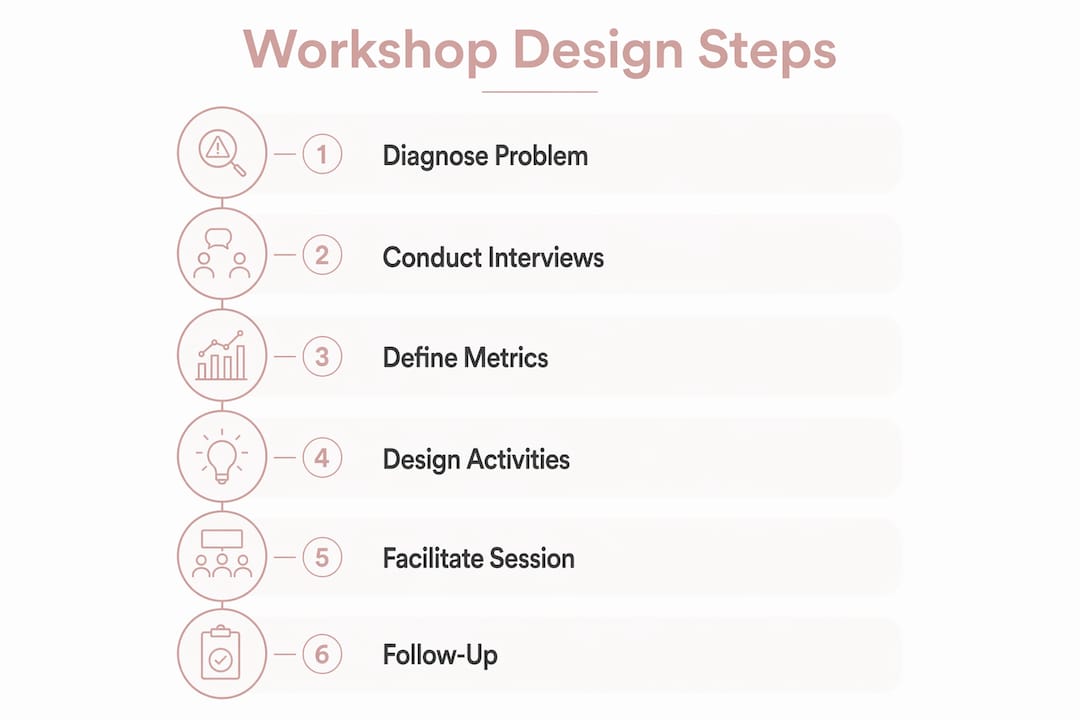
Session design must prioritize doing over listening. Limit passive instruction to no more than 30–40% of total session time. The remaining time goes to role-playing, peer discussion, real-scenario problem-solving, and commitment planning. This ratio reflects the 70-20-10 development model, which places most learning in experience and social interaction rather than formal instruction.
The 4A Model, developed by Jennifer Britton, offers a practical framework for session flow:
- Anchor: Connect new content to participants’ existing experience and assessment data
- Advance: Introduce the core concept or skill with minimal lecture time
- Apply: Practice the skill through a real workplace scenario or role-play
- Activate: Commit to a specific behavior change with a named accountability partner
The 4A Model recommends interaction every 7–10 minutes and limits each session to three core takeaways. More than three and retention drops sharply.
| Design element | Best practice |
|---|---|
| Passive instruction | No more than 30–40% of session time |
| Experiential activities | Role-play, peer coaching, live problem-solving |
| Interaction frequency | Every 7–10 minutes |
| Core takeaways per session | Maximum 3 |
| Psychological safety | Named explicitly at session open |
Psychological safety is not a soft concept. It is a design requirement. Name it at the start of every session. Tell participants what is expected of them and what is off-limits in terms of judgment or ridicule. Without it, leaders will not take the risks that produce real learning.
Pro Tip: Pair DiSC or CliftonStrengths data with a real team challenge participants are currently facing. Abstract exercises teach abstract lessons. Real problems teach real skills.
For additional leadership workshop ideas that connect assessment data to team outcomes, Orloffphillips has published a practical resource worth reviewing before you finalize your design.
How to execute and facilitate workshops that hold attention
Open every workshop with an assessment debrief, not a welcome slide. When participants see their own behavioral data on screen in the first 20 minutes, attention sharpens immediately. They stop thinking about their inbox and start thinking about themselves. That shift is the facilitator’s most powerful tool.
Use custom materials built around your organization’s actual challenges. Generic case studies produce generic insights. When a scenario mirrors a real decision a participant made last quarter, the learning sticks. Work with your stakeholders during planning to gather two or three real situations that can be anonymized and used as workshop cases.
A sample half-day agenda (4 hours) looks like this:
| Time block | Activity |
|---|---|
| 8:00–8:30 AM | Welcome, norms, and assessment debrief |
| 8:30–9:30 AM | Core skill introduction with peer discussion |
| 9:30–10:30 AM | Applied scenario role-play and debrief |
| 10:30–10:45 AM | Break |
| 10:45–11:30 AM | Commitment planning and accountability pairs |
| 11:30 AM–12:00 PM | Wrap-up, Q&A, and next-step assignments |
Dynamic facilitation means naming what you observe. When a participant demonstrates a behavior that illustrates the session’s concept, call it out in real time. That specificity turns abstract theory into lived experience. It also signals to the group that the facilitator is paying close attention, which raises everyone’s engagement.
Pro Tip: Assign accountability partners during the workshop, not after. Pairs formed in the room carry more social weight than ones assigned by email a week later.
What follow-up strategies sustain learning after the workshop ends?
87% of leadership skills learned are lost within 90 days without structured reinforcement. That number is not a warning. It is a design constraint. Build your follow-up plan before the workshop runs, not after.
The most critical window is the first two weeks. Scheduling a follow-up within 14 days prevents the forgetting curve from erasing the workshop’s gains. This follow-up can be a group check-in call, a one-on-one coaching session, or a structured peer conversation. The format matters less than the timing.
Accountability architecture includes visible, public commitments and scheduled behavior-change check-ins at 30, 90, and 180 days. Structured accountability multiplies the likelihood that new skills actually transfer to daily work.
Build your reinforcement calendar into the workshop design from day one:
- Day 1–14: Individual coaching session or group check-in call
- Day 30: Peer accountability partner conversation with a structured prompt
- Day 90: Manager check-in tied to the behavioral outcomes defined in planning
- Day 180: Team-level outcome review against organizational KPIs
Measurement must go beyond completion rates. Leadership evaluation should be multidimensional, tracking behavioral change, team engagement scores, and organizational KPIs. Completion rates and satisfaction surveys are vanity metrics. They tell you people attended and enjoyed themselves. They do not tell you whether anyone leads differently. For a deeper look at measuring business outcomes, Orloffphillips has published a guide specifically for leaders navigating this measurement challenge.
Which leadership workshop themes matter most in 2026?
Leadership development in 2026 requires skills that did not appear on most training agendas three years ago. Managing AI-augmented teams, leading through rapid change, and making decisions under uncertainty are now front-line leadership challenges, not executive-level abstractions.
The most impactful leadership workshop themes for 2026 include:
- Strategic decision-making under uncertainty: How to move fast with incomplete information
- Managing hybrid and AI-augmented teams: Setting expectations, maintaining culture, and evaluating performance across distributed and automated workflows
- Emotional intelligence under pressure: Recognizing and regulating emotional responses during conflict or crisis
- Change management: Leading teams through organizational shifts without losing trust or momentum
- Communication under pressure: Delivering difficult messages clearly and with credibility
- Inclusive leadership: Building teams where different perspectives are heard and used
- Adaptive leadership: Adjusting style and approach based on team needs and context
Align your theme selection to the specific challenges your stakeholders named during planning. A theme that resonates with your organization’s current reality will always outperform a generic curriculum. Blend technical, interpersonal, and self-awareness modules across the program. Leaders who only develop one dimension plateau quickly.
For context on how business strategy consulting intersects with leadership development planning, Kontrol Media Consultancy offers a useful 2026 perspective worth reading alongside your theme selection process.
Key Takeaways
Effective leadership workshops require behavioral outcomes, experiential design, and structured follow-up accountability to produce lasting change and measurable business results.
| Point | Details |
|---|---|
| Define behavioral outcomes first | Write specific, 90-day behavioral goals before designing any content or agenda. |
| Limit passive instruction | Keep lecture time below 40% and fill the rest with role-play and peer practice. |
| Follow up within 14 days | A check-in in the first two weeks prevents the forgetting curve from erasing gains. |
| Measure beyond satisfaction | Track behavioral change, team engagement, and KPIs, not just completion rates. |
| Align themes to 2026 challenges | Prioritize AI team management, emotional intelligence, and adaptive leadership content. |
What I have learned from running leadership workshops that actually work
Most leadership workshops fail for the same reason: organizers treat them as events instead of ecosystems. You run a great day, people leave energized, and then nothing changes. The manager never reinforces the skills. There is no follow-up. The accountability partner conversation never happens. Six months later, the organization runs another workshop and wonders why the culture has not shifted.
The uncomfortable truth is that a workshop without a reinforcement plan is just an expensive morale boost. I have seen organizations spend significant budget on facilitation and materials, then allocate nothing to coaching or check-ins. That is backwards. The workshop is the spark. The follow-up is the fuel.
Psychological safety is the other variable that most planners underestimate. You can have the best assessment data, the sharpest facilitator, and the most relevant case studies. If participants do not feel safe enough to be honest about their gaps, none of it lands. Building safety is not a soft skill. It is a technical design decision. Name it, structure it, and protect it throughout the session.
My strongest recommendation: go deep on fewer topics. Three skills practiced well will change behavior. Ten skills surveyed quickly will change nothing. Depth beats breadth every time in leadership development. Pair that depth with inclusive leadership strategies that make every participant feel the content applies to them, and you have a program worth running.
— Orloff
How Orloffphillips supports leadership workshop planning and execution
Orloffphillips works with mid-sized and large organizations across the United States to design and deliver leadership development programs that produce real behavioral change. The team brings fractional executive experience to workshop planning, which means you get senior-level design thinking without a full-time commitment.
Services include custom workshop design, behavioral assessment integration, facilitation, and post-workshop coaching. Orloffphillips also offers fractional CXO advisory support for organizations that need ongoing leadership strategy beyond a single event. If you are planning 2026 leadership development events and want a program built around measurable outcomes rather than attendance numbers, Orloffphillips is a practical next step. Visit the leadership workshop ideas page to see how the approach translates into program design.
FAQ
What is the ideal timeline for planning a leadership workshop?
Plan multi-day retreats 6–9 months in advance and shorter workshops at least 6–8 weeks out. That lead time allows for stakeholder alignment, assessment distribution, and material customization.
How much of a workshop should be experiential vs. lecture-based?
Limit passive instruction to 30–40% of session time. The remaining time should go to role-playing, peer discussion, and applied problem-solving to anchor skills in real workplace behavior.
Why do leadership skills fade so quickly after training?
87% of skills are lost within 90 days without reinforcement. Structured follow-up at 14 days, 30 days, and 90 days is the primary defense against this skill attrition.
What are the most important leadership workshop themes for 2026?
Managing AI-augmented teams, emotional intelligence, adaptive leadership, and strategic decision-making under uncertainty are the highest-priority themes for 2026 leadership training sessions.
How do you measure whether a leadership workshop actually worked?
Track behavioral change, team engagement scores, and organizational KPIs rather than satisfaction surveys. Multidimensional evaluation built into the design from the start produces the most credible results.

Leave a Reply