
A technology roadmap is a strategic visual plan that links technology initiatives to measurable business outcomes across defined time horizons. Unlike a project plan, it answers the question every executive asks: “Why are we spending this money, and when will it pay off?” The role of IT roadmapping has expanded well beyond the IT department. It now serves as a capital allocation tool, a governance document, and a communication bridge between technical teams and business leadership. This technology roadmapping guide gives you a practical framework to build, prioritize, and maintain a roadmap that actually drives results.
What is a technology roadmap and why does it matter?
A technology roadmap is defined as a structured plan that connects specific technology investments to business goals, with timelines, owners, and budgets attached. The keyword phrase “IT roadmap” is widely used, but the recognized industry term is “technology roadmap” or “strategic technology plan,” and the two are used interchangeably across frameworks from Gartner and the Project Management Institute.
The most common failure mode is building a roadmap that lists technology projects without tying them to business outcomes. Every initiative should trace back to a specific measurable result, such as a targeted reduction in system downtime or a defined revenue growth target. That traceability is what makes a roadmap defensible in a budget meeting.

Technology leaders who treat roadmaps as living governance tools, rather than static slide decks, consistently report stronger executive alignment and faster initiative approval. The roadmap becomes the single source of truth for where the organization is investing in technology and why.
What are the essential components of a technology roadmap?
A defensible technology roadmap contains five non-negotiable elements. Miss any one of them, and the document loses credibility with finance, operations, or the board.
- Business objectives: Stated clearly, ranked by priority, and tied to measurable outcomes.
- Prioritized initiatives: Each initiative linked to at least one business objective.
- Timelines: Segmented into near, mid, and long term horizons of 0–6 months, 6–18 months, and 18–36 months.
- Dependencies: Mapped between initiatives so sequencing decisions are visible.
- Assigned owners: Named individuals accountable for delivery and outcomes.
- Budget breakdown: Separated into one-time costs (implementation, licensing) and recurring costs (support, subscriptions).
The budget breakdown is the element most teams skip. Separating one-time from recurring costs gives finance a clear picture of the total cost of ownership, not just the launch price. That distinction alone can change how leadership prioritizes initiatives.
| Component | What it answers |
|---|---|
| Business objectives | Why are we doing this? |
| Prioritized initiatives | What are we doing, and in what order? |
| Timelines | When will it happen? |
| Dependencies | What must happen first? |
| Owners | Who is accountable? |
| Budget breakdown | What does it cost, now and ongoing? |
Pro Tip: Build your roadmap in a shared document that finance and operations can access directly. When budget reviews happen, your roadmap should already be in the room.
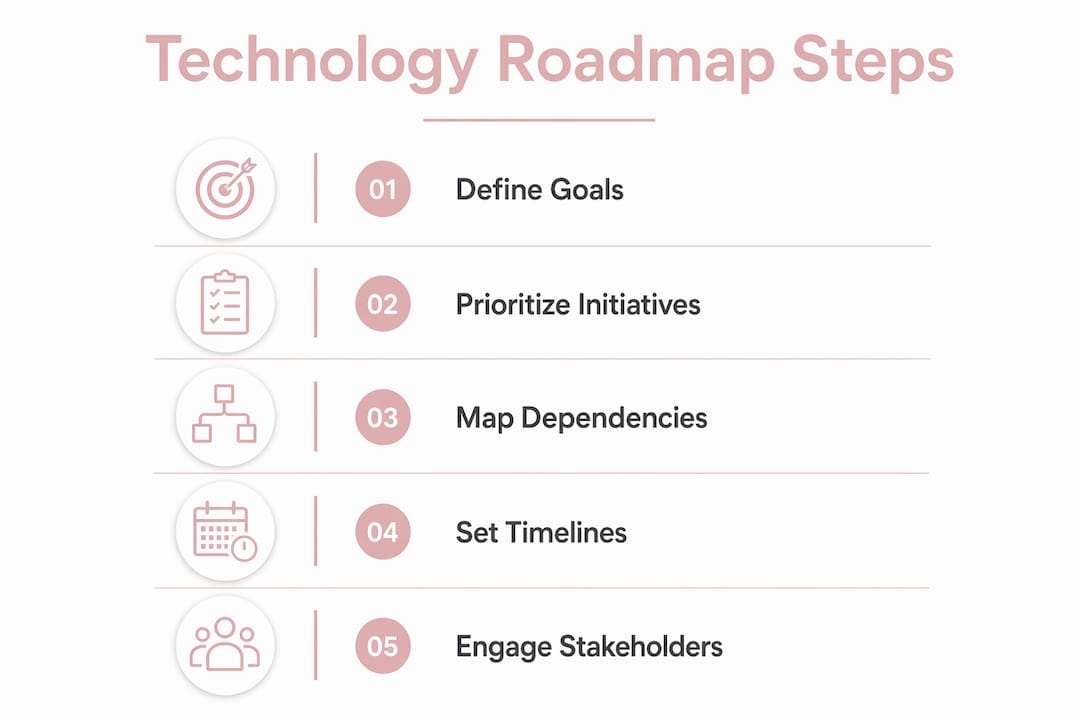
How to build and prioritize initiatives in your technology roadmap
Prioritization is where most roadmaps break down. Teams list everything they want to do, assign arbitrary timelines, and call it a plan. A credible IT roadmapping guide starts with business objectives, not technology wishes.
Step 1: Derive initiatives from business objectives
Start with two or three clear business goals for the next 12–36 months. Examples include reducing customer churn by a specific percentage, cutting operational costs in a defined area, or entering a new market. Every initiative on the roadmap must connect to at least one of those goals. If it does not connect, it does not belong on the roadmap.
Step 2: Score initiatives by impact and effort
Use a scoring model that rates each initiative on business impact (high, medium, low) and implementation effort (high, medium, low). High impact combined with low effort goes first. High impact combined with high effort requires a phased approach. Low impact combined with high effort gets cut or deferred. This scoring creates a transparent, defensible prioritization that leadership can audit.
Step 3: Map dependencies before setting timelines
Dependency mapping before timeline setting is the highest-impact practice for avoiding cascading delays. If your cloud migration must complete before your data analytics platform can go live, that sequence must appear in the roadmap before any dates are assigned. Skipping this step is the single most common cause of mid-program delays.
Step 4: Involve stakeholders early
Bring department heads, finance, and operations into the prioritization conversation before the roadmap is finalized. Their input surfaces dependencies you cannot see from IT, and their buy-in accelerates approval. A roadmap built in isolation by the IT team rarely survives its first executive review intact.
Pro Tip: Run a two-hour prioritization workshop with your leadership team using the impact-effort scoring matrix. The conversation it generates is more valuable than the scores themselves.
The table below shows how scoring translates to sequencing decisions:
| Score combination | Recommended action |
|---|---|
| High impact, low effort | Schedule in near-term (0–6 months) |
| High impact, high effort | Phase across mid and long term |
| Low impact, low effort | Batch with other quick wins or defer |
| Low impact, high effort | Remove from roadmap |
For technology leaders in sectors with rapid regulatory change, such as healthtech, avoiding common go-to-market mistakes during roadmap execution is as important as the planning itself.
How do you keep a technology roadmap current?
A roadmap updated once a year is not a management tool. It is a historical document. Living roadmaps require at least quarterly updates to stay accurate and useful. That cadence is not bureaucratic overhead. It is the mechanism that keeps leadership decisions grounded in current reality.
Quarterly technical business reviews are the most effective way to keep a roadmap accurate and enable proactive decision-making. Without them, the roadmap drifts from operational reality within months, and teams start making decisions based on outdated assumptions.
The quarterly review process should cover four areas:
- Progress against milestones: Which initiatives are on track, delayed, or completed?
- Priority shifts: Have business goals changed in ways that affect initiative ranking?
- Resource and budget changes: Have headcount, vendor contracts, or budgets shifted?
- New risk signals: Have cybersecurity threats, regulatory changes, or vendor failures created new dependencies?
The annual strategic refresh is a deeper exercise. It resets the long-term horizon, incorporates new business strategy inputs, and retires completed or obsolete initiatives. Think of the quarterly review as maintenance and the annual refresh as a rebuild. Both are necessary.
Scalable IT roadmap practices also recommend integrating operational data directly into the review process. Incident logs, system performance metrics, and vendor SLA reports should inform roadmap updates, not just executive conversations.
How to integrate change management and governance into your roadmap
Technology delivery without change management produces systems that nobody uses. Change management must run as a parallel workstream from day one, with its own budget line, clear deliverables, and adoption metrics measured from the start.
The most common governance gap is assigning IT managers as initiative owners without involving business leaders. Assigning a business leader as owner of each initiative shifts accountability from technical delivery to business outcomes. That shift changes the questions asked in status meetings from “Is the system live?” to “Are users adopting it, and is it delivering the expected value?”
Effective governance structures for technology roadmaps include:
- Executive steering committee: Reviews roadmap progress quarterly, makes funding decisions, and resolves cross-functional conflicts.
- Transformation office or PMO: Tracks delivery KPIs, manages dependencies, and escalates risks before they become delays.
- Business owner network: Department leaders who own initiative outcomes and report adoption metrics alongside IT delivery metrics.
- Escalation process: A defined path for surfacing risks from the project level to the steering committee within a set timeframe.
Strong governance bodies with clear roles for funding decisions, risk escalation, and portfolio tracking prevent the roadmap from drifting. Without them, individual initiatives compete for resources without a neutral arbiter, and the roadmap becomes a political document rather than a management tool.
Pro Tip: Track two types of KPIs for every initiative: delivery KPIs (on time, on budget, scope complete) and outcome KPIs (adoption rate, process efficiency, revenue impact). Delivery without outcomes is a sunk cost.
Key Takeaways
A technology roadmap succeeds when every initiative connects to a business outcome, dependencies are mapped before timelines are set, and governance keeps the plan current through disciplined quarterly reviews.
| Point | Details |
|---|---|
| Anchor every initiative to outcomes | Link each technology initiative to a specific, measurable business goal before assigning timelines. |
| Map dependencies first | Identify which initiatives unblock others before setting any dates to prevent cascading delays. |
| Review quarterly, refresh annually | Update priorities, budgets, and timelines every quarter and reset the long-term horizon each year. |
| Assign business owners, not just IT owners | Business leaders as initiative owners shift accountability from delivery to measurable outcomes. |
| Run change management in parallel | Budget and measure adoption from day one, not after the technology goes live. |
What I have learned from building technology roadmaps that actually get used
The most expensive mistake I see technology leaders make is treating the roadmap as an IT artifact. They build it in IT, present it to leadership once a year, and wonder why nobody refers to it when budget decisions get made. A technology roadmap is a capital allocation document. Finance and the CEO should be able to read it without a translator.
The second mistake is chasing ambitious endpoints instead of sequencing work correctly. I have watched organizations commit to a three-year transformation timeline, only to hit a six-month delay in month two because a foundational system was not ready. Sequencing matters more than ambition. Get the dependencies right, and the timeline takes care of itself.
The quarterly rhythm is not optional. I have seen roadmaps that were brilliant in january become irrelevant by april because nobody updated them after a budget cut or an acquisition. The organizations that maintain credibility with their boards are the ones that show up to every quarterly review with a current, honest picture of where things stand.
Business leader ownership is the factor that separates roadmaps that deliver value from those that deliver systems. When a CFO or COO owns an initiative outcome, the conversation in every status meeting changes. The technology becomes a means to an end, not the end itself. That reframe is worth more than any governance framework.
— Orloff
How Orloffphillips supports technology roadmapping and IT leadership
Orloffphillips works with technology leaders and project managers across the United States to build roadmaps that connect IT investments to business outcomes. The practice covers strategic IT leadership for organizations that need experienced executive guidance without a full-time hire. Whether you are building your first formal roadmap or realigning an existing one after a strategic shift, Orloffphillips brings the governance frameworks, prioritization methods, and stakeholder facilitation skills that turn a slide deck into a working management tool. Explore how technology strategy consulting from Orloffphillips can align your technology investments with the business results your leadership team expects.
FAQ
What is technology roadmapping?
Technology roadmapping is the process of creating a structured plan that links technology initiatives to business goals across defined time horizons. The output is a document that shows what will be built, when, by whom, and at what cost.
How long should a technology roadmap cover?
Technology roadmaps typically cover 1–3 years, segmented into near-term (0–6 months), mid-term (6–18 months), and long-term (18–36 months) horizons. Shorter horizons carry more detail; longer horizons carry directional intent.
How often should a technology roadmap be updated?
Roadmaps require at least quarterly updates to reflect changes in priorities, budgets, and operational realities. An annual strategic refresh resets the long-term horizon and retires completed initiatives.
Who should own initiatives on a technology roadmap?
Business leaders, not only IT managers, should own each initiative. Business ownership shifts accountability from technical delivery to measurable operational outcomes.
What is the biggest risk in technology roadmapping?
The biggest risk is failing to map dependencies before setting timelines. Unresolved dependencies create cascading delays that can push an entire program off schedule within the first quarter of execution.

Leave a Reply