
The Chief Technology Officer (CTO) is defined as the executive responsible for aligning an organization’s technology strategy with its business goals to drive growth and competitive advantage. The role of CTO in business has shifted far beyond managing software teams or approving infrastructure budgets. Demand for strategically minded CTOs increased by 150% from 2023 to 2026 as boards push for executives who can translate corporate vision into technology outcomes. That shift reflects a broader truth: technology is no longer a support function. It is the engine of business performance, and the CTO is the driver.
What are the core responsibilities of a CTO in business?
The CTO’s primary job is to build and execute a technology roadmap that serves business objectives, not just engineering goals. That distinction separates effective CTOs from technically skilled executives who struggle at the leadership level. IT investments have risen by over 40%, but organizations without dedicated CTO leadership consistently accumulate technical debt and operational inefficiency. The CTO prevents that waste by governing how technology dollars are spent and why.
The core CTO responsibilities in business fall into five areas:
- Technology strategy: Define a multi-year roadmap that connects technology decisions to revenue, margin, and market positioning.
- Innovation leadership: Identify emerging technologies, run disciplined pilots, and build pipelines that move ideas from concept to production.
- Governance and security: Own compliance frameworks, cybersecurity posture, and ethical AI governance across the organization.
- Financial stewardship: Manage cloud costs, vendor contracts, and R&D budgets as business variables tied to EBITDA outcomes.
- Talent and culture: Recruit engineering leaders, set technical standards, and shape a culture where quality and speed coexist.
Each of these areas requires the CTO to operate at the intersection of technology and business judgment. The role is not about writing the best code. It is about making the right calls at the right time.
Pro Tip: When evaluating a CTO candidate, ask how they have managed a technology decision that hurt short-term engineering quality but accelerated a business outcome. The answer reveals whether they think like an executive or an engineer.

How does the CTO role differ from the CIO?
The CTO and CIO are both technology executives, but they face in opposite directions. The CTO focuses outward on product technology, customer-facing systems, and market innovation. The CIO focuses inward on internal IT infrastructure, enterprise systems, and operational security. Confusing the two roles costs organizations both money and strategic clarity.
Companies generally split these roles at 200–300 employees, when internal IT complexity and external product demands both require dedicated leadership. Below that threshold, one executive often covers both functions. Above it, the overlap creates conflict without clear ownership.
| Dimension | CTO | CIO |
|---|---|---|
| Primary focus | External: product and market technology | Internal: IT systems and operations |
| Key metric | Revenue growth, product velocity | Uptime, security, cost per user |
| Innovation role | Drives new technology adoption | Manages existing technology stability |
| Board interaction | Technology strategy and investment | Risk, compliance, and IT governance |
| Typical hire timing | Early stage or product-led growth | Post-200 employees or regulated industries |
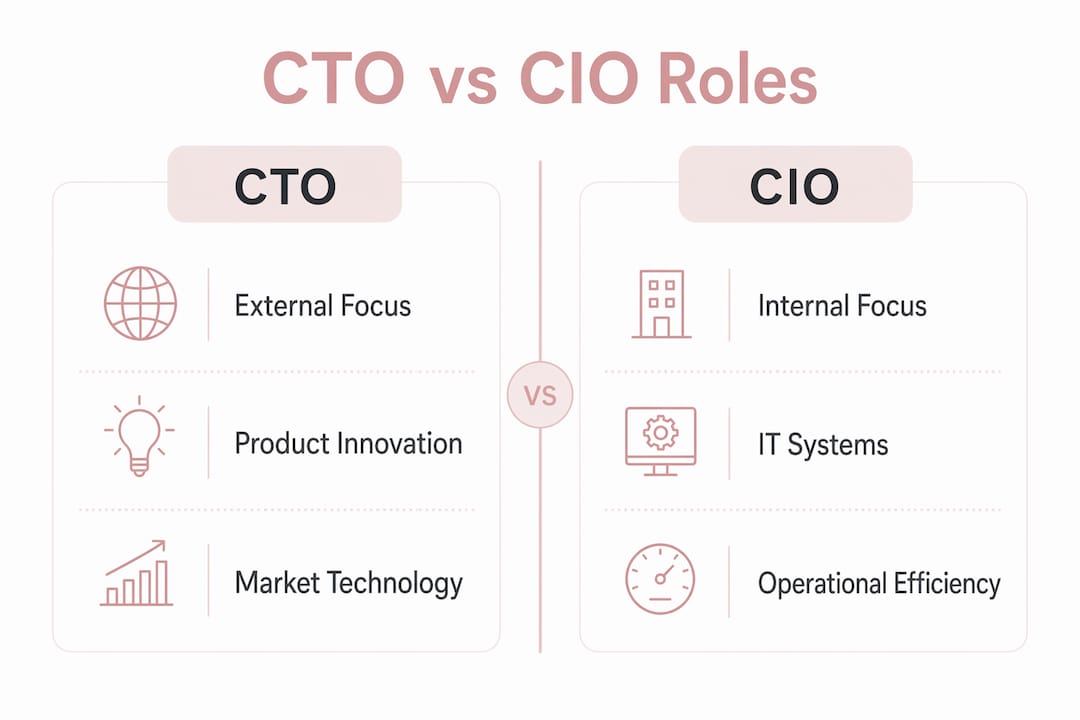
The lines blur in practice. A CTO at a financial services firm carries significant compliance responsibility. A CIO at a software company may own developer tooling. The key is to define ownership explicitly rather than assume the titles carry universal meaning. Startups should prioritize CTO hires focused on customer-facing product technology and delay CIO hiring until internal IT complexity demands it.
What strategic impact does a CTO have on business performance?
The modern CTO is measured by financial outcomes, not engineering throughput. CTOs are now judged by EBITDA and revenue growth rather than by code quality or system uptime. That shift changes how boards hire, evaluate, and retain technology executives. A CTO who cannot speak the language of financial performance will not last long in the boardroom.
Effective CTOs manage AI tool costs and cloud compute as strategic business variables, integrating them directly into financial planning cycles. That means a CTO who approves a cloud migration must also model its impact on gross margin. Technology decisions and financial decisions are the same decision.
The CTO also shapes how the organization reports on technology to its board and investors. Translating complex technical concepts into clear business language for boards is now considered a core CTO competency, not a soft skill. Executives who cannot do this lose credibility and budget authority quickly.
The table below maps the CTO’s strategic contributions to measurable business outcomes:
| CTO Activity | Business Outcome |
|---|---|
| Technology roadmap aligned to revenue goals | Faster product delivery and market share growth |
| Cloud and AI cost governance | Improved gross margin and predictable IT spend |
| Cybersecurity and compliance frameworks | Reduced regulatory risk and lower breach costs |
| Technical debt reduction programs | Higher engineering velocity and lower maintenance cost |
| Board-level technology reporting | Stronger investor confidence and capital allocation |
Technology consulting that supports CTO functions helps organizations connect these activities to measurable growth, particularly when internal leadership capacity is limited.
How can businesses leverage a CTO to drive innovation and growth?
Getting the most from a CTO requires more than hiring the right person. It requires integrating that person into the core of executive decision-making. CTOs who sit outside the strategic planning process produce technology plans that drift from business reality. CTOs who sit inside it produce roadmaps that accelerate growth.
Here is how business leaders can structure that integration effectively:
- Include the CTO in financial planning. Technology budgets set without CTO input produce misaligned priorities. The CTO must own the technology P&L, not just receive a budget allocation.
- Define success in business terms. Set CTO performance metrics around revenue impact, product velocity, and cost efficiency. Avoid measuring purely on technical outputs like system availability or sprint completion.
- Give the CTO board access. CTOs who communicate directly with boards build faster alignment on technology investment priorities and reduce the risk of underfunding critical initiatives.
- Match the CTO profile to company stage. Early-stage companies need generalist CTOs focused on rapid prototyping. Mature organizations need CTOs skilled in governance, vendor ecosystems, and modular architecture.
- Build innovation pipelines with exit criteria. Every technology pilot needs a defined decision point. Without one, failed experiments consume resources indefinitely.
Strategic leadership development for CTOs and their direct reports accelerates the business-technology alignment that boards now expect. The best CTOs combine technical judgment with executive communication skills, and those skills can be developed deliberately.
Pro Tip: CTOs are not necessarily the best coders but excel by balancing business context with technical judgment. Hire for that balance, not for depth in any single technology.
The technology leadership trends shaping 2026 show that the most effective CTOs build systems that continuously modernize technology stacks using AI and automation, rather than personally approving every technical decision. That shift from gatekeeper to system architect defines the modern CTO’s operating model.
Key Takeaways
The role of CTO in business is defined by the ability to translate technology decisions into financial outcomes, not by technical depth alone.
| Point | Details |
|---|---|
| CTO drives financial outcomes | Modern CTOs are evaluated on EBITDA and revenue growth, not engineering metrics. |
| CTO and CIO serve different functions | CTOs focus outward on product and market; CIOs focus inward on IT operations and security. |
| Role split happens at scale | Most organizations separate CTO and CIO roles at 200–300 employees. |
| Business integration is required | CTOs must participate in financial planning and board communications to deliver full value. |
| Company stage shapes the CTO profile | Early-stage firms need generalist CTOs; mature firms need governance-focused executives. |
Why the CTO conversation has changed entirely
I have worked with executive teams across industries, and the pattern I see most often is this: companies hire a CTO for technical credibility and then wonder why the role does not deliver business results. The problem is not the person. It is the mandate.
For years, the CTO was treated as the most senior engineer in the room. Boards wanted someone who could speak to architecture, security, and system reliability. Those things still matter. But they are table stakes now, not differentiators. What boards actually need is an executive who can walk into a budget meeting and defend a $4 million cloud migration in terms of gross margin impact and competitive positioning.
The CTOs I have seen succeed in the last three years share one trait: they own the economics of their technology stack. They know what every major system costs, what it produces, and what it would cost to replace it. That knowledge gives them authority in financial conversations that purely technical executives simply do not have.
The other shift I keep observing is the move away from the CTO as gatekeeper. The best technology leaders I know build systems for impermanence, designing stacks that can adopt and replace tools without operational disruption. That is a fundamentally different mindset from the executive who protects a legacy architecture because it is familiar.
If you are a business leader evaluating your technology leadership, ask one question: can your CTO explain your technology roadmap in terms your CFO finds compelling? If the answer is no, the gap is not technical. It is executive.
— Orloff
How Orloffphillips supports executive teams with technology leadership
Executive teams that need CTO-level thinking without a full-time hire have a proven path forward. Orloffphillips works with mid-sized and large organizations across the United States to provide strategic IT leadership that connects technology decisions to business performance.
Orloffphillips brings fractional CTO and virtual technology executive services to organizations that need board-ready technology strategy, vendor governance, and IT roadmapping without the cost or timeline of a permanent hire. The approach is built around measurable outcomes: revenue alignment, cost governance, and executive communication that boards trust. If your organization is ready to close the gap between technology investment and business results, Orloffphillips delivers the leadership to make that happen.
FAQ
What does a CTO do in a business?
A CTO defines and executes the technology strategy that supports business growth, manages technology investments, leads engineering teams, and communicates technology priorities to the board and executive leadership.
How does the role of CTO differ from the CIO?
The CTO focuses on external, customer-facing technology and product innovation, while the CIO manages internal IT systems, security, and operational infrastructure. Most organizations separate these roles at 200–300 employees.
Why is the CTO important for business growth?
The CTO connects technology spending to revenue and margin outcomes, governs AI and cloud costs as financial variables, and builds the innovation pipelines that create competitive advantage over time.
What skills should a CTO have beyond technical expertise?
The most effective CTOs combine business-technology judgment with executive communication skills, financial literacy, and the ability to align engineering decisions with board-level investment priorities.
When should a company hire a dedicated CTO?
A company should hire a dedicated CTO when product technology becomes a primary driver of revenue or competitive differentiation, typically before or during a significant phase of product-led growth.
Leave a Reply