Author: Orloff Phillips

  • Organizing Leadership Workshops 2026: A Practical Guide

    Organizing Leadership Workshops 2026: A Practical Guide

    Organizing leadership workshops is the process of designing and executing structured learning experiences that develop specific leadership behaviors tied to real business challenges. The best programs in 2026 go far beyond a single training day. They integrate behavioral assessments, experiential practice, and post-workshop accountability to produce measurable change. Only 24% of leadership professionals measure business impact from training, while 92% measure only learner reactions. That gap is exactly what separates forgettable workshops from ones that actually shift how leaders lead.

    How to plan leadership workshops with clear, measurable outcomes

    The first step in planning any leadership development event is diagnosing the real business problem you are trying to solve. A workshop built around vague goals like “improve communication” produces vague results. Write specific behavioral outcomes instead: what should a participant do differently 90 days after the session ends?

    Stakeholder interviews are non-negotiable at this stage. Talk to direct managers, HR partners, and senior leaders before you design a single slide. Their input shapes the charter, which defines scope, success criteria, and budget. For multi-day retreats, plan 6–9 months ahead to allow time for pre-work, logistics, and participant preparation. Shorter half-day workshops can move faster, but still need 6–8 weeks of runway.

    Stakeholder interview in private office

    Participant readiness is a prerequisite, not an afterthought. Sending behavioral assessments like DiSC or CliftonStrengths before the event gives participants time to reflect. That reflection makes the workshop conversation richer and more personal from the first hour.

    Key planning steps to complete before design begins:

    • Define 2–3 specific behavioral outcomes tied to a named business challenge
    • Complete stakeholder interviews and document a workshop charter
    • Select and distribute pre-work assessments at least 3 weeks before the event
    • Confirm timeline: 6–9 months for retreats, 6–8 weeks minimum for workshops
    • Identify a sponsor who will reinforce learning after the event ends

    Pro Tip: Write your success metrics before you write your agenda. If you cannot describe what “success” looks like in behavioral terms, your design will drift toward content delivery instead of behavior change.

    What assessment tools and design frameworks maximize engagement?

    Behavioral assessment data is the foundation of a personalized workshop. Tools like DiSC, CliftonStrengths, and 360-degree feedback give facilitators concrete data to work with. They also give participants a shared language for discussing differences in communication style, decision-making, and conflict response. That shared language accelerates trust and makes difficult conversations feel safer.
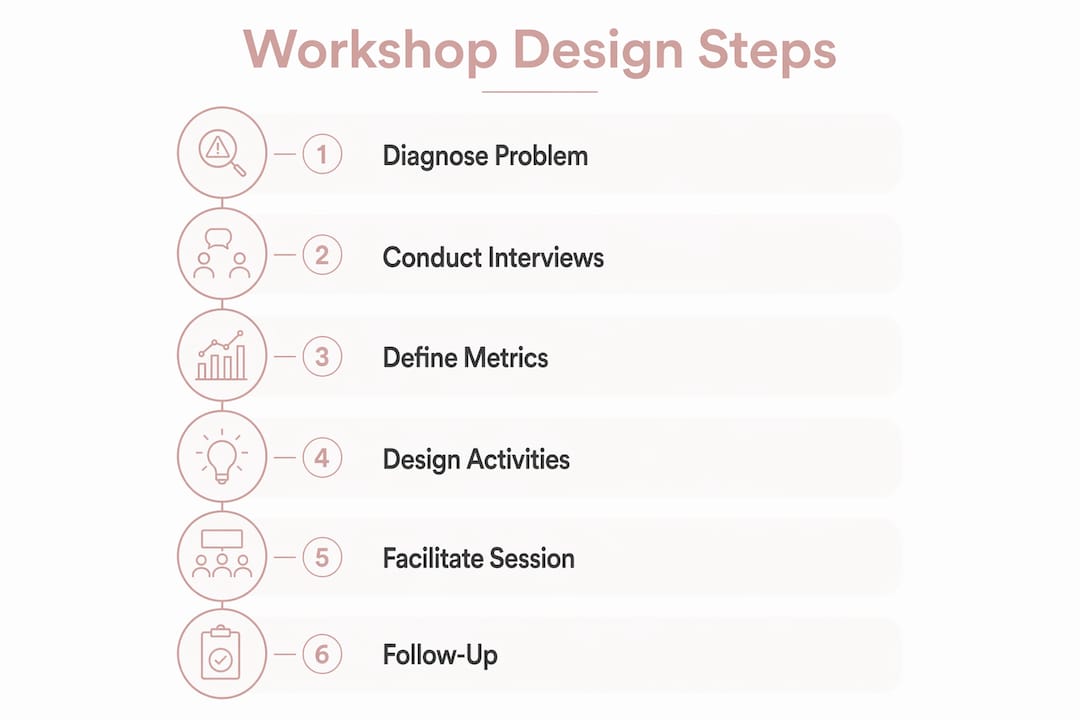
    Infographic showing leadership workshop design steps

    Session design must prioritize doing over listening. Limit passive instruction to no more than 30–40% of total session time. The remaining time goes to role-playing, peer discussion, real-scenario problem-solving, and commitment planning. This ratio reflects the 70-20-10 development model, which places most learning in experience and social interaction rather than formal instruction.

    The 4A Model, developed by Jennifer Britton, offers a practical framework for session flow:

    1. Anchor: Connect new content to participants’ existing experience and assessment data
    2. Advance: Introduce the core concept or skill with minimal lecture time
    3. Apply: Practice the skill through a real workplace scenario or role-play
    4. Activate: Commit to a specific behavior change with a named accountability partner

    The 4A Model recommends interaction every 7–10 minutes and limits each session to three core takeaways. More than three and retention drops sharply.

    Design elementBest practice
    Passive instructionNo more than 30–40% of session time
    Experiential activitiesRole-play, peer coaching, live problem-solving
    Interaction frequencyEvery 7–10 minutes
    Core takeaways per sessionMaximum 3
    Psychological safetyNamed explicitly at session open

    Psychological safety is not a soft concept. It is a design requirement. Name it at the start of every session. Tell participants what is expected of them and what is off-limits in terms of judgment or ridicule. Without it, leaders will not take the risks that produce real learning.

    Pro Tip: Pair DiSC or CliftonStrengths data with a real team challenge participants are currently facing. Abstract exercises teach abstract lessons. Real problems teach real skills.

    For additional leadership workshop ideas that connect assessment data to team outcomes, Orloffphillips has published a practical resource worth reviewing before you finalize your design.

    How to execute and facilitate workshops that hold attention

    Open every workshop with an assessment debrief, not a welcome slide. When participants see their own behavioral data on screen in the first 20 minutes, attention sharpens immediately. They stop thinking about their inbox and start thinking about themselves. That shift is the facilitator’s most powerful tool.

    Use custom materials built around your organization’s actual challenges. Generic case studies produce generic insights. When a scenario mirrors a real decision a participant made last quarter, the learning sticks. Work with your stakeholders during planning to gather two or three real situations that can be anonymized and used as workshop cases.

    A sample half-day agenda (4 hours) looks like this:

    Time blockActivity
    8:00–8:30 AMWelcome, norms, and assessment debrief
    8:30–9:30 AMCore skill introduction with peer discussion
    9:30–10:30 AMApplied scenario role-play and debrief
    10:30–10:45 AMBreak
    10:45–11:30 AMCommitment planning and accountability pairs
    11:30 AM–12:00 PMWrap-up, Q&A, and next-step assignments

    Dynamic facilitation means naming what you observe. When a participant demonstrates a behavior that illustrates the session’s concept, call it out in real time. That specificity turns abstract theory into lived experience. It also signals to the group that the facilitator is paying close attention, which raises everyone’s engagement.

    Pro Tip: Assign accountability partners during the workshop, not after. Pairs formed in the room carry more social weight than ones assigned by email a week later.

    What follow-up strategies sustain learning after the workshop ends?

    87% of leadership skills learned are lost within 90 days without structured reinforcement. That number is not a warning. It is a design constraint. Build your follow-up plan before the workshop runs, not after.

    The most critical window is the first two weeks. Scheduling a follow-up within 14 days prevents the forgetting curve from erasing the workshop’s gains. This follow-up can be a group check-in call, a one-on-one coaching session, or a structured peer conversation. The format matters less than the timing.

    Accountability architecture includes visible, public commitments and scheduled behavior-change check-ins at 30, 90, and 180 days. Structured accountability multiplies the likelihood that new skills actually transfer to daily work.

    Build your reinforcement calendar into the workshop design from day one:

    • Day 1–14: Individual coaching session or group check-in call
    • Day 30: Peer accountability partner conversation with a structured prompt
    • Day 90: Manager check-in tied to the behavioral outcomes defined in planning
    • Day 180: Team-level outcome review against organizational KPIs

    Measurement must go beyond completion rates. Leadership evaluation should be multidimensional, tracking behavioral change, team engagement scores, and organizational KPIs. Completion rates and satisfaction surveys are vanity metrics. They tell you people attended and enjoyed themselves. They do not tell you whether anyone leads differently. For a deeper look at measuring business outcomes, Orloffphillips has published a guide specifically for leaders navigating this measurement challenge.

    Which leadership workshop themes matter most in 2026?

    Leadership development in 2026 requires skills that did not appear on most training agendas three years ago. Managing AI-augmented teams, leading through rapid change, and making decisions under uncertainty are now front-line leadership challenges, not executive-level abstractions.

    The most impactful leadership workshop themes for 2026 include:

    • Strategic decision-making under uncertainty: How to move fast with incomplete information
    • Managing hybrid and AI-augmented teams: Setting expectations, maintaining culture, and evaluating performance across distributed and automated workflows
    • Emotional intelligence under pressure: Recognizing and regulating emotional responses during conflict or crisis
    • Change management: Leading teams through organizational shifts without losing trust or momentum
    • Communication under pressure: Delivering difficult messages clearly and with credibility
    • Inclusive leadership: Building teams where different perspectives are heard and used
    • Adaptive leadership: Adjusting style and approach based on team needs and context

    Align your theme selection to the specific challenges your stakeholders named during planning. A theme that resonates with your organization’s current reality will always outperform a generic curriculum. Blend technical, interpersonal, and self-awareness modules across the program. Leaders who only develop one dimension plateau quickly.

    For context on how business strategy consulting intersects with leadership development planning, Kontrol Media Consultancy offers a useful 2026 perspective worth reading alongside your theme selection process.

    Key Takeaways

    Effective leadership workshops require behavioral outcomes, experiential design, and structured follow-up accountability to produce lasting change and measurable business results.

    PointDetails
    Define behavioral outcomes firstWrite specific, 90-day behavioral goals before designing any content or agenda.
    Limit passive instructionKeep lecture time below 40% and fill the rest with role-play and peer practice.
    Follow up within 14 daysA check-in in the first two weeks prevents the forgetting curve from erasing gains.
    Measure beyond satisfactionTrack behavioral change, team engagement, and KPIs, not just completion rates.
    Align themes to 2026 challengesPrioritize AI team management, emotional intelligence, and adaptive leadership content.

    What I have learned from running leadership workshops that actually work

    Most leadership workshops fail for the same reason: organizers treat them as events instead of ecosystems. You run a great day, people leave energized, and then nothing changes. The manager never reinforces the skills. There is no follow-up. The accountability partner conversation never happens. Six months later, the organization runs another workshop and wonders why the culture has not shifted.

    The uncomfortable truth is that a workshop without a reinforcement plan is just an expensive morale boost. I have seen organizations spend significant budget on facilitation and materials, then allocate nothing to coaching or check-ins. That is backwards. The workshop is the spark. The follow-up is the fuel.

    Psychological safety is the other variable that most planners underestimate. You can have the best assessment data, the sharpest facilitator, and the most relevant case studies. If participants do not feel safe enough to be honest about their gaps, none of it lands. Building safety is not a soft skill. It is a technical design decision. Name it, structure it, and protect it throughout the session.

    My strongest recommendation: go deep on fewer topics. Three skills practiced well will change behavior. Ten skills surveyed quickly will change nothing. Depth beats breadth every time in leadership development. Pair that depth with inclusive leadership strategies that make every participant feel the content applies to them, and you have a program worth running.

    — Orloff

    How Orloffphillips supports leadership workshop planning and execution

    Orloffphillips works with mid-sized and large organizations across the United States to design and deliver leadership development programs that produce real behavioral change. The team brings fractional executive experience to workshop planning, which means you get senior-level design thinking without a full-time commitment.
    https://orloffphillips.com

    Services include custom workshop design, behavioral assessment integration, facilitation, and post-workshop coaching. Orloffphillips also offers fractional CXO advisory support for organizations that need ongoing leadership strategy beyond a single event. If you are planning 2026 leadership development events and want a program built around measurable outcomes rather than attendance numbers, Orloffphillips is a practical next step. Visit the leadership workshop ideas page to see how the approach translates into program design.

    FAQ

    What is the ideal timeline for planning a leadership workshop?

    Plan multi-day retreats 6–9 months in advance and shorter workshops at least 6–8 weeks out. That lead time allows for stakeholder alignment, assessment distribution, and material customization.

    How much of a workshop should be experiential vs. lecture-based?

    Limit passive instruction to 30–40% of session time. The remaining time should go to role-playing, peer discussion, and applied problem-solving to anchor skills in real workplace behavior.

    Why do leadership skills fade so quickly after training?

    87% of skills are lost within 90 days without reinforcement. Structured follow-up at 14 days, 30 days, and 90 days is the primary defense against this skill attrition.

    What are the most important leadership workshop themes for 2026?

    Managing AI-augmented teams, emotional intelligence, adaptive leadership, and strategic decision-making under uncertainty are the highest-priority themes for 2026 leadership training sessions.

    How do you measure whether a leadership workshop actually worked?

    Track behavioral change, team engagement scores, and organizational KPIs rather than satisfaction surveys. Multidimensional evaluation built into the design from the start produces the most credible results.

  • The Role of Keynote Speaking in Leadership

    The Role of Keynote Speaking in Leadership

    Keynote speaking in leadership is defined as the deliberate use of high-stakes public address to shape organizational direction, build executive credibility, and accelerate culture change. The role of keynote speaking in leadership extends well beyond motivation. It functions as a strategic communication tool that drives alignment and trust across entire organizations. Research confirms that effective leadership speaking directly correlates with improved employee engagement, performance, and culture. Orloffphillips works with executives who understand this connection and want to use it deliberately.

    How does keynote speaking influence leadership effectiveness?

    Executive presence is not a personality trait. It is a set of observable behaviors, and keynote speaking is one of the most direct ways to demonstrate it. Audiences evaluate confidence, authenticity, and authority within seconds of a speaker taking the stage. That rapid subconscious judgment shapes how teams perceive a leader’s credibility for weeks afterward.

    Public speaking activates a feedback loop between the speaker and the audience. When a leader delivers a clear, well-structured message under pressure, the audience reads that as competence. When the message is vague or the delivery hesitant, trust erodes fast. This is why effective communication in leadership is now treated as a strategic skill, not a soft one.

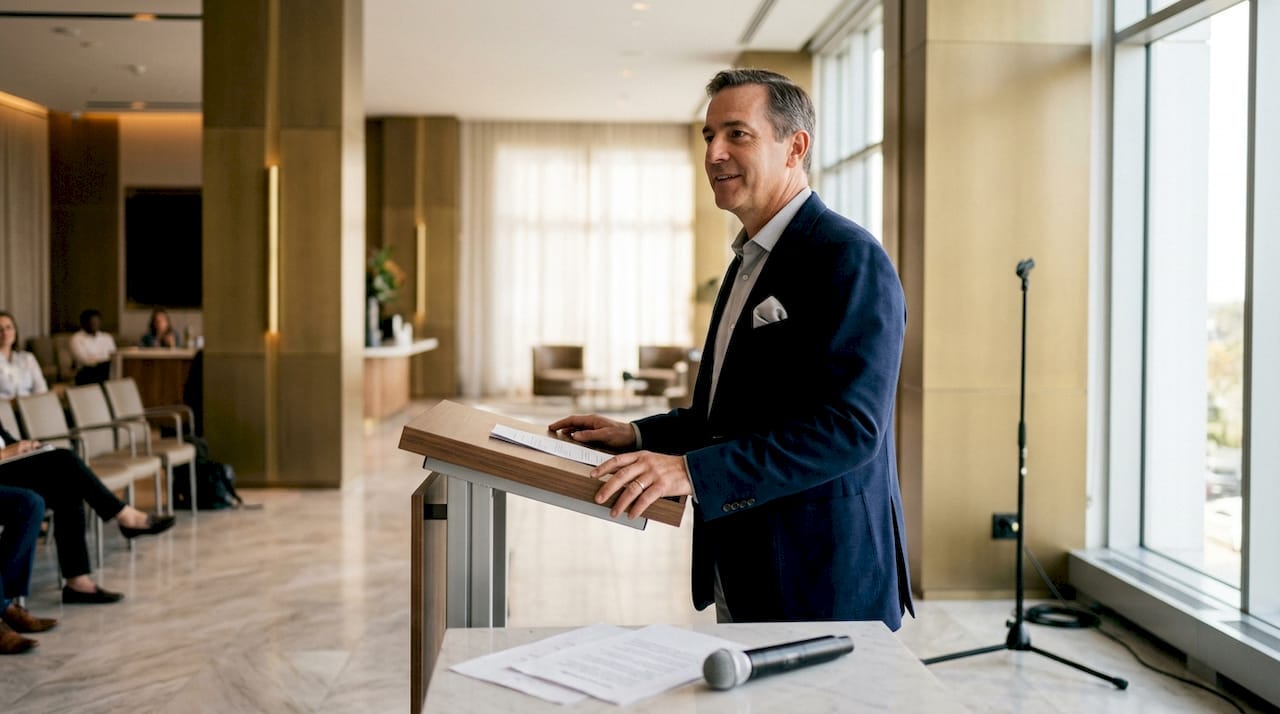
    Executive delivering keynote speech at podium side view

    Keynote speaking also sharpens a leader’s ability to communicate under pressure. Preparing a keynote forces clarity. You cannot hide behind a committee report or a slide deck when you are the only person at the front of the room. That discipline carries directly into board meetings, investor calls, and crisis communications.

    Pro Tip: Record every keynote you deliver, then review it without sound. Watch your body language, pacing, and stage presence. What you see is exactly what your audience experienced.

    • Leaders who speak publicly with regularity report stronger team engagement and faster decision cycles.
    • Keynote preparation builds message discipline that transfers to all leadership communication.
    • Audiences distinguish between performed confidence and lived experience within the first few minutes.
    • Speakers with practitioner backgrounds, such as former executives or consultants, carry measurably higher credibility in change management contexts.

    What role do keynote speakers play in organizational change?

    Keynote speakers act as external validators of internal strategy. When a CEO announces a cultural shift, teams often wait to see if it sticks. When a credible outside voice delivers the same message with evidence and narrative, the shift accelerates. Leadership keynotes serve as catalysts for alignment, giving teams shared language they carry into daily work long after the event ends.

    The amplifying effect is measurable. 65% of organizations report that keynote messages are reinforced internally by leadership for 1–6 weeks after the event when the engagement is well integrated. That reinforcement window is where real culture change happens. A single keynote does not change behavior. Repeated references to its frameworks in meetings, communications, and decisions do.

    External keynotes also outperform internal communications in one specific way: they carry no political baggage. An internal memo from the C-suite arrives with context, history, and skepticism. A well-chosen external speaker arrives with none of that. The message lands cleaner.

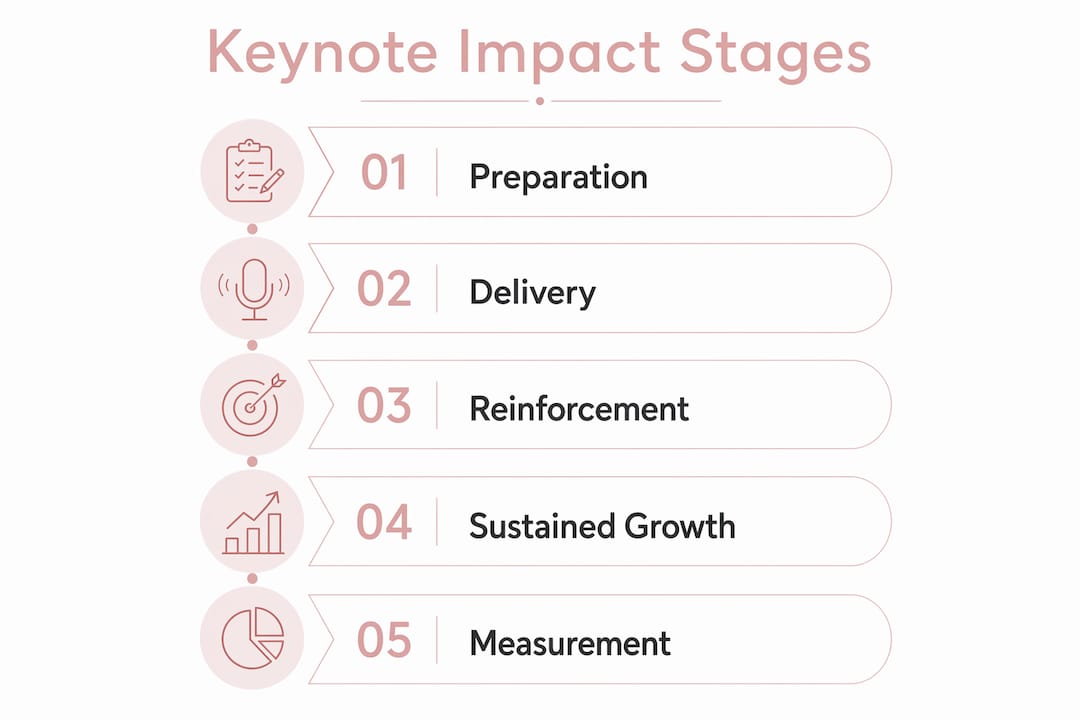
    Infographic detailing stages of keynote speaking impact in leadership

    Pro Tip: Brief your keynote speaker on your organization’s specific language, current challenges, and strategic priorities at least two weeks before the event. Generic talks produce generic results.

    Impact AreaWhat the Research Shows
    Message reinforcement65% of organizations reinforce keynote messages internally for 1–6 weeks post-event
    ROI potentialOrganizations report returns up to five times the speaker’s fee when keynotes align with audience needs
    Culture alignmentLeaders aligned with speaker priorities report stronger shifts in culture metrics
    Change managementPractitioners with lived experience produce higher reception and effectiveness
    Post-event impactHighest ROI occurs when speaker frameworks are referenced repeatedly in meetings

    What do modern CEOs expect from keynote speaking?

    The expectations of executives have shifted sharply. CEOs now demand “substance-first” keynotes that deliver measurable outcomes, including improved decision-making and stronger cultural alignment. Entertainment value alone no longer justifies the investment. The KPIs executives track after a keynote include leadership consistency, communication under pressure, and retention of session content.

    The role of executive leadership in 2026 has grown more complex. Hybrid teams, AI adoption, and market volatility have created communication gaps that keynotes are uniquely positioned to close. Executives want speakers who address these realities directly, not speakers who recycle frameworks from a decade ago.

    Here is what the most effective keynote engagements deliver for executive audiences:

    • Customization: The speaker references the organization’s actual challenges, not generic industry trends.
    • Credibility: The speaker has operated at the executive level or navigated the specific challenge being discussed.
    • Actionability: Attendees leave with frameworks they can apply in their next leadership conversation.
    • Alignment: The keynote message connects directly to the organization’s stated strategy or transformation goals.
    • Measurement: Success metrics are defined before the event, not after.

    The selection process matters as much as the event itself. Executives who brief speakers thoroughly, align the keynote with a broader leadership initiative, and plan post-event reinforcement consistently report higher returns. Those who treat keynotes as standalone events rarely see lasting change.

    How can leaders maximize the impact of keynote speaking?

    The highest-performing keynote engagements follow a deliberate process before, during, and after the event. Transformational keynotes prioritize cognitive, emotional, and behavioral engagement to produce durable change. Experiential and interactive formats running 60–90 minutes consistently outperform shorter, purely motivational talks.

    1. Define the outcome first. Decide what behavior or belief should change before you select a speaker. Work backward from that outcome to identify the right message and format.
    2. Vet for practitioner experience. Speakers with practitioner backgrounds carry greater credibility, especially when communicating difficult change. Ask for examples of how they have navigated the challenge they will speak about.
    3. Integrate, do not isolate. Place the keynote within a broader leadership initiative. A keynote that sits alone in the calendar produces a spike in motivation and nothing else.
    4. Create shared vocabulary. After the event, require leadership to reference the speaker’s frameworks in meetings and written communications. The highest ROI occurs when this shared vocabulary persists for weeks.
    5. Measure the 4–6 week window. Track leadership behavior change in the month following the event. Survey teams on message retention and observe whether the keynote’s language appears in day-to-day decisions.
    6. Use interactive formats. Peer discussion, live problem-solving, and Q&A segments increase retention and behavioral follow-through far more than passive listening.

    Pro Tip: Avoid the “inspiration trap.” If your post-event survey only measures how energized people felt, you are measuring the wrong thing. Measure whether the frameworks appeared in the next leadership cycle.

    Overcoming the fear of public speaking is also part of this equation for leaders who want to deliver keynotes themselves. Building confidence on stage is a learnable skill, and leaders who invest in it gain a communication advantage that compounds over time. Public speaking training is now central to leadership development because communication is how leaders unite teams and drive change, not just inform them.

    Key Takeaways

    Keynote speaking in leadership produces its highest impact when it is integrated into a broader strategy, reinforced by leadership language, and measured against behavioral outcomes, not just audience satisfaction.

    PointDetails
    Keynotes build executive presenceAudiences evaluate a leader’s credibility within seconds, making delivery and substance equally critical.
    Reinforcement drives ROI65% of organizations reinforce keynote messages for 1–6 weeks post-event, which is where culture change takes hold.
    Substance over spectacleCEOs now measure keynote success by leadership consistency, decision quality, and message retention.
    Practitioner speakers outperformSpeakers with lived executive experience produce stronger reception and behavioral change in change management contexts.
    Integration multiplies impactOrganizations report returns up to five times the speaker’s fee when keynotes align with strategy and are reinforced afterward.

    Why I think most organizations underuse keynote speaking

    Most organizations treat keynote speaking as an event. They book a speaker, fill a room, collect feedback forms, and move on. That approach wastes most of the investment.

    What I have seen work, consistently, is treating the keynote as a launch point for a communication campaign. The speaker’s frameworks become the language of the next leadership cycle. The message gets referenced in one-on-ones, embedded in team meetings, and woven into how the executive team talks about strategy. That is when a keynote stops being a moment and starts being a mechanism.

    The other mistake I see is prioritizing name recognition over fit. A famous speaker who delivers a generic talk to your specific team produces less change than a less-known practitioner who has actually solved the problem your organization is facing. Credibility is contextual. Audiences know the difference, and they decide within the first few minutes whether to trust what they are hearing.

    Executives who treat inclusive leadership strategies and keynote speaking as separate disciplines miss the compounding effect. When a keynote reinforces the same values your leadership development program is building, the message lands harder and sticks longer.

    The leaders I respect most are the ones who invest in their own speaking ability as seriously as they invest in hiring external speakers. Both matter. One builds organizational culture. The other builds personal authority. You need both to lead effectively in 2026.

    — Orloff

    How Orloffphillips supports leadership communication and transformation

    Keynote speaking creates the spark. Sustaining that momentum requires the right leadership infrastructure behind it.

    https://orloffphillips.com

    Orloffphillips works with mid-sized to large organizations across the United States to build that infrastructure. From strategic IT leadership to business transformation planning, the firm’s fractional executive services help leadership teams embed the messages, frameworks, and behaviors that keynotes introduce. If your organization is navigating a technology shift, a cultural realignment, or a growth inflection point, Orloffphillips provides the experienced executive guidance to make that change stick well beyond the event itself.

    FAQ

    What is the role of keynote speaking in leadership?

    Keynote speaking in leadership is a strategic communication tool that builds executive presence, aligns organizations around shared language, and accelerates culture change. It functions as both a personal credibility signal and an organizational alignment mechanism.

    How does keynote speaking benefit organizational growth?

    When keynote messages are reinforced by leadership in the weeks following an event, organizations see measurable shifts in culture metrics, decision quality, and team alignment. Returns of up to five times the speaker’s fee are reported when keynotes align with strategy and are followed up consistently.

    What do CEOs look for in a leadership keynote?

    CEOs increasingly prioritize substance over inspiration, seeking keynotes that deliver measurable outcomes such as improved decision-making, stronger cultural alignment, and practical frameworks their teams can apply immediately.

    How long does keynote impact last in an organization?

    The critical reinforcement window is 4–6 weeks post-event. Organizations that actively reference the speaker’s frameworks in meetings and communications during this period see the most durable behavioral change.

    Should leaders develop their own keynote speaking skills?

    Yes. Effective leadership speaking is now recognized as a core executive skill that directly correlates with employee engagement, trust, and organizational performance. Leaders who invest in their own public speaking ability build a communication advantage that strengthens every aspect of their leadership.

  • The Role of CTO in Business: A Leader’s Guide

    The Role of CTO in Business: A Leader’s Guide

    The Chief Technology Officer (CTO) is defined as the executive responsible for aligning an organization’s technology strategy with its business goals to drive growth and competitive advantage. The role of CTO in business has shifted far beyond managing software teams or approving infrastructure budgets. Demand for strategically minded CTOs increased by 150% from 2023 to 2026 as boards push for executives who can translate corporate vision into technology outcomes. That shift reflects a broader truth: technology is no longer a support function. It is the engine of business performance, and the CTO is the driver.

    What are the core responsibilities of a CTO in business?

    The CTO’s primary job is to build and execute a technology roadmap that serves business objectives, not just engineering goals. That distinction separates effective CTOs from technically skilled executives who struggle at the leadership level. IT investments have risen by over 40%, but organizations without dedicated CTO leadership consistently accumulate technical debt and operational inefficiency. The CTO prevents that waste by governing how technology dollars are spent and why.

    The core CTO responsibilities in business fall into five areas:

    • Technology strategy: Define a multi-year roadmap that connects technology decisions to revenue, margin, and market positioning.
    • Innovation leadership: Identify emerging technologies, run disciplined pilots, and build pipelines that move ideas from concept to production.
    • Governance and security: Own compliance frameworks, cybersecurity posture, and ethical AI governance across the organization.
    • Financial stewardship: Manage cloud costs, vendor contracts, and R&D budgets as business variables tied to EBITDA outcomes.
    • Talent and culture: Recruit engineering leaders, set technical standards, and shape a culture where quality and speed coexist.

    Each of these areas requires the CTO to operate at the intersection of technology and business judgment. The role is not about writing the best code. It is about making the right calls at the right time.

    Pro Tip: When evaluating a CTO candidate, ask how they have managed a technology decision that hurt short-term engineering quality but accelerated a business outcome. The answer reveals whether they think like an executive or an engineer.

    Team discussing CTO responsibilities around table

    How does the CTO role differ from the CIO?

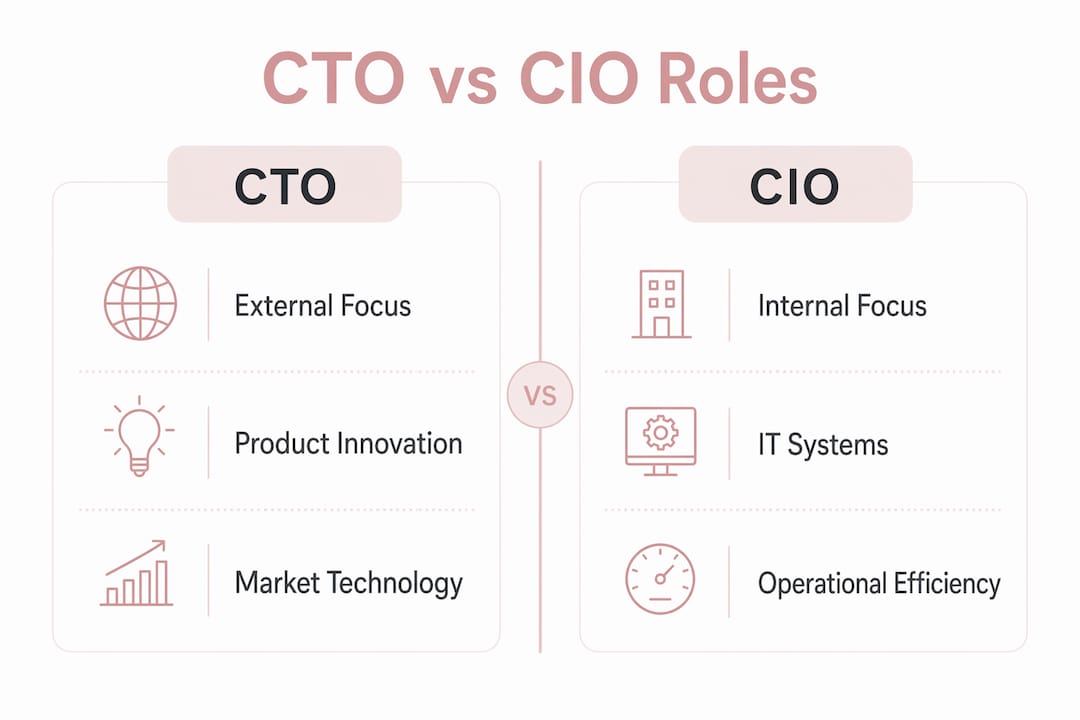
    The CTO and CIO are both technology executives, but they face in opposite directions. The CTO focuses outward on product technology, customer-facing systems, and market innovation. The CIO focuses inward on internal IT infrastructure, enterprise systems, and operational security. Confusing the two roles costs organizations both money and strategic clarity.

    Companies generally split these roles at 200–300 employees, when internal IT complexity and external product demands both require dedicated leadership. Below that threshold, one executive often covers both functions. Above it, the overlap creates conflict without clear ownership.

    DimensionCTOCIO
    Primary focusExternal: product and market technologyInternal: IT systems and operations
    Key metricRevenue growth, product velocityUptime, security, cost per user
    Innovation roleDrives new technology adoptionManages existing technology stability
    Board interactionTechnology strategy and investmentRisk, compliance, and IT governance
    Typical hire timingEarly stage or product-led growthPost-200 employees or regulated industries

    Infographic comparing CTO and CIO roles

    The lines blur in practice. A CTO at a financial services firm carries significant compliance responsibility. A CIO at a software company may own developer tooling. The key is to define ownership explicitly rather than assume the titles carry universal meaning. Startups should prioritize CTO hires focused on customer-facing product technology and delay CIO hiring until internal IT complexity demands it.

    What strategic impact does a CTO have on business performance?

    The modern CTO is measured by financial outcomes, not engineering throughput. CTOs are now judged by EBITDA and revenue growth rather than by code quality or system uptime. That shift changes how boards hire, evaluate, and retain technology executives. A CTO who cannot speak the language of financial performance will not last long in the boardroom.

    Effective CTOs manage AI tool costs and cloud compute as strategic business variables, integrating them directly into financial planning cycles. That means a CTO who approves a cloud migration must also model its impact on gross margin. Technology decisions and financial decisions are the same decision.

    The CTO also shapes how the organization reports on technology to its board and investors. Translating complex technical concepts into clear business language for boards is now considered a core CTO competency, not a soft skill. Executives who cannot do this lose credibility and budget authority quickly.

    The table below maps the CTO’s strategic contributions to measurable business outcomes:

    CTO ActivityBusiness Outcome
    Technology roadmap aligned to revenue goalsFaster product delivery and market share growth
    Cloud and AI cost governanceImproved gross margin and predictable IT spend
    Cybersecurity and compliance frameworksReduced regulatory risk and lower breach costs
    Technical debt reduction programsHigher engineering velocity and lower maintenance cost
    Board-level technology reportingStronger investor confidence and capital allocation

    Technology consulting that supports CTO functions helps organizations connect these activities to measurable growth, particularly when internal leadership capacity is limited.

    How can businesses leverage a CTO to drive innovation and growth?

    Getting the most from a CTO requires more than hiring the right person. It requires integrating that person into the core of executive decision-making. CTOs who sit outside the strategic planning process produce technology plans that drift from business reality. CTOs who sit inside it produce roadmaps that accelerate growth.

    Here is how business leaders can structure that integration effectively:

    1. Include the CTO in financial planning. Technology budgets set without CTO input produce misaligned priorities. The CTO must own the technology P&L, not just receive a budget allocation.
    2. Define success in business terms. Set CTO performance metrics around revenue impact, product velocity, and cost efficiency. Avoid measuring purely on technical outputs like system availability or sprint completion.
    3. Give the CTO board access. CTOs who communicate directly with boards build faster alignment on technology investment priorities and reduce the risk of underfunding critical initiatives.
    4. Match the CTO profile to company stage. Early-stage companies need generalist CTOs focused on rapid prototyping. Mature organizations need CTOs skilled in governance, vendor ecosystems, and modular architecture.
    5. Build innovation pipelines with exit criteria. Every technology pilot needs a defined decision point. Without one, failed experiments consume resources indefinitely.

    Strategic leadership development for CTOs and their direct reports accelerates the business-technology alignment that boards now expect. The best CTOs combine technical judgment with executive communication skills, and those skills can be developed deliberately.

    Pro Tip: CTOs are not necessarily the best coders but excel by balancing business context with technical judgment. Hire for that balance, not for depth in any single technology.

    The technology leadership trends shaping 2026 show that the most effective CTOs build systems that continuously modernize technology stacks using AI and automation, rather than personally approving every technical decision. That shift from gatekeeper to system architect defines the modern CTO’s operating model.

    Key Takeaways

    The role of CTO in business is defined by the ability to translate technology decisions into financial outcomes, not by technical depth alone.

    PointDetails
    CTO drives financial outcomesModern CTOs are evaluated on EBITDA and revenue growth, not engineering metrics.
    CTO and CIO serve different functionsCTOs focus outward on product and market; CIOs focus inward on IT operations and security.
    Role split happens at scaleMost organizations separate CTO and CIO roles at 200–300 employees.
    Business integration is requiredCTOs must participate in financial planning and board communications to deliver full value.
    Company stage shapes the CTO profileEarly-stage firms need generalist CTOs; mature firms need governance-focused executives.

    Why the CTO conversation has changed entirely

    I have worked with executive teams across industries, and the pattern I see most often is this: companies hire a CTO for technical credibility and then wonder why the role does not deliver business results. The problem is not the person. It is the mandate.

    For years, the CTO was treated as the most senior engineer in the room. Boards wanted someone who could speak to architecture, security, and system reliability. Those things still matter. But they are table stakes now, not differentiators. What boards actually need is an executive who can walk into a budget meeting and defend a $4 million cloud migration in terms of gross margin impact and competitive positioning.

    The CTOs I have seen succeed in the last three years share one trait: they own the economics of their technology stack. They know what every major system costs, what it produces, and what it would cost to replace it. That knowledge gives them authority in financial conversations that purely technical executives simply do not have.

    The other shift I keep observing is the move away from the CTO as gatekeeper. The best technology leaders I know build systems for impermanence, designing stacks that can adopt and replace tools without operational disruption. That is a fundamentally different mindset from the executive who protects a legacy architecture because it is familiar.

    If you are a business leader evaluating your technology leadership, ask one question: can your CTO explain your technology roadmap in terms your CFO finds compelling? If the answer is no, the gap is not technical. It is executive.

    — Orloff

    How Orloffphillips supports executive teams with technology leadership

    Executive teams that need CTO-level thinking without a full-time hire have a proven path forward. Orloffphillips works with mid-sized and large organizations across the United States to provide strategic IT leadership that connects technology decisions to business performance.

    https://orloffphillips.com

    Orloffphillips brings fractional CTO and virtual technology executive services to organizations that need board-ready technology strategy, vendor governance, and IT roadmapping without the cost or timeline of a permanent hire. The approach is built around measurable outcomes: revenue alignment, cost governance, and executive communication that boards trust. If your organization is ready to close the gap between technology investment and business results, Orloffphillips delivers the leadership to make that happen.

    FAQ

    What does a CTO do in a business?

    A CTO defines and executes the technology strategy that supports business growth, manages technology investments, leads engineering teams, and communicates technology priorities to the board and executive leadership.

    How does the role of CTO differ from the CIO?

    The CTO focuses on external, customer-facing technology and product innovation, while the CIO manages internal IT systems, security, and operational infrastructure. Most organizations separate these roles at 200–300 employees.

    Why is the CTO important for business growth?

    The CTO connects technology spending to revenue and margin outcomes, governs AI and cloud costs as financial variables, and builds the innovation pipelines that create competitive advantage over time.

    What skills should a CTO have beyond technical expertise?

    The most effective CTOs combine business-technology judgment with executive communication skills, financial literacy, and the ability to align engineering decisions with board-level investment priorities.

    When should a company hire a dedicated CTO?

    A company should hire a dedicated CTO when product technology becomes a primary driver of revenue or competitive differentiation, typically before or during a significant phase of product-led growth.

  • Leadership Training Guide for Restaurant Managers

    Leadership Training Guide for Restaurant Managers

    A leadership training guide for restaurant managers is defined as a structured program that builds the management skills, operational knowledge, and coaching habits needed to run a profitable, high-retention restaurant. The industry makes this urgent: only 25% of new restaurant staff remain beyond their first 90 days, and training costs have risen 70% over the past decade. Those numbers mean every untrained or underprepared manager directly threatens your margins. The standard industry term for this discipline is “management development,” and the best programs combine technical operations, financial literacy, and people leadership into one repeatable system.

    What are the essential leadership skills for restaurant managers?

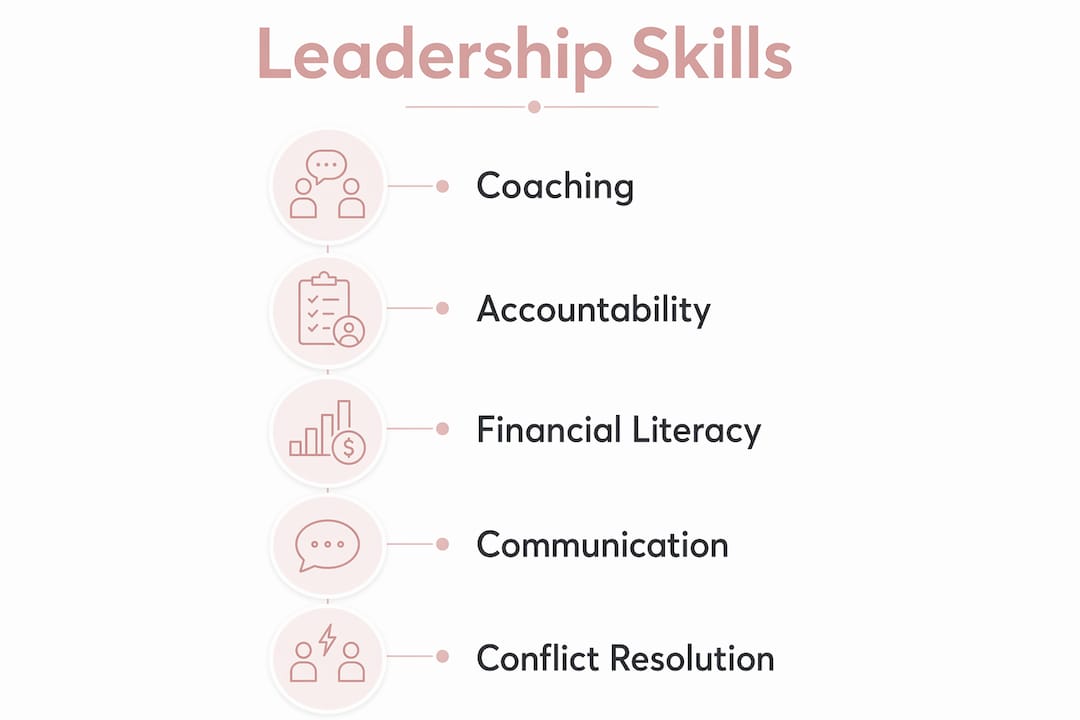
    The four core competencies every restaurant manager must develop are coaching, accountability, financial literacy, and communication. Miss any one of them and the team feels it immediately on the floor.

    Coaching and accountability

    Coaching is not the same as correcting. A manager who only corrects mistakes creates a team that hides problems. A manager who coaches builds a team that surfaces them early. Accountability follows naturally when expectations are written down, reviewed consistently, and tied to real consequences. The transformational and democratic leadership styles produce the strongest retention outcomes because they give staff ownership over their work while keeping standards clear.

    Manager coaching team member in restaurant kitchen

    Financial literacy

    Reading a P&L, tracking labor cost percentage, and managing food cost variance are the skills most often skipped in restaurant management training. That is a costly gap. Managers who understand their numbers protect margins more effectively and make better calls on staffing and ordering. A manager who cannot read a weekly P&L is flying blind on every shift.

    Communication that works in a restaurant

    Restaurant communication is fast, loud, and high-stakes. Managers need to give clear pre-shift briefings, deliver feedback in real time without humiliating staff, and escalate problems to ownership without drama. Written communication matters too. Shift notes, incident logs, and performance records create the paper trail that protects the business legally and operationally.

    Infographic outlining key restaurant manager leadership skills

    Pro Tip: Practice the “24-hour rule” for conflict feedback. Address performance issues within 24 hours while details are fresh, but never in front of guests or other staff.

    Key leadership skills for restaurant managers also include conflict resolution, scheduling judgment, and the ability to read a room during a rush. These are teachable, but only through deliberate practice and structured feedback, not by throwing someone into a manager role and hoping for the best.

    How to structure a phased training program for new managers

    Phased training is the most reliable method for building manager competence without overwhelming new leaders. Each phase has a clear goal, a defined timeline, and a checkpoint before the manager advances.

    1. Phase 1: Shadow and learn. The new manager observes experienced leaders running shifts, handling staff issues, and managing service flow. They ask questions but do not make decisions. This phase typically runs two to four weeks.
    2. Phase 2: Own tasks with backup. The manager takes responsibility for specific duties, such as opening procedures, pre-shift meetings, or inventory counts, while a senior manager remains available. Mistakes happen here, and that is the point. Debrief every shift.
    3. Phase 3: Run shifts independently with review. The manager leads full shifts solo. A weekly review session covers what went well, what broke down, and what the manager will do differently. This phase never fully ends.
    Training phasePrimary focusKey checkpoint
    Phase 1: ShadowObservation and standardsCan describe all core procedures accurately
    Phase 2: Supervised ownershipTask execution with supportCompletes duties without prompting
    Phase 3: Independent leadershipFull shift managementPasses shift review with no critical gaps

    Promoting from within creates a specific challenge. The hardest shift for promoted managers is moving from peer to leader. That transition requires deliberate training on new expectations, accountability, and how to handle the social dynamics of managing former coworkers. Promotion alone does not prepare anyone for that shift. You need a written transition plan that addresses it directly.

    Pro Tip: Give promoted managers a “clean slate conversation” with their former peers on day one. Acknowledge the change openly, set new expectations, and move forward. Silence creates resentment.

    A well-built phased onboarding framework also protects the business from over-reliance on any single manager. When the system is documented and repeatable, losing one manager does not collapse the operation.

    How to use data to drive better manager decisions

    Data-driven management is not a corporate concept. It is a daily practice that separates reactive managers from effective ones. The metrics that matter most in a restaurant are labor cost percentage, food cost variance, table turn times, and callout patterns.

    • Labor cost percentage tells you whether your scheduling matches your actual revenue. A manager who checks this number before building the next week’s schedule makes fewer costly mistakes.
    • Food cost variance reveals waste, theft, and portioning problems before they become margin killers. Track it weekly, not monthly.
    • Table turn times show whether the floor is being managed or just staffed. Slow turns during a rush are a leadership problem, not a kitchen problem.
    • Callout patterns expose disengagement early. Three callouts from the same employee in 30 days is a signal, not a coincidence.

    Point-of-sale analytics and real-time dashboards give managers the visibility to act on these numbers during a shift, not after the fact. That speed matters. A manager who adjusts staffing at 6:00 PM based on reservation data saves labor cost and improves guest experience at the same time.

    High turnover costs nearly $6,000 per employee in the restaurant industry. That figure makes the case for data-driven scheduling and retention tracking as core manager responsibilities, not optional add-ons.

    Building what experienced operators call a “bulletproof communication loop” means tying data to action. The manager sees a metric, interprets it, acts on it, and documents the result. That loop, repeated daily, is what separates a manager who runs the place from one who just shows up for it.

    What ongoing coaching practices retain managers and grow your team?

    Retention of managers requires more than a paycheck. Continuous development programs that include stretch responsibilities, structured feedback, and visible career ladders prevent the plateauing that drives good managers out the door.

    • Weekly one-on-ones are the single highest-leverage tool in a manager’s development. Ten-minute weekly check-ins identify disengaged employees early and give managers a consistent space to raise problems before they escalate. Keep them focused on performance and career path, not just logistics.
    • Cross-training across front and back of house builds empathy and operational range. A front-of-house manager who has worked a line service understands kitchen pressure. That understanding changes how they communicate during a rush.
    • Visible career ladders with clear promotion criteria remove ambiguity. Managers who can see the next step stay longer. Managers who cannot see it leave for places where they can.
    • Documentation as a development tool creates consistency and legal protection. Every coaching conversation, performance review, and policy update should be written down and signed.

    “Managers trained to lead with curiosity rather than authority foster open dialogue, reduce resentment, and improve team morale over time. The question ‘What got in your way?’ produces better results than ‘Why didn’t you do it?’”

    Inclusive leadership approaches that build psychological safety on the floor also reduce the friction that causes good staff to quit. When managers model curiosity and accountability together, the team follows.

    40% of restaurants now use digital onboarding, and the operators who combine digital tools with structured coaching programs see faster time-to-competence for new managers. Technology accelerates the process. Coaching sustains it.

    Key Takeaways

    Effective restaurant manager development requires phased training, financial literacy, data-driven decision making, and continuous coaching to build leaders who retain staff and protect profits.

    PointDetails
    Phased training worksShadow, supervised ownership, and independent leadership phases build competence without overwhelming new managers.
    Financial literacy is non-negotiableManagers who read P&L statements and track labor cost protect margins more effectively than those who do not.
    Data drives daily decisionsTracking labor cost, food cost variance, and callout patterns turns reactive managers into proactive ones.
    Weekly one-on-ones retain talentTen-minute structured check-ins identify disengagement early and keep managers on a clear career path.
    Documentation protects everyoneWritten records of coaching conversations and performance reviews create operational consistency and legal safeguards.

    What I have learned about training restaurant managers

    The most common mistake I see is treating a promotion as the training itself. An operator promotes a strong line cook or server, hands them a set of keys, and assumes competence transfers automatically. It does not. The skills that make someone excellent at their individual job are almost entirely different from the skills that make someone effective at leading others. That gap needs a deliberate bridge, not wishful thinking.

    The second mistake is skipping documentation because it feels bureaucratic. Documentation is not paperwork for its own sake. It is the system that frees a restaurant from depending on any single person’s memory or presence. When standards are written, training is repeatable. When coaching conversations are recorded, there is no ambiguity about what was said or agreed.

    The balance between hands-on management and systems management is where most new managers struggle longest. The instinct is to stay on the floor, do the work yourself, and fix problems directly. The discipline is to delegate small decisions, let staff own their roles, and intervene only when the system breaks. That shift from doer to leader is the hardest one to teach, and the most important one to get right.

    — Orloff

    How Orloffphillips supports restaurant leaders

    Restaurant managers who want to move beyond reactive management need more than a training checklist. They need a framework that connects leadership development to real operational outcomes.

    https://orloffphillips.com

    Orloffphillips works with operators and leadership teams to build the systems, coaching structures, and technology strategies that make management development repeatable and measurable. From digital transformation trends that reshape how managers use data, to leadership workshop frameworks designed for high-pressure service environments, Orloffphillips brings the same rigor it applies to enterprise technology leadership directly to the restaurant floor. If your management team is ready to lead with more confidence and fewer crises, the resources are there.

    FAQ

    What is a leadership training guide for restaurant managers?

    A leadership training guide for restaurant managers is a structured program covering coaching, financial literacy, operations, and communication skills. It gives managers a repeatable system for leading teams and protecting profits.

    How long should restaurant manager training take?

    Phased training typically runs 8–12 weeks, moving from shadowing through supervised task ownership to independent shift management. The review and coaching process continues indefinitely after that.

    What are the most important leadership skills for restaurant managers?

    The most critical skills are coaching, accountability, financial literacy, and clear communication. Transformational and democratic leadership styles produce the strongest retention and operational outcomes.

    How do you train a manager promoted from within?

    Promoted managers need an explicit transition plan that addresses the peer-to-leader shift. Promotion alone does not prepare someone for leadership accountability, so written expectations and structured feedback are required from day one.

    Why do restaurant managers leave, and how does training help?

    Managers leave when they plateau, feel unsupported, or see no clear path forward. Structured development programs with visible career ladders and weekly coaching conversations directly address all three causes.

  • Technology Roadmapping: A Strategic Guide for Leaders

    Technology Roadmapping: A Strategic Guide for Leaders

    Technology roadmapping is defined as a structured planning process that connects an organization’s technology initiatives directly to its business goals, specifying what work gets done, when, why it matters, and who owns it. The industry term for this practice is IT roadmapping, though technology roadmapping has become the standard phrase across executive and consulting circles. Roadmap time horizons typically range from 1 to 5 years, with most organizations focusing on 1–3 year cycles. This guide covers what technology roadmapping entails, how it differs from related planning tools, and the practical steps to build one that delivers measurable results.

    What is technology roadmapping and why does it matter?

    A technology roadmap is the most direct tool for turning abstract business goals into funded, sequenced technology work. Without one, organizations default to reactive spending, where the loudest problem gets the next budget dollar rather than the highest-priority initiative. Formal roadmaps reduce reactive spending by linking IT execution to revenue, cost reduction, and retention metrics. That connection is what separates a technology roadmap from a wish list.

    The process maps where an organization’s technology stands today against where it needs to be, then plots a phased path between those two points. Orloffphillips works with mid-sized and large organizations that have often invested heavily in technology without a clear map, and the pattern is consistent: spending accelerates, outcomes stall. A well-built roadmap reverses that pattern by forcing prioritization before a dollar is committed.

    Hands pointing at technology roadmap timeline print

    Roadmaps also integrate cybersecurity and infrastructure planning, which means risk reduction becomes a planned activity rather than a surprise expense. That alone justifies the investment in building one.

    What are the key components of a technology roadmap?

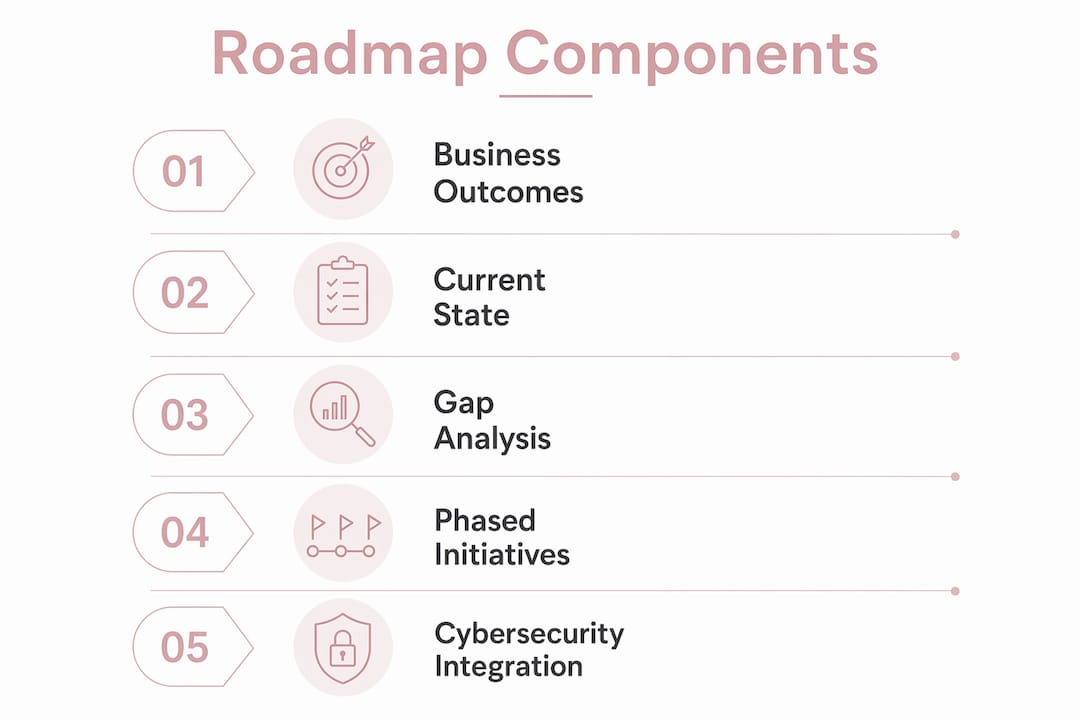
    Every effective technology roadmap contains six core elements. Missing any one of them produces a document that looks like a plan but functions like a calendar.

    • Business outcomes: The 3–5 quantified goals the roadmap exists to support, such as reducing operating costs by a specific percentage or reaching a new customer segment by a target date.
    • Current state assessment: An honest inventory of existing technology, processes, and capabilities across infrastructure, applications, and data.
    • Gap analysis: A clear identification of what is missing, outdated, or misaligned between the current state and the desired outcomes.
    • Prioritized initiatives: Specific projects ranked by business impact, risk, and organizational readiness, each with an estimated budget and timeline.
    • Ownership and accountability: Named individuals or teams responsible for each initiative, not just departments.
    • Success metrics: Measurable indicators that confirm an initiative delivered its intended value, tied back to the original business outcomes.
    ComponentPurpose
    Business outcomesAnchors every initiative to a measurable goal
    Current state assessmentEstablishes the baseline for gap analysis
    Gap analysisIdentifies what must change and why
    Prioritized initiativesSequences work by impact and readiness
    Success metricsConfirms value delivered after execution

    Pro Tip: Build your gap analysis across four dimensions: people, process, technology, and data. Organizations that skip the people and process dimensions consistently underestimate the effort required to adopt new technology.

    Layering the roadmap by audience improves buy-in and budget approval. Executives see business outcomes and investment totals. Technical teams receive detailed initiative plans and sequencing logic. One document, two views.

    Infographic depicting key components of technology roadmap

    How does technology roadmapping differ from IT strategy and project planning?

    These three documents serve distinct purposes, and confusing them is one of the most common governance mistakes executive teams make.

    An IT strategy is the high-level “what and why.” It defines guiding principles, technology philosophy, and the broad direction the organization intends to take. It answers questions like: Should we build or buy? Should we centralize or federate? It does not specify timelines or costs.

    A technology roadmap is the detailed “how and when.” It translates the IT strategy into a phased, funded plan with named initiatives, owners, and milestones. It is the operational bridge between strategic intent and actual execution.

    A project plan is the granular “who does what by when” for a single initiative within the roadmap. It contains task lists, sprint schedules, and resource assignments. It lives inside the roadmap, not alongside it.

    DocumentFocusTime horizonPrimary audience
    IT strategyPrinciples and direction3–5 yearsC-suite and board
    Technology roadmapPhased initiatives and budgets1–3 yearsExecutive and IT leadership
    Project planTask-level executionWeeks to monthsProject and delivery teams

    Understanding this hierarchy matters because organizations that skip the roadmap layer often find their project plans executing work that no longer aligns with business strategy. The roadmap is the governance layer that keeps execution honest.

    What are the benefits of technology roadmapping for business leaders?

    The benefits of technology roadmapping are concrete and measurable, not theoretical. Organizations that build and maintain roadmaps gain five specific advantages over those that do not.

    • Budget predictability: Phased cost estimates across foundation, implementation, adoption, and ongoing categories eliminate surprise spending requests mid-year.
    • Reduced fire drills: Businesses with roadmaps avoid reactive spending and prioritize cybersecurity and infrastructure upgrades before they become crises.
    • Executive alignment: A shared roadmap gives the CEO, CFO, and CIO a single source of truth for technology investment decisions.
    • Clearer communication: Segmenting roadmap layers by audience ensures decision-makers and technical teams each receive information calibrated to their role.
    • Measurable ROI: Linking initiatives to revenue, cost, and retention metrics makes it possible to evaluate whether technology spending delivered its intended return.

    Starting from business questions rather than a technology shopping list is the single factor that most consistently separates high-performing roadmaps from low-performing ones. Organizations that lead with tools instead of business problems see lower revenue growth. The roadmap forces the right question first: what outcome are we trying to achieve?

    Pro Tip: Present your roadmap to the CFO before the CIO. If the CFO cannot connect every initiative to a business outcome, the roadmap needs revision before it reaches the board.

    How to create a technology roadmap: a practical step-by-step approach

    Building a technology roadmap is a leadership activity, not an IT activity. The process requires executive involvement from the first session.

    1. Define 3–5 quantified business outcomes. Leadership must identify specific, measurable goals before any technology discussion begins. “Improve customer retention” is not an outcome. “Reduce churn by 15% within 18 months” is.

    2. Conduct a maturity assessment. Evaluate current capabilities across people, process, technology, and data. This assessment reveals where the organization actually is, not where leadership assumes it is.

    3. Perform a gap analysis. Map the distance between the current state and each business outcome. Identify which gaps require new technology, which require process change, and which require skills development.

    4. Prioritize initiatives. Rank each identified initiative by three criteria: business impact, risk if unaddressed, and organizational readiness. High-impact, high-risk, high-readiness initiatives go first.

    5. Sequence initiatives to respect dependencies. Mapping initiative dependencies clearly prevents sequencing errors that delay ROI from secondary projects. A cloud migration cannot follow a security framework implementation if the security work depends on the cloud environment.

    6. Estimate phased budgets. Categorize costs into four buckets: foundation (infrastructure and prerequisites), implementation (deployment and integration), adoption (training and change management), and ongoing (licensing, support, and maintenance).

    7. Assign ownership and success metrics. Every initiative needs a named owner and at least one measurable outcome. Shared ownership is no ownership.

    8. Establish a quarterly review cadence. A technology roadmap is the most effective governance tool when treated as a living document with quarterly reviews. Markets shift, priorities change, and the roadmap must reflect those changes to remain useful.

    Pro Tip: Run your first roadmap session as a half-day leadership workshop, not an IT presentation. Bring the business unit leaders into the room before the technology team. The sequence matters.

    For organizations building their first roadmap, technology consulting can accelerate the process significantly by providing a structured framework and an outside perspective on prioritization.

    What are common pitfalls in technology roadmapping?

    Most roadmap failures trace back to a small set of repeatable mistakes. Recognizing them early prevents the most expensive errors.

    • Treating the roadmap as a static document. A roadmap reviewed once at launch and filed away provides no governance value. Roadmaps must be dynamic living documents regularly reviewed and updated to adapt to changing business strategies.
    • Separating infrastructure from application planning. The IT environment must be treated as an integrated operating system that includes network, security, device lifecycle, and business software. Planning these in silos creates hidden technical debt.
    • Leading with technology instead of business outcomes. Executives should avoid roadmaps driven by wish lists and focus on measurable business outcomes to prioritize investments effectively.
    • Ignoring organizational readiness. Internal culture and organizational readiness critically impact roadmap success. A technically sound plan fails when the organization lacks the capacity or willingness to adopt it.
    • Unclear prioritization governance. When no one owns the decision about what gets funded next, every stakeholder lobbies for their own priority and the roadmap loses credibility.

    “Many roadmaps fail when treated as a launch event. Successful ones define prioritization ownership, trade-off management, and adaptability to changing conditions. A roadmap is a managed portfolio, not a fixed plan.”

    The most underrated pitfall is failing to build audience-specific views. A single technical document handed to a board produces confusion, not confidence. Segmenting roadmap layers by audience ensures strategic communication tailored to decision-makers and technical teams, improving alignment and funding.

    You can find real-world examples of how this plays out in practice through technology innovation success stories that show how structured planning translates into measurable business outcomes.

    Key Takeaways

    A technology roadmap delivers measurable business value only when it starts with quantified outcomes, assigns clear ownership, and undergoes quarterly review to stay current with shifting priorities.

    PointDetails
    Start with outcomes, not toolsDefine 3–5 quantified business goals before selecting any technology initiative.
    Treat it as a living documentQuarterly reviews keep the roadmap aligned with changing business and market conditions.
    Layer views by audienceExecutives need outcome summaries; technical teams need initiative detail and sequencing logic.
    Integrate all IT layersPlan infrastructure, security, applications, and data together to avoid hidden technical debt.
    Assign named ownershipEvery initiative requires one accountable owner, not a department, to drive execution.

    Why roadmapping has become a leadership discipline, not an IT task

    I have worked with organizations that had detailed project plans, a written IT strategy, and a technology budget, but no roadmap connecting them. The result was predictable: projects completed on time that delivered no measurable business value, because no one had asked the right question at the start.

    The shift I have seen over the past decade is significant. Technology roadmapping has moved from an IT planning exercise to a core governance discipline that belongs in the boardroom. The organizations that treat it as a leadership tool, not a technical document, consistently outperform those that delegate it entirely to the IT department.

    What I find most telling is how quickly a roadmap reveals misalignment. When you put a CEO, CFO, and CIO in a room and ask them to agree on the top five business outcomes, the conversation is rarely easy. That friction is valuable. The roadmap surfaces disagreements that would otherwise show up as failed projects 18 months later.

    The future of technology roadmapping sits at the intersection of agility and governance. Organizations need a plan firm enough to guide investment decisions and flexible enough to absorb the disruption that comes with rapid technology change. That balance is not a technical problem. It is a leadership problem, and it requires leaders who are willing to own the process.

    — Orloff

    How Orloffphillips supports technology roadmapping and IT leadership

    Orloffphillips works with mid-sized and large organizations that need experienced technology leadership without the cost or commitment of a full-time executive hire. The firm’s advisory services cover the full roadmapping process, from defining business outcomes and conducting maturity assessments to sequencing initiatives and establishing governance cadences.

    https://orloffphillips.com

    For executive teams ready to build or rebuild their technology roadmap, Orloffphillips provides structured frameworks and hands-on guidance grounded in real-world IT leadership experience. The firm’s strategic IT leadership services are designed specifically for organizations navigating digital transformation and technology strategy decisions. If you are evaluating your current roadmap or starting from scratch, leading digital transformation with the right advisory support makes the difference between a plan that sits in a drawer and one that drives results.

    FAQ

    What is technology roadmapping in simple terms?

    Technology roadmapping is a planning process that connects technology investments to specific business goals over a defined time horizon, typically 1–3 years. It specifies what technology work gets done, in what order, and why it matters.

    How long does it take to create a technology roadmap?

    A first-pass roadmap for a mid-sized organization typically takes 4–8 weeks when leadership is actively involved. The process includes a maturity assessment, gap analysis, initiative prioritization, and budget estimation.

    How often should a technology roadmap be updated?

    A technology roadmap functions best as a living document reviewed quarterly. Annual reviews are insufficient because business priorities and technology conditions shift faster than a yearly cycle can accommodate.

    What is the difference between a technology roadmap and an IT strategy?

    An IT strategy defines guiding principles and broad direction. A technology roadmap translates that strategy into a phased, funded plan with named initiatives, owners, timelines, and success metrics.

    Who should own the technology roadmapping process?

    Ownership sits with senior leadership, not the IT department alone. The CEO, CFO, and CIO must align on business outcomes before the roadmap is built, and a named executive must own the governance and review cadence.

  • Restaurant Technology Transformation Guide for 2026

    Restaurant Technology Transformation Guide for 2026

    Restaurant technology transformation is the process of modernizing and integrating your operational systems to improve efficiency, guest experience, and profitability. The industry term for this work is “digital transformation in restaurants,” and it covers everything from point-of-sale (POS) upgrades to AI-driven scheduling. This guide gives restaurant owners and managers a practical, step-by-step framework for building a tech stack that actually fits how your operation runs. You will learn which layers to build first, how to avoid the most expensive mistakes, and where agentic AI fits into your 2026 plans.

    What operational layers compose a modern restaurant tech stack?

    A modern restaurant tech stack follows a seven-layer architecture, and each layer depends on the one below it. The POS system sits at the foundation and acts as the center of gravity for all downstream data. If your POS has a closed or unstable API, every other system in your stack suffers.

    LayerPrimary Function
    POS (Point of Sale)Captures all transaction data; serves as the system of record
    Order entryManages online, kiosk, and tableside ordering channels
    Kitchen Display System (KDS)Routes tickets to stations and tracks prep times
    Inventory and procurementTracks usage, variance, and supplier ordering
    PaymentsProcesses card, contactless, and digital wallet transactions
    Accounting and analyticsConsolidates financial data and generates performance reports
    Guest-facing and marketingManages loyalty programs, CRM, and guest communications

    Data flows upward through these layers. The POS feeds the inventory system with real sales figures. The inventory system feeds the accounting layer with actual cost data. The guest-facing layer pulls from all of it to personalize offers. When one layer is missing or poorly integrated, the layers above it produce unreliable outputs. That is the “garbage-in, garbage-out” problem that derails most restaurant tech projects.

    Close-up hands reviewing restaurant workflow diagrams

    Back-of-house integration with live sales data can reduce food costs by 1–2 percentage points within the first 60 days. That is a direct result of real-time variance tracking catching over-ordering and waste before it compounds. For a restaurant doing $1 million in annual food purchases, that is $10,000–$20,000 recovered in two months.

    The guest-facing layer is where most operators want to start, because loyalty programs and marketing feel exciting. That instinct is wrong. Building a loyalty program on top of a broken inventory system means your marketing data is unreliable and your guest offers are disconnected from actual product availability.

    How to plan and execute a phased rollout

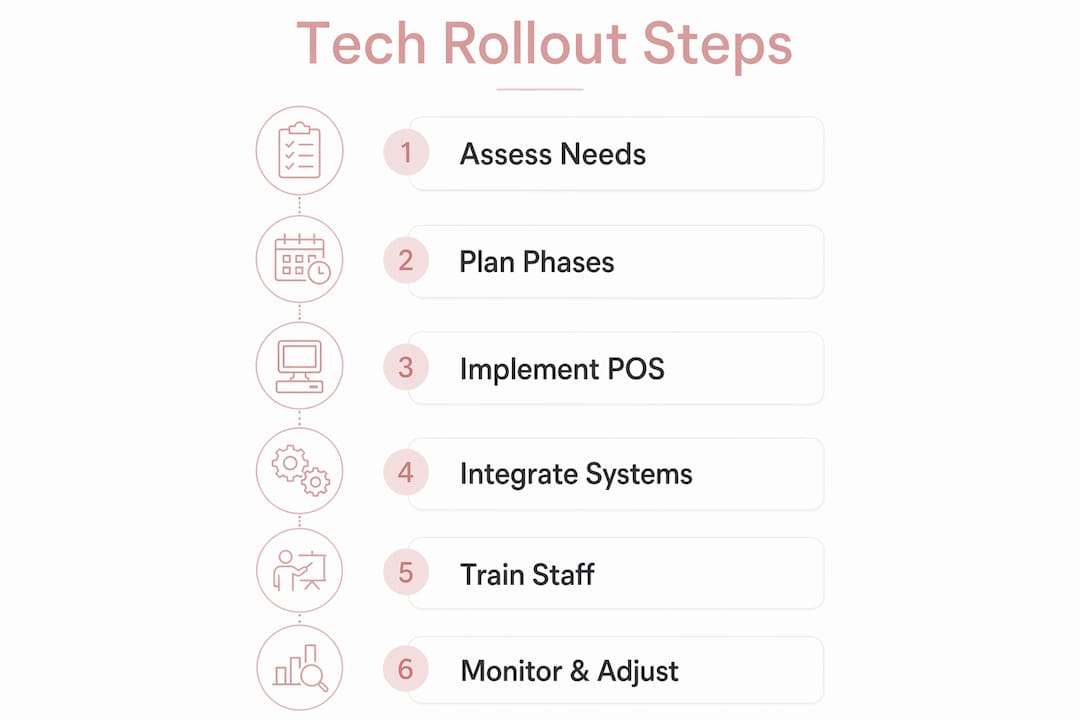
    Phased implementation is the only reliable way to modernize restaurant technology without disrupting daily operations. The correct sequence follows the dependency order of the seven-layer stack: foundation first, then back-of-house, then financials, then guest-facing systems.

    Infographic illustrating phases of restaurant technology rollout

    Successful digital transformation follows this exact dependency order to prevent data integrity failures at every stage. Skipping layers to save time creates compounding problems that cost more to fix than the time you saved.

    Phased rollout steps:

    1. Map your current workflows. Document every daily process before touching any software. Identify where data is recorded manually, where errors occur most often, and which tasks take the most staff time.
    2. Select and install POS and payments. This is your foundation. POS hardware and software setup typically requires 2–3 weeks. Payments integration runs concurrently.
    3. Add order entry channels. Connect online ordering, kiosk, or tableside ordering to your POS. Test that every order type posts correctly to the system of record.
    4. Install the Kitchen Display System. Route tickets from all order entry channels to the KDS. Verify prep time tracking works before moving forward.
    5. Integrate inventory and procurement. Connect your inventory system to POS sales data. Set up supplier ordering and configure variance alerts.
    6. Bring in payroll, scheduling, and accounting. Connect workforce management to your sales data for labor cost tracking. Link accounting to inventory and payments.
    7. Launch guest-facing and marketing tools. Build your loyalty program and CRM on top of clean, verified data from every layer below.
    8. Run parallel testing before go-live. Operate old and new systems simultaneously for at least one week. Compare outputs and resolve discrepancies before cutting over.

    New restaurant tech stack setup typically requires 6–8 weeks total, with POS taking 2–3 weeks, payroll and scheduling 1–2 weeks, and inventory setup 2–3 weeks. For existing restaurants integrating new systems into a live operation, plan for a 90-day phased integration to allow staff to adapt at each stage.

    Pro Tip: Assign one internal owner per technology layer. That person owns training, testing, and issue escalation for their layer. Distributed ownership prevents the “everyone assumes someone else is handling it” failure mode.

    Certified implementation partners provide role-based training and manage parallel testing phases, which reduces rollout risk significantly. If your team lacks dedicated IT resources, a certified partner is not optional. It is the difference between a 90-day rollout and a 9-month one.

    What common mistakes should restaurants avoid during technology transformation?

    The most expensive mistake in restaurant tech is selecting software before mapping workflows. Owners see a feature-rich platform and assume it will fix operational problems. The platform then forces the team to adapt to its workflow instead of the other way around.

    The integration tax is real. Every time your POS lacks an open, stable API, your team pays the price in manual reconciliations, duplicate data entry, and reporting errors. That hidden labor cost compounds weekly and is rarely tracked as a technology expense. Choosing a POS with a closed API to save on licensing fees almost always costs more in staff time within the first year.

    Top mistakes and how to avoid them:

    • Overbuilding before operational need. Adding a sophisticated CRM before your POS data is clean means your guest profiles are built on bad data. Establish each layer before adding the next.
    • Skipping the KDS. Many operators jump from POS directly to inventory, leaving kitchen communication on paper tickets. The KDS is not optional. It is the link between front-of-house orders and back-of-house execution.
    • Running parallel rollouts of multiple layers. Installing inventory, payroll, and a new POS simultaneously overwhelms staff and makes it impossible to isolate the source of problems when they occur.
    • Ignoring integration documentation. Before signing any vendor contract, confirm the API is open and documented. Ask for a list of current integrations and test one before committing.
    • Treating training as a one-time event. Staff turnover in restaurants is high. Build training into your standard onboarding process, not just the initial rollout.

    Operational mapping before software selection prevents mismatched workflows and integration failures. The operators who skip this step spend months customizing platforms to approximate what a properly selected tool would have done from day one.

    How is agentic AI changing restaurant technology transformation?

    Agentic AI is defined as software that takes autonomous actions across multiple systems to complete a goal, without requiring a human to trigger each step. This is different from traditional automation, which executes a single predefined task. An agentic AI system can monitor inventory levels, detect a shortage, place a supplier order, update the prep schedule, and notify the kitchen manager, all without manual input.

    Agentic AI systems unify isolated workflows like scheduling, ordering, and payroll into a single real-time operating layer. This directly reduces the integration complexity that plagues fragmented seven-layer stacks. Instead of managing seven vendor relationships and seven API connections, operators work within one platform that handles cross-system logic internally.

    The practical benefits are significant. Automated guest management tasks save 10+ staff-hours weekly per location by eliminating manual messaging, reservation follow-ups, and scheduling errors. That time goes back to service quality and staff development.

    The rising integration tax of fragmented stacks makes consolidated AI platforms the logical next step for operations that need real-time data. When you are paying staff to manually reconcile data between five systems, the cost of switching to a unified platform becomes easy to justify. Thought leaders like Dr. Mark van Rijmenam have documented how AI-driven consolidation reshapes operational decision-making across industries, and restaurants are no exception.

    Migration from a fragmented stack to an agentic AI platform requires the same phased discipline as any other transformation. Start by identifying which workflows are most manual and error-prone. Replace those first. Do not attempt a full-stack migration in a single cutover.

    Pro Tip: Before committing to any AI platform, ask the vendor for a live demonstration using your actual data. Generic demos hide integration gaps. Your real menu, your real supplier list, and your real labor rules will surface problems that a scripted demo never will.

    For a deeper look at how AI fits into a broader technology leadership workflow, the frameworks that apply to enterprise operations translate directly to restaurant management at scale.

    Key Takeaways

    Restaurant technology transformation succeeds when you build in dependency order, map workflows before selecting tools, and treat your tech stack as a long-term capital asset rather than a one-time purchase.

    PointDetails
    Build in dependency orderStart with POS and payments before adding inventory, financials, or guest-facing tools.
    Map workflows firstDocument actual daily operations before evaluating any software platform.
    Plan for 6–8 weeks minimumNew openings need 6–8 weeks; existing operations need a 90-day phased integration.
    Avoid the integration taxChoose a POS with an open, documented API to prevent costly manual reconciliations.
    Agentic AI reduces complexityUnified AI platforms replace fragmented stacks and cut integration maintenance costs.

    What I have learned from watching restaurants get this wrong

    Most restaurant owners approach technology the way they approach a new menu item. They taste something exciting, add it immediately, and figure out the kitchen workflow later. That approach works for food. It fails completely for technology.

    The operators I have seen succeed treat their tech stack the way a CFO treats a capital budget. Every tool has a defined purpose, a measurable outcome, and a clear dependency on what came before it. They do not add a loyalty platform until their POS data is clean. They do not add AI scheduling until their labor rules are documented and tested.

    The operators who struggle share one pattern: they selected technology to solve a symptom rather than a system problem. A new online ordering platform does not fix a broken kitchen communication process. A new CRM does not fix inaccurate guest data. The tool amplifies whatever is already there, good or bad.

    Privacy is also becoming a competitive differentiator, not just a compliance requirement. Managing guest data properly builds trust and improves marketing effectiveness at the same time. Operators who treat guest data as a liability to be minimized are leaving revenue on the table.

    My strongest advice: treat your technology stack as a long-term capital asset. Budget for it annually. Review it quarterly. And never add a new layer until the layer below it is stable, tested, and owned by someone on your team.

    — Orloff

    How Orloffphillips supports your restaurant technology work

    Restaurant technology decisions carry real financial risk. A misaligned POS selection or a failed integration rollout can cost months of productivity and thousands of dollars in manual workarounds.

    https://orloffphillips.com

    Orloffphillips works with restaurant owners and operators to evaluate tech stacks, map operational workflows, and build phased implementation plans that hold up under real-world conditions. The fractional executive model gives you experienced technology leadership without the cost of a full-time CTO or CIO. For operators ready to move from fragmented tools to a unified, data-driven operation, Orloffphillips provides the structure and accountability to get there. Learn more about leading digital transformation with a framework built for measurable results.

    FAQ

    What is restaurant technology transformation?

    Restaurant technology transformation is the process of replacing or integrating operational systems, including POS, inventory, payments, and guest management, to improve efficiency and profitability. It follows a layered dependency order to protect data integrity at every stage.

    How long does a restaurant tech stack rollout take?

    A new restaurant tech stack typically requires 6–8 weeks, with POS setup taking 2–3 weeks and inventory and supplier integration taking another 2–3 weeks. Existing operations integrating new systems into a live environment should plan for a 90-day phased rollout.

    What is the biggest mistake restaurants make with technology?

    The most common and costly mistake is selecting software before mapping actual workflows. Technology should support how your team already operates, not force your team to adapt to a vendor’s default process.

    What is agentic AI and how does it apply to restaurants?

    Agentic AI is software that autonomously completes multi-step tasks across systems, such as detecting a low inventory item, placing a supplier order, and updating the prep schedule without manual input. It reduces the integration complexity of fragmented tech stacks.

    How do I know if my POS is limiting my tech stack?

    If your team manually reconciles data between your POS and other systems, your POS API is either closed or poorly documented. An open, stable API is the single most important technical requirement when selecting a POS platform.

Orloff
Orloff AI AI
Online — Direct answers, no fluff
Powered by Orloff Phillips